
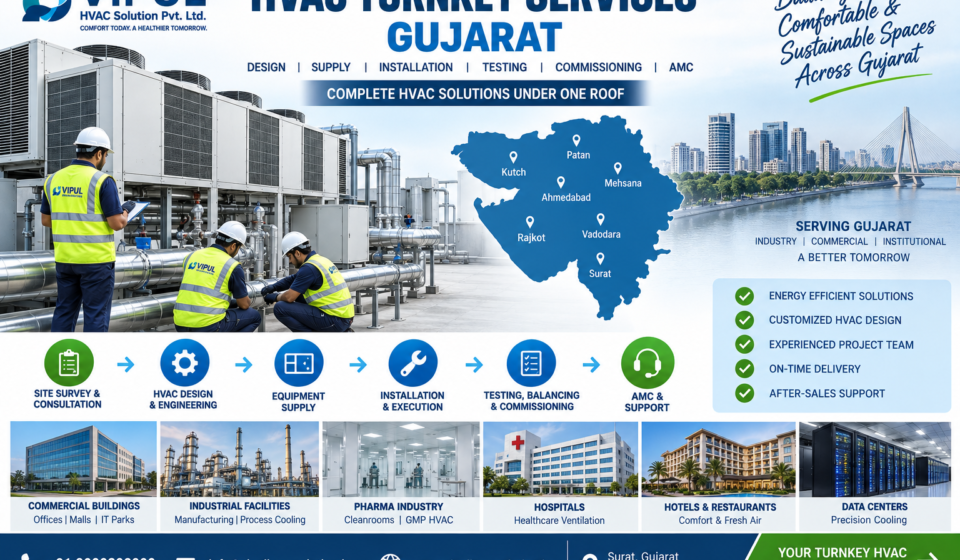

HVAC Turnkey Services Gujarat: Complete Guide to End-to-End HVAC Design, Installation & Commissioning
If you are searching for HVAC turnkey services in Gujarat, you need more than an air-conditioning supplier. A turnkey HVAC partner should be capable of handling the complete project lifecycle—from site survey, heat-load calculation and HVAC design to equipment selection, procurement, installation, ductwork, testing, balancing, commissioning and after-sales support.
VIPUL HVAC SOLUTION PVT LTD provides HVAC engineering and project execution support for commercial, industrial and institutional applications across Gujarat. Its official website describes turnkey HVAC project execution along with design, load calculation, equipment selection, installation, testing and commissioning support.
This guide explains what HVAC turnkey services include, how the process works, which HVAC systems are commonly used, and how to select the right HVAC turnkey contractor in Gujarat.
What Are HVAC Turnkey Services?
HVAC turnkey services mean that a single HVAC project partner takes responsibility for coordinating major stages of the HVAC project, from engineering and design through installation and commissioning.
A typical turnkey HVAC project can include:
Site Survey → Heat Load Calculation → HVAC Design → Equipment Selection → BOQ → Procurement → Installation → Ducting/Piping → Electrical & Controls Coordination → Testing → Balancing → Commissioning → Handover → AMC
The main advantage is that the client has one coordinated HVAC project team instead of separately managing designers, equipment suppliers, duct contractors, installers and commissioning teams.
Industry turnkey HVAC approaches commonly cover design, equipment supply, installation, testing, balancing and commissioning.
Why Choose HVAC Turnkey Services in Gujarat?
Gujarat has a diverse industrial and commercial environment, including manufacturing plants, pharmaceutical facilities, hospitals, offices, hotels, malls, warehouses and data-intensive facilities.
Each project can have different requirements for:
- Cooling capacity
- Fresh air
- Ventilation
- Indoor air quality
- Temperature
- Humidity
- Energy efficiency
- Process cooling
- Cleanroom conditions
- Air distribution
- Automation
A turnkey HVAC approach can simplify coordination between these requirements.
Key benefits include:
- Single-point project coordination
- Integrated engineering
- Better equipment coordination
- Reduced interface problems
- Faster project execution
- Centralized responsibility
- Testing and commissioning support
- Easier maintenance after handover
HVAC Turnkey Services in Gujarat by VIPUL HVAC Solution
VIPUL HVAC Solution provides HVAC project support for commercial, industrial and institutional environments.
Its official services include commercial HVAC solutions, customized HVAC design, ventilation systems, HVAC maintenance, ductwork installation and cleaning, pharmaceutical HVAC and indoor air-quality solutions.
The company’s official contact information also describes turnkey project execution, including design, supply, installation, testing and commissioning.
Depending on the project, the HVAC scope can include:
- HVAC design
- Heat-load calculation
- VRF/VRV systems
- Chiller systems
- AHU systems
- Precision air conditioning
- Ductable air conditioning
- Fresh-air ventilation
- Exhaust systems
- Ductwork
- Piping
- HVAC controls
- BMS integration
- Airflow testing and balancing
- Commissioning
- Maintenance and AMC
Complete HVAC Turnkey Project Process
A successful HVAC turnkey project should follow a structured engineering process.
1. Site Survey
The first stage is understanding the actual project site.
The HVAC team evaluates:
- Building layout
- Floor area
- Ceiling height
- Orientation
- Existing HVAC systems
- Electrical availability
- Equipment locations
- Outdoor conditions
- Occupancy
- Process requirements
A detailed site survey helps prevent design assumptions that may create problems during installation.
2. Requirement Analysis
The HVAC engineer should understand the purpose of the building.
For example:
Office
Focus may include:
- Occupant comfort
- Fresh air
- Energy efficiency
- Zoning
Hospital
Additional considerations may include:
- Healthcare ventilation
- Pressure relationships
- Filtration
- Temperature and humidity
- Specialized clinical spaces
Pharmaceutical Facility
Requirements can include:
- Cleanrooms
- HEPA filtration
- Pressure cascade
- Temperature/humidity control
- Contamination control
- Qualification
Factory
Requirements may include:
- Process cooling
- High heat loads
- Ventilation
- Exhaust
- Industrial air conditioning
Data Center
Requirements can include:
- Precision cooling
- High availability
- Airflow management
- Redundancy
- Temperature/humidity monitoring
3. Heat Load Calculation
Heat-load calculation is one of the most important steps in HVAC design.
The cooling requirement can depend on:
- Building area
- Solar heat gain
- Wall and roof construction
- Windows
- Occupants
- Lighting
- Electrical equipment
- Machinery
- Fresh air
- Infiltration
- Process heat
- Operating schedule
An incorrectly calculated cooling load can lead to either:
Undersized HVAC → Poor cooling + equipment overload
or
Oversized HVAC → Higher capital cost + inefficient operation
Therefore, professional heat-load calculation should be completed before final equipment selection.
4. HVAC System Selection
After determining the project requirements, the appropriate HVAC architecture can be selected.
Common options include:
VRF / VRV Systems
Suitable for many offices, hotels, commercial buildings and other applications requiring flexible zoning.
Chiller Systems
Commonly considered for larger commercial and industrial facilities where centralized chilled-water cooling is appropriate.
AHU Systems
Used in centralized HVAC applications requiring controlled air distribution and filtration.
Ducted AC
Suitable for selected commercial and institutional applications.
Package Units
Can be appropriate for certain larger spaces and industrial applications.
Precision Air Conditioning
Used for environments requiring close control of temperature and humidity, such as certain IT and critical applications.
Fresh-Air Systems
Designed to introduce controlled outdoor air.
Exhaust & Ventilation
Used to remove unwanted heat, moisture, odors, contaminants or process air.
5. HVAC Design and Engineering
The design stage converts project requirements into engineering drawings and specifications.
Depending on project scope, HVAC design may include:
- Heat-load calculations
- Equipment selection
- HVAC layout
- Duct design
- Chilled-water piping
- Refrigerant piping
- Fresh-air design
- Exhaust design
- Static-pressure calculations
- Airflow calculations
- Equipment-room planning
- Control philosophy
- BMS integration
- Energy-efficiency evaluation
VIPUL’s official services describe customized HVAC design based on project requirements, including precise load calculations and scalable HVAC solutions.
6. HVAC Shop Drawings and Layouts
Detailed drawings are essential before installation.
Typical drawings may include:
- HVAC floor plans
- Duct layouts
- Piping layouts
- Equipment layouts
- AHU layouts
- Chiller layouts
- Fresh-air layouts
- Exhaust layouts
- Section details
- Control diagrams
- Schematic diagrams
Good coordination is especially important where HVAC systems share ceiling or service spaces with electrical, plumbing and fire-safety systems.
7. Equipment Procurement
Once the design is approved, HVAC equipment can be selected and procured.
Depending on the project, this can include:
- VRF/VRV outdoor units
- Indoor units
- Chillers
- AHUs
- FAHUs
- Pumps
- Cooling towers
- CRAC/CRAH units
- Fans
- Exhaust systems
- VFDs
- Filters
- Dampers
- Controls
- BMS components
Equipment selection should consider both initial cost and lifecycle performance.
8. HVAC Ductwork Installation
Ductwork is responsible for distributing conditioned air throughout the building.
A professional ductwork system should consider:
- Airflow
- Static pressure
- Duct dimensions
- Insulation
- Leakage
- Noise
- Access
- Fire requirements
- Ceiling coordination
VIPUL provides ductwork installation and cleaning services as part of its HVAC offering.
9. HVAC Piping
Depending on the HVAC system, piping may include:
Chilled-Water Piping
Used with chilled-water systems.
Condenser-Water Piping
Used in water-cooled chiller systems.
Refrigerant Piping
Used for VRF/VRV and certain DX systems.
Drain Piping
Used to remove condensate from indoor HVAC equipment.
Correct pipe sizing, insulation, supports and testing are important for system reliability.
10. Fresh Air and Ventilation
Modern HVAC design is not only about cooling.
Fresh-air ventilation can help manage:
- Indoor air quality
- CO₂
- Odors
- Humidity
- Stale air
- Occupant comfort
VIPUL’s ventilation solutions include fresh-air handling units, supply and exhaust fans, heat recovery, filters, dampers, VAV systems, airflow testing and balancing, and HVAC integration.
11. HVAC Controls and BMS
Modern HVAC projects can integrate automation and building-management systems.
A BMS can monitor:
- Temperature
- Humidity
- Equipment status
- Fan operation
- Chiller operation
- AHU operation
- Alarms
- Energy consumption
- HVAC schedules
VIPUL’s HVAC portfolio includes BMS and HVAC automation capabilities for monitoring and control of HVAC systems.
12. Testing, Adjusting and Balancing – TAB
HVAC installation is not complete simply because equipment is switched on.
The system should be tested and balanced.
Testing may include:
- Supply-airflow measurement
- Return-airflow measurement
- Fresh-air measurement
- Exhaust-air measurement
- Static pressure
- Room pressure
- Temperature
- Humidity
- Fan performance
- Pump performance
TAB — Testing, Adjusting and Balancing — helps verify that the installed HVAC system delivers the intended airflow.
13. HVAC Commissioning
Commissioning confirms that the complete HVAC system operates as intended.
The commissioning process may include:
- Equipment startup
- Control verification
- Sensor verification
- Safety interlock testing
- Airflow verification
- Temperature testing
- Pressure testing
- BMS testing
- Alarm testing
- Performance verification
Turnkey HVAC providers commonly include commissioning as the final stage before project handover.
14. Project Handover
After commissioning, the client can receive project documentation such as:
- Equipment details
- Test reports
- Balancing reports
- Warranty documents
- Operation manuals
- Maintenance schedules
- As-built drawings
- Control documentation
The exact handover package depends on the project contract and specifications.
HVAC Turnkey Solutions for Different Industries in Gujarat
HVAC Turnkey Services for Pharmaceutical Industry
Pharmaceutical HVAC requires specialized environmental control.
The HVAC system may include:
- AHU
- FAHU
- HEPA filtration
- Cleanroom HVAC
- Pressure cascade
- Temperature control
- Humidity control
- Airflow balancing
- BMS
- Qualification support
VIPUL officially lists pharmaceutical HVAC among its specialized services.
HVAC Turnkey Services for Hospitals
Hospital HVAC can require:
- AHUs
- Chillers
- Fresh-air systems
- Exhaust systems
- Filtration
- Pressure control
- Operating-theatre HVAC
- Isolation-room ventilation
- BMS
- Air balancing
Healthcare HVAC should be designed according to applicable healthcare standards and project-specific requirements.
HVAC Turnkey Services for Industrial Facilities
Industrial HVAC projects can involve:
- Factory air conditioning
- Process cooling
- Ventilation
- Exhaust
- Chillers
- AHUs
- Package units
- Fresh-air systems
- Dust-control interfaces
The design should account for machinery heat loads and the manufacturing process.
HVAC Turnkey Services for Offices
Office HVAC focuses on:
- Thermal comfort
- Fresh air
- Zoning
- Energy efficiency
- Noise control
- BMS integration
VRF, ducted systems, AHUs and chilled-water systems can all be considered depending on building size and design.
HVAC Turnkey Services for Hotels
Hotels have diverse HVAC requirements across:
- Guest rooms
- Lobby
- Restaurants
- Kitchens
- Banquet halls
- Meeting rooms
- Back-of-house areas
- Service areas
A coordinated HVAC solution can improve comfort and operational efficiency.
HVAC Turnkey Services for Restaurants
Restaurant HVAC can involve:
- Kitchen exhaust
- Fresh-air supply
- Make-up air
- Air conditioning
- Kitchen ventilation
- Exhaust fans
- Ductwork
- Odor control
Kitchen ventilation should be designed together with air conditioning and replacement-air requirements.
HVAC Turnkey Services for Data Centers
Data-center HVAC is a critical application.
Solutions may include:
- CRAC
- CRAH
- Chillers
- Precision cooling
- Fresh air
- Airflow management
- Hot/cold aisle containment
- BMS
- Redundancy
- Environmental monitoring
The HVAC architecture should be selected based on IT load, rack density, availability requirements and facility design.
HVAC Turnkey Services for Malls & Commercial Buildings
Large commercial buildings can require centralized HVAC systems involving:
- Chillers
- Cooling towers
- AHUs
- Pumps
- Fresh-air systems
- Exhaust systems
- BMS
- Energy monitoring
A turnkey contractor can coordinate these systems as one integrated HVAC project.
Benefits of Turnkey HVAC Project Execution
1. Single Point of Responsibility
One HVAC partner coordinates the project.
2. Better Coordination
Design and installation teams work from the same engineering concept.
3. Reduced Interface Problems
Equipment, ductwork, piping and controls can be coordinated from the beginning.
4. Faster Decision-Making
A single project team can resolve HVAC-related issues more efficiently.
5. Better Quality Control
The project can be monitored from design through commissioning.
6. Simplified Handover
The client receives a coordinated HVAC system rather than disconnected components.
7. Lifecycle Support
A turnkey partner can continue supporting the system through maintenance and AMC.
VIPUL’s official website states that it provides HVAC maintenance and AMC services intended to support performance, energy efficiency and system reliability.
How to Choose an HVAC Turnkey Contractor in Gujarat
Choosing the right contractor is important because HVAC affects both building comfort and operating costs.
1. Check Engineering Capability
Ask whether the contractor can perform:
- Heat-load calculations
- HVAC design
- Equipment selection
- Duct design
- Piping design
- Ventilation calculations
2. Review Relevant Experience
Look for experience relevant to your specific building type.
A pharmaceutical project, hospital and office building have very different HVAC requirements.
3. Check Complete Project Scope
Confirm whether the contractor handles:
Design → Supply → Installation → Testing → Commissioning
rather than only equipment supply or installation.
4. Ask About Testing & Balancing
TAB is important for verifying actual system performance.
5. Check Maintenance Support
HVAC requires ongoing maintenance after installation.
6. Consider Energy Efficiency
Evaluate lifecycle operating costs rather than selecting equipment solely on initial purchase price.
7. Check Documentation
A professional project should have appropriate drawings, equipment schedules, test reports and handover documentation.
HVAC Turnkey Services Gujarat: Cities Covered
For businesses searching for HVAC turnkey services in Gujarat, project support may be required across major commercial and industrial locations such as:
- Surat
- Ahmedabad
- Vadodara
- Bharuch
- Ankleshwar
- Vapi
- Rajkot
- Junagadh
- Talala
- Other Gujarat industrial and commercial locations
VIPUL’s official website states that it provides HVAC services across Surat, Gujarat and nearby regions.
Why Choose VIPUL HVAC Solution for Turnkey HVAC Projects?
VIPUL HVAC Solution positions itself as an HVAC project partner for commercial, industrial and institutional climate solutions, with an end-to-end engineering approach rather than simply supplying HVAC products.
Key capabilities include:
1. HVAC Design
Customized engineering based on building and process requirements.
2. Heat Load Calculation
Engineering-based capacity estimation.
3. VRF / VRV Systems
Flexible HVAC solutions for suitable applications.
4. Chiller Systems
Centralized cooling solutions for appropriate commercial and industrial projects.
5. AHU Systems
Air handling and centralized HVAC solutions.
6. Ventilation
Fresh-air and exhaust systems.
7.Ductwork
HVAC duct installation and cleaning.
8. Precision Cooling
Solutions for critical environments where close environmental control is required.
9. BMS & Automation
HVAC monitoring and control.
10. Testing & Balancing
Verification of airflow and system performance.
11. Maintenance & AMC
Post-installation support and preventive maintenance.
HVAC Turnkey Project Workflow
A simplified turnkey workflow can be represented as:
1. Client Requirement
↓
2. Site Survey
↓
3. Heat Load Calculation
↓
4. HVAC System Selection
↓
5. Engineering & Design
↓
6. BOQ & Cost Estimation
↓
7. Client Approval
↓
8. Equipment Procurement
↓
9. Ducting & Piping
↓
10. Equipment Installation
↓
11. Electrical & Controls Coordination
↓
12. Testing & Balancing
↓
13. Commissioning
↓
14. Documentation & Handover
↓
15. AMC & Maintenance
This end-to-end approach helps create a more coordinated project delivery process.
Common HVAC Turnkey Project Mistakes
Mistake 1: Selecting Equipment Before Calculating Load
Equipment should be selected after understanding the actual cooling requirement.
Mistake 2: Ignoring Fresh Air
Cooling alone does not address all ventilation requirements.
Mistake 3: Poor Duct Design
Incorrect duct sizing can increase pressure loss and energy consumption.
Mistake 4: No Coordination with Other Services
HVAC ductwork often competes for ceiling space with:
- Electrical
- Plumbing
- Fire fighting
- Fire alarm
- Structural systems
Coordination should happen before installation.
Mistake 5: Ignoring Maintenance Access
AHUs, filters, dampers and other equipment require service access.
Mistake 6: Skipping Testing and Balancing
An installed system may not deliver the intended airflow without proper balancing.
Mistake 7: Selecting Only on Initial Price
A low initial price can become expensive if the system consumes excessive energy or requires frequent repairs.
HVAC Turnkey Services and Energy Efficiency
Energy efficiency should be considered from the design stage.
Possible strategies include:
- High-efficiency chillers
- Efficient VRF systems
- Variable-speed drives
- EC fans where appropriate
- Optimized ductwork
- Heat recovery
- Fresh-air optimization
- BMS controls
- Temperature scheduling
- Demand-based operation
- Preventive maintenance
The objective should be to achieve the required environmental conditions with efficient system operation.
Maintenance After HVAC Turnkey Project Completion
A turnkey project should not end when the system starts.
Regular maintenance can include:
Monthly/Periodic Inspection
- Filters
- Fans
- Motors
- Belts
- Sensors
- Controls
AHU Maintenance
- Coil cleaning
- Filter replacement
- Drain-pan cleaning
- Fan inspection
Chiller Maintenance
- Operating parameters
- Refrigerant/water-side checks as applicable
- Pumps
- Heat exchangers
- Controls
Ductwork
- Leakage inspection
- Insulation inspection
- Cleaning where required
BMS
- Sensor verification
- Alarm testing
- Trend review
VIPUL provides HVAC maintenance and AMC services as part of its broader HVAC service offering.
Frequently Asked Questions
1. What are HVAC turnkey services in Gujarat?
HVAC turnkey services cover the complete HVAC project lifecycle, generally from design and engineering through equipment supply, installation, testing, balancing and commissioning, with the exact scope defined by the project contract.
2. What does an HVAC turnkey contractor do?
A turnkey HVAC contractor can coordinate HVAC design, calculations, equipment selection, procurement, ducting, piping, installation, controls, testing, commissioning and handover.
3. Why choose a turnkey HVAC contractor?
It provides a single coordinated HVAC project team and can reduce interface problems between separate designers, suppliers and installers.
4. Does turnkey HVAC include equipment supply?
It can. The exact scope should be clearly defined in the commercial and technical proposal.
5. Does HVAC turnkey service include ductwork?
It can include complete duct design, fabrication and installation depending on the project scope.
6. Does HVAC turnkey include commissioning?
A complete turnkey scope can include testing, balancing and commissioning before handover. VIPUL’s official contact information specifically describes turnkey project execution including design, supply, installation, testing and commissioning.
7. Can turnkey HVAC services be provided for pharmaceutical projects?
Yes. Pharmaceutical HVAC requires specialized engineering for cleanrooms, filtration, pressure, temperature and humidity control. VIPUL lists HVAC solutions for the pharmaceutical industry.
8. Can turnkey HVAC services be provided for hospitals?
Yes. Hospital HVAC can include AHUs, chillers, fresh air, exhaust, filtration, specialized ventilation and controls, subject to the project’s healthcare requirements.
9. Can turnkey HVAC include BMS?
Yes. HVAC automation and BMS integration can be incorporated where required.
10. What is the difference between an HVAC supplier and turnkey HVAC contractor?
An HVAC supplier primarily supplies equipment. A turnkey contractor can take responsibility for coordinating the engineering, equipment, installation, testing and commissioning of the HVAC project.
11. How do I select an HVAC turnkey contractor in Gujarat?
Evaluate engineering capability, relevant project experience, complete scope, installation quality, testing and balancing, commissioning, documentation, maintenance support and energy-efficiency expertise.
12. Does VIPUL HVAC Solution provide turnkey HVAC services in Gujarat?
Yes. VIPUL’s official website states that it provides turnkey HVAC project execution support along with design, load calculation, equipment selection, installation, testing and commissioning services.
Conclusion
HVAC turnkey services in Gujarat provide a practical approach for businesses that want one coordinated partner for their complete HVAC project.
A properly executed turnkey project can bring together:
Site Survey + Heat Load Calculation + HVAC Design + Equipment Selection + Procurement + Ducting + Piping + Installation + Controls + Testing + Balancing + Commissioning + Maintenance
The most important point is that HVAC should be engineered around the actual building or industrial process rather than using a one-size-fits-all system.
For offices, factories, hospitals, pharmaceutical facilities, hotels, restaurants, malls, data centers and other commercial or industrial buildings, the HVAC solution should be selected according to the project’s cooling load, ventilation requirements, operating conditions, energy goals and applicable standards.
For businesses looking for HVAC turnkey services in Gujarat, VIPUL HVAC Solution can provide an integrated HVAC project approach covering design, equipment, installation, testing, commissioning and ongoing support.
Contact VIPUL HVAC Solution Pvt. Ltd.
Call: +91 8000392000
Email: info@vipulhvacsolution.in
Website: VIPUL HVAC Solution
Important Links :
- Customized HVAC Design
- Commercial HVAC Solutions
- Ventilation Systems
- HVAC in Pharma Industry
- Ductwork Installation & Cleaning
- BMS & HVAC Automation
- Indoor Air Quality Solutions
- HVAC Maintenance & Repairs
- Chiller Systems
- Air Handling Units (AHU)



-
-
-
-
-
-
-
-
-
-
-
-
-
-
-
-
-
-
-
-
-
-
-
-
-
-
-
-
-
-
-
-
Show Comments[…] HVAC Turnkey Services Gujarat […]
[…] HVAC Turnkey Services Gujarat […]
[…] HVAC Turnkey Services Gujarat […]
[…] HVAC Turnkey Services Gujarat […]
[…] HVAC Turnkey Services Gujarat […]
[…] HVAC Turnkey Services Gujarat […]
[…] HVAC Turnkey Services Gujarat […]
[…] HVAC Turnkey Services Gujarat […]
[…] Turnkey HVAC projects […]
[…] HVAC Turnkey Services Gujarat […]
[…] HVAC Turnkey Services Gujarat […]
[…] HVAC Turnkey Services Gujarat […]
[…] HVAC Turnkey Services Gujarat […]
[…] HVAC Turnkey Services Gujarat […]
[…] HVAC Turnkey Services Gujarat […]
[…] HVAC Turnkey Services in Gujarat […]
[…] HVAC Turnkey Services Gujarat […]
[…] HVAC Turnkey Services […]
[…] Vipul HVAC’s published Gujarat turnkey HVAC services describe a project approach covering design, load calculation, equipment selection, installation, testing and commissioning. Vipulhvac Solution […]
[…] The company also provides broader HVAC project support covering design, heat-load calculation, AHU systems, ductwork, ventilation, controls, testing, balancing, commissioning and maintenance/AMC. Vipulhvac Solution […]
[…] HVAC Turnkey Services Gujarat […]
[…] HVAC Turnkey Services Gujarat […]
[…] HVAC Turnkey Services […]
[…] Vipul’s broader HVAC project services include design, equipment selection, installation, testing, balancing and commissioning. Vipulhvac Solution […]
[…] HVAC Turnkey Services Gujarat […]
[…] HVAC Turnkey Services Gujarat […]
[…] HVAC Turnkey Services Gujarat […]
[…] HVAC Turnkey Services Gujarat […]
[…] VIPUL’s published turnkey HVAC scope includes design, supply, installation, testing and commissioning, with ductwork, piping, controls, BMS, ventilation and maintenance depending on project requirements. Vipulhvac Solution […]
[…] Its published turnkey HVAC scope includes design, heat-load calculation, VRF/VRV, chillers, AHUs, precision AC, fresh-air ventilation, exhaust systems, ductwork, piping, controls, BMS integration, testing/balancing, commissioning and maintenance/AMC. Vipulhvac Solution […]
[…] HVAC Turnkey Services Gujarat […]
[…] HVAC Turnkey Services Gujarat […]