

Which Type of BMS Is Best? Complete HVAC Guide
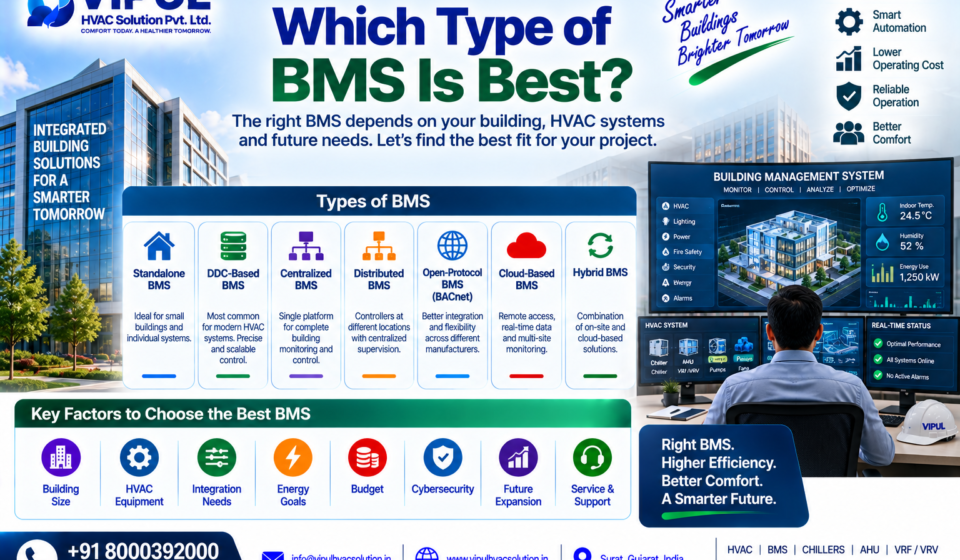
Which type of BMS is best? There is no single BMS type that is best for every building. The right Building Management System depends on the size of the building, HVAC equipment, number of control points, integration requirements, energy goals, budget, cybersecurity requirements and future expansion.
For many modern commercial and industrial HVAC projects, a DDC-based BMS with open communication such as BACnet can be a practical architecture because it supports centralized monitoring and control and can facilitate interoperability between compatible equipment from different manufacturers. However, the final selection should be based on the project’s actual requirements rather than the protocol alone. ASHRAE Guideline 13-2024 covers BAS architecture, DDC, communication, programming, testing, documentation and integration considerations.
For HVAC projects, VIPUL HVAC Solution Pvt. Ltd. provides BMS and HVAC automation focused on monitoring and control, energy tracking, alarms, remote access, and integration with VRF, chillers and AHUs.
Quick Answer: Which Type of BMS Is Best?
For a new commercial or industrial HVAC project, an appropriate starting point is often:
A scalable DDC-based BMS using open communication protocols such as BACnet, with centralized monitoring, HVAC equipment integration, alarms, scheduling, trend logging and energy monitoring.
But this is not a universal recommendation.
For example:
| Building / Application | Suitable BMS Approach |
|---|---|
| Small building | Standalone or small-scale controller system |
| Small commercial building | Networked DDC system |
| Large office | Centralized DDC/BAS |
| Hotel | Distributed DDC + centralized BMS |
| Hospital | Scalable DDC/BMS with detailed monitoring |
| Factory | Industrial HVAC BMS/automation |
| Pharma facility | Specialized HVAC automation with detailed monitoring and documentation |
| Large chiller plant | Centralized plant BMS with chiller/pump/AHU integration |
| Multi-building campus | Distributed BMS with centralized supervisory platform |
| Existing building | BMS selected around legacy-equipment integration |
ASHRAE identifies BAS as computerized systems that can perform functions including monitoring, equipment control, scheduling, alarm reporting, energy-use monitoring and trend logging.
What Is a BMS?
BMS stands for Building Management System.
In HVAC applications, a BMS is a computerized system used to monitor and control connected equipment such as:
- Chillers
- AHUs
- FCUs
- VRF/VRV systems
- Pumps
- Fans
- Dampers
- Valves
- Sensors
- Energy meters
- Ventilation systems
A typical architecture can be represented as:
Sensors
↓
DDC Controllers
↓
Communication Network
↓
BMS Server / Supervisor
↓
Operator Interface
The system can collect information from HVAC equipment and provide centralized monitoring and control.
What Are the Main Types of BMS?
Before deciding which BMS is best, it helps to understand the major architectures.
1. Standalone HVAC Control System
A standalone control system operates individual HVAC equipment or small systems without a large centralized BMS.
For example:
Temperature Sensor → Controller → AC/AHU
This approach can be suitable for:
- Small offices
- Small commercial spaces
- Individual HVAC units
- Small mechanical rooms
Advantages
- Lower complexity
- Simple operation
- Lower initial infrastructure requirements
- Suitable for limited HVAC equipment
Limitations
- Limited centralized monitoring
- Limited system integration
- Less suitable for large buildings
- Limited historical data depending on controller
2. DDC-Based BMS
DDC means Direct Digital Control.
In a DDC system, digital controllers receive information from sensors and execute programmed control logic.
A simplified example:
Temperature Sensor
↓
DDC Controller
↓
Control Logic
↓
Valve / Damper / Fan / HVAC Equipment
DDC is an important architecture for modern HVAC automation. ASHRAE Guideline 13-2024 specifically covers DDC for HVAC control, monitoring and management, along with hardware, communication, programming, testing and documentation.
Advantages
- Precise digital control
- Scalable
- Centralized monitoring
- Scheduling
- Alarm management
- Trend logging
- Equipment integration
- Energy monitoring
Suitable For
- Offices
- Hotels
- Hospitals
- Shopping malls
- Factories
- Pharmaceutical facilities
- Data centers
- Large commercial buildings
3. Centralized BMS
A centralized BMS brings information from multiple HVAC systems to a central supervisory platform.
For example:
Chillers
AHUs
Pumps
Fans
VRF Systems
↓
Central BMS
↓
Operator Workstation
The operator can see multiple systems from one interface.
Main Functions
- Equipment monitoring
- Centralized control
- Alarm management
- Scheduling
- Trend logging
- Energy monitoring
- Reports
- User management
This architecture is particularly useful when a facility has many HVAC systems.
4. Distributed BMS
A distributed BMS places controllers closer to the equipment or building zones while providing centralized supervisory monitoring.
For example:
AHU-1 → DDC-1
AHU-2 → DDC-2
Chiller Plant → DDC-3
VRF Zone → Controller
↓
BMS Network
↓
Central BMS
This architecture can reduce dependence on one controller and can make large projects easier to expand.
5. Open-Protocol BMS
An open-protocol BMS uses standardized communication methods that can allow compatible products from different manufacturers to communicate.
One of the most important examples is BACnet.
ASHRAE describes BACnet as a communication protocol specifically designed for building automation and control and used to integrate products from different manufacturers.
The BACnet Committee also describes BACnet as a global data communication standard supporting vendor-independent interoperability between networked building-control equipment.
Why Is Open Communication Important?
A building may contain:
- Chiller from Manufacturer A
- AHU controls from Manufacturer B
- VRF from Manufacturer C
- Energy meters from Manufacturer D
An appropriate open communication architecture can make integration easier when the devices support compatible standards and required objects/functions.
6. Proprietary BMS
A proprietary BMS is closely associated with a particular manufacturer’s hardware and software ecosystem.
Possible Advantages
- Integrated manufacturer ecosystem
- Vendor-specific features
- Controlled hardware/software environment
- Potentially straightforward support within that ecosystem
Potential Limitations
- Greater dependence on one manufacturer
- Integration with third-party equipment may require gateways
- Future expansion may need compatibility checks
- Migration can be more complicated
This does not mean proprietary systems are inherently unsuitable. The important consideration is whether the system meets the project’s performance, integration, service and lifecycle requirements.
7. Cloud-Based BMS
A cloud-based BMS can provide remote access to building information through network-connected software.
Potential capabilities include:
- Remote monitoring
- Dashboards
- Alarm notifications
- Energy data
- Equipment trends
- Reports
- Multi-site monitoring
However, cloud architecture introduces additional considerations such as:
- Internet connectivity
- Cybersecurity
- User authentication
- Data ownership
- Network reliability
- IT policies
- Vendor support
ASHRAE Guideline 13-2024 explicitly includes cybersecurity considerations for BAS and network infrastructure.
8. Hybrid BMS
A hybrid BMS combines local controls, on-site controllers and centralized or cloud-based supervisory software.
For example:
Local DDC Controllers
↓
Building Network
↓
BMS Server
↓
Cloud Dashboard
This architecture can provide local control while allowing centralized monitoring where required.
So, Which BMS Type Is Best?
Instead of asking only:
“Which BMS brand is best?”
A better engineering question is:
“Which BMS architecture best matches my HVAC system and building requirements?”
The selection should consider at least these factors:
- Building size
- HVAC equipment
- Number of control points
- Integration requirements
- Communication protocols
- Energy-management requirements
- Remote-access requirements
- Cybersecurity
- Future expansion
- Maintenance and service support
Why DDC + BACnet Is Commonly Considered for Modern HVAC
For many modern projects, a DDC-based architecture with BACnet communication can provide a useful combination of digital control and interoperability.
BACnet supports communication of information such as:
- Binary inputs/outputs
- Analog inputs/outputs
- Schedules
- Alarms
- Events
- Trend information
- Control logic
- Other building automation data
ASHRAE documents BACnet under Standard 135, and the BACnet standard is maintained by the ASHRAE BACnet Committee.
However, simply specifying “BACnet” does not guarantee complete interoperability.
The project should also verify:
- BACnet device support
- Required objects
- Read/write capabilities
- Points list
- Network architecture
- Gateway requirements
- Testing requirements
- Control sequences
What Makes a Good BMS?
A good BMS should not be judged only by its brand name.
The system should be evaluated based on its actual project capabilities.
1. Scalability
Can the BMS accommodate additional:
- AHUs
- Chillers
- Pumps
- VRF systems
- Sensors
- Buildings
- Control points?
2. Interoperability
Can it communicate with the HVAC equipment already installed or planned?
BACnet can support vendor-independent interoperability, but actual integration still depends on the devices and implemented functionality.
3. HVAC Control Capability
The BMS should support the required control sequences for:
- Chillers
- AHUs
- Pumps
- Fans
- Dampers
- Valves
- VRF systems
4. Alarm Management
The BMS should be able to display and manage relevant alarms.
Examples:
- Chiller fault
- Fan failure
- Pump fault
- High temperature
- Low temperature
- High pressure
- Filter alarm
- Communication failure
5. Trend Logging
A good system should be able to record historical information such as:
- Temperature
- Humidity
- Pressure
- Equipment status
- Energy data
- Operating hours
6. Energy Monitoring
Energy meters and equipment data can be integrated to help facility teams understand HVAC energy use.
7. User-Friendly Graphics
Operators should be able to understand equipment status quickly.
Typical screens may include:
- Chiller plant
- AHU
- VRF
- Pump
- Fan
- Building floor plan
- Energy dashboard
- Alarm dashboard
8. Remote Access
Remote access can be useful for facilities where engineers or facility managers need to monitor HVAC systems without being physically present.
Security requirements should be established before enabling remote access.
9. Cybersecurity
A connected BMS should be designed with appropriate cybersecurity measures.
Consider:
- User authentication
- Access levels
- Network segmentation
- Secure remote access
- Password management
- Software updates
- Backup
- IT coordination
ASHRAE Guideline 13-2024 specifically includes cybersecurity considerations in BAS specifications.
Which BMS Is Best for a Chiller Plant?
For a large chiller plant, a scalable DDC/BMS architecture can be appropriate when centralized monitoring and coordinated control are required.
A typical system may include:
Chiller 1
Chiller 2
Chiller 3
↓
Chilled-Water Pumps
↓
Cooling Towers / Condenser System
↓
AHUs / FCUs
↓
BMS
The BMS may monitor:
- Chiller status
- Chilled-water temperatures
- Condenser-water temperatures
- Pump status
- Flow
- Pressure
- Energy
- Alarms
- Operating schedules
VIPUL’s BMS service specifically includes chiller integration.
Which BMS Is Best for AHU?
For multiple AHUs, a DDC-based centralized BMS can provide useful centralized monitoring and control.
Typical AHU points include:
- Supply-air temperature
- Return-air temperature
- Outdoor-air temperature
- Humidity
- Fan status
- Filter differential pressure
- Damper position
- Cooling-valve position
- Static pressure
- Alarm status
The exact point list should be established during HVAC controls design.
Which BMS Is Best for VRF?
For VRF buildings, the BMS should be selected based on the VRF manufacturer’s communication and integration capability.
Important considerations include:
- Indoor-unit integration
- Outdoor-unit integration
- Setpoint monitoring
- Operating mode
- Fault monitoring
- Scheduling
- Energy data
- Gateway requirements
VIPUL currently provides BMS integration for VRF systems as part of its HVAC automation service.
Which BMS Is Best for Hospitals?
Hospitals may require detailed HVAC monitoring because different areas can have different environmental requirements.
The BMS selection should consider:
- AHU quantity
- Pressure monitoring
- Temperature
- Humidity
- Ventilation
- Filtration
- Chiller plant
- Alarm requirements
- Critical-area monitoring
- Data logging
- Redundancy
- Integration requirements
The BMS architecture should be developed around the hospital’s HVAC design and applicable project requirements.
Which BMS Is Best for Pharmaceutical Plants?
Pharmaceutical HVAC systems can require detailed environmental monitoring.
The BMS/control system may need to monitor:
- Temperature
- Relative humidity
- Pressure differential
- AHU operation
- Filter status
- Airflow-related parameters
- Alarms
- Trends
For regulated facilities, BMS selection should also consider:
- Validation requirements
- Documentation
- User access
- Data integrity
- Audit requirements
- Change management
The correct architecture depends on the facility’s actual regulatory and engineering requirements.
Which BMS Is Best for Hotels?
Hotels can have many independent HVAC zones and different occupancy schedules.
A BMS may integrate:
- Guest-room HVAC
- AHUs
- Chillers
- Pumps
- Ventilation
- VRF systems
- Energy meters
Scheduling and centralized monitoring can be particularly useful because hotel occupancy can change throughout the day.
BMS Selection: Important Comparison
| Factor | Standalone | Proprietary | Open-Protocol DDC | Cloud/Hybrid |
|---|---|---|---|---|
| Small projects | Suitable | Suitable | Suitable | Possible |
| Large projects | Limited | Suitable | Suitable | Suitable |
| Scalability | Limited | Depends | High potential | High potential |
| Third-party integration | Limited | May require gateway | Generally easier | Depends |
| Central monitoring | Limited | Yes | Yes | Yes |
| Remote access | Limited | Possible | Possible | Strong |
| Energy monitoring | Basic/optional | Yes | Yes | Yes |
| Custom HVAC control | Limited | Strong | Strong | Depends |
| Vendor flexibility | Low | Lower | Higher | Depends |
| Cybersecurity planning | Required | Required | Required | Especially important |
This is an architectural comparison, not a universal ranking. Actual suitability depends on the project’s specifications and equipment.
What Should You Ask a BMS Company Before Selection?
Before selecting a BMS, ask the integrator:
1. Does it support BACnet?
Ask which BACnet functions and device profiles are supported.
2. Can it integrate my chiller?
Provide the exact chiller manufacturer and model.
3. Can it integrate my AHU?
Ask for the proposed AHU point list.
4. Can it integrate my VRF?
Check whether a manufacturer gateway is required.
5. How many points can the system support?
Consider current and future requirements.
6. Can I access the system remotely?
Ask about cybersecurity and authentication.
7. Does it support historical trends?
Confirm the storage period and data-resolution requirements.
8. Does it provide energy monitoring?
Ask what meters and data points are supported.
9. What happens if the network fails?
Local controllers should be evaluated for appropriate standalone operation.
10. Who will commission the system?
Commissioning should be clearly defined in the project scope.
BMS Selection Mistakes to Avoid
Mistake 1: Choosing Only by Brand
The most important issue is whether the system satisfies the project’s technical requirements.
Mistake 2: Choosing Only by Price
A lower initial price can exclude required points, integration, graphics, commissioning or future expansion.
Mistake 3: Ignoring Compatibility
Always verify communication and integration requirements with the HVAC equipment manufacturer.
Mistake 4: No Point List
A detailed point list is essential for defining what the BMS will monitor and control.
Mistake 5: No Sequence of Operation
The BMS programmer needs clearly defined HVAC control sequences.
Mistake 6: Ignoring Cybersecurity
Networked BMS systems should be coordinated with the project’s IT/security requirements.
Mistake 7: Poor Commissioning
Installation alone does not guarantee correct BMS operation.
ASHRAE Guideline 13-2024 includes system testing and documentation among BAS specification considerations.
Can BMS Improve HVAC Energy Efficiency?
Yes, BMS can support HVAC energy optimization, but the result depends on how the system is designed and operated.
Potential strategies include:
- Equipment scheduling
- Temperature setpoint management
- Chiller sequencing
- Pump control
- Fan-speed control
- Occupancy-based operation
- Energy monitoring
- Fault detection
- Trend analysis
- Equipment coordination
ASHRAE notes that automatic HVAC controls can sequence equipment according to load requirements and support energy conservation, but controls cannot compensate for poorly designed or incorrectly sized mechanical systems.
Therefore:
Good HVAC design + Good Controls + Proper Commissioning = Better BMS Performance
How VIPUL HVAC Solution Can Help With BMS Selection
VIPUL HVAC Solution Pvt. Ltd. provides HVAC-focused BMS and automation solutions.
Its current BMS service includes:
- HVAC monitoring & control
- Energy consumption tracking
- Alarm & fault detection
- Remote access capability
- VRF integration
- Chiller integration
- AHU integration
For a new BMS project, VIPUL can help evaluate the HVAC equipment and determine the appropriate automation architecture based on the project’s requirements.
A professional BMS project should begin with:
HVAC Equipment Schedule
↓
Point List
↓
Sequence of Operation
↓
Communication Architecture
↓
BMS Hardware
↓
Software & Graphics
↓
Installation
↓
Testing & Commissioning
Frequently Asked Questions
1. Which type of BMS is best?
There is no single best BMS for every building. For many modern HVAC projects, a scalable DDC-based architecture with open communication such as BACnet can be considered when interoperability and centralized control are important.
2. Is DDC better than conventional HVAC control?
DDC provides digital control, monitoring, scheduling and data capabilities that are useful for many modern HVAC applications. Whether it is appropriate depends on project size and requirements.
3. Is BACnet a BMS?
No. BACnet is a communication protocol, while BMS/BAS is the broader automation and management system. BACnet can be used to allow compatible BMS components and HVAC equipment to communicate.
4. What is the difference between BMS and DDC?
DDC is the digital control technology used by controllers, while BMS generally refers to the broader supervisory monitoring, control and management platform.
5. Is open-protocol BMS better?
Open protocols can provide greater interoperability potential, but actual compatibility depends on the equipment, implementation, available points and integration requirements.
6. Can BMS control a chiller?
Yes. Compatible chillers can be integrated with BMS for monitoring and selected control functions.
7. Can BMS control AHU?
Yes. AHUs are commonly connected to BMS for temperature, fan, damper, valve, pressure and alarm monitoring/control.
8. Can BMS integrate with VRF?
Yes, subject to the VRF manufacturer’s communication interface and integration capabilities.
9. Does BMS reduce electricity consumption?
BMS can support energy optimization through scheduling, monitoring and control, but actual energy savings depend on the HVAC system and operating strategy.
10. What should I check before buying a BMS?
Check scalability, communication protocols, equipment compatibility, point capacity, cybersecurity, alarm functions, trend logging, energy monitoring, remote access, commissioning and after-sales support.
Conclusion
So, which type of BMS is best?
The answer depends on the project.
For a modern HVAC installation, the BMS should be selected based on:
HVAC Equipment + Building Size + Control Points + Integration + Energy Goals + Scalability + Cybersecurity + Lifecycle Support
A DDC-based BMS with appropriate open communication such as BACnet can be a strong architectural option for many commercial and industrial HVAC applications, particularly where multiple manufacturers’ equipment needs to communicate. BACnet is specifically designed for building automation communication and interoperability.
But the protocol alone does not make a BMS suitable. Point lists, control sequences, equipment compatibility, commissioning and proper HVAC engineering are equally important. ASHRAE’s current Guideline 13-2024 reflects this broader approach by covering architecture, hardware, communication, programming, testing, documentation and cybersecurity.
For BMS & HVAC Automation, chiller integration, AHU integration and VRF integration, VIPUL HVAC Solution Pvt. Ltd. provides HVAC-focused automation solutions.
BMS & HVAC Automation Consultation
📞 +91 8000392000
📧 info@vipulhvacsolution.in
🌐 vipulhvacsolution.in
Important Links:

[…] Which Type of BMS Is Best? […]