
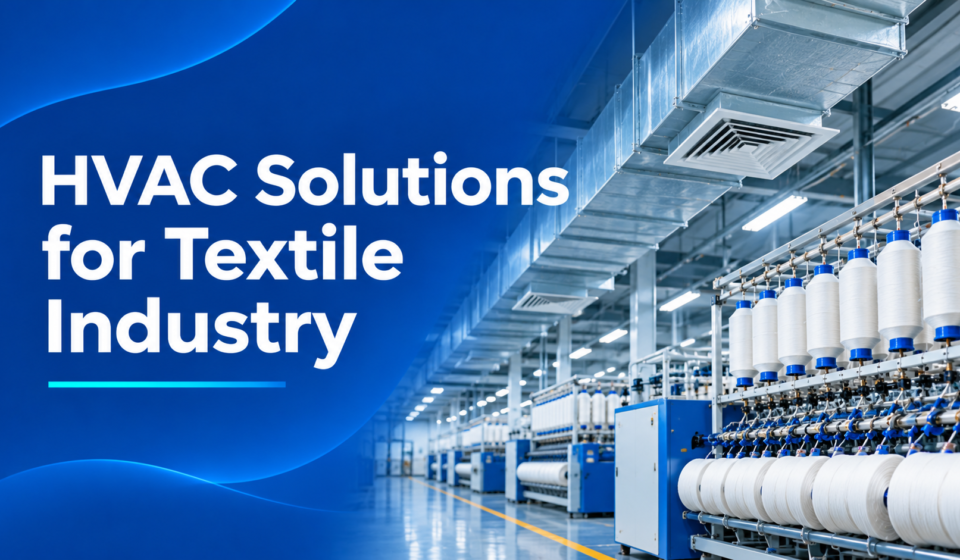

HVAC Solutions for Textile Industry: Complete Guide to Industrial Cooling, Humidity Control & Ventilation
The textile industry depends on carefully controlled indoor environmental conditions to maintain production quality, improve machinery performance, and support worker comfort. From spinning and weaving to knitting, dyeing, processing, and garment manufacturing, each production area generates different levels of heat, humidity, dust, and airborne contaminants.
A properly designed HVAC system for the textile industry helps regulate temperature, control relative humidity, remove process heat, manage lint and dust, and provide suitable ventilation. These factors can influence yarn quality, fabric handling, machine efficiency, and the overall working environment.
Unlike ordinary commercial air conditioning, textile mill HVAC requires an understanding of production processes, fibre characteristics, machinery heat loads, moisture requirements, and industrial airflow patterns.
VIPUL HVAC SOLUTION PVT. LTD. provides HVAC solutions involving industrial air conditioning, AHU systems, chillers, fresh air ventilation, ductable AC, and VRF/VRV systems. This guide explains the HVAC requirements of textile factories, system options, production-area applications, design considerations, and energy-efficiency strategies.
What Are HVAC Solutions for the Textile Industry?
HVAC solutions for textile industries are engineered heating, ventilation, air-conditioning, filtration, and humidity-management arrangements designed to maintain suitable environmental conditions in textile manufacturing facilities.
Depending on the production process, a textile factory HVAC installation may include:
- Centralised industrial air-conditioning systems
- Air Handling Units (AHUs)
- Chiller systems
- Fresh Air Handling Units (FAHUs)
- Industrial ventilation systems
- Evaporative cooling and air-washer systems
- Humidification and dehumidification equipment
- Industrial exhaust fans
- Air filtration systems
- Dust and fibre collection systems
- Ductwork and air distribution systems
- Temperature and humidity monitoring
- Building Management System (BMS) integration
The exact configuration depends on the textile material, manufacturing process, machinery, factory layout, local climate, production targets, and environmental requirements.
Why Is HVAC Important in Textile Manufacturing?
Temperature, relative humidity, air movement, and cleanliness can influence textile manufacturing operations. Fibres and yarns interact with the surrounding atmosphere, so environmental conditions can affect their moisture content, handling characteristics, and production behaviour.
ASHRAE’s industrial air-conditioning guidance identifies temperature and relative humidity as important factors for hygroscopic materials such as textiles. https://handbook.ashrae.org/Handbooks/A19/SI/a19_ch15/a19_ch15_si.aspx
1. Temperature Control
Textile machinery generates heat through motors, friction, electrical equipment, and continuous production operations.
Excessive heat can create uncomfortable working conditions and affect equipment operating conditions. A properly designed HVAC system helps remove heat and maintain the required production environment.
2. Relative Humidity Control
Relative humidity is particularly important in textile production because natural fibres absorb and release moisture depending on surrounding atmospheric conditions.
Incorrect humidity can contribute to:
- Changes in fibre moisture content
- Increased static electricity in some processes
- Yarn breakage and handling problems
- Variations in yarn strength and elongation
- Fabric processing difficulties
- Inconsistent production conditions
The optimum humidity level depends on the fibre type and manufacturing operation. It should be established through process-specific engineering and production requirements.
3. Dust and Fibre Management
Spinning, carding, weaving, and other textile operations can release lint, fibre fly, and fine dust.
Industrial ventilation, suitable filtration, and dedicated dust collection systems help control airborne material and maintain a cleaner working environment.
4. Machinery Cooling
High-speed textile machines, motors, electrical panels, compressors, and electronic controls generate heat.
Suitable ventilation and cooling arrangements help maintain the operating environment required by equipment manufacturers.
5. Worker Comfort and Workplace Conditions
Textile factories may operate for extended production shifts. Proper ventilation and cooling can help reduce heat stress and improve indoor working conditions.
6. Production Consistency
Maintaining suitable environmental conditions helps reduce fluctuations that may affect fibre handling, yarn processing, and fabric quality.
HVAC Requirements for Different Textile Manufacturing Processes
Every textile manufacturing department has different environmental requirements. The HVAC design should therefore be developed according to the actual production process.
1. Spinning Mill HVAC System
Spinning is a critical textile manufacturing process in which fibres are converted into yarn.
Spinning departments may include blow rooms, carding, drawing, combing, roving, ring spinning, and winding.
Important HVAC requirements include:
- Controlled temperature and humidity
- Uniform air distribution
- Machinery heat removal
- Fibre fly and dust extraction
- Suitable air filtration
- Air balancing
- Coordination with central waste collection systems
Spinning machines can generate substantial heat and airborne fibre waste. A properly planned air-conditioning and extraction arrangement helps maintain suitable production conditions.
2. Weaving Mill HVAC System
Weaving converts yarn into fabric through the interlacing of warp and weft yarns.
Looms generate heat, and weaving operations can produce fibre fly and dust.
Important HVAC requirements include:
- Temperature management
- Humidity control according to yarn requirements
- Uniform air distribution
- Machinery cooling
- Dust and lint management
- Suitable ventilation
- Worker comfort
A well-designed system should avoid unwanted air currents that interfere with machinery operation or disturb production materials.
3. Knitting Industry HVAC System
Knitting machines operate at high speeds and generate heat during continuous production.
The HVAC system should consider:
- Machine heat loads
- Temperature control
- Humidity management
- Air movement
- Fibre and dust removal
- Suitable ventilation
- Production-area zoning
Environmental requirements vary according to the type of yarn, knitting process, and finished fabric.
4. Textile Dyeing and Processing Units
Dyeing and processing departments may involve hot water, steam, chemicals, drying equipment, and moisture-generating processes.
HVAC and ventilation considerations include:
- Heat removal
- General ventilation
- Local exhaust for relevant process emissions
- Moisture management
- Corrosion-resistant equipment where required
- Make-up air
- Suitable equipment-room cooling
Process exhaust must be designed according to the actual chemical and thermal characteristics of the emissions. General comfort ventilation should not replace dedicated process exhaust where required.
5. Textile Printing Units
Textile printing operations may involve printing machines, inks, drying processes, and chemical products.
HVAC considerations include:
- Temperature control
- Suitable fresh-air ventilation
- Process exhaust where required
- Heat removal
- Odour management
- Filtration
- Humidity control where relevant
The ventilation system should be coordinated with the chemicals and processes used at the facility.
6. Fabric Finishing and Drying Departments
Finishing and drying processes may generate significant heat and moisture.
Important requirements include:
- High-temperature process heat management
- Exhaust ventilation
- Moisture removal
- Make-up air
- Equipment cooling
- Suitable air distribution
- Corrosion-resistant materials where needed
The HVAC system should be coordinated with the process equipment’s exhaust and heat-rejection requirements.
7. Garment Manufacturing Units
Garment manufacturing facilities generally include cutting, stitching, pressing, inspection, finishing, and packing areas.
HVAC considerations include:
- Worker comfort
- Fresh-air ventilation
- Heat removal
- Dust and lint control
- Temperature management
- Suitable air distribution
- Electrical and equipment cooling
8. Textile Raw Material and Finished Fabric Storage
Storage areas may require environmental controls depending on the stored material and storage duration.
Considerations include:
- Moisture management
- Temperature monitoring
- Ventilation
- Condensation prevention
- Suitable storage conditions
- Protection against dampness and mould
Storage requirements should be determined according to the fibre, fabric, packaging, and quality-control specifications.
Major HVAC Components Used in Textile Industries
A textile factory may require several HVAC components working together to maintain the required indoor environment.
1. Industrial Air Handling Unit (AHU)
An Air Handling Unit is a major component of many centralized industrial HVAC systems.
An industrial AHU may include:
- Fresh-air intake section
- Return-air section, where permitted
- Pre-filters and fine filters
- Cooling coils
- Heating coils, where required
- Humidification or dehumidification sections
- Supply and return fans
- Dampers
- Drain pans
- Control sensors
AHUs condition and distribute air across designated manufacturing areas.
For textile applications, AHU selection should consider large airflow requirements, fibre contamination, filter loading, access for cleaning, corrosion, and maintenance requirements.
2. Chiller System for Textile Mills
Chillers provide chilled water for cooling coils in AHUs and other compatible equipment.
They may be considered for large textile manufacturing facilities with significant and continuous cooling loads.
Common chiller-system components include:
- Air-cooled or water-cooled chillers
- Chilled-water pumps
- Cooling towers, where required
- AHU cooling coils
- Chilled-water piping
- Valves and controls
- Expansion and water-treatment arrangements
The choice between air-cooled and water-cooled chillers depends on project capacity, available space, water availability, climate, maintenance resources, and lifecycle cost.
3. Fresh Air Ventilation System
Fresh-air ventilation supplies outdoor air to designated factory areas.
A typical arrangement may include:
- Fresh-air intake louvers
- Filters
- Fresh-air fans
- FAHUs
- Ductwork
- Air distribution outlets
- Dampers and controls
Fresh-air quantities should be calculated according to occupancy, process requirements, exhaust quantities, indoor air quality, and applicable regulations.
4. Evaporative Cooling and Air-Washer Systems
Evaporative cooling and air washers are used in some textile manufacturing environments to cool and condition large quantities of air.
An air washer passes air through a water-spray section, where contact with water can cool and humidify the air depending on the operating conditions.
Potential applications include selected spinning and weaving departments where the process benefits from controlled humidity and high-volume air circulation.
Important design considerations include:
- Water quality
- Filtration
- Nozzle selection
- Pumping arrangements
- Water treatment
- Hygiene and biological-growth control
- Drift elimination
- Drainage
- Maintenance access
ASHRAE’s textile processing guidance discusses air washers, humidification, dust collection, industrial ductwork, chillers, and air distribution as relevant design considerations. https://handbook.ashrae.org/Handbooks/A19/IP/a19_ch22/a19_ch22_ip.aspx
5. Industrial Exhaust and Ventilation Fans
Industrial exhaust fans remove unwanted heat, moisture, odours, and process emissions from designated areas.
Applications may include:
- Dyeing departments
- Drying areas
- Chemical handling areas
- Utility rooms
- Compressor rooms
- General factory ventilation
Fan selection should consider airflow, static pressure, temperature, moisture, contaminants, operating hours, and material compatibility.
6. Air Filtration and Dust Collection Systems
Textile processes can produce fibre fly, lint, and dust that require appropriate collection and filtration.
The overall arrangement may include:
- Pre-filters
- Fine filters
- Centralized dust collection
- Machine-level suction
- Industrial ductwork
- Dust separation equipment
- Waste collection and disposal arrangements
The HVAC filtration system and machine dust collection system perform related but different functions. They should be coordinated rather than treated as interchangeable.
7. Humidification and Dehumidification Systems
Humidity-management equipment helps maintain process-specific moisture conditions.
Depending on the application, a facility may use:
- Air washers
- Water-spray humidifiers
- Steam humidifiers
- Evaporative humidifiers
- Cooling-coil dehumidification
- Dedicated dehumidification equipment
The appropriate technology depends on the required humidity range, water quality, hygiene, process material, and energy considerations.
Temperature and Humidity Control in Textile Industries
Temperature and relative humidity should be determined for each manufacturing department rather than applying one fixed value across the entire factory.
The environmental requirements can differ considerably between cotton spinning, synthetic fibre production, weaving, dyeing, drying, and finishing.
For example:
- Spinning may require controlled humidity to support fibre handling and yarn production.
- Weaving may require conditions suitable for warp and weft yarn performance.
- Drying departments may require lower moisture levels to support the drying process.
- Synthetic fibre processes may have specialized temperature and airflow requirements.
The final design values should be confirmed with production specialists, machinery manufacturers, fibre specifications, and applicable technical guidance.
Important: There is no single ideal temperature or relative humidity that applies to every textile factory.
Textile Industry HVAC Design: Important Engineering Considerations
A reliable industrial HVAC design requires a detailed understanding of production operations and building conditions.
1. Heat Load Calculation
The cooling-load calculation should consider:
- Machinery heat generation
- Motor and electrical equipment loads
- Number of workers
- Lighting load
- Outdoor air temperature
- Solar heat gain
- Roof and wall insulation
- Fresh-air requirements
- Process exhaust and make-up air
- Operating hours
- Heat generated by steam and process equipment
A machine-wise heat-load assessment is particularly important for large spinning and weaving facilities.
2. Airflow Calculation
Airflow requirements depend on the cooling load, ventilation requirement, process exhaust, dust collection, and air-distribution strategy.
The HVAC design should avoid relying on generic airflow values without considering the actual production conditions.
3. Humidity Load Calculation
Humidity control requires an assessment of moisture sources and moisture removal.
Sources may include:
- Outdoor air
- Evaporative cooling
- Process water
- Steam
- Wet materials
- Dyeing and finishing processes
- Occupants
The design should account for the moisture load and the required process humidity.
4. Uniform Air Distribution
Uneven air distribution can create local hot spots, humidity variations, and uncomfortable working conditions.
Proper duct sizing, diffuser selection, air outlets, return-air locations, and balancing are important for achieving uniform conditions.
5. Dust and Lint Management
Textile fibres can accumulate on filters, coils, fans, and duct surfaces.
The design should consider:
- Suitable filtration
- Machine-level collection
- Filter access
- Cleaning arrangements
- Duct inspection
- Maintenance intervals
- Safe waste handling
6. Factory Building Insulation
Roof and wall heat gain can contribute significantly to the cooling demand of industrial buildings.
Suitable insulation, reflective roofing, shading, and prevention of unwanted air leakage can help reduce HVAC loads.
7. Corrosion Protection
Dyeing, processing, and humid production environments may expose equipment to moisture and chemicals.
Materials, coatings, fasteners, and equipment finishes should be selected according to the actual environmental exposure.
8. Controls and Monitoring
A suitable monitoring and control system may track:
- Temperature
- Relative humidity
- Supply-air temperature
- Return-air temperature
- Filter differential pressure
- Fan operating status
- Chilled-water temperature
- Pump status
- Airflow
- System alarms
Central monitoring can help factory maintenance teams identify operational problems and maintain process conditions.
Energy-Efficient HVAC Solutions for Textile Factories
HVAC systems can represent a significant part of a textile facility’s energy consumption. Efficient design and operation can help reduce operating costs while maintaining required process conditions.
1. Select Efficient Chillers
Select chiller capacity based on calculated cooling demand and actual operating conditions. Consider part-load efficiency and total lifecycle cost.
2. Use Variable Frequency Drives (VFDs)
VFDs can adjust the speed of compatible fans and pumps according to system demand.
They may help reduce energy use in systems with variable airflow or water-flow requirements.
3. Optimise Air Distribution
Correct duct sizing, suitable fan selection, and air balancing help avoid unnecessary fan energy consumption.
4. Use Heat Recovery Where Suitable
Waste heat recovery can be considered where compatible exhaust and incoming air streams allow safe and practical energy transfer.
The design must assess contamination and cross-leakage risks before selecting a heat-recovery arrangement.
5. Maintain Filters and Cooling Coils
Dirty filters and cooling coils can increase pressure drop and reduce system performance.
Regular inspection and cleaning help maintain airflow and heat-transfer efficiency.
6. Improve Factory Insulation
Roof and wall insulation can reduce heat gain and lower the cooling demand.
7. Apply Automated Controls
Temperature, humidity, fan operation, and equipment schedules can be monitored and controlled through suitable automation systems.
8. Prevent Unnecessary Over-Ventilation
Airflow should meet the actual ventilation and process requirements. Excessive airflow can increase fan energy and the energy needed to condition incoming air.
Energy-saving measures must not compromise required process conditions, worker safety, dust collection, or ventilation performance.
Common HVAC Problems in Textile Industries and Their Solutions
| Common problem | Possible cause | Recommended action |
|---|---|---|
| High temperature in production areas | High machinery heat load or inadequate cooling | Review heat-load calculation and cooling capacity |
| Low relative humidity | Insufficient humidification or excessive dry-air supply | Check humidity controls and outdoor-air treatment |
| Excessive humidity | High moisture load or insufficient dehumidification | Review moisture sources and cooling-coil performance |
| Frequent yarn breakage | Process conditions or fibre-related issues | Review humidity, temperature, yarn and machinery parameters |
| High dust and lint levels | Inadequate extraction or filtration | Inspect machine suction and dust collection |
| Uneven temperature | Poor air distribution | Review ductwork, diffusers and air balancing |
| High electricity consumption | Inefficient equipment or excess airflow | Review fan, pump, chiller and control performance |
| Corrosion of HVAC equipment | Moisture or chemical exposure | Review material compatibility and protective coatings |
| Poor ventilation | Inadequate fresh air or exhaust | Measure airflow and review ventilation design |
These are possible causes, not automatic diagnoses. Production problems such as yarn breakage can also result from raw material quality, machine settings, and process conditions.
HVAC Installation and Commissioning for Textile Industries
A systematic installation and commissioning process helps ensure that the HVAC system operates according to its design requirements.
A typical project workflow includes:
- Understanding the textile manufacturing process.
- Reviewing the factory layout and machinery arrangement.
- Identifying room-wise temperature and humidity requirements.
- Calculating cooling and ventilation loads.
- Assessing exhaust and dust collection requirements.
- Selecting AHUs, chillers, fans, filters, and controls.
- Preparing ductwork and equipment layouts.
- Installing HVAC equipment and piping.
- Completing electrical and control connections.
- Testing airflow and balancing the system.
- Checking temperature and humidity controls.
- Testing equipment operation and alarms.
- Completing commissioning documentation and handover.
Where specialist humidification, dust collection, process exhaust, or fire and explosion protection is required, the relevant systems should be designed and tested by appropriately qualified specialists.
Preventive Maintenance of Textile Industry HVAC Systems
Regular maintenance is essential because textile environments can generate fibre, dust, moisture, and heat that affect HVAC equipment.
A preventive-maintenance programme may include:
- Cleaning and replacing air filters
- Inspecting AHU cooling coils
- Checking fans and motors
- Inspecting belts and bearings
- Checking chilled-water pumps
- Inspecting piping and valves
- Cleaning air washers and water tanks
- Checking humidification equipment
- Inspecting ductwork for lint accumulation
- Checking exhaust fan performance
- Inspecting dampers and air outlets
- Calibrating temperature and humidity sensors
- Reviewing system energy consumption
- Checking electrical panels and control systems
Maintenance frequency should be based on equipment manufacturer recommendations, operating hours, dust loading, water quality, and site conditions.
Why Choose VIPUL HVAC SOLUTION PVT. LTD. for Textile Industry HVAC Requirements?
Selecting an HVAC solution provider for a textile factory requires an understanding of industrial cooling, airflow, ventilation, and equipment requirements.
VIPUL HVAC SOLUTION PVT. LTD. works with HVAC solutions involving:
- Industrial air-conditioning systems
- Air Handling Units (AHUs)
- Chiller systems
- VRF/VRV air-conditioning systems
- Ductable air-conditioning systems
- Fresh air ventilation systems
- HVAC consultancy and planning support
- Cooling-load and equipment selection support
For textile manufacturing projects, the HVAC scope should be planned according to the production process, machinery heat load, fibre requirements, indoor conditions, and operating schedule.
Specialized textile humidification, central waste evacuation, dust collection, chemical exhaust, and process-safety systems should be clearly identified in the project scope and coordinated with qualified specialists where required.
Whether you are planning a new textile factory, expanding a spinning mill, upgrading a weaving unit, or improving an existing industrial cooling system, discuss your HVAC requirements with our team.
Conclusion
A properly designed HVAC system is an important part of modern textile manufacturing. Temperature control, humidity management, ventilation, dust collection, and uniform air distribution all contribute to suitable production conditions and a better working environment.
From spinning and weaving mills to knitting, dyeing, printing, finishing, and garment manufacturing, every textile process has specific HVAC requirements.
Industrial AHUs, chillers, fresh-air systems, ventilation equipment, and suitable humidity-control solutions can be combined to create an efficient textile factory HVAC arrangement.
VIPUL HVAC SOLUTION PVT. LTD. can assist with relevant industrial HVAC solutions, equipment planning, and project discussions for textile manufacturing facilities.
Contact VIPUL HVAC SOLUTION PVT. LTD.
Website: https://vipulhvacsolution.in/
Phone: +91 8000392000
Discuss your textile factory HVAC requirements with our team.
Frequently Asked Questions (FAQs)
1. Why is HVAC important in the textile industry?
HVAC is important because temperature, relative humidity, airflow, and air cleanliness can influence fibre handling, yarn production, machinery conditions, and worker comfort. A suitable system helps maintain the environmental conditions required for different textile processes.
2. Which HVAC system is best for textile mills?
The best system depends on factory size, production process, machinery heat load, humidity requirements, and ventilation needs. Industrial AHUs, chillers, air washers, fresh-air systems, and exhaust ventilation may be combined according to the project.
3. Why is humidity control important in textile manufacturing?
Humidity affects moisture absorption, fibre behaviour, static electricity, yarn handling, and fabric processing. The required relative humidity varies according to fibre type and manufacturing operation.
4. What is the role of an AHU in a textile factory?
An AHU filters, cools, heats, humidifies, dehumidifies, and distributes air depending on its configuration. Industrial AHUs can help maintain suitable temperature, humidity, and airflow conditions in production areas.
5. How does a chiller system help textile industries?
A chiller produces chilled water that can be supplied to AHU cooling coils and compatible equipment. Chiller systems are commonly considered for textile facilities with large and continuous cooling requirements.
6. How can textile factories reduce HVAC electricity consumption?
Factories can improve HVAC energy efficiency through efficient chillers, variable-speed fans and pumps, optimised airflow, proper insulation, automated controls, heat recovery where suitable, and preventive maintenance.
7. What is the difference between textile HVAC and normal commercial air conditioning?
Commercial air conditioning mainly focuses on occupant comfort. Textile HVAC may also need to control process temperature, humidity, fibre dust, machinery heat, airflow patterns, and production-specific environmental conditions.
Important links:
Technical references
These authoritative references support the technical discussion:
-
ASHRAE – Textile Processing Plants — textile process air conditioning, humidity, air distribution, filtration, dust collection, and equipment.
-
ASHRAE – Industrial Air Conditioning — temperature, humidity, industrial ventilation, and process environmental requirements.
-
ASHRAE Technical Committee 9.2 — industrial air conditioning and ventilation guidance.
-
Indian Textile Journal – Controlling Humidity and Total Air — textile humidity, airflow, dust, and production considerations.
-
UNIDO – Energy Conservation in Textile Mills — energy considerations for textile mill air conditioning.