
HVAC Solutions for Power Plants: Complete Guide to Industrial HVAC Design, Ventilation, Chiller Systems and Equipment Cooling
Advanced HVAC Systems for Thermal Power Plants, Gas Power Plants, Hydroelectric Stations and Industrial Power Generation Facilities
Power plants are critical industrial facilities that require reliable mechanical, electrical and environmental control systems to support continuous power generation. From turbine halls and boiler buildings to electrical switchgear rooms, control centres, battery rooms and administrative offices, every area has specific heating, ventilation and air conditioning requirements.
Unlike conventional commercial buildings, power plants operate with heavy machinery, high-temperature equipment, electrical installations, process heat and potentially hazardous industrial environments. These conditions make industrial HVAC engineering an important part of power plant infrastructure.
A properly designed HVAC System for Power Plants helps maintain suitable environmental conditions for personnel, protect sensitive electrical and electronic equipment, remove unwanted heat, manage dust and contaminants, and support reliable plant operations.
VIPUL HVAC SOLUTION PVT. LTD. provides HVAC consultancy and mechanical building-service solutions, including industrial HVAC, central chiller systems, Air Handling Units (AHUs), VRF/VRV air conditioning, ductable AC, ventilation and cooling solutions.
This comprehensive guide explains power plant HVAC systems, industrial ventilation, equipment cooling, chiller plants, AHUs, control room air conditioning, electrical room ventilation, energy efficiency and important engineering considerations.
What Are HVAC Solutions for Power Plants?
HVAC solutions for power plants involve the design, engineering, installation and maintenance of heating, ventilation and air conditioning systems for power generation facilities.
The primary objectives are to:
- Maintain suitable environmental conditions for plant equipment.
- Remove excess heat generated by machinery.
- Provide appropriate ventilation for industrial spaces.
- Control temperature and humidity in electrical and control rooms.
- Reduce dust and airborne contaminants entering sensitive areas.
- Support personnel comfort and workplace safety.
- Maintain reliable operation of critical HVAC equipment.
- Improve energy efficiency and reduce unnecessary operating costs.
Power plant HVAC requirements vary according to the type of generation facility, process equipment, fuel, plant layout, outdoor climate and operational requirements.
A thermal power station, gas turbine power plant, hydroelectric station and nuclear power facility do not necessarily require identical HVAC configurations.
Why Is a Proper HVAC System Important for Power Plants?
Power generation facilities contain equipment that may generate significant heat and require specific environmental conditions.
A professionally engineered HVAC system provides several important benefits.
1. Protection of Electrical and Electronic Equipment
Control panels, switchgear, instrumentation, communication equipment and computer systems can be sensitive to excessive temperatures, humidity, dust and airborne contaminants.
Suitable air conditioning, filtration and room pressurisation help maintain the required equipment environment.
2. Industrial Heat Removal
Turbines, generators, motors, pumps and other mechanical equipment can release considerable heat into enclosed spaces.
Industrial ventilation and suitable cooling systems help remove excess heat and maintain acceptable working conditions.
3. Personnel Comfort and Safety
Power plants contain areas where employees work near hot equipment, mechanical systems and industrial processes.
Proper ventilation and environmental control help support suitable working conditions.
4. Dust and Contamination Control
Coal handling, material movement and other industrial operations can generate dust and airborne particles.
Appropriate filtration, pressurisation and ventilation arrangements help protect sensitive equipment and occupied areas.
5. Reliable Plant Operation
Power plants depend on continuous operation of critical equipment.
HVAC system reliability, standby equipment, backup power and preventive maintenance should therefore be considered during engineering design.
6. Energy Efficiency
Efficient fans, pumps, chillers, ventilation systems and intelligent controls can help reduce the energy required for building environmental control.
Major Components of Power Plant HVAC Systems
Power plant HVAC systems consist of several mechanical and electrical components working together.
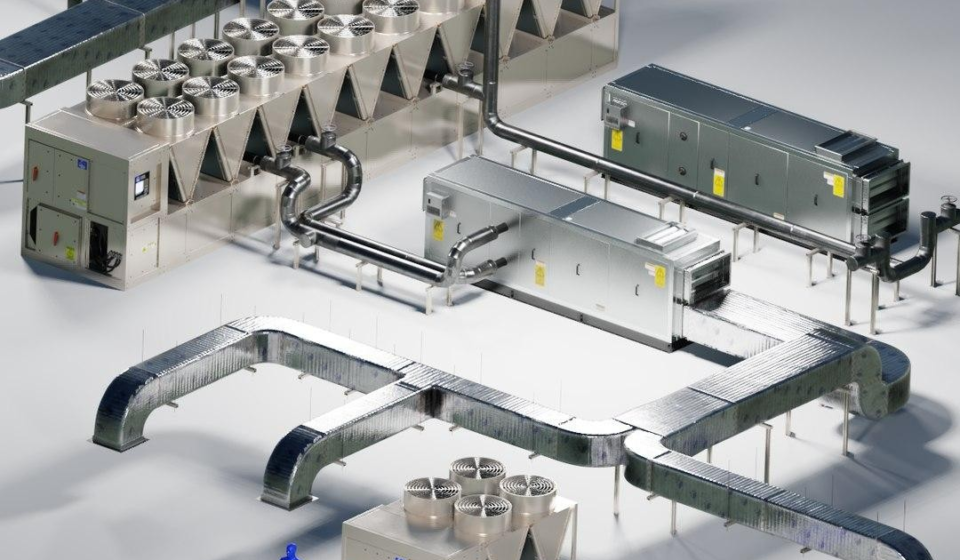
1. Industrial Air Handling Unit (AHU)
Air Handling Units are important components of industrial HVAC systems.
An AHU conditions and circulates air through filters, cooling coils, heating components where required, fans and dampers.
Typical AHU components include:
- Fresh-air intake section.
- Pre-filters.
- Fine filters.
- Cooling coils.
- Heating coils where required.
- Supply-air fans.
- Return-air sections.
- Dampers.
- Drain pans.
- Temperature sensors.
- Humidity sensors.
- Differential-pressure monitoring.
- Control systems.
Power plant AHU applications:
- Control rooms.
- Electrical rooms.
- Instrumentation rooms.
- Administrative buildings.
- Laboratories.
- Maintenance workshops.
- Communication rooms.
- Operator facilities.
Important AHU selection parameters include airflow capacity, cooling load, external static pressure, filter efficiency, air leakage, fan selection, equipment redundancy and maintenance accessibility.
2. Central Chiller Plant System
Central chiller plants are used in power generation facilities where centralised cooling is required for multiple buildings or equipment rooms.
A chiller produces chilled water that is circulated to AHUs and Fan Coil Units (FCUs).
The conditioned air is then distributed through ducts or local air distribution units.
Two common chiller configurations are:
Air-Cooled Chiller
An air-cooled chiller rejects heat directly to the outdoor atmosphere.
It may be considered for projects where cooling-tower installation or a separate cooling-water circuit is not preferred.
Water-Cooled Chiller
A water-cooled chiller rejects heat through a cooling-water circuit connected to a cooling tower.
It may be suitable for larger installations where site conditions, water availability and operating requirements support this arrangement.
Important chiller design considerations include:
- Total cooling load.
- Equipment heat generation.
- Outdoor design conditions.
- Chiller capacity.
- Chilled-water temperature.
- Pump selection.
- Cooling-tower requirements.
- Part-load efficiency.
- Piping insulation.
- Equipment redundancy.
- Maintenance requirements.
Chiller selection should be based on actual cooling demand and the specific requirements of the power plant.
3. Industrial Ventilation System
Industrial ventilation is essential for removing excess heat, fumes, dust and other airborne contaminants from designated areas.
Power plants may require different ventilation arrangements depending on the process and equipment installed.
Common industrial ventilation applications include:
- Turbine hall ventilation.
- Boiler building ventilation.
- Generator room ventilation.
- Electrical room ventilation.
- Battery room ventilation.
- Workshop ventilation.
- Pump room ventilation.
- Compressor room ventilation.
- Chemical storage ventilation.
- Conveyor gallery ventilation.
Ventilation design should consider the heat load, contaminant characteristics, airflow direction, hazardous-area classification, outdoor air quality and applicable safety requirements.
4. Exhaust Air System
Exhaust systems remove unwanted air, fumes, heat and contaminants from selected power plant areas.
Typical applications include:
- Battery rooms.
- Chemical laboratories.
- Workshops.
- Oil storage areas.
- Equipment rooms.
- Toilets and welfare facilities.
- Designated process areas.
Exhaust systems must be designed according to the nature of the contaminants and the relevant industrial safety requirements.
Where hazardous gases or flammable vapours may be present, the ventilation design must be coordinated with gas detection, electrical classification and fire protection systems.
5. Cooling and Air Conditioning for Control Rooms
Control rooms are among the most important air-conditioned spaces in a power plant.
They accommodate control panels, computers, monitoring systems, communication equipment and instrumentation.
These systems may require stable environmental conditions for reliable operation.
Important control room HVAC considerations include:
- Continuous temperature control.
- Humidity management.
- Dust filtration.
- Suitable room pressurisation.
- Reliable air distribution.
- Low noise levels.
- Redundant cooling arrangements where required.
- Backup power considerations.
- Equipment alarm monitoring.
For critical control centres, standby AHUs or cooling equipment may be considered to maintain cooling during equipment failure or maintenance.
6. Electrical Room and Switchgear Room Cooling
Electrical rooms contain switchgear, distribution panels, motor control centres and other electrical equipment that generate heat during operation.
Excessive temperature can affect equipment performance and service life.
HVAC design should consider:
- Electrical equipment heat loads.
- Required room temperature.
- Ventilation requirements.
- Dust filtration.
- Humidity control.
- Room pressurisation.
- Equipment clearances.
- Backup cooling arrangements.
The cooling capacity should be calculated using the actual equipment heat dissipation data.
7. Battery Room Ventilation System
Battery rooms require special ventilation considerations because certain battery types can release hydrogen gas during charging and operation.
The ventilation system should be designed according to the battery chemistry, charging conditions, manufacturer’s information and applicable electrical and safety standards.
Important considerations include:
- Hydrogen generation rate.
- Required ventilation airflow.
- Exhaust fan selection.
- Air intake and exhaust positioning.
- Gas detection where required.
- Electrical equipment suitability.
- Emergency operating arrangements.
Battery room ventilation must be specifically engineered to prevent the accumulation of hazardous gas concentrations.
8. VRF and VRV Air Conditioning Systems
VRF (Variable Refrigerant Flow) and VRV (Variable Refrigerant Volume) systems may be considered for suitable power plant offices and support buildings.
Typical applications include:
- Administrative offices.
- Meeting rooms.
- Training rooms.
- Staff facilities.
- Management buildings.
- Selected technical support spaces.
Advantages include:
- Individual zone temperature control.
- Flexible indoor-unit configurations.
- Variable-capacity operation.
- Space-efficient installation.
- Centralised control options.
VRF/VRV systems should be selected according to the building layout, cooling load, refrigerant piping limitations, outdoor conditions and operating requirements.
They should not automatically replace purpose-designed ventilation or process cooling systems in critical industrial areas.
9. Ductable Air Conditioning System
Ductable AC systems may be used in suitable power plant offices, training facilities and administrative buildings.
Important design considerations include:
- Cooling-load calculation.
- Duct sizing.
- Airflow distribution.
- External static pressure.
- Diffuser selection.
- Return-air arrangements.
- Duct insulation.
- Noise control.
- Maintenance accessibility.
10. Building Management System (BMS)
A Building Management System can help monitor and control HVAC equipment across a power plant.
Depending on the design, BMS integration may include:
- AHU operating status.
- Chiller operating status.
- Supply-air temperature.
- Return-air temperature.
- Chilled-water temperature.
- Pump operation.
- Fan operation.
- Filter differential pressure.
- Room temperature.
- Humidity.
- Pressure differential.
- Equipment alarms.
- Energy consumption.
Integration with the plant’s Distributed Control System (DCS) or other industrial control platforms should be carefully designed with appropriate cybersecurity, functional boundaries and operational responsibilities.
HVAC Solutions for Different Areas of Power Plants
Different power plant departments have different environmental and ventilation requirements.
1. Turbine Hall HVAC System
The turbine hall contains steam turbines, generators, associated piping and other heat-generating equipment.
These areas may experience substantial heat accumulation during operation.
Important HVAC considerations include:
- General industrial ventilation.
- High-level heat extraction.
- Low-level supply air.
- Roof exhaust fans.
- Localised cooling where required.
- Personnel working conditions.
- Equipment heat dissipation.
- Noise control.
The ventilation design should account for the plant’s equipment layout and heat distribution.
2. Boiler Building Ventilation System
Boiler buildings contain combustion equipment, hot surfaces, piping and supporting machinery.
Ventilation may be required to remove excess heat and maintain suitable conditions for workers.
Design considerations include:
- Thermal load assessment.
- Air supply arrangements.
- Mechanical exhaust.
- Air distribution at different elevations.
- Dust management.
- Equipment access.
- Fire and explosion safety considerations.
3. Generator Room HVAC System
Generator areas may contain electrical and mechanical equipment that generates heat.
The HVAC design should consider equipment operating temperatures, ventilation, local cooling requirements and manufacturer specifications.
4. Main Control Room HVAC System
Control rooms require reliable cooling because they contain temperature-sensitive electronic equipment.
Important requirements may include:
- Dedicated air conditioning.
- Filtered outdoor air.
- Appropriate room pressure.
- Continuous operation.
- Redundant cooling equipment.
- Temperature and humidity monitoring.
- Alarm systems.
5. Switchgear and MCC Room HVAC
Motor Control Centre (MCC) and switchgear rooms require suitable cooling and ventilation according to the heat dissipation and environmental requirements of installed equipment.
The system should also protect equipment against excessive dust and humidity.
6. Electrical Substation HVAC
Substation control buildings contain protection panels, control equipment, batteries, communication systems and other electrical components.
The HVAC design should consider:
- Equipment heat load.
- Dust infiltration.
- Temperature control.
- Humidity management.
- Room pressurisation.
- Equipment redundancy.
- Maintenance accessibility.
7. Battery Room HVAC
Battery rooms require specific ventilation and temperature-control arrangements based on the battery type and charging system.
Hydrogen accumulation, where applicable, must be addressed through properly engineered ventilation and safety measures.
8. Chemical Laboratory HVAC
Power plant laboratories may handle water treatment chemicals, testing materials and other potentially hazardous substances.
The HVAC design may include:
- General ventilation.
- Dedicated fume extraction.
- Make-up air.
- Appropriate exhaust discharge.
- Temperature control.
- Chemical storage ventilation.
Laboratory exhaust systems should be designed according to the materials handled and applicable safety requirements.
9. Administrative Building HVAC
Power plant administrative buildings generally have conventional commercial HVAC requirements.
VRF/VRV, ductable AC, cassette AC and AHU-based systems may be evaluated according to the building area, occupancy and operational schedule.
10. Conveyor and Coal Handling Areas
Coal-fired power plants may contain coal storage, crushers, conveyor galleries and transfer points.
These areas can generate airborne dust and may present combustible dust hazards.
Ventilation and dust-control systems must be engineered according to the process, dust characteristics, equipment layout and applicable fire and explosion safety requirements.
Ordinary ventilation fans should not be assumed suitable for hazardous dust environments without appropriate engineering review.
HVAC Requirements for Different Types of Power Plants
Different power generation technologies have different HVAC and ventilation requirements.
1. Thermal Power Plants
Thermal power plants use heat energy to generate electricity through steam turbines.
Major HVAC applications include:
- Boiler building ventilation.
- Turbine hall ventilation.
- Generator room cooling.
- Control room air conditioning.
- Electrical room cooling.
- Battery room ventilation.
- Switchgear room ventilation.
- Administrative building HVAC.
2. Gas Power Plants
Gas power plants use gas turbines or combined-cycle systems for electricity generation.
Important HVAC considerations include:
- Turbine enclosure ventilation.
- Equipment cooling.
- Control room air conditioning.
- Electrical room ventilation.
- Fuel system area ventilation.
- Noise control.
- Gas detection integration.
- Hazardous-area requirements.
Turbine enclosure HVAC and ventilation requirements must be coordinated with the turbine manufacturer’s specifications and safety design.
3. Hydroelectric Power Plants
Hydroelectric facilities generate electricity using water turbines and generators.
HVAC applications may include:
- Turbine hall ventilation.
- Generator room ventilation.
- Electrical room cooling.
- Control room air conditioning.
- Cable gallery ventilation.
- Battery room ventilation.
- Workshop ventilation.
Humidity management and protection against moisture ingress can be especially important in hydroelectric facilities.
4. Nuclear Power Plants
Nuclear facilities require highly specialised HVAC engineering.
Their systems may involve safety-related ventilation, radiological containment, pressure zoning, filtration, redundancy and regulatory qualification.
Such systems must be designed and approved by appropriately qualified nuclear-sector specialists under the applicable regulatory framework.
General industrial HVAC solutions should not be treated as substitutes for nuclear safety-related ventilation systems.
5. Solar Power Plant Support Facilities
Large solar power installations may include inverter stations, electrical control rooms, battery energy storage facilities and administrative buildings.
HVAC requirements may include:
- Inverter room cooling.
- Battery room ventilation and thermal management.
- Control room air conditioning.
- Electrical room ventilation.
- Transformer-area ventilation where applicable.
- Monitoring and communication room cooling.
The battery chemistry and equipment manufacturer’s requirements must guide the thermal-management and ventilation design.
6. Wind Power Plant Support Facilities
Wind power projects may require HVAC for:
- Control buildings.
- Electrical substations.
- Converter equipment rooms.
- Battery storage facilities.
- Maintenance workshops.
- Communication rooms.
The final design depends on the equipment heat loads, environmental conditions and site configuration.
How to Calculate HVAC Cooling Load for Power Plants?
Cooling-load calculation is a critical stage in power plant HVAC design.
Industrial facilities contain heat-generating machinery, electrical equipment, piping, motors and process systems that can contribute significantly to the indoor heat load.
Important cooling-load factors include:
- Building area and room dimensions.
- Outdoor design temperature and humidity.
- Equipment heat dissipation.
- Electrical panel heat load.
- Motor and pump heat generation.
- Lighting load.
- Occupancy.
- Fresh-air ventilation load.
- Heat transfer through walls and roofs.
- Solar heat gain.
- Air infiltration.
- Operating schedules.
Example of Cooling Load Assessment for a Control Room
Suppose a power plant control room contains:
- Electrical control panels.
- Computers and monitoring systems.
- Communication equipment.
- Lighting.
- Operating personnel.
The HVAC engineer must assess the heat generated by each equipment group, the heat gain through the building envelope, occupancy, ventilation load and outdoor design conditions.
The final cooling capacity should be selected using detailed engineering calculations and equipment manufacturer data.
Important: Control room cooling capacity should not be selected using only a simple area-based AC tonnage formula. Equipment heat dissipation and operational reliability are important design factors.
Energy-Efficient HVAC Solutions for Power Plants
Power plants have significant energy requirements, and their HVAC systems should be designed to avoid unnecessary electrical consumption.
Energy-efficient engineering can help reduce auxiliary power consumption while maintaining required environmental conditions.
1. High-Efficiency Chiller Selection
Select chillers according to actual cooling demand, operating schedules and part-load performance.
2. Variable Frequency Drives (VFDs)
VFDs can adjust fan and pump speeds according to system demand, where appropriate.
3. Optimised Industrial Ventilation
Ventilation airflow should be based on actual heat-removal, contaminant-control and personnel requirements.
4. Efficient AHU Fan Selection
Proper fan selection and static-pressure optimisation can reduce unnecessary electrical consumption.
5. Heat Recovery
Suitable heat-recovery systems may help reduce energy demand where compatible with process conditions, safety and contamination-control requirements.
6. HVAC Zoning
Separate control zones can help avoid unnecessary conditioning of areas that do not require continuous air conditioning.
7. Smart Monitoring and Automation
BMS monitoring can help identify inefficient operating conditions, equipment faults and abnormal energy consumption.
8. Preventive Maintenance
Clean filters, efficient heat-transfer surfaces and properly maintained fans and pumps help preserve system performance.
HVAC Design Standards and Guidelines for Power Plants
Power plant HVAC systems should be designed according to applicable engineering standards, industrial safety regulations, equipment specifications and project requirements.
Important technical references include:
1. ASHRAE Handbook – Power Plants
Provides engineering guidance for HVAC systems in power generation facilities, including turbine areas, control rooms, electrical rooms and industrial ventilation.
2. ASHRAE Handbook – Industrial Air Conditioning
Covers environmental control, ventilation, air filtration, industrial process conditions and energy conservation.
3. ASHRAE Standard 62.1
Provides guidance on ventilation and acceptable indoor air quality for applicable occupied spaces.
4. NFPA Standards
Relevant fire and electrical safety standards should be applied according to the power plant’s equipment, fuel and hazard classification.
5. IEEE Guidelines
Applicable IEEE guidance should be considered for battery systems and electrical equipment environments.
6. National Building Code of India
Relevant provisions should be reviewed for building services, ventilation and fire safety.
7. Applicable BIS and Local Regulations
The design must comply with applicable Indian standards, electrical safety requirements, environmental regulations and project specifications.
Important: Power plants may contain combustible dust, flammable vapours, toxic gases and other hazardous conditions. HVAC design must be coordinated with fire protection, gas detection, explosion protection and emergency shutdown systems. The applicable authority and specialist safety engineers must determine the final requirements.
Common HVAC Design Challenges in Power Plants
Power plant HVAC projects involve several technical and operational challenges.
1. High Heat Generation
Turbines, generators, pumps, motors and electrical equipment can create substantial heat loads.
2. Dust and Airborne Contamination
Coal handling, ash handling and industrial operations may generate dust that can affect equipment and indoor air quality.
3. Continuous Plant Operation
Critical power generation facilities require reliable HVAC operation and carefully planned maintenance arrangements.
4. Equipment Sensitivity
Control panels, instrumentation, servers and electrical equipment may require specific temperature and humidity conditions.
5. Hazardous Atmospheres
Certain rooms may contain flammable, toxic or combustible materials. HVAC equipment and controls must be selected according to the relevant hazard classification.
6. Equipment Redundancy
Critical control rooms and other essential areas may require standby cooling equipment and backup power.
7. Difficult Maintenance Conditions
Industrial plants may have limited access, high installation levels and complex mechanical layouts. Maintenance accessibility should be considered during the design stage.
HVAC Installation, Testing and Commissioning for Power Plants
Proper installation and commissioning are essential for reliable power plant HVAC operation.
Depending on the agreed project scope, commissioning activities may include:
- Equipment installation inspection.
- AHU performance checks.
- Chiller performance verification.
- Ductwork leakage testing.
- Chilled-water piping pressure testing.
- Airflow measurement.
- Air balancing.
- Water balancing.
- Room temperature verification.
- Humidity verification.
- Exhaust airflow testing.
- Gas detection and ventilation interface testing where applicable.
- BMS control testing.
- Equipment alarm verification.
- Standby equipment changeover testing.
- Emergency operating sequence verification.
Commissioning documentation should be prepared and reviewed by the responsible engineering and plant-operation teams before handover.
HVAC Maintenance Checklist for Power Plants
Regular maintenance helps maintain HVAC equipment performance and operational reliability.
| HVAC Component | Maintenance Activity |
|---|---|
| AHU | Inspect fans, coils, dampers and drain pans |
| Pre-Filters | Inspect and replace as required |
| Fine Filters | Monitor pressure drop and condition |
| Chiller | Check performance and operating parameters |
| Cooling Tower | Inspect fans and water quality |
| Chilled-Water Pumps | Check vibration, seals and flow |
| Cooling Coils | Inspect cleanliness and heat transfer |
| Industrial Exhaust Fans | Verify airflow and motor operation |
| Ventilation Louvers | Check for obstruction and damage |
| Ductwork | Inspect leakage and insulation |
| VFD | Check alarms and speed control |
| Room Sensors | Verify temperature and humidity readings |
| Pressure Monitoring | Check room pressure relationships |
| BMS | Verify alarms, controls and communication |
| Standby Equipment | Test availability and changeover operation |
Maintenance frequency should be established according to manufacturer recommendations, equipment criticality, operating hours and the plant’s maintenance programme.
Why Choose VIPUL HVAC SOLUTION PVT. LTD. for Power Plant HVAC Requirements?
Selecting the right HVAC engineering partner is important for power plant construction, expansion, renovation and industrial infrastructure upgrades.
VIPUL HVAC SOLUTION PVT. LTD. provides HVAC consultancy and mechanical building-service solutions for commercial and industrial applications.
The company’s HVAC service portfolio includes:
1. Industrial HVAC Solutions
HVAC and ventilation solutions for industrial buildings, equipment rooms and specialized mechanical applications.
2. Air Handling Unit (AHU) Solutions
AHU-related engineering solutions for cooling, filtration and ventilation requirements.
3. Chiller System Solutions
Air-cooled and water-cooled chiller solutions for centralised cooling applications.
4. Fresh-Air Ventilation Systems
Ventilation solutions based on project-specific airflow, heat-removal and indoor air quality requirements.
5. VRF and VRV Air Conditioning Systems
Suitable air conditioning solutions for administrative buildings, meeting rooms and support facilities.
6. Ductable Air Conditioning Systems
Ducted air distribution and cooling solutions for suitable commercial and industrial spaces.
7. Cassette Air Conditioning Systems
Ceiling-mounted air conditioning solutions for appropriate office and support areas.
8. HVAC Consultancy
Technical discussions and engineering support for equipment selection, cooling requirements and mechanical building services.
Every power plant has different process conditions, environmental requirements and equipment specifications. The HVAC system should therefore be selected after evaluating the plant layout, heat loads, operating conditions, ventilation requirements and safety considerations.
For critical power generation facilities, project-specific experience, hazardous-area engineering qualifications, statutory approvals, redundancy design and commissioning responsibilities should be confirmed before appointing an HVAC contractor or consultant.
Conclusion: Choose the Right HVAC Solutions for Power Plants
A properly engineered HVAC system is an important part of power plant infrastructure.
From turbine hall ventilation and electrical room cooling to control room air conditioning, chiller plants, AHUs and industrial exhaust systems, every component must be designed according to the specific operating requirements of the facility.
The right HVAC design can help protect sensitive equipment, remove excess heat, maintain suitable working conditions, improve energy efficiency and support reliable power generation operations.
Whether you are developing a thermal power plant, gas power station, hydroelectric facility, solar power project or industrial power generation unit, professional HVAC engineering should be considered from the earliest project planning stage.
VIPUL HVAC SOLUTION PVT. LTD. can discuss your HVAC consultancy and mechanical building-service requirements for industrial and power generation projects.
Contact VIPUL HVAC SOLUTION PVT. LTD.
Company: VIPUL HVAC SOLUTION PVT. LTD.
Phone: +91 8000392000
Website: https://vipulhvacsolution.in/
Looking for HVAC Solutions for Power Plants? Contact Vipul HVAC Solution to discuss industrial HVAC, chiller systems, AHUs, equipment cooling and ventilation requirements.
Frequently Asked Questions – HVAC Solutions for Power Plants
1. What are HVAC solutions for power plants?
HVAC solutions for power plants include industrial air conditioning, ventilation, cooling, filtration and temperature-control systems designed to support equipment reliability and suitable working conditions.
2. Which HVAC systems are used in thermal power plants?
Thermal power plants may use industrial ventilation, AHUs, central chiller systems, control room air conditioning, electrical room cooling and dedicated exhaust systems.
3. Why is HVAC important in power plant control rooms?
Control rooms contain sensitive electronic equipment, computers and instrumentation. Proper HVAC systems help maintain suitable temperature, humidity and air cleanliness for reliable equipment operation.
4. What is the role of AHUs in power plants?
Air Handling Units filter, cool and circulate air. They are used in control rooms, electrical rooms, administrative buildings and other areas requiring controlled environmental conditions.
5. Why is battery room ventilation important in power plants?
Certain battery types can release hydrogen during charging. Properly engineered ventilation helps prevent hazardous gas accumulation and maintain safe operating conditions.
6. How can power plants reduce HVAC energy consumption?
Power plants can improve HVAC efficiency through high-efficiency chillers, VFDs, optimised ventilation, efficient AHU fans, heat recovery where suitable and preventive maintenance.
7. Which factors should be considered when designing HVAC systems for power plants?
Important factors include equipment heat loads, outdoor climate, dust levels, hazardous-area classification, ventilation requirements, temperature control, equipment redundancy, maintenance accessibility and applicable safety standards.
Technical References and Authority Links
For technical research and engineering accuracy, refer to:
-
ASHRAE Handbook – Power Plants – Power plant HVAC design, turbine halls, control rooms, battery rooms and electrical facilities.