
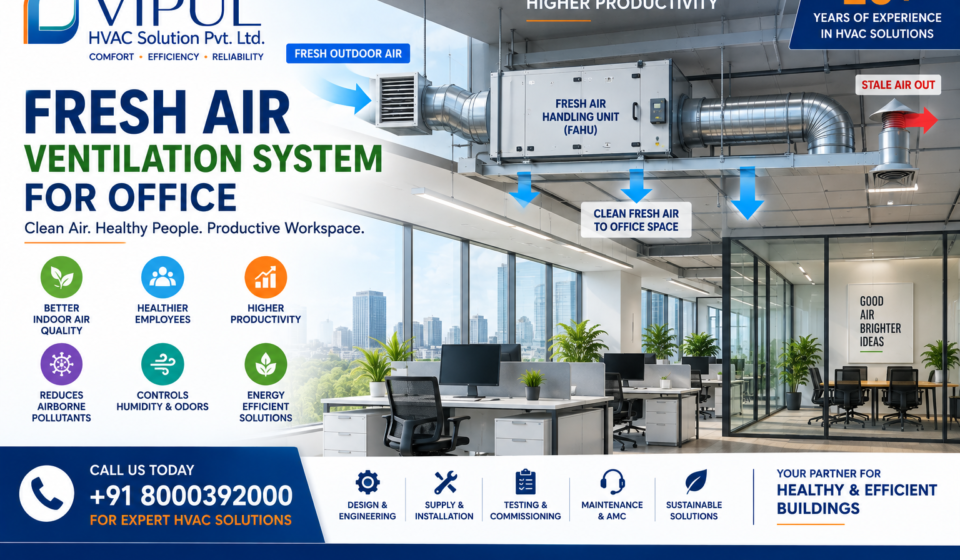

Fresh Air Ventilation System for Office and Home: Complete Guide to Better Indoor Air Quality
A fresh air ventilation system for office and home is designed to bring filtered outdoor air into an indoor space while removing stale, humid, or polluted air. Unlike an air conditioner, whose primary purpose is temperature control, a ventilation system focuses on fresh-air exchange, indoor air quality, humidity management and pollutant removal.
For modern offices and homes where doors and windows may remain closed for long periods, professionally designed ventilation can play an important role in maintaining a comfortable indoor environment. ASHRAE’s current Standard 62.1-2025 addresses ventilation and acceptable indoor air quality for commercial and institutional buildings, including requirements related to ventilation, air-cleaning systems, installation, commissioning, operation and maintenance.
VIPUL HVAC Solution Pvt. Ltd. provides engineered ventilation and indoor-air-quality solutions for residential, commercial and industrial applications, including fresh-air handling units, exhaust and supply fans, heat-recovery systems, filters, dampers and HVAC integration.
What Is a Fresh Air Ventilation System?
A fresh air ventilation system mechanically replaces some indoor air with outdoor air.
A simplified airflow process is:
Outdoor Air → Filter → Fresh Air Unit → Supply Duct → Indoor Space
while:
Indoor Stale Air → Exhaust/Return → Outdoor
Depending on the building and project requirements, the system may include filtration, heat or energy recovery, humidity control, sensors, dampers and automated controls.
The objective is not simply to move air around the room. The system should be designed to provide the required amount of outdoor air to occupied spaces while managing energy consumption and indoor comfort.
Why Is Fresh Air Ventilation Important?
Indoor air quality is affected by several factors, including pollutant sources, moisture, occupancy, HVAC design and ventilation system operation.
The U.S. EPA identifies three important strategies for improving indoor air quality:
- Control pollutant sources
- Ventilate to dilute and remove pollutants
- Filter or clean the air
EPA also notes that ventilation-system design, outdoor-air supply, filtration and equipment maintenance are important considerations for office indoor air quality.
A properly designed ventilation system can therefore become an important part of an overall HVAC and IAQ strategy.
Fresh Air Ventilation System for Office
Offices can have many indoor pollutant sources, including occupants, furniture, cleaning products, printers, computers, building materials and other activities.
EPA specifically notes that inadequate or poorly designed ventilation can contribute to indoor-air-quality problems in office buildings.
A properly designed office fresh-air system can help:
- Supply outdoor air to occupied areas
- Remove stale air
- Dilute indoor pollutants
- Manage odors
- Support humidity control
- Improve air circulation
- Support occupant comfort
- Integrate with existing HVAC systems
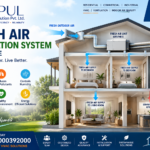
Fresh Air Ventilation System for Home
Modern homes are often designed with improved sealing and insulation, which can reduce uncontrolled air leakage.
If windows remain closed because of air conditioning, outdoor pollution, noise or weather conditions, mechanical ventilation can provide a more controlled method of introducing outdoor air.
A residential fresh-air system may supply air to:
- Bedrooms
- Living rooms
- Family rooms
- Study rooms
- Other occupied areas
Meanwhile, exhaust can be provided from:
- Bathrooms
- Kitchens
- Utility areas
- Other moisture- or odor-producing spaces
The actual airflow pattern should be determined through HVAC design rather than using the same arrangement for every home.
Fresh Air Ventilation vs Air Conditioning
One of the most common misconceptions is that an AC automatically provides sufficient fresh air.
That is not always the case.
| Feature | Air Conditioning | Fresh Air Ventilation |
|---|---|---|
| Primary purpose | Cooling/heating | Outdoor-air exchange |
| Fresh outdoor air | Depends on system | Main function |
| Stale-air removal | Usually not primary function | Yes |
| Temperature control | Yes | Depends on system |
| Filtration | Usually available | Can include filtration |
| Humidity control | Depending on system | Depends on design |
| Indoor air quality | Supports comfort | Directly addresses ventilation |
A modern building may therefore need both:
HVAC for thermal comfort + ventilation for outdoor-air management.
How Does a Fresh Air Ventilation System Work?
A typical system can operate through the following sequence:
Step 1: Outdoor Air Intake
Outdoor air enters through a dedicated intake.
Step 2: Filtration
The incoming air passes through an appropriate filter to reduce selected airborne particles.
Step 3: Fresh-Air Treatment
Depending on the system, the outdoor air may be cooled, heated, dehumidified or energy-recovered before distribution.
Step 4: Air Distribution
Ductwork delivers fresh air to designated rooms or zones.
Step 5: Stale-Air Exhaust
Indoor air containing odors, moisture or pollutants is exhausted from suitable areas.
Step 6: Energy Recovery
Where appropriate, an ERV or heat-recovery system can transfer energy between outgoing and incoming air streams.
Step 7: Monitoring & Control
Sensors and controls can regulate airflow and system operation according to project requirements.
Types of Fresh Air Ventilation Systems
1. Fresh Air Supply System
A supply system introduces outdoor air into selected indoor areas.
It can be suitable for offices, homes and other buildings where controlled outdoor-air delivery is required.
2. Exhaust Ventilation System
Exhaust ventilation removes indoor air from specific locations.
Typical applications include:
- Toilets
- Bathrooms
- Kitchens
- Utility rooms
- Storage areas
- Pollutant-generating areas
3. Balanced Ventilation System
A balanced ventilation system combines:
Fresh-Air Supply + Stale-Air Exhaust
This creates a more controlled air-exchange strategy.
4. Heat Recovery Ventilator — HRV
An HRV transfers sensible heat between incoming and outgoing air streams while keeping the two airflows separated.
It can help reduce the energy impact of outdoor-air ventilation in appropriate climates and applications.
5. Energy Recovery Ventilator — ERV
An ERV transfers sensible energy and some moisture between the incoming and outgoing air streams.
This can be useful where humidity management is an important part of the HVAC design.
VIPUL lists ERV and HRV solutions among its indoor-air-quality services.
Fresh Air Ventilation System Components
A complete ventilation system may include:
Fresh Air Handling Unit
Designed to introduce and condition outdoor air.
Exhaust Fans
Remove stale or contaminated air.
Supply Fans
Move fresh air through the ventilation system.
Filters
Help remove selected airborne particles from incoming or recirculated air.
Ductwork
Transfers air between the ventilation equipment and occupied zones.
Dampers
Control or balance airflow through different sections.
Diffusers & Grilles
Distribute or extract air from individual spaces.
Heat/Energy Recovery Equipment
Transfers energy between incoming and outgoing air streams where applicable.
Sensors & Controls
Monitor parameters such as temperature, humidity, CO₂ or system operating conditions depending on the project.
VIPUL’s ventilation portfolio includes fresh-air handling units, exhaust and supply fans, heat-recovery systems, filters, dampers, axial fans, jet fans and VAV systems.
Benefits of Fresh Air Ventilation for Offices
1. Better Outdoor-Air Supply
A mechanical system can provide controlled outdoor air instead of relying entirely on open windows.
2. Helps Dilute Indoor Pollutants
Ventilation can help dilute pollutants generated by people, furnishings, equipment and office activities.
3. Odor Management
Proper exhaust and outdoor-air supply can help manage unwanted odors.
4. Humidity Management
Ventilation can assist with moisture removal, although dedicated dehumidification may be necessary in some climates.
5. Better Air Distribution
Properly designed supply and exhaust locations can help distribute outdoor air more effectively.
6. HVAC Integration
Fresh-air systems can be integrated with existing commercial HVAC systems.
7. Support for Occupant Comfort
Good ventilation contributes to a comfortable indoor environment when combined with suitable temperature and humidity control.
EPA emphasizes that ventilation-system design, operation and maintenance are important components of office indoor air quality.
Benefits of Fresh Air Ventilation for Homes
A residential ventilation system can provide several practical advantages:
- Fresh outdoor-air supply
- Stale-air removal
- Odor reduction
- Moisture management
- Controlled ventilation
- Filtration of incoming air
- Better indoor-air circulation
- Compatibility with air conditioning
- Potential energy recovery
- Reduced dependence on opening windows
The exact benefits depend on the system design, outdoor-air quality, filtration, climate and building characteristics.
Fresh Air Ventilation for Offices With Central AC
A common commercial arrangement is:
Central AC → Cooling & Temperature Control
Fresh-Air Unit → Outdoor-Air Supply
Exhaust System → Stale-Air Removal
These systems can be integrated through the building’s HVAC controls.
For larger offices, the design may incorporate:
- AHUs
- Fresh-air handling units
- VAV systems
- Ductwork
- Exhaust fans
- Filters
- CO₂ monitoring
- BMS integration
The ventilation design should consider occupancy, room usage, outdoor-air conditions, duct distribution and applicable standards.
Fresh Air Ventilation for Homes With Split AC
A fresh-air system can also work alongside split AC units.
For example:
Fresh Air Unit → Fresh Outdoor Air
Split AC → Room Cooling
Bathroom/Kitchen Exhaust → Stale-Air Removal
This approach can be useful when the home requires controlled outdoor-air ventilation but does not have a central ducted AC system.
Fresh Air Ventilation for Conference Rooms
Conference rooms can experience rapidly changing occupancy.
When many people occupy a relatively small room, ventilation requirements can become particularly important.
A suitable system may include:
- Fresh-air supply
- CO₂ monitoring
- Exhaust/return air
- Filtration
- Automatic controls
The ventilation rate should be calculated according to the occupancy and applicable design requirements rather than using a fixed fan size.
Fresh Air Ventilation for Meeting Rooms
Meeting rooms, training rooms and boardrooms can similarly benefit from properly planned outdoor-air supply.
A good design considers:
- Maximum occupancy
- Room volume
- Operating hours
- Door opening patterns
- Outdoor-air conditions
- HVAC capacity
- Air distribution
Fresh Air Ventilation for Commercial Buildings
Commercial buildings can include:
- Offices
- Retail stores
- Restaurants
- Hotels
- Showrooms
- Banks
- Educational buildings
- Corporate offices
- Shopping complexes
Each building type has different occupancy and ventilation requirements.
ASHRAE Standard 62.1-2025 is specifically intended for spaces within buildings other than dwelling units and addresses ventilation and acceptable indoor air quality.
Fresh Air Ventilation for Industrial Offices
Industrial facilities may have office areas located near manufacturing or process areas.
In such cases, ventilation planning should consider:
- Outdoor pollutants
- Process-related contaminants
- Pressure relationships
- Fresh-air intake location
- Exhaust requirements
- Filtration
- Airflow direction
Industrial and office ventilation systems should not automatically be treated as the same system.
Fresh Air Ventilation and Indoor Air Quality
Indoor air quality depends on more than ventilation alone.
A comprehensive IAQ strategy can include:
Source Control
Reduce or isolate pollutant sources.
Ventilation
Dilute and remove indoor pollutants.
Filtration
Remove selected airborne particles.
Humidity Control
Manage excessive moisture or overly dry conditions.
Maintenance
Keep HVAC and ventilation equipment operating correctly.
EPA recommends combining source control, ventilation and filtration as complementary IAQ strategies.
Fresh Air Ventilation and CO₂
Carbon dioxide (CO₂) can increase in occupied spaces when outdoor-air ventilation is insufficient relative to occupancy.
CO₂ monitoring can therefore be useful as part of a building’s ventilation-management strategy.
However, CO₂ should not be treated as a complete measure of indoor air quality because many pollutants are not represented by CO₂ concentration.
A professional HVAC design can consider occupancy, airflow requirements and, where appropriate, CO₂ sensors and demand-controlled ventilation.
Fresh Air Ventilation and Energy Efficiency
One important concern is:
Will fresh air ventilation increase AC electricity consumption?
Introducing outdoor air can increase the cooling or heating load because the incoming air may need conditioning.
However, an appropriately designed system can reduce unnecessary energy use through:
- Efficient fans
- Correct airflow calculation
- Variable-speed drives
- Demand-controlled ventilation
- Heat recovery
- Energy recovery
- Proper filtration
- Automated controls
- Regular maintenance
Therefore, ventilation and energy efficiency should be designed together, rather than treating them as separate objectives.
Fresh Air Ventilation System Maintenance
A ventilation system requires regular maintenance to maintain performance.
Important maintenance activities include:
- Filter inspection
- Filter replacement
- Fan inspection
- Duct inspection
- Damper inspection
- Outdoor-air intake inspection
- Airflow measurement
- Cleaning accessible components
- Checking vibration and noise
- Sensor calibration where applicable
- Control-system inspection
EPA emphasizes preventive HVAC maintenance as an important component of maintaining good indoor air quality.
VIPUL provides HVAC maintenance, ductwork cleaning and related indoor-air-quality services.
Common Fresh Air Ventilation Mistakes
Mistake 1: Using Only an Exhaust Fan
Exhausting indoor air without providing an appropriate replacement-air strategy may not deliver the desired ventilation performance.
Mistake 2: Selecting a Fan Without Calculating Airflow
The correct airflow depends on occupancy, room size, use and applicable requirements.
Mistake 3: Ignoring Outdoor Air Quality
Outdoor air can contain dust, pollen and other pollutants, so intake location and filtration matter.
Mistake 4: Poor Duct Design
Incorrect duct sizing can cause noise, pressure losses and inadequate airflow.
Mistake 5: Ignoring AC Load
Outdoor air can add cooling and dehumidification loads, particularly in hot or humid climates.
Mistake 6: Neglecting Maintenance
Dirty filters and poorly maintained equipment can reduce system performance and affect IAQ.
Mistake 7: Blocking Supply or Return Grilles
Furniture, partitions or other obstructions can interfere with air distribution.
EPA specifically recommends keeping vents and grilles unobstructed and ensuring HVAC systems are properly maintained.
How to Choose the Right Fresh Air Ventilation System
Before selecting a system, consider:
1. Building Type
Is it a home, office, showroom, hotel, factory or institutional building?
2. Occupancy
How many people normally occupy the space?
3. Floor Area
Larger spaces generally require more detailed ventilation calculations.
4. Existing HVAC System
Consider whether the building has:
- Split AC
- Ducted AC
- VRF/VRV
- AHU
- Chiller
- Package AC
5. Outdoor Air Quality
The filtration strategy should consider the local outdoor environment.
6. Climate
Temperature and humidity influence the design and energy requirements.
7. Duct Availability
New construction generally offers more flexibility for concealed ductwork.
8. Energy Efficiency
Consider energy recovery, variable-speed fans and intelligent controls where appropriate.
9. Maintenance
Select equipment that can be accessed, cleaned and maintained efficiently.
Why Choose VIPUL HVAC Solution for Fresh Air Ventilation?
VIPUL HVAC Solution Pvt. Ltd. provides engineered ventilation solutions designed around the requirements of residential, commercial and industrial buildings.
Its ventilation services include:
- Fresh Air Handling Units
- Exhaust Fans
- Supply Fans
- Heat Recovery Systems
- Filters
- Dampers
- Noise Control
- Axial Fans
- Jet Fans
- VAV Systems
- Airflow Testing & Balancing
- HVAC Integration
- Energy-Efficient Ventilation Design
VIPUL HVAC Solution – Ventilation Systems
The company also offers indoor-air-quality solutions involving fresh-air ventilation, ERV, HRV, air purification, filtration, humidity control and IAQ monitoring for homes, offices and industrial environments.
Key advantages:
- Customized HVAC and ventilation design
- Residential ventilation solutions
- Office ventilation solutions
- Commercial HVAC expertise
- Industrial ventilation
- Fresh-air systems
- ERV/HRV solutions
- Filtration
- Ductwork
- Airflow testing and balancing
- HVAC integration
- Maintenance and support
VIPUL’s website states that it serves commercial buildings, hospitals, factories, offices, malls and cleanroom environments, in addition to residential applications.
Fresh Air Ventilation System: Office vs Home
| Requirement | Office | Home |
|---|---|---|
| Occupancy | Usually higher and variable | Usually lower |
| Ventilation design | Occupancy-driven | Occupancy + residential layout |
| CO₂ monitoring | Often useful | Optional depending on design |
| Fresh-air supply | Important | Important |
| Exhaust | Toilets, pantry, special areas | Kitchen, bathroom, utility areas |
| HVAC integration | AHU/VRF/chiller/ducted systems | Split/ducted/VRF systems |
| Energy recovery | Often useful | Useful in suitable applications |
| BMS | Common in larger buildings | Optional |
| Maintenance | Facility-managed | Homeowner/service-managed |
The correct design depends on the individual building rather than simply whether the space is an office or home.
Fresh Air Ventilation System Installation Process
A professional installation can follow these stages:
Step 1 — Site Survey
Evaluate the building layout, occupancy and existing HVAC system.
Step 2 — Ventilation Calculation
Determine required outdoor-air and exhaust airflow.
Step 3 — Equipment Selection
Select fresh-air units, fans, filters, recovery equipment and controls.
Step 4 — Duct Design
Plan supply and exhaust routes.
Step 5 — Installation
Install equipment, ductwork, grilles, dampers and controls.
Step 6 — Testing
Measure airflow and verify system operation.
Step 7 — Balancing
Balance supply and exhaust airflow according to the design.
Step 8 — Commissioning
Check system operation and controls before handover.
VIPUL specifically lists ventilation design, equipment supply and installation, airflow testing and balancing, and HVAC integration within its ventilation capabilities.
Frequently Asked Questions
What is a fresh air ventilation system for office and home?
It is a mechanical system that introduces outdoor air into indoor spaces while removing stale indoor air. It can incorporate filtration, exhaust, heat recovery, energy recovery and controls depending on the project.
Is fresh air ventilation necessary for an office?
Adequate ventilation is an important part of office indoor air quality. The required system depends on occupancy, building design, HVAC configuration and applicable ventilation requirements.
Is fresh air ventilation necessary for a home?
The need depends on the home’s construction, airtightness, occupancy, climate and existing ventilation. Modern homes with limited natural ventilation can benefit from a properly designed mechanical ventilation system.
Can fresh air ventilation work with AC?
Yes. Fresh-air ventilation can be integrated with central AC, AHUs, VRF/VRV, ducted AC and, in appropriate designs, operate alongside split AC systems.
Does fresh air ventilation cool the room?
Not necessarily. The primary purpose is outdoor-air exchange. If the incoming air is conditioned by a fresh-air handling unit, the system can also contribute to thermal conditioning.
Does ventilation remove indoor odors?
Properly designed ventilation and exhaust can help dilute and remove odors from kitchens, bathrooms, offices and other areas.
Can fresh air ventilation reduce dust?
Ventilation alone does not remove all dust. Appropriate filters can help reduce selected airborne particles, while source control and regular cleaning remain important.
What is better: HRV or ERV?
Neither is universally better. HRV primarily transfers sensible heat, while ERV can transfer sensible energy and some moisture. The appropriate option depends on climate, humidity and project requirements.
Does fresh air ventilation increase electricity consumption?
Outdoor-air ventilation can add cooling or heating loads. However, efficient fans, heat/energy recovery, appropriate airflow control and automation can help manage energy consumption.
How often should ventilation filters be changed?
There is no single interval for every system. Filter replacement depends on filter type, outdoor-air quality, operating hours and the amount of particulate loading. Filters should be inspected regularly.
Does VIPUL HVAC Solution provide fresh-air ventilation systems?
Yes. VIPUL provides fresh-air handling units, exhaust and supply fans, heat-recovery systems, filters, dampers and customized ventilation solutions for residential, commercial and industrial applications.
Conclusion
A fresh air ventilation system for office and home is an important component of modern HVAC and indoor-air-quality planning. It helps provide controlled outdoor-air supply, remove stale air and support better indoor environmental conditions.
For an office, the system should consider occupancy, ventilation rates, air distribution, filtration, exhaust, HVAC integration and applicable commercial-building requirements. For a home, the design should consider occupancy, room layout, airtightness, existing AC, outdoor-air quality, humidity and available duct space.
The best ventilation solution is not simply the largest fan. It is a properly calculated, designed, installed, tested and maintained system.
VIPUL HVAC Solution Pvt. Ltd. provides customized fresh-air ventilation and indoor-air-quality solutions for homes, offices, commercial buildings and industrial facilities, including fresh-air units, exhaust systems, ERV/HRV, filtration, ductwork, airflow testing and HVAC integration.
📞 Need a Fresh Air Ventilation System?
VIPUL HVAC SOLUTION PVT. LTD.
Call: +91 8000392000
Email: info@vipulhvacsolution.in
Important Links:
- Fresh air ventilation system for office
- Fresh air ventilation system for home
- Fresh air system for office
- Fresh air system for home
- Office ventilation system
- Home ventilation system
- Fresh air HVAC system
- Commercial fresh air ventilation
- Residential fresh air ventilation
- Fresh air ventilation system
- Office indoor air quality
- Home indoor air quality
- ERV ventilation system
- HRV ventilation system
- Fresh air unit for office
- Fresh air unit for home
- HVAC ventilation system
- Indoor air quality solutions
- Fresh air ventilation company

[…] VIPUL HVAC’s fresh-air ventilation solutions similarly focus on outdoor-air supply, filtration, humidity management, exhaust and HVAC integration. Vipulhvac Solution […]