
Fresh Air Ventilation System for Home: Complete Guide to Healthier Indoor Air
A fresh air ventilation system for home is a mechanical ventilation solution that brings outdoor air into the house while removing stale indoor air. It can be especially useful in modern, tightly enclosed homes where windows are not opened frequently, helping manage indoor pollutants, odors, moisture and carbon dioxide while supporting better indoor air quality.
VIPUL HVAC Solution Pvt. Ltd. provides engineered ventilation and indoor-air-quality solutions for residential, commercial and industrial spaces, including fresh-air ventilation units, exhaust and supply fans, heat-recovery systems, filtration and customized ventilation design.
What Is a Fresh Air Ventilation System for Home?
A fresh air ventilation system is designed to continuously or periodically introduce outdoor air into a home and remove stale indoor air.
Unlike a conventional air conditioner, whose primary purpose is temperature control, a ventilation system focuses on air exchange and indoor air quality.
A typical system can work through:
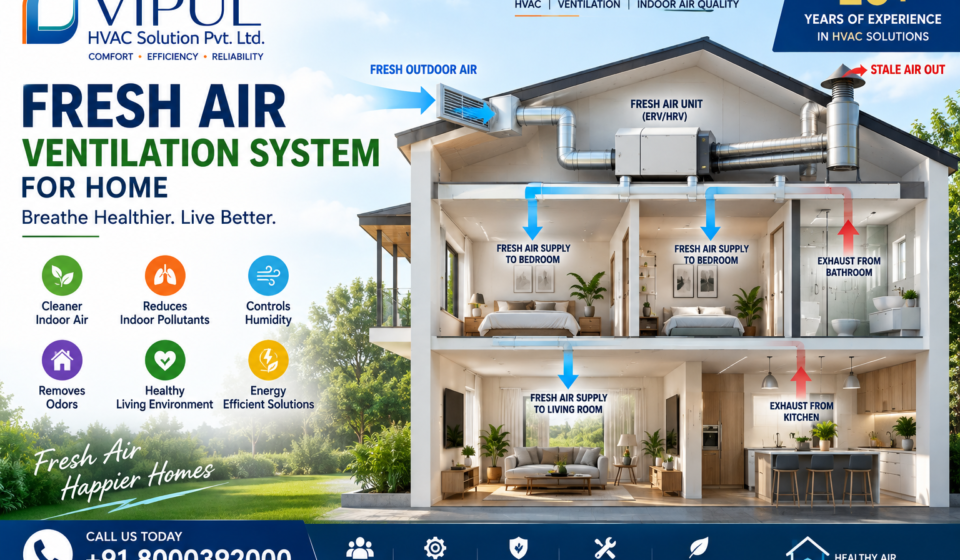
Outdoor Air → Filter → Fresh-Air Unit → Ductwork → Rooms → Return/Exhaust → Outdoor
The exact arrangement depends on the home’s size, layout, occupancy, climate and ventilation requirements.
ASHRAE’s residential ventilation standard, ANSI/ASHRAE Standard 62.2-2025, addresses minimum requirements for mechanical ventilation, local exhaust and source-control measures intended to provide acceptable indoor air quality in dwelling units.
Why Does Your Home Need Fresh Air Ventilation?
Modern homes are often designed to be relatively airtight for energy efficiency and comfort. While this can reduce uncontrolled air leakage, it also means that relying only on natural infiltration may not provide sufficient ventilation.
Indoor air can contain pollutants generated by:
- Cooking
- Cleaning products
- Furniture and building materials
- Dust
- Smoke
- Occupants
- Moisture
- Outdoor pollutants entering the building
The U.S. EPA recommends three broad strategies for improving indoor air quality: source control, adequate ventilation, and filtration/air cleaning.
Benefits of a Fresh Air Ventilation System at Home
1. Brings Fresh Outdoor Air Inside
The primary purpose is to replace some stale indoor air with appropriately treated outdoor air.
This is particularly useful in homes where doors and windows remain closed for long periods.
2. Helps Reduce Indoor Pollutants
Proper ventilation can help dilute and remove indoor-generated pollutants.
Depending on the system and filtration provided, it can support the management of:
- Dust
- Odors
- Smoke
- Cooking pollutants
- Excess moisture
- Certain airborne particles
Ventilation should complement, rather than replace, source control and suitable filtration.
3. Helps Control Odors
Kitchen, bathroom and other household activities can generate unpleasant odors.
A properly designed exhaust and fresh-air system can help move contaminated or odorous air outdoors while supplying replacement air.
4. Helps Manage Humidity
Moisture from cooking, bathing and daily activities can increase indoor humidity.
Proper ventilation can help remove moisture-laden air, although ventilation alone may not be sufficient in every climate; dedicated dehumidification may sometimes be required.
5. Supports Better Indoor Air Quality
Good ventilation is one component of an overall IAQ strategy.
ASHRAE identifies residential ventilation as an important part of achieving acceptable indoor air quality, alongside other measures such as source control and filtration.
Fresh Air Ventilation vs Air Conditioner
Many homeowners assume that an AC automatically provides enough fresh air. That is not necessarily true.
| Feature | Air Conditioner | Fresh Air Ventilation System |
|---|---|---|
| Primary purpose | Cooling/heating | Air exchange |
| Removes indoor stale air | Usually not the main function | Yes |
| Introduces outdoor air | Depends on system | Yes |
| Temperature control | Yes | Depends on system |
| Filtration | Usually available | Can include filtration |
| Humidity management | Often | Depends on system |
| Indoor air quality | Supports comfort | Directly addresses ventilation |
A home’s HVAC system can therefore require both temperature control and properly designed ventilation.
Types of Fresh Air Ventilation Systems for Homes
Different homes require different ventilation strategies.
1. Fresh Air Supply System
A supply ventilation system introduces filtered outdoor air into selected areas of the home.
It can be suitable when the design requires controlled fresh-air delivery.
2. Exhaust Ventilation System
Exhaust systems remove indoor air from areas such as:
- Bathrooms
- Kitchens
- Utility rooms
- Other moisture- or odor-producing spaces
Bathroom and kitchen exhaust are important components of residential ventilation planning.
3. Balanced Ventilation System
A balanced system combines:
Fresh-Air Supply + Stale-Air Exhaust
This provides a more controlled approach to air exchange.
For larger or better-sealed homes, balanced ventilation can be considered where the design requires controlled supply and exhaust airflow.
4. Energy Recovery Ventilator (ERV)
An ERV exchanges heat and moisture between incoming and outgoing air streams through an energy-recovery process.
This can help reduce the conditioning burden associated with bringing outdoor air into the building.
VIPUL lists Energy Recovery Ventilators (ERV) among its residential indoor-air-quality solutions.
5. Heat Recovery Ventilator (HRV)
An HRV transfers sensible heat between outgoing and incoming air streams while keeping the two airflows separated.
HRV and ERV selection depends on the home’s climate, humidity conditions and project requirements.
Fresh Air Ventilation System With AC
One of the most effective approaches for a modern home can be to integrate ventilation with the air-conditioning system.
For example:
Outdoor Air
↓
Fresh Air Intake
↓
Filter
↓
Fresh Air / Energy Recovery Unit
↓
Ductwork
↓
Living Room + Bedrooms + Other Areas
At the same time:
Kitchen/Bathroom/Stale Areas
↓
Exhaust Duct
↓
Exhaust Fan
↓
Outdoor
The final design should be based on airflow requirements, room usage, pressure relationships and the home’s HVAC configuration.
Fresh Air Ventilation System Components
A residential fresh-air system can include several components.
Fresh Air Intake
Brings outdoor air into the ventilation system.
Filters
Filters can remove selected airborne particles before fresh air enters the home.
Fresh Air Unit
Conditions or distributes outdoor air according to the system design.
Exhaust Fans
Remove stale, humid or contaminated air.
Ductwork
Carries supply and exhaust air between the ventilation equipment and rooms.
Dampers
Help control airflow through different sections of the system.
Grilles & Diffusers
Distribute or extract air from individual spaces.
Sensors & Controls
Advanced systems may use sensors and controls for automated operation.
VIPUL’s ventilation portfolio includes fresh-air handling units, fans, filters, dampers, heat-recovery systems and VAV-related solutions.
Where Should Fresh Air Enter a Home?
Fresh-air distribution should be planned carefully.
Potential supply locations can include:
- Living rooms
- Bedrooms
- Family rooms
- Study rooms
- Other occupied spaces
Exhaust is commonly concentrated in areas where moisture, odors or pollutants are generated, such as:
- Bathrooms
- Kitchens
- Utility areas
The exact airflow pattern should be determined during HVAC design.
How Much Fresh Air Does a Home Need?
There is no single fresh-air quantity that is suitable for every home.
Required ventilation depends on factors such as:
- Floor area
- Number of occupants
- Number of bedrooms
- Building airtightness
- Room usage
- Local climate
- Existing exhaust systems
- Indoor pollutant sources
- Applicable local codes and standards
ASHRAE Standard 62.2-2025 is the current residential ventilation and acceptable-IAQ standard listed by ASHRAE.
For this reason, homeowners should avoid selecting a ventilation fan simply based on the lowest price or highest advertised airflow.
Fresh Air Ventilation for Apartments
Apartments often have limited opportunities for natural cross-ventilation.
A mechanical ventilation solution can help provide controlled outdoor-air supply and stale-air removal.
It can be particularly useful for:
- High-rise apartments
- Luxury apartments
- Modern sealed homes
- Homes with central AC
- Homes with limited window opening
- Bedrooms with prolonged occupancy
The system must be designed around the building’s structure, available shaft/duct space and applicable building requirements.
Fresh Air Ventilation for Villas & Bungalows
Large villas can benefit from a properly zoned ventilation strategy.
A customized system can potentially serve:
- Bedrooms
- Living rooms
- Dining areas
- Home offices
- Kitchens
- Bathrooms
- Utility areas
For a new villa, ventilation ducts are generally easier to integrate when planned during the architectural and HVAC design stage.
Fresh Air Ventilation for Homes With Central AC
If your home already has ducted AC, fresh-air ventilation can potentially be integrated with the existing HVAC arrangement.
A professional design can coordinate:
- Outdoor-air intake
- Filtration
- Fresh-air unit
- AC system
- Supply ducts
- Return air
- Exhaust
- Controls
This can provide a more integrated approach to cooling + ventilation + indoor air quality.
Can a Fresh Air System Work With a Split AC?
Yes, a separate fresh-air ventilation system can be used alongside split AC systems.
A typical arrangement might be:
Split AC → Temperature Control
Fresh-Air System → Outdoor-Air Ventilation
Exhaust Fan → Stale-Air Removal
The ventilation system and AC should be coordinated so that the introduction of outdoor air does not create unnecessary cooling or humidity loads.
Fresh Air Ventilation and Energy Efficiency
A common concern among homeowners is:
“Won’t bringing outdoor air inside increase my AC electricity consumption?”
It can increase the cooling/heating load because outdoor air must often be conditioned. However, the overall impact depends on the system design, airflow rate, climate and controls.
Energy recovery ventilation can reduce the conditioning penalty by transferring energy between outgoing and incoming air streams.
Therefore, energy efficiency should be considered during the design stage rather than simply selecting the largest ventilation fan.
Fresh Air Ventilation System Maintenance
Like other HVAC equipment, ventilation systems require maintenance.
Important maintenance activities include:
- Filter inspection
- Filter replacement
- Fan inspection
- Duct inspection
- Damper inspection
- Cleaning of accessible components
- Checking airflow
- Checking unusual noise or vibration
- Inspecting outdoor-air intake
- Testing controls
Dirty filters can restrict airflow and reduce system performance.
VIPUL provides HVAC maintenance, ductwork cleaning and indoor-air-quality services as part of its HVAC service portfolio.
Common Mistakes When Installing Home Ventilation
Mistake 1: Choosing Only by Fan Size
A larger fan does not automatically mean better ventilation.
The airflow should match the building’s actual requirements.
Mistake 2: Ignoring Filtration
Outdoor air may contain dust and particulate matter, so filtration should be considered where appropriate.
Mistake 3: Poor Duct Design
Improper duct sizing can cause:
- Noise
- High pressure losses
- Poor airflow
- Uneven ventilation
- Higher energy consumption
Mistake 4: No Exhaust Strategy
Simply supplying outdoor air without considering stale-air removal may not provide the desired ventilation pattern.
Mistake 5: Ignoring Outdoor Air Quality
When outdoor pollution is high, bringing untreated outdoor air inside may be counterproductive. EPA specifically notes that ventilation strategies should consider outdoor air conditions.
Mistake 6: No Maintenance Plan
Filters, fans and ducts need periodic inspection and maintenance.
How to Choose the Best Fresh Air Ventilation System for Home
Before selecting a system, consider these factors:
1. Home Size
Larger homes generally require more carefully planned airflow distribution.
2. Number of Occupants
Occupancy affects ventilation requirements.
3. Climate
Hot and humid climates may require additional consideration of cooling and moisture loads.
4. Outdoor Air Quality
Filtration and air-treatment requirements depend partly on outdoor conditions.
5. Existing AC System
The ventilation system should be compatible with your current HVAC arrangement.
6. Duct Space
New construction provides greater flexibility for concealed ductwork.
7. Noise Requirements
Fans and airflow components should be selected and installed with acoustic performance in mind.
8. Energy Consumption
Energy-efficient fans, controls and heat/energy recovery can help reduce operating costs.
Why Choose VIPUL HVAC Solution for Fresh Air Ventilation?
VIPUL HVAC Solution Pvt. Ltd. provides engineered ventilation and indoor-air-quality solutions for residential, commercial and industrial applications. Its ventilation offering includes fresh-air handling units, exhaust and supply fans, heat-recovery systems, filters, dampers, noise-control measures and customized energy-efficient designs.
The company also provides indoor-air-quality solutions including fresh-air ventilation units, ERV, HRV, filtration, humidity control and IAQ monitoring options.
Key advantages include:
- Customized ventilation design
- Fresh-air ventilation
- Exhaust ventilation
- Supply ventilation
- Balanced ventilation
- ERV / HRV solutions
- Filtration
- Ductwork solutions
- Airflow testing and balancing
- HVAC integration
- Indoor air-quality solutions
- Residential HVAC expertise
- Commercial and industrial ventilation capability
- HVAC maintenance and support
VIPUL also states that it has 26+ years of HVAC experience and provides HVAC solutions for residential, commercial and industrial projects.
Fresh Air Ventilation System: Simple Example
Consider a modern 3-bedroom home where windows remain closed because the family uses air conditioning throughout the day.
Without a planned ventilation strategy:
Indoor air → accumulates pollutants/moisture → stale air
With a properly designed system:
Outdoor air → filtration → fresh-air unit → bedrooms/living areas
and:
Bathrooms/kitchen → exhaust → outdoors
This creates a controlled air-exchange strategy rather than depending entirely on random infiltration.
Frequently Asked Questions
What is a fresh air ventilation system for home?
It is a mechanical system that introduces outdoor air into a home while removing stale indoor air. Depending on the design, it can include filtration, exhaust, heat/energy recovery and controlled air distribution.
Is fresh air ventilation necessary in a home?
The need depends on the home’s construction, ventilation characteristics, occupancy, climate and applicable requirements. Modern, tightly enclosed homes can benefit from properly designed mechanical ventilation.
Does a fresh air ventilation system cool the home?
Not necessarily. Its primary function is ventilation. A system may condition incoming outdoor air, but dedicated air conditioning is generally responsible for primary space cooling.
Can fresh air ventilation work with split AC?
Yes. A separate ventilation system can operate alongside split AC units, provided the airflow, cooling load and system controls are properly coordinated.
Is fresh air ventilation useful in an apartment?
Yes, particularly where natural ventilation is limited or windows remain closed for extended periods. The system should be designed according to the apartment’s layout and building constraints.
Does fresh air ventilation reduce indoor odors?
Properly designed ventilation can help remove or dilute odors, especially when exhaust is located near odor-generating areas such as kitchens and bathrooms.
Does fresh air ventilation remove dust?
Ventilation itself does not remove every pollutant. However, appropriately selected filtration on incoming air can reduce certain airborne particles.
What is the difference between ERV and HRV?
Both recover energy between outgoing and incoming air streams. An HRV primarily transfers sensible heat, while an ERV transfers sensible heat plus some moisture, making ERV selection particularly relevant where humidity is an important design consideration.
How often should fresh-air filters be changed?
There is no universal replacement interval. Filter life depends on filter type, outdoor air quality, operating hours and pollutant loading. The filter should be inspected regularly and replaced according to its condition and manufacturer/design recommendations.
Does VIPUL HVAC Solution provide fresh-air ventilation for homes?
Yes. VIPUL lists fresh-air ventilation units, ERV, HRV and customized ventilation solutions for residential applications among its indoor-air-quality offerings.
How can I get a fresh-air ventilation system designed for my home?
A professional HVAC evaluation can consider your home’s floor area, occupancy, room layout, existing AC system, outdoor-air conditions and ventilation requirements before recommending the appropriate solution.
Conclusion
A fresh air ventilation system for home is an important part of modern indoor-air-quality planning. It helps bring outdoor air into occupied spaces while removing stale air, odors and excess moisture, and it can work alongside air conditioning, filtration and humidity-control systems.
The right solution is not simply the biggest fan or the cheapest ventilation unit. Airflow calculation, filtration, duct design, exhaust strategy, noise control, energy efficiency and maintenance should all be considered.
VIPUL HVAC Solution Pvt. Ltd. provides customized fresh-air ventilation, exhaust, supply, balanced ventilation, ERV/HRV, filtration, ductwork and indoor-air-quality solutions for residential applications. With 26+ years of HVAC experience, VIPUL can help homeowners plan ventilation solutions based on their specific building and comfort requirements.
📞 Planning Fresh Air Ventilation for Your Home?
VIPUL HVAC SOLUTION PVT. LTD.
Call: +91 8000392000
Email: info@vipulhvacsolution.in
Important Link:
- Fresh air ventilation system for home
- Home fresh air ventilation system
- Fresh air system for home
- Fresh air ventilation for house
- Residential fresh air ventilation
- Fresh air ventilation system
- Home ventilation system
- Fresh air HVAC system
- Fresh air unit for home
- Residential ventilation system
- Fresh air system with AC
- ERV ventilation system for home
- HRV ventilation system for home
- Home indoor air quality
- Fresh air ventilation installation