
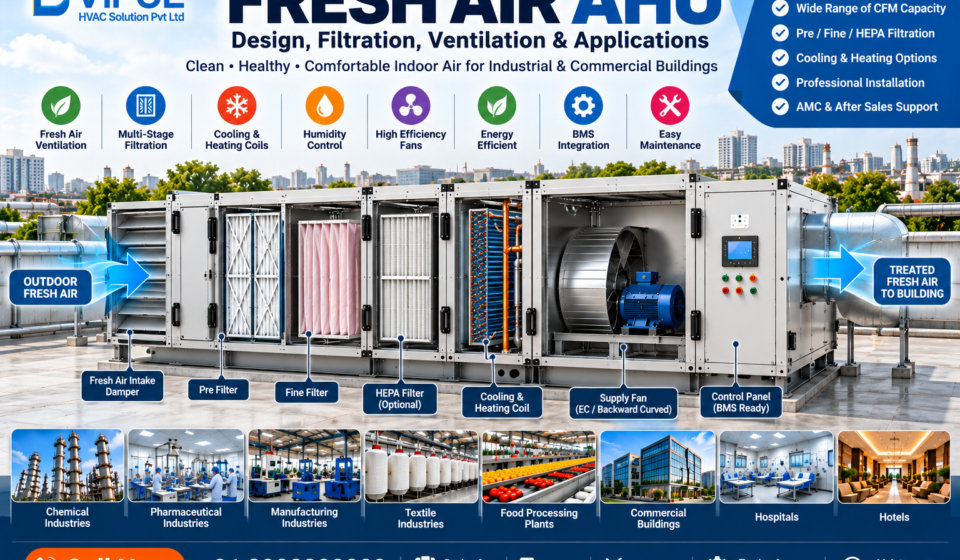

Fresh Air AHU: Design, Filtration, Ventilation & Applications
A Fresh Air AHU (Air Handling Unit) is an important HVAC solution for buildings and industrial facilities that require controlled outdoor-air ventilation, filtration, cooling, humidity management and air distribution.
Unlike a conventional air-conditioning system that primarily focuses on temperature control, a Fresh Air AHU is designed to introduce treated outdoor air into an indoor environment. Depending on the project, the system can filter incoming air, cool or heat it, control humidity and distribute the conditioned fresh air through ductwork.
A typical fresh-air system can be represented as:
Outdoor Air → Filter → Cooling/Heating → Fan → Supply Duct → Conditioned Space
The exact configuration depends on occupancy, building use, outdoor-air requirement, indoor-air-quality objectives, climate, filtration requirements and HVAC design.
VIPUL HVAC SOLUTION PVT. LTD. provides AHU and fresh-air HVAC solutions for commercial, industrial and institutional applications, including customized AHUs, filtration, cooling/heating coils, treated fresh-air units, air distribution, installation, commissioning and maintenance. Vipulhvac Solution
What Is a Fresh Air AHU?
A Fresh Air AHU, also called a Fresh Air Handling Unit (FAHU) or Treated Fresh Air Unit in some applications, is an HVAC unit designed primarily to condition outdoor air before supplying it to a building or process area.
The unit can include:
- Fresh-air intake
- Dampers
- Pre-filters
- Fine filters
- HEPA filters where required
- Cooling coils
- Heating coils
- Supply fans
- Motors
- Humidity-control components
- Sensors
- Control systems
- VFDs
- BMS integration
- Drain trays
- Insulated casing
VIPUL HVAC’s published AHU range includes treated fresh-air handling units, filtration options, cooling and heating coils, EC and backward-curved fans, controls and customized CFM configurations. Vipulhvac Solution
Fresh Air AHU vs Conventional AHU
Although both systems handle air, their design objectives can be different.
| Feature | Fresh Air AHU | Conventional AHU |
|---|---|---|
| Outdoor-air handling | Primary function | May be partial |
| Fresh-air treatment | Yes | Depending on design |
| Filtration | Required | Required |
| Cooling | Yes, where required | Yes |
| Heating | Application dependent | Application dependent |
| Humidity control | Often important | Application dependent |
| Fresh-air duct | Usually required | May be included |
| Indoor air quality | Major design consideration | Important |
| Energy recovery | Possible | Possible |
| Industrial applications | Excellent | Excellent |
A project may use a dedicated Fresh Air AHU together with conventional AHUs or FCUs, depending on the HVAC strategy.
Why Is Fresh Air AHU Important?
Modern buildings can remain closed for long periods, reducing natural air exchange. Mechanical ventilation can therefore play an important role in supplying outdoor air and managing indoor air quality.
A properly designed fresh-air system can help with:
1. Outdoor-Air Supply
It introduces controlled outdoor air into occupied or process areas.
2. Filtration
Incoming outdoor air can be filtered before entering the building.
3. Temperature Control
Cooling or heating coils can condition the incoming air.
4. Humidity Management
Depending on the design, the AHU can help manage excessive moisture or provide humidification where required.
5. Indoor Air Quality
Proper ventilation and filtration can contribute to better indoor-air-quality management.
6. Building Pressurization
Fresh-air systems can be incorporated into pressure-control strategies where required.
VIPUL HVAC’s fresh-air ventilation solutions similarly focus on outdoor-air supply, filtration, humidity management, exhaust and HVAC integration. Vipulhvac Solution
Fresh Air AHU Design: Important Parameters
Fresh Air AHU design should be based on engineering calculations rather than simply selecting an AHU according to building size.
Important parameters include:
- Required fresh-air CFM
- Number of occupants
- Room usage
- Outdoor-air conditions
- Indoor design temperature
- Indoor relative humidity
- Cooling load
- Heating requirement
- Air changes
- Filtration level
- Static pressure
- Duct pressure losses
- Fan efficiency
- Coil capacity
- Fresh-air percentage
- Exhaust-air quantity
- Building pressure
- Operating hours
- Control requirements
VIPUL HVAC’s published AHU guidance identifies airflow, outdoor air, space pressure, coil capacity, filtration and fan pressure capability as important AHU selection parameters. Vipulhvac Solution
Fresh Air AHU Airflow Design
One of the first steps in designing a Fresh Air AHU is determining the required airflow.
The required airflow may depend on:
Occupancy + ventilation requirement + application + air-change requirement + process requirements
For example, a pharmaceutical facility may have substantially different ventilation and filtration requirements from a conventional office.
Similarly:
- Hospitals require application-specific ventilation.
- Pharmaceutical facilities may require controlled pressure and filtration.
- Industrial facilities may require process ventilation.
- Hotels may require ventilation for guest rooms and common areas.
- Restaurants require specialized kitchen exhaust and make-up air strategies.
Therefore, the fresh-air CFM should be calculated based on the actual application.
Fresh Air AHU Filtration
Filtration is a major part of Fresh Air AHU design.
Outdoor air can contain:
- Dust
- Particulate matter
- Pollen
- Dirt
- Industrial pollutants
- Other airborne contaminants
The filtration arrangement should therefore be selected according to the outdoor environment and indoor application.
Common AHU Filtration Stages
Pre-Filter
The pre-filter provides the first stage of particulate protection and helps protect downstream components.
Fine Filter
Fine filtration provides a higher level of particulate removal than a basic pre-filter.
HEPA Filter
HEPA filtration may be specified for applications requiring high-efficiency particulate filtration, such as certain healthcare, pharmaceutical and cleanroom environments.
The exact filter specification should be based on the project’s air-quality requirements and applicable standards.
VIPUL HVAC’s published AHU offering includes pre-, fine- and HEPA-filtration options depending on application requirements. Vipulhvac Solution
Why Filter Pressure Drop Matters
A filter does not simply remove particles; it also creates resistance to airflow.
As filters become loaded with dust, their pressure drop can increase.
This can affect:
- Airflow
- Fan energy consumption
- System performance
- Indoor comfort
- Operating cost
Therefore, an effective Fresh Air AHU maintenance program should include regular filter inspection and replacement.
Fresh Air AHU Cooling System
In many Indian applications, outdoor air must be cooled before entering the conditioned space.
A cooling coil can reduce the temperature of incoming outdoor air.
The cooling system may use:
Chilled Water
A chilled-water AHU receives chilled water from a central chiller plant.
DX Cooling
A DX system uses refrigerant directly through the cooling coil.
The selection depends on:
- Project size
- Cooling load
- Existing HVAC infrastructure
- Energy strategy
- Operating conditions
- Maintenance requirements
Fresh Air AHU Humidity Control
Humidity can significantly affect indoor comfort, equipment, materials and industrial processes.
A Fresh Air AHU can be designed to help manage humidity through:
- Cooling and dehumidification
- Reheat where appropriate
- Humidification where required
- Airflow control
- Temperature control
- Dedicated fresh-air treatment
Humidity requirements are particularly important in:
- Pharmaceutical facilities
- Textile industries
- Food-processing facilities
- Hospitals
- Laboratories
- Cleanrooms
- Certain manufacturing processes
Fresh Air AHU Ventilation System
A complete fresh-air ventilation system normally includes more than the AHU itself.
A typical arrangement can include:
Outdoor Air Intake → Damper → Filters → Cooling Coil → Supply Fan → Fresh-Air Duct → Diffusers → Occupied Space
The system may also include:
Indoor Air → Return/Exhaust → Exhaust Fan → Outdoor
Depending on the building, energy-recovery equipment, sensors, dampers and automated controls may also be integrated.
VIPUL HVAC’s ventilation solutions include fresh-air units, exhaust and supply fans, filters, dampers and heat-recovery systems as applicable to the project. Vipulhvac Solution
7 Major Applications of Fresh Air AHU
1. Pharmaceutical Industry
Pharmaceutical HVAC systems can require carefully controlled:
- Temperature
- Humidity
- Filtration
- Pressure
- Airflow
- Fresh-air supply
Fresh Air AHUs can form an important part of the overall HVAC strategy.
For controlled environments, the AHU should be engineered according to the specific process and cleanroom requirements.
2. Hospitals
Hospital ventilation requirements vary by space.
Examples include:
- Operating rooms
- ICUs
- Isolation rooms
- Patient rooms
- Laboratories
- Emergency departments
- General areas
Healthcare HVAC systems require application-specific consideration of ventilation, filtration, pressure and airflow. VIPUL HVAC also provides fresh-air ventilation solutions for healthcare applications. Vipulhvac Solution
3. Commercial Buildings
Fresh Air AHUs can be used in:
- Office buildings
- Shopping malls
- Corporate facilities
- Showrooms
- Business centers
- Institutional buildings
They can provide controlled outdoor air while the main HVAC system handles space cooling.
4. Hotels
Hotels have diverse ventilation requirements across:
- Guest rooms
- Lobbies
- Restaurants
- Banquet halls
- Conference rooms
- Corridors
- Service areas
Fresh-air treatment can therefore be integrated with the hotel’s overall HVAC design. Vipulhvac Solution
5. Manufacturing Plants
Industrial buildings may require fresh-air systems for:
- Employee areas
- Production areas
- Process support areas
- Control rooms
- Packaging areas
- Utility spaces
The system should consider heat generation, contaminants, dust, operating hours and process requirements.
6. Textile Industry
Textile manufacturing can require careful management of:
- Temperature
- Humidity
- Airflow
- Dust
- Process conditions
A properly designed AHU system can help maintain the required environmental conditions.
7. Food Processing Industry
Food-processing facilities can require controlled:
- Temperature
- Humidity
- Air cleanliness
- Ventilation
- Pressure
Fresh-air AHUs can be integrated with the facility’s overall HVAC and hygiene strategy.
Fresh Air AHU for Cleanrooms
Cleanrooms require specialized HVAC design.
The Fresh Air AHU may work with:
- Pre-filtration
- Fine filtration
- HEPA filtration
- Cooling coils
- Heating coils
- Humidity control
- Pressure control
- Air-change management
- BMS monitoring
The exact design depends on the required cleanroom classification, process and applicable standards.
A Fresh Air AHU should therefore not be treated as a generic ventilation unit for a cleanroom.
Fresh Air AHU for Data Centers
Data centers have high heat loads and operate continuously.
Their HVAC strategy primarily focuses on maintaining appropriate environmental conditions for IT equipment.
Fresh-air systems may be incorporated for specific ventilation, pressurization, filtration, energy-recovery or economization strategies, but outdoor air should not automatically replace the dedicated cooling system. Vipulhvac Solution
Energy Efficiency in Fresh Air AHU Design
Fresh-air treatment can consume significant energy because outdoor air must often be cooled or heated to indoor design conditions.
Energy efficiency can be improved through:
- Efficient fans
- EC fan technology
- VFD control
- Correct filter selection
- Low-pressure-drop components
- Proper duct design
- Heat/energy recovery where suitable
- Demand-controlled ventilation where applicable
- BMS integration
- Proper coil selection
- Regular filter maintenance
VIPUL HVAC’s published AHU solutions include EC and backward-curved fan options and BMS-ready controls. Vipulhvac Solution
Fresh Air AHU Components
A typical Fresh Air AHU may contain:
1. Fresh-Air Damper
Controls outdoor-air entry.
2. Filter Section
Removes airborne particles.
3. Cooling Coil
Cools and can dehumidify incoming air.
4. Heating Coil
Provides heating where required.
5. Fan Section
Moves air through the system.
6. Motor
Provides mechanical power to the fan.
7. Drain Pan
Collects condensate produced during cooling/dehumidification.
8. Sensors
Monitor temperature, pressure, humidity and other operating conditions.
9. Controls
Automate system operation.
10. BMS Integration
Allows centralized monitoring and control where required.
Fresh Air AHU Installation Process
A professional installation normally involves several stages.
Step 1: Site Survey
Evaluate:
- AHU location
- Equipment access
- Structural requirements
- Duct routes
- Piping
- Electrical requirements
Step 2: AHU Positioning
Install the AHU with appropriate access for inspection and maintenance.
Step 3: Duct Connection
Connect fresh-air and supply-air ductwork according to the approved design.
Step 4: Piping
Complete chilled-water, condensate and other required connections.
Step 5: Electrical Work
Connect:
- Power
- Motor
- VFD
- Sensors
- Control panel
Step 6: Testing
Check airflow, temperature, pressure, fan operation and controls.
Step 7: Air Balancing
Measure and adjust airflow according to design requirements.
Step 8: Commissioning
Verify the complete system before handover.
VIPUL HVAC’s published AHU services include installation, testing, commissioning, duct and air-distribution design and maintenance planning. Vipulhvac Solution
Fresh Air AHU Maintenance
Regular maintenance is essential for reliable performance.
A preventive maintenance program can include:
- Filter inspection
- Filter replacement
- Coil cleaning
- Fan inspection
- Motor inspection
- Belt inspection where applicable
- Bearing inspection where applicable
- Drain-pan cleaning
- Drain-line inspection
- Damper inspection
- Sensor calibration
- Electrical inspection
- Vibration checking
- Airflow measurement
- Static-pressure checking
Poor filter or coil maintenance can increase airflow resistance and affect system performance.
How to Select the Right Fresh Air AHU Supplier
Before selecting a supplier, evaluate:
Technical Expertise
Can the supplier perform airflow and cooling calculations?
Customized Design
Can the AHU be configured according to the application?
Filtration
Can the supplier provide the required filtration stages?
Installation
Does the company provide professional installation?
Testing & Commissioning
Will the system be tested and balanced?
Maintenance
Is AMC and preventive maintenance available?
HVAC Integration
Can the system integrate with chillers, ductwork, controls and BMS?
These factors are generally more important than simply comparing the initial equipment price.
Why Choose VIPUL HVAC SOLUTION PVT. LTD.?
VIPUL HVAC SOLUTION PVT. LTD. provides complete HVAC engineering and project-support solutions for industrial, commercial and institutional applications.
For Fresh Air AHU projects, the company can support:
- Fresh Air AHU selection
- Customized AHU design
- CFM requirements
- Filtration selection
- Cooling and heating coils
- EC and backward-curved fans
- Treated fresh-air units
- Duct and air-distribution design
- HVAC controls
- BMS-ready solutions
- Installation
- Testing
- Commissioning
- Maintenance
- AMC
These capabilities are consistent with the company’s published AHU and fresh-air HVAC information. Vipulhvac Solution
Complete Project Approach
Site Survey → HVAC Design → Fresh Air Calculation → AHU Selection → Supply → Installation → Ducting → Testing → Air Balancing → Commissioning → AMC
This integrated approach can make it easier for clients to manage a complete HVAC project through one experienced HVAC partner.
Fresh Air AHU Cost
There is no single fixed price for a Fresh Air AHU.
The final cost depends on:
- Fresh-air CFM
- Cooling capacity
- Heating requirement
- AHU casing
- Filter stages
- HEPA filtration
- Fan type
- Motor
- Coil specification
- Static pressure
- Controls
- VFD
- BMS integration
- Ductwork
- Installation
- Testing and commissioning
- Project location
For this reason, a technical AHU selection and project requirement assessment should be completed before preparing a quotation.
What Information Is Needed for a Fresh Air AHU Quotation?
For an accurate quotation, provide:
- Project location
- Application
- Required fresh-air CFM
- Room size
- Occupancy
- Indoor temperature
- Indoor humidity
- Outdoor design conditions
- Filtration requirement
- Cooling requirement
- Heating requirement
- Static pressure
- Duct length
- Chilled-water or DX requirement
- BMS/control requirement
- Number of AHUs
- Installation requirements
Providing these details helps the HVAC engineer select an appropriately sized system.
Frequently Asked Questions
What is a Fresh Air AHU?
A Fresh Air AHU is an air-handling system designed primarily to take outdoor air, filter it, condition it and supply it into a building or process area.
What is FAHU?
FAHU means Fresh Air Handling Unit. It is commonly used for treating outdoor air before supplying it to occupied or process spaces.
What is the difference between AHU and FAHU?
An AHU can handle return air, mixed air and/or outdoor air depending on the design. A FAHU is primarily designed to handle and condition outdoor fresh air.
Does a Fresh Air AHU cool air?
Yes. Where cooling is required, a Fresh Air AHU can use a chilled-water or DX cooling coil to condition outdoor air.
Does a Fresh Air AHU require filters?
Yes. Filtration is an important part of fresh-air treatment. The number and type of filters depend on outdoor-air quality and application requirements.
Can HEPA filters be used in a Fresh Air AHU?
Yes, HEPA filtration can be incorporated where the application requires high-efficiency particulate filtration. The complete filtration design should be based on the project’s requirements.
Can Fresh Air AHU control humidity?
It can be designed to help control humidity through cooling/dehumidification and, where required, humidification or other humidity-control methods.
Where are Fresh Air AHUs used?
They can be used in offices, hospitals, pharmaceutical facilities, cleanrooms, hotels, manufacturing plants, textile industries, food-processing facilities and other commercial or industrial buildings.
Can Fresh Air AHU be connected to a chiller?
Yes. A chilled-water Fresh Air AHU can be connected to a central chiller plant.
Does VIPUL HVAC provide Fresh Air AHU installation?
Yes. VIPUL HVAC provides AHU-related design, supply, installation, testing, commissioning and maintenance support according to project requirements. Vipulhvac Solution
Conclusion
A Fresh Air AHU is much more than a fan and filter. It is an engineered HVAC system that can combine outdoor-air ventilation, filtration, cooling, heating, humidity control, air distribution and automation.
The correct design should consider fresh-air quantity, cooling load, filtration, static pressure, indoor conditions, energy efficiency, ductwork and maintenance.
For industrial, pharmaceutical, healthcare, commercial and institutional projects, choosing an experienced HVAC partner can help ensure that the Fresh Air AHU works as part of the complete ventilation and air-conditioning system.
VIPUL HVAC SOLUTION PVT. LTD. provides Fresh Air AHU and complete HVAC solutions with design, supply, installation, commissioning and maintenance support.
Need Fresh Air AHU for Your Project?
Call VIPUL HVAC SOLUTION PVT. LTD.
📞 +91 8000392000
Fresh Air AHU | FAHU | AHU | HVAC Design | Filtration | Ventilation | Installation | Commissioning | AMC
Important Links:
- AHU Supplier in India
- AHU Supplier in Gujarat
- AHU Supplier in Bharuch
- AHU Supplier in Ankleshwar
- AHU Supplier in Surat
- AHU Supplier in Ahmedabad
- AHU Supplier in Vadodara
- Fresh Air Ventilation System for Office
- Fresh Air Ventilation System for Hospital
- Fresh Air Ventilation System for Hotel
- HVAC Turnkey Services Gujarat
- AHU Contractor in Gujarat



[…] Fresh Air AHU: Design, Filtration & Applications […]