

Fresh Air Ventilation System for Hotel: Complete Guide for Healthy, Comfortable & Energy-Efficient Hotels
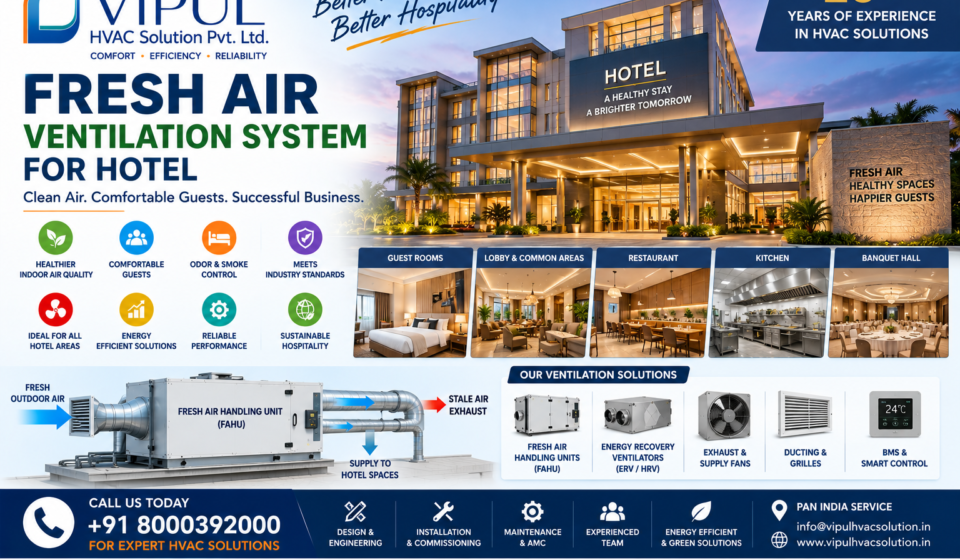
A fresh air ventilation system for hotel is an essential part of modern hotel HVAC design. It continuously introduces appropriate outdoor air into guest rooms and common areas while removing stale, humid, odorous or contaminated air. Unlike ordinary air conditioning, which primarily controls temperature, a properly designed ventilation system addresses fresh-air supply, exhaust, indoor air quality, humidity and air circulation.
For hotels, ventilation requirements can vary significantly between guest rooms, restaurants, kitchens, corridors, lobbies, banquet halls, conference rooms, bathrooms and service areas. ANSI/ASHRAE Standard 62.1-2025 specifies minimum ventilation rates and other measures intended to provide acceptable indoor air quality in commercial and institutional buildings, along with requirements covering ventilation-system design, installation, commissioning, operation and maintenance.
VIPUL HVAC Solution Pvt. Ltd. provides engineered ventilation systems for residential, commercial and industrial applications, including fresh-air handling units, exhaust and supply fans, heat-recovery systems, filters, dampers, VAV systems and customized energy-efficient ventilation solutions.
What Is a Fresh Air Ventilation System for a Hotel?
A hotel fresh-air ventilation system is a mechanical system designed to:
- Bring outdoor air into occupied areas
- Remove stale indoor air
- Control odors
- Help manage humidity
- Support indoor air quality
- Provide appropriate ventilation to occupied spaces
- Integrate with the hotel’s HVAC system
A simplified airflow arrangement is:
Outdoor Air → Fresh-Air Intake → Filter → FAHU/AHU/ERV → Ductwork → Hotel Spaces
At the same time:
Hotel Spaces → Return/Exhaust → Exhaust System → Outdoor
The exact design depends on the hotel size, occupancy, climate, building layout, HVAC system and applicable codes and standards.
Why Does a Hotel Need Fresh Air Ventilation?
Hotels have unique ventilation requirements because people may occupy the building 24 hours a day, and different areas have dramatically different uses.
For example:
- Guest rooms require comfortable and quiet ventilation.
- Restaurants require ventilation for occupants and odors.
- Kitchens require dedicated exhaust.
- Bathrooms require exhaust.
- Banquet halls may have high and changing occupancy.
- Lobbies need continuous ventilation.
- Laundry areas may generate heat and humidity.
- Conference rooms may experience high occupancy for several hours.
ASHRAE identifies ventilation and acceptable indoor air quality as key considerations for commercial buildings and includes requirements for ventilation, filtration, controls, air cleaning and building operation and maintenance.
Benefits of a Fresh Air Ventilation System in Hotels
1. Improves Indoor Air Quality
A properly designed ventilation system introduces outdoor air and removes indoor-generated pollutants.
It can help manage:
- Stale air
- Odors
- Excess moisture
- Cooking-related pollutants
- Occupancy-related contaminants
- Certain airborne particles when suitable filtration is provided
Ventilation is only one part of an IAQ strategy; filtration and pollutant-source control should also be considered.
2. Provides Fresh Air to Guest Rooms
Guest rooms may remain occupied for many hours with doors and windows closed.
A controlled ventilation system can provide outdoor air without requiring guests to keep windows open.
This can be especially useful in hotels located in:
- Busy urban areas
- Hot climates
- Humid climates
- High-pollution environments
- Areas with significant outdoor noise
3. Helps Control Hotel Odors
Hotels have numerous potential odor sources.
These include:
- Restaurants
- Kitchens
- Bathrooms
- Laundry rooms
- Waste-storage areas
- Service areas
Dedicated exhaust and properly positioned outdoor-air supply can help prevent unwanted odors from spreading between zones.
4. Helps Manage Humidity
Hotels can experience significant moisture loads from:
- Bathrooms
- Showers
- Kitchens
- Swimming pools
- Laundry
- High occupancy
Ventilation can assist with moisture removal, although dedicated dehumidification may be necessary in hot and humid climates.
5. Supports Guest Comfort
Guest comfort is one of the most important considerations in hotel HVAC design.
Ventilation should be designed so that guests receive fresh air without excessive:
- Drafts
- Noise
- Temperature variation
- Odors
- Air movement
Fresh Air Ventilation vs Hotel Air Conditioning
A common misconception is that the hotel’s air-conditioning system automatically provides sufficient outdoor air.
That depends on the HVAC system design.
| Feature | Hotel Air Conditioning | Fresh Air Ventilation |
|---|---|---|
| Primary function | Cooling/heating | Outdoor-air exchange |
| Outdoor-air supply | Depends on system | Main function |
| Stale-air removal | Not normally the primary function | Yes |
| Temperature control | Yes | May be integrated |
| Filtration | Usually | Can be included |
| Humidity control | Depending on system | Depending on design |
| Odor control | Limited | Supports exhaust strategy |
| IAQ support | Yes | Major function |
The most effective hotel HVAC strategy often combines:
Cooling + Ventilation + Filtration + Exhaust + Humidity Control + Automation
Fresh Air Ventilation for Hotel Guest Rooms
Guest rooms require special attention because noise, comfort and air distribution are extremely important.
A typical arrangement can include:
Outdoor Air → Filter → Fresh-Air Unit → Supply Duct → Guest Room
and:
Bathroom → Exhaust Grille → Exhaust Duct → Outdoor
A properly designed guest-room ventilation system should consider:
- Room occupancy
- Room size
- Fresh-air requirement
- Exhaust requirement
- Air distribution
- Noise level
- Pressure relationships
- Door undercut/transfer arrangements where applicable
- Existing AC system
Fresh Air Ventilation for Hotel Lobby
Hotel lobbies are often large spaces with fluctuating occupancy.
A ventilation system may need to respond to:
- Guest traffic
- Reception areas
- Waiting areas
- Entrance-door opening
- Seasonal outdoor conditions
For larger hotels, ventilation can be integrated with an AHU or dedicated fresh-air handling unit.
Fresh Air Ventilation for Hotel Restaurant
Restaurants require careful ventilation planning because food preparation and high occupancy can generate:
- Heat
- Odors
- Smoke
- Grease
- Moisture
- Carbon dioxide
Restaurant ventilation should generally be designed separately from normal guest-room ventilation.
A professional system can include:
- Fresh-air supply
- Kitchen exhaust
- Exhaust hoods
- Make-up air
- Filtration
- Odor-control measures
- Air balancing
Fresh Air Ventilation for Hotel Kitchen
The hotel kitchen is one of the most demanding areas from a ventilation perspective.
A commercial kitchen may require dedicated systems for:
- Cooking exhaust
- Grease-laden air
- Heat removal
- Smoke removal
- Make-up air
- Fresh-air supply
A simplified concept is:
Kitchen → Exhaust Hood → Grease Exhaust Duct → Exhaust Fan → Outdoor
while:
Outdoor Air → Make-Up Air/Fresh-Air Unit → Kitchen
The exact design should follow the applicable local fire, building, mechanical and kitchen-ventilation requirements.
Fresh Air Ventilation for Hotel Bathrooms
Bathrooms require reliable exhaust to remove:
- Humidity
- Odors
- Moisture
Hotel bathrooms commonly use dedicated exhaust systems.
A basic airflow concept is:
Bathroom → Exhaust Grille → Exhaust Duct → Exhaust Fan → Outdoor
Proper exhaust can also help reduce moisture-related problems.
Fresh Air Ventilation for Hotel Corridors
Hotel corridors can require ventilation depending on the building design and applicable requirements.
A corridor ventilation strategy should consider:
- Guest-room doors
- Staircases
- Lift lobbies
- Fire/smoke-control strategy
- Pressurization requirements
- Fresh-air distribution
- Exhaust
Ventilation and smoke-control systems should be coordinated with the project’s fire and life-safety design.
Fresh Air Ventilation for Banquet Halls
Banquet halls can experience significant changes in occupancy.
For example:
Normal occupancy → Moderate ventilation requirement
Wedding/event → High occupancy
Empty hall → Lower ventilation requirement
This makes demand-controlled ventilation and appropriate controls potentially useful in larger facilities.
ASHRAE’s current 62.1-2025 standard includes demand-control ventilation control sequences among its updated requirements.
Fresh Air Ventilation for Hotel Conference Rooms
Conference rooms can become densely occupied during meetings.
A good design can consider:
- Maximum occupancy
- Room size
- Outdoor-air requirement
- CO₂ monitoring where appropriate
- Fresh-air supply
- Return/exhaust air
- Automatic controls
This can help maintain a more consistent indoor environment when occupancy changes.
Fresh Air Ventilation for Hotel Swimming Pool Areas
Swimming pool areas can have significant moisture loads.
Ventilation design may need to address:
- Humidity
- Condensation
- Chlorine-related air quality concerns
- Outdoor-air requirements
- Exhaust
- Dehumidification
A dedicated pool HVAC and dehumidification strategy may be necessary rather than relying on a standard hotel ventilation system.
Types of Fresh Air Ventilation Systems for Hotels
1. Fresh Air Handling Unit — FAHU
A Fresh Air Handling Unit (FAHU) is designed to process outdoor air before distributing it to the building.
Depending on the design, it may include:
- Filters
- Cooling coil
- Heating coil
- Fan
- Dampers
- Controls
- Humidity-control components
2. Air Handling Unit — AHU
AHUs can handle a combination of outdoor air and return air, depending on the system configuration.
They are widely used in larger hotels for:
- Lobbies
- Restaurants
- Banquet halls
- Corridors
- Common areas
3. Exhaust Ventilation
Exhaust systems remove unwanted indoor air from areas such as:
- Bathrooms
- Kitchens
- Laundry rooms
- Waste areas
- Service rooms
4. Supply Ventilation
Supply systems introduce outdoor air into designated areas.
5. Balanced Ventilation
A balanced system combines:
Fresh-Air Supply + Exhaust Air Removal
This allows more controlled air exchange.
6. Energy Recovery Ventilation
Energy-recovery systems can transfer energy between outgoing and incoming air streams.
They can potentially reduce the conditioning load associated with outdoor-air ventilation.
VIPUL provides heat-recovery and energy-efficient ventilation solutions.
Fresh Air Ventilation System Components for Hotels
A complete hotel ventilation system can include:
Fresh Air Handling Unit
Processes outdoor air before distribution.
Exhaust Fans
Remove stale or contaminated air.
Supply Fans
Deliver outdoor air to designated spaces.
Filters
Remove selected airborne particles.
Dampers
Control and balance airflow.
Ductwork
Transfers air throughout the building.
Diffusers & Grilles
Distribute or extract air.
Heat/Energy Recovery
Recovers energy between outgoing and incoming air streams where appropriate.
Sensors
Can monitor temperature, humidity, CO₂ or other parameters depending on the design.
BMS Controls
Can integrate ventilation equipment with the hotel’s building-management system.
Fresh Air Ventilation and Hotel HVAC Systems
A hotel’s ventilation system should not be designed independently of the air-conditioning system.
It needs to coordinate with:
VIPUL’s HVAC portfolio includes VRF/VRV systems, ducted and package air conditioning, AHUs, chillers, ductwork and ventilation systems.
Fresh Air Ventilation With VRF/VRV in Hotels
VRF/VRV systems are often considered for hotels because they can provide flexible zone control.
However, VRF/VRV primarily addresses space conditioning; fresh-air ventilation needs to be separately designed or integrated through appropriate equipment.
A typical strategy may be:
VRF/VRV → Room Temperature Control
Fresh-Air Unit → Outdoor-Air Supply
Bathroom Exhaust → Moisture/Odor Removal
This combination can provide a more complete hotel HVAC strategy.
Fresh Air Ventilation With Chiller & AHU Systems
Large hotels may use centralized chilled-water systems.
A typical arrangement can be:
Chiller → Chilled Water → AHU/FAHU → Conditioned Air
with:
Outdoor Air → FAHU/AHU → Hotel Spaces
This approach can be appropriate for large hotels with substantial common-area and guest-room cooling loads.
Fresh Air Ventilation and Energy Efficiency
One important concern is:
Does bringing outdoor air into a hotel increase energy consumption?
Outdoor air often needs to be cooled, heated or dehumidified, so ventilation does create an additional conditioning load.
However, energy consumption can be managed through:
- Heat recovery
- Energy recovery
- Variable-speed fans
- Demand-controlled ventilation
- Efficient motors
- Proper duct sizing
- Correct airflow calculation
- BMS automation
- Occupancy-based controls
- Regular maintenance
ASHRAE’s 62.1-2025 standard includes requirements covering ventilation-system controls and operation and maintenance in addition to ventilation and air-cleaning design.
BMS & Hotel Ventilation Automation
For medium and large hotels, integrating ventilation with a Building Management System (BMS) can provide better visibility and control.
Possible functions include:
- Fan start/stop
- Temperature monitoring
- Humidity monitoring
- CO₂ monitoring
- Filter-status monitoring
- Fault alarms
- Energy monitoring
- Schedule-based operation
- Variable-speed control
VIPUL provides BMS and HVAC automation capabilities including HVAC monitoring and control, energy tracking, alarm/fault detection and integration with systems such as VRF, chillers and AHUs.
Indoor Air Quality in Hotels
Hotel indoor air quality can be influenced by:
- High occupancy
- Cooking
- Cleaning products
- Furnishings
- Outdoor pollution
- Moisture
- Poor ventilation
- Improper filtration
- Inadequate maintenance
A good IAQ strategy should combine:
Source Control + Ventilation + Filtration + Humidity Control + Maintenance
Ventilation alone should not be considered a complete air-purification strategy.
How Much Fresh Air Does a Hotel Need?
There is no single fresh-air quantity that applies to every hotel.
The required outdoor airflow depends on:
- Hotel category
- Room type
- Occupancy
- Floor area
- Space usage
- Outdoor-air conditions
- HVAC system
- Applicable codes
- Applicable ventilation standards
- Building operating conditions
Guest rooms, restaurants, kitchens, bathrooms, banquet halls and corridors can all have different requirements.
For commercial hotel spaces, the applicable design approach should be based on the current project requirements and relevant standards such as ASHRAE 62.1-2025.
Common Mistakes in Hotel Fresh-Air Ventilation
Mistake 1: Treating Every Hotel Area the Same
Guest rooms, kitchens and banquet halls have different ventilation requirements.
Mistake 2: Relying Only on Air Conditioning
Cooling does not automatically mean adequate outdoor-air ventilation.
Mistake 3: Incorrect Fresh-Air Quantity
Too little ventilation may affect IAQ, while excessive outdoor air can increase energy consumption.
Mistake 4: Poor Duct Design
Poorly designed ducts can cause:
- Noise
- Pressure losses
- Uneven airflow
- Poor room ventilation
- Higher fan energy
Mistake 5: Ignoring Kitchen Exhaust
Kitchen ventilation requires specialized planning.
Mistake 6: Ignoring Humidity
High humidity can contribute to comfort problems and moisture-related building issues.
Mistake 7: Poor Maintenance
Dirty filters, blocked grilles and poorly maintained fans can reduce ventilation performance.
How to Choose the Best Fresh Air Ventilation System for a Hotel
Before selecting a system, consider:
1. Hotel Size
A 20-room hotel and a 300-room hotel require very different HVAC strategies.
2. Number of Guests
Occupancy directly influences ventilation requirements.
3. Hotel Facilities
Consider:
- Restaurants
- Kitchen
- Banquet hall
- Gym
- Spa
- Swimming pool
- Conference rooms
- Laundry
- Commercial kitchen
4. Existing HVAC System
Determine whether the property uses:
- VRF/VRV
- Chillers
- AHUs
- FCUs
- Ducted AC
- Package systems
5. Climate
Temperature and humidity strongly influence outdoor-air conditioning loads.
6. Outdoor Air Quality
The fresh-air intake and filtration strategy should account for local outdoor conditions.
7. Noise
Guest comfort requires careful acoustic consideration.
8. Energy Efficiency
Consider heat recovery, variable-speed fans and automated controls.
9. Maintenance
The system should be accessible for filter replacement, cleaning, inspection and repairs.
Why Choose VIPUL HVAC Solution for Hotel Ventilation?
VIPUL HVAC Solution Pvt. Ltd. provides engineered HVAC and ventilation solutions for commercial and institutional applications. The company’s ventilation solutions include fresh-air handling units, exhaust and supply fans, heat-recovery systems, filters, dampers, noise-control measures, axial fans, jet fans and VAV systems.
VIPUL’s broader HVAC portfolio includes:
- VRF / VRV Systems
- Chiller Systems
- Air Handling Units
- Ducted & Package Air Conditioning
- Ductwork Systems
- Ventilation Systems
- Indoor Air Quality Solutions
- BMS & HVAC Automation
- HVAC Maintenance & AMC
The company states that it provides HVAC solutions for commercial buildings, hospitals, factories, offices, malls and cleanroom environments, with 26+ years of HVAC experience.
Key advantages include:
- Customized ventilation design
- Hotel HVAC engineering
- Fresh-air systems
- FAHU/AHU solutions
- Exhaust systems
- Kitchen ventilation
- Ductwork design
- Filtration
- Heat/energy recovery
- Airflow testing and balancing
- HVAC integration
- BMS integration
- Maintenance and AMC support
Fresh Air Ventilation System for Hotel: Complete Airflow Concept
A simplified hotel ventilation strategy can look like this:
Guest Rooms
Fresh Air → FAHU/AHU → Guest Room
Bathroom → Exhaust → Outdoor
Lobby
Fresh Air → AHU → Lobby
Restaurant
Fresh Air → AHU/FAHU → Restaurant
Restaurant Exhaust → Exhaust System
Kitchen
Make-Up Air → Kitchen
Cooking Exhaust → Hood → Exhaust Fan → Outdoor
Banquet Hall
Fresh Air → AHU/FAHU → Banquet Hall
Return/Exhaust → HVAC System
The actual system should be engineered according to the hotel layout and project requirements.
Fresh Air Ventilation System Installation Process for Hotels
A professional hotel ventilation project can follow these stages:
Step 1 — Site Survey
Study the building, floor plans and existing HVAC infrastructure.
Step 2 — Occupancy Assessment
Determine expected occupancy for each area.
Step 3 — Ventilation Calculation
Calculate outdoor-air and exhaust requirements.
Step 4 — HVAC Integration
Coordinate ventilation with VRF, chiller, AHU or other HVAC systems.
Step 5 — Equipment Selection
Select FAHU, AHU, fans, filters, dampers and recovery systems.
Step 6 — Duct Design
Design supply and exhaust ductwork.
Step 7 — Installation
Install equipment, ductwork, grilles, diffusers and controls.
Step 8 — Testing
Measure airflow and verify equipment performance.
Step 9 — Balancing
Balance supply and exhaust airflow.
Step 10 — Commissioning
Verify operation, controls and system performance before handover.
Frequently Asked Questions
What is a fresh air ventilation system for a hotel?
It is a mechanical ventilation system that introduces outdoor air into hotel spaces and removes stale indoor air. It can include fresh-air units, AHUs, exhaust fans, filtration, heat recovery, ductwork and controls.
Why is fresh air ventilation important in hotels?
Hotels have continuously changing occupancy and many different types of spaces. Proper ventilation helps manage outdoor-air supply, odors, moisture and indoor air quality.
Does hotel AC provide fresh air?
It depends on the HVAC system design. Some systems incorporate outdoor air, while others primarily recirculate and condition indoor air. A dedicated fresh-air system may therefore be required.
What is FAHU in a hotel?
FAHU means Fresh Air Handling Unit. It is designed to handle outdoor air and can incorporate filtration, cooling, heating, dehumidification, fans and controls depending on the project.
Is fresh air ventilation required for hotel guest rooms?
Guest-room ventilation requirements depend on the building design, occupancy, applicable standards and local regulations. A professional HVAC consultant should calculate the required outdoor airflow.
What type of ventilation is required for a hotel kitchen?
Hotel kitchens generally require specialized cooking exhaust and make-up/fresh-air arrangements. The design must account for cooking equipment, heat, grease, smoke, fire safety and applicable codes.
Can VRF be used with fresh air ventilation in hotels?
Yes. VRF/VRV can provide room temperature control while a separate or integrated ventilation system provides outdoor air.
Can a chiller system be used with hotel ventilation?
Yes. Chilled-water systems can be integrated with AHUs and FAHUs to provide conditioned outdoor air and space cooling.
Does fresh air ventilation increase hotel energy consumption?
Outdoor air can increase cooling and heating loads. However, energy recovery, efficient fans, demand-controlled ventilation and BMS automation can help manage energy consumption.
How does BMS help hotel ventilation?
BMS can monitor and control ventilation equipment, schedules, temperatures, alarms, energy use and selected IAQ parameters depending on the system design.
Does VIPUL HVAC Solution provide hotel ventilation systems?
VIPUL provides engineered ventilation solutions including fresh-air handling units, exhaust and supply fans, heat-recovery systems, filters, dampers and customized ventilation design for commercial applications.
Conclusion
A fresh air ventilation system for hotel is much more than an exhaust fan or an outdoor-air duct. A successful hotel ventilation strategy must coordinate fresh-air supply, exhaust, filtration, humidity control, air distribution, energy efficiency, noise control, HVAC integration and maintenance.
Guest rooms, lobbies, restaurants, kitchens, bathrooms, banquet halls, conference rooms and service areas each have different ventilation requirements. Therefore, a hotel should have its ventilation system professionally calculated and designed rather than using a standard one-size-fits-all solution.
VIPUL HVAC Solution Pvt. Ltd. provides customized ventilation and HVAC solutions including fresh-air handling units, exhaust and supply fans, heat-recovery systems, filtration, ductwork, VAV systems, HVAC integration and maintenance support. With 26+ years of HVAC experience, VIPUL can support hotel owners, developers, architects and project teams looking for professionally engineered ventilation and HVAC solutions.
📞 Planning a Hotel Fresh-Air Ventilation System?
VIPUL HVAC SOLUTION PVT. LTD.
Call: +91 8000392000
Email: info@vipulhvacsolution.in
Important Links:
- Fresh air ventilation system for hotel
- Hotel fresh air ventilation system
- Hotel ventilation system
- Fresh air system for hotel
- Hotel HVAC ventilation
- Hotel ventilation design
- Hotel fresh air unit
- FAHU for hotel
- Fresh air handling unit for hotel
- Hotel exhaust ventilation system
- Hotel indoor air quality
- Hotel HVAC system
- Hotel kitchen ventilation
- Hotel guest room ventilation
- Commercial ventilation system
- Hospitality HVAC solutions
- Hotel air ventilation system
- Fresh air HVAC system


[…] Fresh-air treatment can therefore be integrated with the hotel’s overall HVAC design. Vipulhvac Solution […]
[…] Fresh Air Ventilation System for Hotel […]