
100% Fresh Air AHU: Working Principle, Applications & Benefits
A 100% Fresh Air AHU is an air-handling system designed to supply conditioned outdoor air without intentionally mixing return air into the supply-air stream. It is also commonly described as a 100% Outdoor Air AHU, Fresh Air Handling Unit (FAHU) or, depending on the project, a Treated Fresh Air Unit (TFA).
The basic concept is:
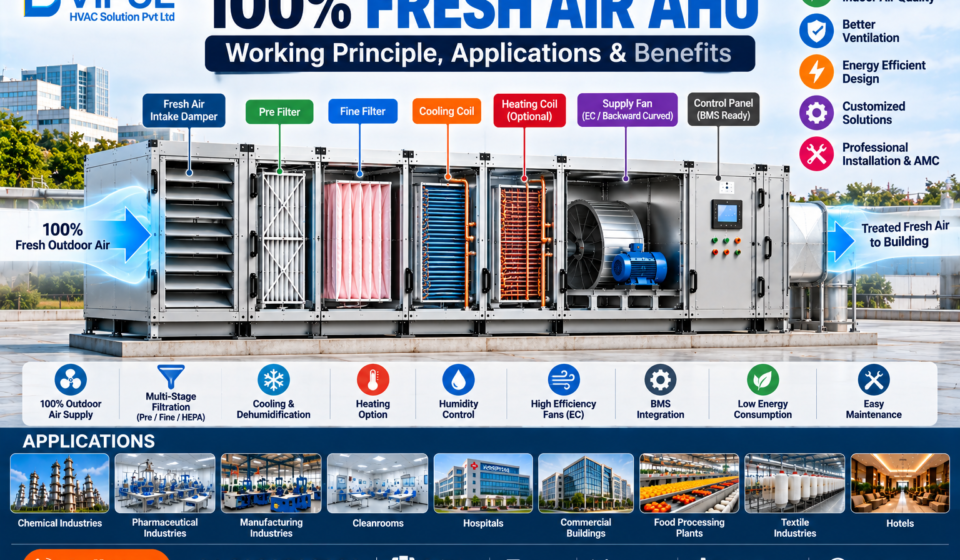
100% Outdoor Air → Filtration → Cooling/Heating → Humidity Treatment → Fan → Supply Duct → Conditioned Space
Unlike a conventional mixed-air AHU, which may combine return air with outdoor air, a 100% fresh-air system is designed around outdoor-air treatment. ASHRAE describes outdoor air as air brought intentionally into a building from the environment and distinguishes it from return and recirculated air. ASHRAE Handbook Online
For commercial, industrial, pharmaceutical, healthcare and specialized HVAC applications, the correct design must consider ventilation requirements, outdoor-air quality, filtration, cooling load, humidity, exhaust/relief air, building pressure and energy consumption.
VIPUL HVAC SOLUTION PVT. LTD. provides customized AHU solutions including treated fresh-air handling units, filtration, cooling/heating coils, fan configurations, controls, duct and air-distribution design, installation, commissioning and maintenance. Vipulhvac Solution
What Is a 100% Fresh Air AHU?
A 100% Fresh Air AHU is an AHU in which the designed supply-air stream consists of outdoor air rather than a mixture of outdoor and return air.
In simple terms:
100% Fresh Air AHU = Outdoor Air as the Supply-Air Source
The unit receives outdoor air, filters it, conditions it and supplies it to the required area.
A typical unit may contain:
- Fresh-air intake
- Intake damper
- Pre-filter
- Fine filter
- HEPA filter where required
- Cooling coil
- Heating coil where required
- Supply fan
- EC or backward-curved fan
- Humidity-control provisions
- Drain pan
- Sensors
- VFD
- Control panel
- BMS interface
The exact configuration depends on the application and engineering requirements. VIPUL HVAC’s published AHU specifications include custom CFM, single- and double-skin construction, pre/fine/HEPA filtration, cooling/heating coils, backward-curved and EC fans, acoustic insulation, BMS-ready controls and treated fresh-air units. Vipulhvac Solution
Important: What Does “100% Fresh Air” Actually Mean?
The term 100% fresh air refers primarily to the air source for the supply stream.
It does not mean that the building operates without exhaust, return-air pathways or pressure-control systems.
A properly designed system normally needs a corresponding strategy for removing or relieving air from the conditioned space.
For example:
Outdoor Air → 100% Fresh Air AHU → Supply Space → Exhaust/Relief → Outdoor
This is particularly important in industrial applications where contaminants, heat, moisture or process emissions must be removed.
The outdoor-air intake and exhaust arrangement also needs careful design so that contaminated exhaust does not get drawn back into the fresh-air intake. ASHRAE’s ventilation guidance includes requirements concerning outdoor-air intakes, exhaust locations and separation from potential contaminant sources. ASHRAE
100% Fresh Air AHU Working Principle
The working principle can be explained in seven major stages.
1. Outdoor Air Intake
The system draws air from outside through a properly positioned intake.
The intake should be located away from:
- Exhaust outlets
- Vehicle emissions
- Industrial emissions
- Dust sources
- Cooling-tower discharge
- Other potential contaminant sources
Outdoor-air quality is an important part of ventilation design.
2. Pre-Filtration
The incoming air first passes through a pre-filter.
The pre-filter can capture larger airborne particles and help protect downstream components.
This can reduce the particulate load reaching the finer filtration stages and cooling coil.
3. Fine Filtration
The air can then pass through a finer filtration stage.
The required filtration level depends on:
- Application
- Outdoor-air quality
- Indoor-air-quality objectives
- Process requirements
- Applicable standards
For specialized environments, additional high-efficiency filtration may be specified.
4. HEPA Filtration Where Required
HEPA filtration can be included when the application requires high-efficiency particulate filtration.
It may be considered for applications such as:
- Pharmaceutical facilities
- Cleanrooms
- Certain healthcare areas
- Laboratories
- Specialized manufacturing
However, HEPA filtration should not automatically be specified for every 100% fresh-air AHU. It adds pressure drop and energy requirements, so the filtration stage should be selected according to the actual application.
VIPUL HVAC publishes AHU configurations with pre-, fine- and HEPA-filtration options. Vipulhvac Solution
5. Cooling or Heating
After filtration, the outdoor air may pass through a cooling or heating coil.
In India’s climate, cooling and dehumidification are often important because outdoor air can contain both high temperature and moisture.
A chilled-water system may operate as:
Chiller → Chilled Water → AHU Cooling Coil → Conditioned Fresh Air
A DX-based system can instead use refrigerant directly through the cooling coil.
The selection depends on the project design.
6. Fan Section
The supply fan moves the treated outdoor air through the AHU and duct system.
Fan selection depends on:
- CFM
- Static pressure
- Filter pressure drop
- Coil pressure drop
- Duct resistance
- Terminal-device resistance
- Efficiency
- Operating schedule
VIPUL HVAC lists backward-curved and EC fan options for its AHU solutions. Vipulhvac Solution
7. Conditioned Fresh Air to the Building
Finally, the treated air travels through the supply ductwork to the required areas.
The system can be connected to:
- Supply-air ducts
- Diffusers
- Grilles
- VAV systems
- FCUs
- AHUs
- Process areas
- Cleanrooms
The complete ventilation strategy should be designed so that the supply and exhaust/relief quantities support the required building pressure.
100% Fresh Air AHU vs Conventional AHU
| Feature | 100% Fresh Air AHU | Conventional Mixed-Air AHU |
|---|---|---|
| Main air source | Outdoor air | Outdoor + return air |
| Return-air mixing | Normally not used in supply stream | Common |
| Fresh-air treatment | Primary function | Part of overall design |
| Filtration | Important | Important |
| Cooling load | Higher outdoor-air load | Lower outdoor-air load |
| Dehumidification | Often significant | Application dependent |
| Exhaust/relief strategy | Very important | Application dependent |
| Energy consumption | Can be higher | Can be lower |
| Heat recovery | Highly useful where suitable | May be used |
| Contaminant dilution | Strong potential benefit | Depends on ventilation rate |
| Industrial applications | Excellent for specific processes | Widely used |
A 100% outdoor-air design can provide strong ventilation control, but it may require more energy because all supplied outdoor air must be conditioned.
7 Major Benefits of a 100% Fresh Air AHU
1. Controlled Outdoor-Air Supply
A dedicated system provides a predictable source of outdoor air instead of relying on uncontrolled infiltration.
ASHRAE Standard 62.1-2025 addresses ventilation and acceptable indoor air quality and includes requirements related to ventilation, filtration, controls, air cleaning, commissioning and operation and maintenance. ASHRAE
2. Better Ventilation Control
A properly engineered system allows HVAC engineers to control:
- Fresh-air CFM
- Supply-air temperature
- Filtration
- Pressure
- Exhaust
- Humidity
- Operating schedules
This is especially valuable in industrial and specialized applications.
3. Helps Dilute Indoor Contaminants
Introducing outdoor air and exhausting indoor air can help control contaminant concentrations when the system is correctly designed and operated.
However, ventilation alone does not guarantee acceptable indoor air quality. ASHRAE notes that IAQ depends on several factors, including outdoor-air quality, contaminant sources and system operation and maintenance. ASHRAE
4. Reduced Dependence on Recirculated Air
For applications where recirculation is undesirable or restricted by the process, a 100% outdoor-air design can be advantageous.
Examples may include areas with:
- Strong odors
- Certain process contaminants
- High moisture loads
- Specific hygiene requirements
- Specialized industrial processes
The exact suitability should be determined by an HVAC engineer.
5. Improved Process Ventilation
Industrial processes may require a controlled supply of treated outdoor air while contaminated or heated air is exhausted.
A 100% Fresh Air AHU can therefore work as part of an integrated:
Supply + Exhaust + Pressure-Control System
6. Flexible Filtration
The AHU can be designed with multiple filtration stages according to the application.
Possible arrangements include:
Pre-Filter → Fine Filter → HEPA Filter
Not every project requires all three stages.
7. Integration with Modern Controls
A 100% Fresh Air AHU can be integrated with:
- Temperature sensors
- Humidity sensors
- Pressure sensors
- Differential-pressure monitoring
- VFD
- Motor controls
- Dampers
- BMS
- Alarm systems
This allows facility operators to monitor system performance and optimize operation.
Applications of 100% Fresh Air AHU
1. Pharmaceutical Industry
Pharmaceutical manufacturing may require controlled:
- Temperature
- Humidity
- Filtration
- Pressure
- Air changes
- Fresh-air supply
A 100% fresh-air system may be used where the process or ventilation strategy requires dedicated outdoor-air treatment.
The final design should follow the project’s applicable GMP, cleanroom and HVAC requirements.
2. Cleanrooms
Cleanrooms require carefully controlled environmental conditions.
A Fresh Air AHU can support:
- Outdoor-air treatment
- Filtration
- Temperature control
- Humidity control
- Pressure control
- Air-change management
HEPA filtration and terminal filtration may be incorporated depending on the cleanroom design.
3. Hospitals
Healthcare applications can have different ventilation requirements depending on the room.
Potential applications include:
- Isolation areas
- Operating areas
- Laboratories
- Patient-care areas
- General hospital areas
Healthcare HVAC should be designed according to the specific room function and applicable healthcare ventilation standards.
4. Chemical Industries
Chemical facilities may require specialized ventilation because of:
- Process emissions
- Odors
- Heat
- Chemical vapors
- Humidity
- Contamination risks
A 100% fresh-air AHU can be part of the ventilation strategy, but it must be coordinated with appropriate local exhaust and process-safety systems.
5. Manufacturing Plants
Manufacturing facilities can use 100% Fresh Air AHUs for:
- Production areas
- Process areas
- Assembly areas
- Packaging areas
- Utility areas
- Worker areas
The design should consider process heat, dust, pollutants and operating schedules.
6. Food Processing Plants
Food-processing environments can require controlled ventilation and environmental conditions.
A Fresh Air AHU can provide:
- Filtered outdoor air
- Temperature control
- Humidity control
- Controlled ventilation
- Positive or negative pressure support where appropriate
7. Textile Industries
Textile manufacturing can have specific requirements for:
- Temperature
- Relative humidity
- Airflow
- Dust control
Fresh-air treatment can be integrated into the overall textile HVAC system according to the production process.
8. Laboratories
Laboratories may require high ventilation rates and dedicated exhaust systems.
A 100% outdoor-air AHU can be considered for supplying conditioned air while exhaust systems remove contaminated air.
For laboratories using hazardous materials, the ventilation design must be based on the specific process and safety requirements.
9. Commercial Buildings
100% Fresh Air AHUs can also be used in:
- Offices
- Shopping malls
- Hotels
- Corporate buildings
- Educational facilities
- Large commercial spaces
However, a 100% outdoor-air design is not automatically the most energy-efficient solution for every commercial building.
100% Fresh Air AHU Design Parameters
Before selecting the equipment, an HVAC engineer should evaluate:
Outdoor Airflow
Required fresh-air CFM or m³/h.
Indoor Design Condition
Required:
- Temperature
- Relative humidity
- Pressure
Outdoor Design Condition
Outdoor:
- Dry-bulb temperature
- Wet-bulb temperature
- Humidity
- Air quality
Cooling Load
Because all supply air is outdoor air, the cooling and dehumidification load can be significant.
Filtration
Determine the required filtration stages and efficiency.
Static Pressure
Calculate pressure losses through:
- Filters
- Coils
- AHU casing
- Ducts
- Dampers
- Diffusers
- Other components
Exhaust Air
A 100% outdoor-air system needs an appropriate exhaust or relief strategy.
Heat Recovery
Where suitable, heat or energy recovery can reduce the energy penalty associated with conditioning outdoor air.
Energy Efficiency of 100% Fresh Air AHU
One of the biggest challenges of 100% outdoor-air systems is energy consumption.
When outdoor air is hot and humid, the AHU must remove substantial sensible and latent heat before the air reaches the required supply condition.
Energy efficiency can be improved through:
- High-efficiency fans
- EC motors
- VFD control
- Correct duct sizing
- Low-pressure-drop filters
- Efficient coils
- Heat recovery
- Energy recovery
- Proper control sequences
- Demand-based operation where applicable
- Regular filter maintenance
ASHRAE’s current ventilation guidance includes energy and ventilation considerations, while its 2025 Standard 62.1 includes updated requirements related to humidity control, demand-controlled ventilation and filtration. ASHRAE
Heat Recovery with 100% Fresh Air AHU
Heat or energy recovery can be especially useful when a facility continuously exhausts conditioned indoor air.
A simplified arrangement is:
Outdoor Air → Energy Recovery → AHU → Building
and:
Building Exhaust → Energy Recovery → Outdoor
The energy exchanger transfers thermal energy between the exhaust and incoming outdoor air without intentionally mixing the two air streams.
The suitability of a heat-recovery system depends on the application, contamination risk and equipment design.
100% Fresh Air AHU for Industrial HVAC
Industrial applications often have more complex ventilation requirements than standard comfort cooling.
A complete industrial HVAC strategy may include:
Fresh Air AHU + Supply Duct + Process Area + Local Exhaust + General Exhaust + Pressure Control + Controls
For example, in a chemical facility, the Fresh Air AHU may supply conditioned outdoor air while dedicated exhaust systems remove process contaminants.
This is why the AHU should be designed as part of the complete HVAC and ventilation system, not as an isolated piece of equipment.
Fresh Air AHU Filtration Design
Filtration should be selected according to the application.
Stage 1: Pre-Filtration
Protects downstream components from larger particles.
Stage 2: Fine Filtration
Provides higher particulate filtration.
Stage 3: HEPA Filtration
Used where high-efficiency particulate filtration is required.
Filter Monitoring
Differential-pressure monitoring can be used to identify increasing filter resistance.
A filter that becomes excessively loaded can increase system pressure drop and fan energy requirements.
100% Fresh Air AHU Maintenance
Regular maintenance is essential.
A preventive maintenance program should include:
- Pre-filter inspection
- Fine-filter inspection
- HEPA-filter inspection where installed
- Filter pressure-drop monitoring
- Cooling-coil cleaning
- Fan inspection
- Motor inspection
- Bearing inspection
- Belt inspection where applicable
- Drain-pan cleaning
- Drain-line inspection
- Damper inspection
- Sensor checking
- Control-panel inspection
- VFD inspection
- Airflow measurement
- Static-pressure measurement
- Duct inspection
VIPUL HVAC’s published AHU guidance also recommends maintenance planning covering filters, coils, fans, drains, dampers and related components. Vipulhvac Solution
How to Select a 100% Fresh Air AHU Supplier
Before purchasing a Fresh Air AHU, evaluate the supplier’s ability to provide:
1. HVAC Design
Can the supplier calculate airflow and cooling requirements?
2. AHU Customization
Can the equipment be customized according to CFM, filtration and pressure requirements?
3. Filtration
Can the supplier provide the required filtration configuration?
4. Duct Design
Can supply and exhaust ductwork be properly engineered?
5. Installation
Does the supplier provide complete installation?
6. Testing & Commissioning
Can airflow, pressure and temperature be tested after installation?
7. Maintenance
Does the supplier provide AMC and preventive maintenance?
VIPUL HVAC’s published AHU project approach covers selection, customization, duct and air-distribution design, installation, testing, commissioning and maintenance. Vipulhvac Solution
Why Choose VIPUL HVAC SOLUTION PVT. LTD.?
VIPUL HVAC SOLUTION PVT. LTD. provides customized AHU and complete HVAC solutions for industrial, commercial and institutional applications.
For 100% Fresh Air AHU projects, the company can support:
- Fresh-air AHU selection
- Custom CFM requirements
- AHU engineering
- Pre/fine/HEPA filtration
- Cooling coils
- Heating coils
- EC fans
- Backward-curved fans
- Treated fresh-air units
- Duct and air-distribution design
- HVAC controls
- BMS-ready systems
- Installation
- Testing
- Commissioning
- Preventive maintenance
- AMC
These capabilities are reflected in VIPUL HVAC’s published AHU specifications and service information. Vipulhvac Solution
Complete HVAC Project Approach
Site Survey → Fresh-Air Calculation → Cooling Load → AHU Selection → Filtration Design → Equipment Supply → Ductwork → Installation → Testing → Air Balancing → Commissioning → AMC
This approach helps ensure that the 100% Fresh Air AHU works as part of the complete ventilation system.
100% Fresh Air AHU Cost
There is no standard fixed price for a 100% Fresh Air AHU.
The final project cost depends on:
- CFM
- Cooling capacity
- Heating capacity
- AHU casing
- Number of filtration stages
- HEPA filtration
- Fan type
- Motor
- Static pressure
- Coil specification
- Controls
- VFD
- BMS
- Heat recovery
- Ductwork
- Piping
- Installation
- Testing
- Commissioning
- AMC
Therefore, a technical specification should be prepared before comparing quotations.
Information Required for a 100% Fresh Air AHU Quotation
For a project-specific quotation, provide:
- Project location
- Application
- Required CFM
- Room area
- Room height
- Occupancy
- Indoor temperature
- Indoor humidity
- Outdoor design conditions
- Required filtration
- Cooling requirement
- Heating requirement
- Static pressure
- Supply duct details
- Exhaust requirement
- Chilled-water or DX requirement
- BMS requirement
- Number of AHUs
- Installation requirements
The more complete the technical information, the more accurately the AHU can be selected.
Frequently Asked Questions
What is a 100% Fresh Air AHU?
A 100% Fresh Air AHU is an air-handling unit designed to condition outdoor air for supply to a building or process area without intentionally mixing return air into that supply-air stream.
What is the difference between 100% Fresh Air AHU and FAHU?
In many HVAC projects, the terms are used interchangeably. FAHU means Fresh Air Handling Unit. The exact terminology can vary by project and supplier.
Does a 100% Fresh Air AHU use return air?
The supply-air stream is designed around outdoor air rather than return-air mixing. However, the building still needs an appropriate exhaust or relief-air strategy.
Is 100% fresh air always better?
Not necessarily. A 100% outdoor-air system can provide strong ventilation control, but it can also increase cooling, heating and fan energy requirements. The correct solution depends on the building and process.
Does a 100% Fresh Air AHU require an exhaust system?
Usually, the ventilation strategy needs an appropriate exhaust or relief path so that the supplied outdoor air can displace indoor air and the building pressure remains controlled.
Can HEPA filters be installed?
Yes. HEPA filtration can be incorporated where the application requires it, but the additional pressure drop and energy impact should be considered during design.
Can a 100% Fresh Air AHU be connected to a chiller?
Yes. A chilled-water Fresh Air AHU can use chilled water supplied from a central chiller plant.
Can it control humidity?
Yes. A properly selected cooling coil can provide dehumidification, and additional humidity-control equipment can be incorporated where required.
Where are 100% Fresh Air AHUs used?
Applications include pharmaceutical plants, cleanrooms, laboratories, hospitals, chemical industries, manufacturing plants, food-processing facilities, textile industries and selected commercial buildings.
Does VIPUL HVAC supply Fresh Air AHUs?
Yes. VIPUL HVAC provides customized AHU solutions including treated fresh-air units, filtration, coils, fans, controls, installation, commissioning and maintenance. Vipulhvac Solution
Conclusion
A 100% Fresh Air AHU is a specialized HVAC solution designed to condition outdoor air before supplying it to a building or industrial process area.
Its working principle can be summarized as:
Outdoor Air → Filtration → Cooling/Heating → Humidity Treatment → Fan → Supply → Exhaust/Relief
The major benefits include controlled outdoor-air supply, ventilation management, flexible filtration, process ventilation support and integration with modern HVAC controls.
However, 100% outdoor-air systems can have higher cooling and heating loads than mixed-air systems. Therefore, proper engineering, filtration selection, energy recovery, fan selection, duct design and controls are essential.
For pharmaceutical, chemical, industrial, healthcare, cleanroom, food-processing, textile and commercial projects, the 100% Fresh Air AHU should be designed according to the specific application and applicable standards. ASHRAE Standard 62.1-2025 is the current published standard addressing ventilation and acceptable indoor air quality for covered commercial and institutional spaces. ASHRAE
Need a 100% Fresh Air AHU?
VIPUL HVAC SOLUTION PVT. LTD.
100% Fresh Air AHU | FAHU | Industrial HVAC | Filtration | Ventilation | AHU Design | Installation | Commissioning | AMC
📞 Call: +91 8000392000
Important Links:
- AHU Supplier in India
- AHU Supplier in Gujarat
- AHU Supplier in Ankleshwar
- AHU Supplier in Bharuch
- AHU Supplier in Surat
- AHU Supplier in Ahmedabad
- AHU Supplier in Vadodara
- Fresh Air AHU
- Fresh Air Ventilation System for Office
- Fresh Air Ventilation System for Hospital
- Fresh Air Ventilation System for Hotel
- AHU Contractor in Gujarat
- HVAC Turnkey Services Gujarat