
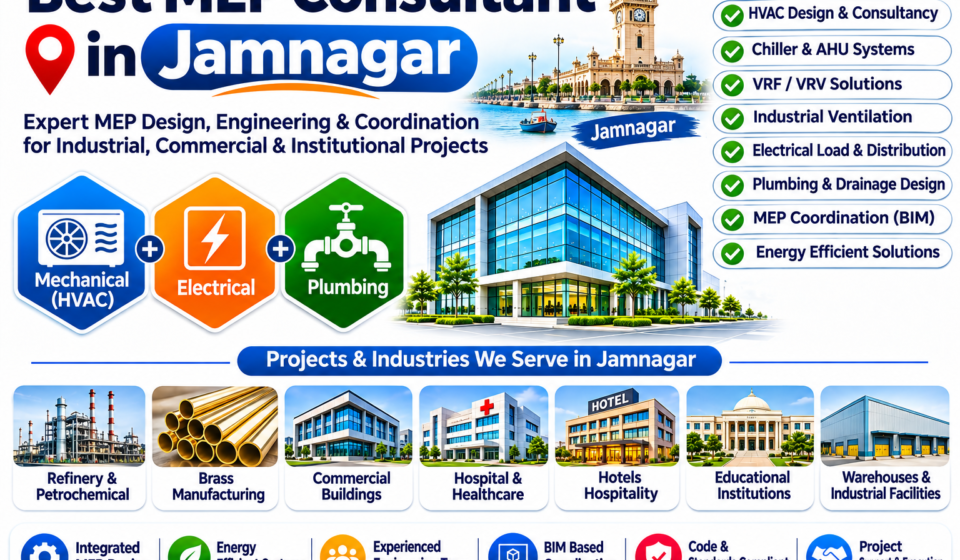

Best MEP Consultant in Jamnagar: Expert MEP Design, HVAC Engineering & Industrial Building Solutions
Modern buildings and industrial facilities require more than architectural planning and structural construction. They need properly coordinated mechanical, electrical and plumbing systems to ensure safety, comfort, energy efficiency and reliable operation.
If you are planning a factory, refinery-support facility, commercial building, hospital, hotel, warehouse or institutional project, selecting the right MEP consultant in Jamnagar is an important step towards successful project execution.
VIPUL HVAC SOLUTION PVT. LTD. provides HVAC-focused engineering and consultancy solutions, including VRF/VRV systems, chillers, Air Handling Units (AHUs), ventilation, ductable AC systems and other commercial and industrial cooling solutions.
This guide explains MEP consultancy, important HVAC services, industrial requirements in Jamnagar and the factors to consider when selecting an MEP and HVAC engineering partner.
Why Is MEP Consultancy Important for Projects in Jamnagar?
Jamnagar is an important industrial centre in Gujarat, particularly known for petroleum refining, petrochemicals, brass manufacturing, engineering and other industrial activities. The district also has commercial buildings, healthcare facilities, educational institutions and hospitality projects.
These different building types require carefully planned building services. An industrial facility may need process-area ventilation and equipment-room cooling, while a hospital requires suitable air distribution, filtration and pressure-control strategies in designated areas.
A professional MEP design and coordination process helps project teams:
- Plan mechanical, electrical and plumbing requirements.
- Coordinate HVAC equipment with architectural and structural layouts.
- Estimate cooling and ventilation requirements.
- Reduce design clashes and avoid unnecessary modifications.
- Improve equipment accessibility and maintainability.
- Support energy-efficient building operation.
- Prepare coordinated engineering drawings and specifications.
The exact design requirements depend on the building’s purpose, occupancy, operating schedule, equipment loads and applicable regulations.
What Does an MEP Consultant Do?
MEP stands for Mechanical, Electrical and Plumbing. These three engineering disciplines work together to make a building functional.
| MEP discipline | Main responsibilities |
|---|---|
| Mechanical | HVAC, air conditioning, ventilation, heating and mechanical equipment |
| Electrical | Power distribution, lighting, electrical loads and backup power coordination |
| Plumbing | Water supply, drainage, sanitary systems and piping |
| Fire and life safety | Fire protection and related safety-system coordination, where included in project scope |
| Building coordination | Coordination of layouts, service routes, equipment spaces and construction requirements |
An MEP consultant reviews how these systems interact and helps coordinate their design with the overall building plan.
Important: Complete MEP consultancy may involve several specialist disciplines. VIPUL HVAC SOLUTION PVT. LTD.’s established service focus is HVAC and related mechanical building services. Electrical, plumbing and specialist fire-protection designs should be provided or coordinated by appropriately qualified professionals according to the agreed project scope.
HVAC Consultancy Services in Jamnagar
HVAC is one of the most important parts of mechanical building services. The correct HVAC solution depends on cooling demand, indoor conditions, ventilation requirements, building use and operating costs.
1. HVAC System Design and Consultancy
HVAC design begins with understanding the building and its cooling requirements.
Typical design activities include:
- Cooling-load assessment.
- Equipment-capacity selection.
- Airflow and ventilation planning.
- Duct routing and space coordination.
- Indoor and outdoor equipment placement.
- Equipment-room planning.
- Energy-efficiency considerations.
- Technical specifications and design documentation.
A properly designed HVAC system helps provide suitable indoor conditions without unnecessary equipment oversizing.
2. VRF and VRV Air Conditioning Systems
Variable Refrigerant Flow (VRF) and Variable Refrigerant Volume (VRV) systems are commonly considered for buildings with different cooling zones and operating schedules.
Potential applications include:
- Corporate offices.
- Hotels and hospitality buildings.
- Commercial complexes.
- Educational institutions.
- Showrooms.
- Selected healthcare and institutional spaces, subject to their specific requirements.
A VRF/VRV design considers indoor-unit capacity, outdoor-unit configuration, refrigerant piping, diversity, controls, installation constraints and manufacturer recommendations.
3. Chiller System Consultancy
Chiller systems are suitable for many large commercial and industrial applications where centralized cooling is required.
Depending on project conditions, the design may consider:
Air-cooled chillers
- Suitable where cooling-tower installation is not preferred or practical.
- Require adequate outdoor airflow and equipment clearance.
- Need consideration of ambient temperature and operating conditions.
Water-cooled chillers
- Can be considered for large cooling applications.
- Require cooling towers, condenser-water pumps and associated piping.
- Need proper water treatment and maintenance planning.
Chiller selection should consider cooling load, operating hours, efficiency, water availability, installation space, maintenance access and lifecycle cost.
4. Air Handling Unit (AHU) Design and Selection
AHUs condition and distribute air through a building. They are widely used in commercial, institutional, industrial and specialised environments.
Important AHU design considerations include:
- Required airflow in CFM or CMH.
- Cooling and heating coil capacity.
- Filter stages and filtration requirements.
- Fan selection and external static pressure.
- Fresh-air and return-air arrangement.
- Condensate drainage.
- Access for inspection and maintenance.
- Noise and vibration control.
For hospitals, pharmaceutical facilities and cleanrooms, filtration, pressure relationships and air-change requirements must be established according to the specific room classification and applicable standards.
5. Ductable and Cassette Air Conditioning
Ductable AC systems are often used where conditioned air needs to be distributed through ducts to multiple outlets.
Cassette AC systems may be appropriate for selected offices, retail spaces, meeting rooms and commercial interiors.
The selection depends on room layout, ceiling height, occupancy, cooling load, air distribution, aesthetics and maintenance access.
6. Industrial Ventilation and Fresh Air Systems
Industrial and manufacturing facilities may require ventilation to manage heat, odours, airborne contaminants and indoor air quality.
A ventilation design may include:
- Fresh-air supply systems.
- Exhaust ventilation.
- Industrial air circulation.
- Equipment-room ventilation.
- Dedicated exhaust arrangements.
- Filtration where required.
- Make-up air planning.
The ventilation strategy must reflect the actual process, contaminant characteristics, occupational safety requirements and building conditions. Hazardous or potentially explosive environments require specialist engineering and suitable equipment selection.
MEP and HVAC Requirements for Different Jamnagar Industries
Jamnagar’s industrial environment creates varied building-services requirements. A single HVAC solution cannot be applied to every project.
1. Refineries and Petrochemical Facilities
Industrial facilities may have control rooms, electrical rooms, laboratories, administrative buildings and other spaces with different environmental requirements.
Potential HVAC considerations include:
- Precision cooling for selected control and equipment rooms.
- Dedicated ventilation.
- Air filtration.
- Equipment heat-load assessment.
- Suitable equipment location.
- Safety and process coordination.
HVAC design for hazardous areas must follow the applicable hazardous-area classification and specialist safety requirements. Standard commercial HVAC equipment should not be assumed suitable for such locations.
2. Brass Manufacturing and Engineering Units
Jamnagar has an established brass manufacturing industry. Manufacturing spaces may experience heat from machinery, production processes and equipment.
Possible engineering requirements include:
- General ventilation.
- Local exhaust ventilation where necessary.
- Operator-area cooling.
- Electrical-room cooling.
- Dust and fume management based on process assessment.
- Air movement and heat-removal planning.
3. Chemical and Fertilizer Industries
Chemical and fertilizer facilities may require specialised ventilation and environmental controls.
Design considerations can include:
- Process-specific exhaust systems.
- Corrosion-resistant material selection where justified.
- Equipment-room cooling.
- Air filtration.
- Pressure-control requirements.
- Safe discharge and make-up air arrangements.
The system must be designed around the actual chemical properties, process conditions and safety assessment.
4. Hospitals and Healthcare Buildings
Healthcare buildings need carefully coordinated building services to support patient comfort and specialised clinical functions.
Depending on the area, HVAC planning may consider:
- Air filtration.
- Fresh-air requirements.
- Temperature and humidity control.
- Pressure relationships.
- Operating theatre air-conditioning requirements.
- Isolation-room ventilation.
- Maintenance and infection-control considerations.
Healthcare HVAC design must follow the relevant healthcare guidelines and applicable standards for each space.
5. Hotels and Commercial Buildings
Hotels, offices, shopping complexes and other commercial properties require reliable and maintainable cooling systems.
Possible solutions include:
- VRF/VRV systems.
- Chiller-based central air conditioning.
- AHUs and FCUs.
- Ductable AC systems.
- Fresh-air ventilation.
- Exhaust systems.
- Building-management and control-system coordination.
How to Select the Right MEP Consultant in Jamnagar
Before appointing an MEP or HVAC consultancy partner, evaluate the following factors.
1. Relevant engineering experience
Check whether the consultant understands your building type and its technical requirements. Industrial HVAC design is different from office or hotel air-conditioning design.
2. Technical design capability
Ask about cooling-load calculations, equipment selection, airflow calculations, duct design, piping layouts and technical documentation.
3. Coordination with other disciplines
MEP services must fit within architectural and structural constraints. Confirm how design coordination and drawing revisions will be managed.
4. Energy-efficiency approach
Review how the consultant considers equipment efficiency, system controls, operating schedules and lifecycle costs.
5. Maintenance and accessibility
Equipment selection should consider filter replacement, service clearances, inspection access, drainage and future maintenance.
6. Clear project scope
Confirm which services are included, which drawings will be delivered, who approves the design and which disciplines require separate specialists.
7. Technical support
Discuss the availability of support during equipment selection, installation coordination, commissioning and troubleshooting.
Our HVAC Consultancy and Engineering Approach
At VIPUL HVAC SOLUTION PVT. LTD., the focus is on practical HVAC engineering and cooling solutions for commercial and industrial applications.
A typical project approach can include the following stages, depending on the agreed scope.
| Stage | Activities |
|---|---|
| 1. Requirement study | Understand building use, project size and operating conditions |
| 2. Site and drawing review | Review available architectural layouts and technical information |
| 3. Load assessment | Evaluate cooling and ventilation requirements |
| 4. System selection | Compare suitable VRF, chiller, AHU or other HVAC options |
| 5. Engineering coordination | Coordinate equipment, ducting, piping and service spaces |
| 6. Technical documentation | Prepare relevant layouts, specifications and schedules |
| 7. Project support | Provide agreed technical assistance during implementation |
Actual deliverables and responsibilities are confirmed according to the project contract.
Important HVAC Design Considerations for Jamnagar’s Climate
Jamnagar’s coastal location and seasonal weather conditions make local environmental assessment important when selecting HVAC equipment.
A design team should evaluate:
- Outdoor design temperature and humidity.
- Coastal exposure and potential corrosion.
- Equipment location and ventilation clearance.
- Dust and environmental conditions.
- Indoor occupancy and equipment heat loads.
- Operating hours and cooling demand.
- Condensate drainage.
- Outdoor-unit and cooling-tower maintenance access.
For coastal installations, suitable protective coatings, materials and maintenance practices may be considered based on actual exposure conditions and manufacturer guidance.
MEP Drawings and Technical Documentation
Good engineering documentation helps reduce misunderstandings between consultants, contractors and installation teams.
Depending on the agreed scope, HVAC documentation may include:
- HVAC layout drawings.
- Cooling-load calculation reports.
- Duct routing and sizing drawings.
- Chilled-water piping layouts.
- Refrigerant piping layouts.
- AHU and equipment schedules.
- Ventilation and exhaust layouts.
- Technical specifications.
- Equipment installation details.
- Coordination drawings.
For larger projects, BIM-based coordination may also help identify clashes between ducts, pipes, cable trays, structural elements and architectural components.
Why Choose VIPUL HVAC SOLUTION PVT. LTD.?
Choosing an HVAC engineering partner involves more than comparing equipment prices. It requires understanding the project’s cooling requirements, building constraints and long-term operating needs.
VIPUL HVAC SOLUTION PVT. LTD. focuses on HVAC-related services such as:
- HVAC design and consultancy.
- VRF and VRV air-conditioning solutions.
- Air-cooled and water-cooled chiller systems.
- AHU and ventilation systems.
- Ductable and cassette AC systems.
- Industrial and commercial cooling solutions.
- HVAC installation coordination and related project support.
- HVAC maintenance and AMC-related services.
Our objective is to help clients evaluate suitable HVAC solutions based on project requirements, technical feasibility and operational considerations.
For electrical, plumbing and specialist fire-protection disciplines, the project scope should identify the relevant qualified design professionals and coordination responsibilities.
Areas Around Jamnagar for Project Enquiries
HVAC and building-services requirements may arise across Jamnagar city and nearby industrial or commercial locations.
Project enquiries may include locations such as:
- Jamnagar City.
- Dared Industrial Area.
- Shankar Tekri.
- Sikka.
- Dhrol.
- Lalpur.
- Jam Khambhalia.
- Nearby industrial and commercial developments.
Project feasibility, site visits and service availability should be confirmed directly with the company.
Frequently Asked Questions About MEP Consultants in Jamnagar
1. Who is a MEP consultant in Jamnagar?
An MEP consultant plans and coordinates a building’s mechanical, electrical and plumbing systems. The exact services depend on the consultant’s qualifications and agreed project scope.
2. What services does an HVAC consultant provide in Jamnagar?
An HVAC consultant may provide cooling-load calculations, air-conditioning system selection, VRF/VRV design, chiller consultancy, AHU selection, ventilation planning, duct design and related engineering support.
3. Which HVAC system is suitable for an industrial building in Jamnagar?
The suitable system depends on the building’s cooling load, production process, operating hours, indoor conditions, ventilation needs and available installation space. Options may include chillers, AHUs, VRF systems or dedicated ventilation arrangements.
4. Is a chiller system suitable for factories?
Chillers can be suitable for factories that require centralised cooling or process-related cooling. The selection depends on cooling capacity, temperature requirements, operating profile, water availability and lifecycle cost.
5. What is the difference between VRF and a chiller system?
VRF systems circulate refrigerant between outdoor and indoor units and are commonly used for zoned building air conditioning. Chiller systems cool water, which is then circulated to air-conditioning equipment or process loads. Their suitability depends on the application and project requirements.
6. Why is HVAC load calculation important?
Cooling-load calculation helps estimate the required cooling capacity by considering building orientation, heat gain, occupancy, lighting, equipment, ventilation and outdoor conditions. It helps avoid inappropriate equipment sizing.
7. Do hospitals need specialised HVAC systems?
Yes. Different healthcare areas may require specific filtration, ventilation, temperature, humidity and pressure-control conditions. Requirements should be determined according to the function of each room and applicable healthcare standards.
8. Can one consultant handle all MEP services?
Some firms provide integrated MEP consultancy through multidisciplinary teams. However, clients should verify the qualifications and scope of each discipline, including electrical, plumbing and fire protection.
9. What information is required for an HVAC project quotation?
Typically, the consultant or contractor may request architectural drawings, building area, location, building use, floor plans, ceiling heights, occupancy, operating hours and details of any existing equipment.
10. How can I contact VIPUL HVAC SOLUTION PVT. LTD.?
You can contact the company to discuss commercial and industrial HVAC requirements, including VRF/VRV systems, chillers, AHUs, ventilation and HVAC consultancy.
Conclusion
Selecting the right MEP and HVAC engineering partner is an important part of planning a reliable building or industrial facility. From cooling-load calculations and VRF systems to chiller plants, AHUs and industrial ventilation, each solution should be designed around the project’s actual requirements.
If you are searching for a MEP consultant in Jamnagar or require specialised HVAC consultancy for a commercial or industrial project, contact VIPUL HVAC SOLUTION PVT. LTD. to discuss your requirements.
Contact VIPUL HVAC SOLUTION PVT. LTD.
Company: VIPUL HVAC SOLUTION PVT. LTD.
Phone: +91 8000392000
Email: info@vipulhvacsolution.in
Website: https://vipulhvacsolution.in/
Important Links:


