

Table of Contents
ToggleIndustrial HVAC System: Design, Applications and 7 Best Practices
Are you planning an HVAC system for a factory, manufacturing plant, pharmaceutical facility, textile mill, food-processing unit, warehouse, hospital, or large industrial building? Selecting the right industrial HVAC system is essential for maintaining suitable working conditions, controlling process temperatures, managing ventilation, and supporting equipment performance.
Industrial HVAC is more complex than conventional residential or office air conditioning. A factory may generate heat from machinery, dust from manufacturing processes, chemical fumes, moisture, odours, and other airborne contaminants. Each production area may have different temperature, humidity, filtration, ventilation, and air-pressure requirements.
VIPUL HVAC SOLUTION PVT. LTD. provides HVAC solutions for commercial and industrial applications, including chiller systems, air handling units (AHUs), VRF/VRV systems, ducted air conditioning, ventilation, industrial panel AC, precision air conditioning, and HVAC automation.
This guide explains industrial HVAC system design, major equipment, applications across different industries, engineering considerations, installation, energy efficiency, maintenance, and seven practical best practices.
What Is an Industrial HVAC System?
An industrial HVAC system is an integrated arrangement of heating, ventilation, air conditioning, air filtration, air distribution, and environmental-control equipment designed for industrial buildings and processes.
HVAC stands for:
- Heating: Maintaining or increasing indoor temperature when required.
- Ventilation: Supplying outdoor air and removing stale, hot, or contaminated air.
- Air Conditioning: Controlling temperature and, where required, humidity and other environmental conditions.
Unlike a conventional room air conditioner, an industrial HVAC system may need to control several environmental parameters simultaneously.
These can include:
- Indoor temperature.
- Relative humidity.
- Airflow and air velocity. Fresh-air supply.
- Exhaust air.
- Dust and particulate contamination.
- Odours and chemical vapours.
- Air filtration.
- Room-to-room pressure differences.
- Process equipment heat loads.
- Personnel comfort and safety.
The required conditions depend on the manufacturing process, equipment, products, building design, and applicable regulations. ASHRAE’s industrial air-conditioning guidance also treats temperature, humidity, air motion, air quality, noise, and cleanliness as important parts of the industrial environment.
Why Is Industrial HVAC System Design Important?
A properly engineered industrial HVAC system does more than cool a factory. It helps create an environment suitable for manufacturing, product handling, equipment operation, and personnel.
1. Maintain Process Temperature
Certain manufacturing operations need controlled temperatures to maintain product quality and process consistency.
For example, temperature-sensitive production equipment, electronic components, and selected pharmaceutical processes may require a specific operating environment.
2. Control Humidity
Excessive humidity can contribute to condensation, corrosion, material deterioration, and production problems.
Very low humidity may also create static-electricity concerns in selected industries.
Humidity requirements must be established according to the product and process rather than applying one setting to the entire facility.
3. Improve Industrial Ventilation
Industrial processes can generate heat, dust, fumes, odours, aerosols, and other airborne contaminants.
A suitable ventilation arrangement supplies clean replacement air and removes unwanted contaminants. Where possible, local exhaust ventilation should capture contaminants close to their source rather than relying only on general dilution ventilation.
4. Support Equipment Reliability
Electrical panels, control rooms, production machinery, and sensitive equipment may require specific temperature and environmental conditions.
Suitable cooling can help maintain the specified operating environment, although equipment protection must also consider electrical design, enclosure rating, contamination, and manufacturer recommendations.
5. Support Worker Comfort and Safety
Industrial environments may involve heat-generating machinery, large production spaces, and varying occupancy.
Suitable ventilation and cooling help improve working conditions. However, HVAC design must be coordinated with occupational safety, process ventilation, and industrial hygiene requirements.
6. Manage Energy Consumption
Industrial cooling and ventilation can consume substantial electricity.
Proper equipment selection, airflow design, insulation, controls, heat recovery where suitable, and preventive maintenance can help reduce avoidable energy consumption.
Main Components of an Industrial HVAC System
An industrial HVAC installation may include different equipment depending on the building and process requirements.
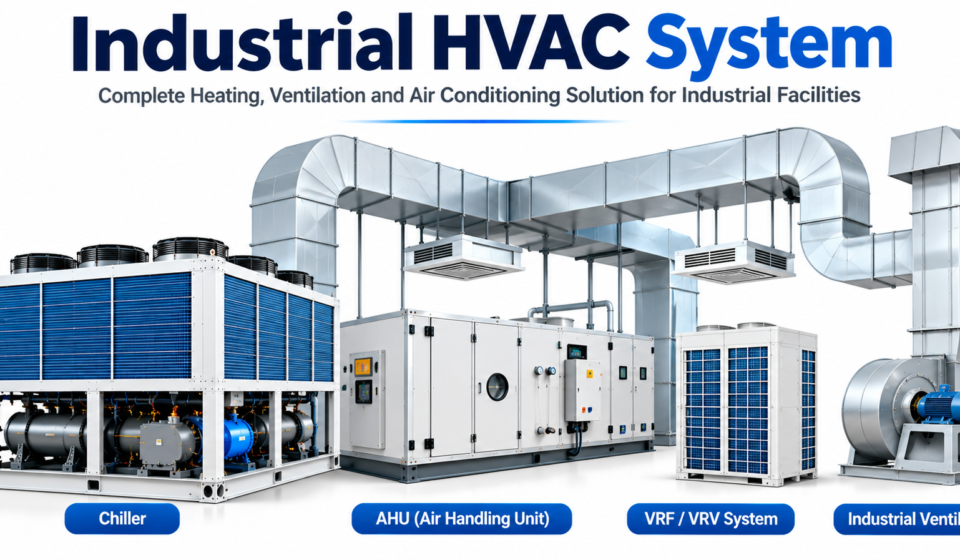
1. Chiller System
A chiller produces chilled water or another specified cooling fluid for central cooling applications.
Common chiller configurations include:
- Air-cooled chillers.
- Water-cooled chillers.
- Screw chillers.
- Scroll chillers.
- Centrifugal chillers.
- Process chillers.
- Specialised low-temperature chillers.
A chiller may supply chilled water to AHUs, FCUs, or process heat exchangers.
Typical applications: Large factories, pharmaceutical plants, hospitals, food-processing facilities, shopping complexes, and industrial production areas.
2. Air Handling Unit (AHU)
An air handling unit conditions and distributes air through a building or designated process area.
A typical AHU may include:
- Supply and return fans.
- Cooling or heating coils.
- Filter sections.
- Mixing chambers.
- Dampers.
- Drain pans.
- Humidification or dehumidification components, where required.
- Sensors and control devices.
AHU selection depends on airflow, external static pressure, filtration requirements, cooling load, humidity requirements, and installation conditions.
Typical applications: Pharmaceutical facilities, cleanrooms, hospitals, textile plants, manufacturing units, and large commercial buildings.
3. VRF/VRV Air Conditioning System
VRF stands for Variable Refrigerant Flow, while VRV is a term used by a particular manufacturer for its system technology.
A VRF system connects multiple indoor units to one or more outdoor units through refrigerant piping.
It may be useful for areas requiring separate temperature control, such as:
- Administrative offices.
- Conference rooms.
- Control rooms.
- Staff areas.
- Commercial spaces inside industrial campuses.
VRF is not automatically a replacement for industrial ventilation or process exhaust. Manufacturing areas with dust, fumes, hazardous vapours, or high process heat loads need a separate assessment.
4. Ducted and Packaged Air Conditioning
Ducted systems distribute conditioned air through a duct network. Packaged units combine major air-conditioning components into a factory-assembled equipment package or configuration.
These systems may be considered for:
- Manufacturing halls.
- Warehouses.
- Large offices.
- Assembly areas.
- Retail and commercial facilities.
Proper duct sizing, airflow balancing, filtration, insulation, and maintenance access are important for reliable operation.
5. Industrial Ventilation System
Industrial ventilation supplies clean replacement air and removes heat, fumes, dust, odours, and other contaminants.
Common arrangements include:
- Fresh-air supply systems.
- General exhaust systems.
- Local exhaust ventilation.
- Roof exhaust fans.
- Wall-mounted exhaust fans.
- Make-up air units.
- Filtered ventilation systems.
- Heat and smoke management systems.
The ventilation system should be designed for the actual process and contaminant characteristics. Simply installing large exhaust fans does not guarantee effective contaminant removal.
6. Precision Air Conditioning (PAC)
Precision air conditioning is designed for applications requiring close control of temperature and, where specified, humidity and other environmental conditions.
It may be considered for:
- Server rooms.
- Data centres.
- Electrical and control rooms.
- Laboratories.
- Sensitive electronic equipment areas.
- Selected industrial process environments.
Equipment selection should account for sensible and latent heat loads, operating hours, airflow, redundancy, and maintenance requirements.
7. Ductwork and Air Distribution System
Ductwork carries conditioned, fresh, or exhaust air to and from different building areas.
A complete duct system may include:
- Supply-air ducts.
- Return-air ducts.
- Exhaust-air ducts.
- Fresh-air ducts.
- Volume-control dampers.
- Fire and smoke dampers where required.
- Diffusers and grilles.
- Insulation and acoustic lining where appropriate.
- Supports and access doors.
Correct duct design is important because poor airflow distribution and excessive pressure losses can reduce system performance.
8. HVAC Controls and Building Management System
Industrial HVAC controls help monitor and operate equipment according to system requirements.
Depending on the project, control arrangements may include:
- Temperature sensors.
- Humidity sensors.
- Differential-pressure sensors.
- Airflow switches.
- Fan and pump controls.
- Variable-frequency drives.
- Programmable logic controllers (PLCs).
- Building Management System (BMS) integration.
- Alarms and operating schedules.
Controls should be designed around the equipment and process. A monitoring system cannot compensate for incorrect equipment selection or poor ventilation design.
Industrial HVAC System Design: Step-by-Step Process
Successful industrial HVAC design begins with the process and building requirements, not simply selecting a chiller or air conditioner.
Step 1: Understand the Industrial Application
The engineer should identify the type of facility and the activities taking place in each area.
Important questions include:
- What products are manufactured?
- What machinery generates heat?
- Are dust, fumes, chemicals, or aerosols produced?
- Which areas require temperature control?
- Which rooms require humidity control?
- What are the working hours?
- Are there special cleanliness requirements?
- Are any areas classified as hazardous?
The process owner, facility team, and HVAC designer should agree on the environmental design requirements.
Step 2: Conduct a Site Survey
A site survey helps establish the building’s physical and operational conditions.
The survey may cover:
- Factory layout and architectural drawings.
- Building dimensions and ceiling height.
- Roof and wall construction.
- Machinery locations.
- Electrical infrastructure.
- Existing HVAC equipment.
- Equipment access and maintenance clearances.
- Available plant-room and outdoor space.
- Fresh-air and exhaust locations.
- Utility availability.
The site survey also helps identify coordination requirements with electrical, fire protection, plumbing, structural, and process systems.
Step 3: Calculate Heating and Cooling Loads
Cooling-load calculation determines the required cooling capacity.
Industrial cooling loads can include:
Building heat gain: Heat entering through the roof, walls, windows, and openings.
Machinery heat: Heat released by motors, compressors, production equipment, conveyors, furnaces, and other machinery.
Occupant heat: Heat generated by workers and visitors.
Lighting load: Heat generated by industrial and general lighting.
Outdoor-air load: Cooling or heating energy required to condition replacement ventilation air.
Process load: Heat generated by manufacturing or other industrial operations.
Other loads: Heat from electrical panels, process equipment, material handling, and other sources.
The calculation should reflect the operating schedule, simultaneous equipment operation, load diversity, design temperatures, and expected future capacity requirements.
Avoid selecting equipment based only on floor area or a general tons-per-square-foot rule.
Step 4: Establish Temperature and Humidity Requirements
Different production areas may need different environmental conditions.
For example:
- A general manufacturing floor may need worker-focused cooling and ventilation.
- An electronics assembly area may need specific temperature and humidity control.
- A pharmaceutical production area may need defined cleanliness and environmental conditions.
- A food-processing facility may need temperature control suited to product handling and hygiene.
- A server room may need continuous cooling based on IT heat loads.
The required values must be established from product, process, equipment, and applicable regulatory requirements.
Step 5: Design Fresh-Air and Exhaust Ventilation
Ventilation planning is an important part of industrial HVAC design.
The engineer should identify the type, location, and quantity of contaminants and determine how to control them.
A good design may include:
- Outdoor-air supply.
- General exhaust.
- Local exhaust hoods.
- Dust collection.
- Fume extraction.
- Filtered make-up air.
- Controlled air replacement.
- Building pressure management.
Important best practice: Capture contaminants near the point of generation wherever practicable. Local exhaust may control a specific contaminant more effectively than relying only on general dilution ventilation.
Step 6: Select the Appropriate HVAC Equipment
The system type should match the process and building requirements.
For example:
- Chillers and AHUs may be suitable for large central cooling applications.
- VRF/VRV can serve offices and other multi-zone areas.
- Ducted and packaged AC may serve selected industrial or commercial spaces.
- PAC may be suitable for sensitive electronic areas.
- Dedicated ventilation and exhaust may be required for production processes.
The equipment selection should consider capacity, energy efficiency, operating conditions, controls, service access, and lifecycle cost.
Step 7: Prepare Ductwork and Piping Designs
The design process may include:
- Airflow calculations.
- Duct sizing.
- External static-pressure calculations.
- Chilled-water piping sizing.
- Pump head and flow calculations.
- Refrigerant piping design where applicable.
- Diffuser and grille selection.
- Valve and damper selection.
- Insulation specifications.
- Drainage arrangements.
- Coordination with building services.
A complete design package may include HVAC layouts, equipment schedules, sections, schematic diagrams, specifications, and a bill of quantities.
Step 8: Design HVAC Controls and Automation
The control system should coordinate equipment operation with actual demand and process requirements.
Examples include:
- Variable-speed fan control.
- Pump control.
- Chiller sequencing.
- Temperature and humidity monitoring.
- Differential-pressure monitoring.
- Ventilation scheduling.
- Equipment fault alarms.
- Energy monitoring.
- BMS integration.
Safety-related interlocks should be developed with the relevant process, electrical, and fire-safety specialists.
Step 9: Installation, Testing, and Commissioning
Installation should follow approved drawings, equipment manufacturer’s instructions, and project specifications.
Commissioning may include:
- Equipment inspection.
- Duct leakage checks where specified.
- Water-piping pressure tests.
- Refrigerant-piping tests where applicable.
- Electrical checks.
- Air balancing.
- Water balancing.
- Filter installation and verification.
- Control-system testing.
- Sensor calibration.
- Equipment performance checks.
- Operator training.
- Handover documentation.
Commissioning and balancing help verify whether the installed system performs according to its design intent.
Industrial HVAC Applications Across Different Industries
Industrial HVAC systems are designed differently according to the manufacturing process and environmental requirements.
1. Pharmaceutical Industry
Pharmaceutical manufacturing may require controlled temperature, humidity, filtration, airflow, and room pressure.
Depending on the process and applicable GMP requirements, an HVAC installation may include:
- AHUs.
- Cooling coils and heating systems.
- HEPA filtration where specified.
- Fresh-air and exhaust systems.
- Pressure-differential monitoring.
- Temperature and humidity controls.
- Cleanroom air distribution.
- HVAC automation and alarms.
Room pressure relationships should be established through a contamination-control and safety strategy. Not every pharmaceutical room should be positive or negative pressure by default.
2. Textile Industry
Textile manufacturing can involve machinery heat, fibres, lint, airborne dust, and humidity-sensitive operations.
HVAC design may include:
- Industrial ventilation.
- Humidity control.
- Air washers where appropriate.
- Dust collection.
- Exhaust systems.
- Fresh-air supply.
- Process-area cooling.
- Temperature monitoring.
Humidity requirements depend on fibre type, manufacturing process, material handling, and production quality objectives.
3. Food and Beverage Industry
Food-processing environments may require temperature control, ventilation, suitable filtration, and hygienic equipment arrangements.
Applications can include:
- Food production areas.
- Packaging rooms.
- Processing facilities.
- Storage spaces.
- Beverage manufacturing.
- Cold-room support areas.
The HVAC design should account for hygiene, moisture, cleaning procedures, heat loads, and the risk of cross-contamination. Food storage and process cooling may also need specialised refrigeration equipment.
4. Automobile and Automotive Components Industry
Automotive plants may have different environmental requirements across assembly, paint, testing, welding, and component-manufacturing areas.
Possible HVAC applications include:
- Factory ventilation.
- Paint-shop ventilation and air conditioning.
- Welding-fume extraction.
- Assembly-area cooling.
- Electrical-room air conditioning.
- Dedicated process exhaust.
- Dust collection.
Specialist process ventilation and safety design are essential in paint, welding, and other areas with hazardous or combustible contaminants.
5. Chemical Industry
Chemical manufacturing can generate heat, fumes, gases, vapours, and other process-specific contaminants.
The HVAC design may require:
- Dedicated exhaust systems.
- Make-up air systems.
- Corrosion-resistant materials where required.
- Appropriate air filtration or gas treatment.
- Pressure management.
- Equipment suited to the classified hazardous area, where applicable.
- Monitoring and safety interlocks.
Equipment and electrical systems must be selected according to the site’s process hazard assessment and applicable area classification. A standard comfort AC should not be assumed suitable for hazardous areas.
6. Electronics and Electrical Manufacturing
Electronics production, electrical assembly, and sensitive testing may need controlled temperature, humidity, dust, and electrostatic conditions.
Potential systems include:
- Precision air conditioning.
- AHUs with suitable filtration.
- Humidity-control equipment.
- Controlled ventilation.
- Differential-pressure monitoring.
- Dedicated equipment cooling.
The required environmental conditions should be based on the actual components and manufacturing processes.
7. Warehouses and Logistics Facilities
Warehouses may need ventilation, worker comfort cooling, temperature-controlled storage, or specialised environmental protection.
Design factors can include:
- Building height.
- Occupancy patterns.
- Storage material requirements.
- Roof heat gain.
- Loading-bay openings.
- Forklift and equipment heat.
- Air stratification.
- Ventilation requirements.
For high-bay spaces, the occupied zone and storage conditions should be considered when deciding air distribution and cooling strategy.
8. Data Centres and Server Rooms
Data centres and server rooms require cooling designed around IT equipment heat loads and reliability objectives.
Potential solutions include:
- Precision air conditioning.
- Chilled-water cooling.
- Dedicated cooling units.
- Hot-aisle and cold-aisle arrangements.
- Temperature and humidity monitoring.
- Redundancy and backup arrangements.
- BMS or data-centre infrastructure monitoring.
The system design should reflect equipment density, rack layouts, future expansion, redundancy philosophy, and continuous operating requirements.
Seven Best Practices for Industrial HVAC System Design
The following practices can help improve system performance, energy use, and maintainability.
Best Practice 1: Design According to the Actual Industrial Process
Do not use a standard office HVAC design for every factory.
Study machinery heat loads, dust, fumes, humidity requirements, occupancy, production schedules, and product sensitivity before selecting the equipment.
Best Practice 2: Separate Clean and Contaminated Areas
Separate processes that generate dust, fumes, or other contamination from areas requiring cleaner air wherever the building and process allow.
Plan airflow paths to reduce the potential transfer of contaminants from dirty areas to cleaner areas.
Room pressure relationships should be based on the required contamination-control and safety strategy.
Best Practice 3: Capture Contaminants at Their Source
Local exhaust ventilation is often more practical than relying entirely on general ventilation when contaminants originate from specific machines or operations.
Examples include:
- Welding-fume extraction.
- Dust collection.
- Chemical-process extraction.
- Paint-booth exhaust.
- Laboratory fume extraction.
- Kitchen and process exhaust.
The exhaust hood should be designed for the actual source, capture geometry, contaminant characteristics, and operating conditions.
Best Practice 4: Provide Proper Make-Up Air
When industrial exhaust systems remove large volumes of air, replacement air must be provided.
Make-up air helps prevent excessive negative pressure and supports effective exhaust operation.
It should be drawn from an appropriate clean location, filtered and conditioned where required, and distributed so that it does not disrupt local exhaust capture or create uncomfortable drafts.
ASHRAE’s industrial ventilation guidance explains the importance of clean make-up air, proper distribution, and coordination between supply and exhaust systems.
Best Practice 5: Select Filtration According to the Contaminant
Not every industrial HVAC system needs the same filter arrangement.
The selection should consider:
- Particle size and concentration.
- Nature of the contaminant.
- Required cleanliness.
- Airflow and pressure drop.
- Filter maintenance and replacement.
- Whether gaseous contaminants require specialized treatment.
Use suitable filters at equipment intakes to protect coils and maintain the required air cleanliness. HEPA filtration should be specified when the application and cleanroom requirements justify it, rather than installed automatically everywhere.
Best Practice 6: Improve Energy Efficiency Through Design
Consider energy performance throughout the equipment’s operating life.
Useful measures may include:
- Correct equipment sizing.
- High-efficiency chillers and motors.
- Variable-frequency drives where appropriate.
- Efficient fan and pump selection.
- Duct and pipe insulation.
- Airflow balancing.
- Optimised operating schedules.
- Heat recovery from suitable exhaust streams.
- Automatic controls.
- Regular filter and coil cleaning.
Heat recovery must be evaluated carefully. Contaminated, corrosive, or hazardous exhaust streams may not be suitable for direct heat recovery without appropriate isolation and engineering controls.
Best Practice 7: Plan for Maintenance and Commissioning
Industrial HVAC systems should be designed with enough access for inspection, filter replacement, coil cleaning, fan maintenance, pump servicing, and equipment replacement.
Include commissioning, airflow balancing, water balancing, sensor testing, control checks, and operator training in the project plan.
A system that cannot be accessed or maintained easily may become less reliable and more expensive to operate.
Industrial HVAC Energy Efficiency: Important Design Considerations
Industrial cooling and ventilation can consume substantial energy. Equipment selection should therefore consider operating cost as well as initial investment.
Use Correct Equipment Capacity
Oversized equipment can increase purchase costs and may operate inefficiently under low-load conditions. Undersized equipment can fail to meet peak cooling demand.
Select capacity based on an engineering calculation and actual operating profile.
Consider Part-Load Performance
Many industrial facilities experience different cooling requirements during different production shifts.
Compare chiller and HVAC performance under realistic part-load conditions rather than evaluating only full-load ratings.
Optimise Fans and Pumps
Use appropriately selected fans and pumps, efficient motors, and variable-speed control where the load profile supports it.
Avoid excessive duct pressure losses and unnecessary pumping head.
Maintain Duct and Pipe Insulation
Poor insulation can increase heat gain, energy consumption, and condensation risk.
Use suitable insulation and vapour protection according to the operating temperatures and environmental conditions.
Recover Heat Where Practical
Suitable waste-heat recovery can reduce energy demand in certain industrial applications.
The exhaust stream must be evaluated for contamination, corrosion, temperature, and safety before selecting a heat-recovery arrangement.
Monitor System Performance
Track operating parameters such as:
- Chiller electricity consumption.
- Chilled-water supply and return temperatures.
- Pump and fan power.
- Filter pressure drop.
- Room temperature and humidity.
- Ventilation and exhaust operation.
- Equipment alarms and downtime.
Monitoring helps identify performance changes and maintenance requirements.
Industrial HVAC Installation and Commissioning Checklist
Before handing over an industrial HVAC system, review the following items.
| Inspection area | What should be checked |
|---|---|
| Equipment | Model, capacity, installation position, and access |
| Ductwork | Size, supports, insulation, leakage, and cleanliness |
| Piping | Material, supports, insulation, valves, and pressure tests |
| AHUs and FCUs | Coils, fans, filters, drains, and access |
| Ventilation | Supply, exhaust, make-up air, and airflow direction |
| Filtration | Correct filter grade, installation, and sealing |
| Electrical | Power supply, earthing, protection, and connections |
| Controls | Sensors, actuators, alarms, and operating logic |
| Air balancing | Design airflow and distribution |
| Water balancing | Flow rate and system pressure |
| Safety | Interlocks, access, and fire-safety coordination |
| Commissioning | Functional checks, records, and operator training |
The exact commissioning checklist depends on the system type, project specifications, applicable requirements, and manufacturer instructions.
Industrial HVAC Standards and Design References in India
Industrial HVAC design should follow the applicable Indian building requirements, occupational-safety provisions, process-specific regulations, and recognized engineering standards.
Relevant references may include:
National Building Code of India 2016 (NBC 2016): Part 8, Section 3 covers air conditioning, heating, and mechanical ventilation. The NBC is published by the Bureau of Indian Standards and provides a national model code for building construction and services.
ASHRAE Handbook — Industrial Air Conditioning: Provides engineering guidance on industrial temperature, humidity, filtration, cooling, equipment selection, and energy considerations.
ASHRAE Industrial Ventilation Guidance: Covers ventilation, local exhaust, make-up air, air filtration, and industrial contaminant-control considerations.
Process-specific requirements: Pharmaceutical, food, chemical, electronics, and other specialized industries may have additional regulatory, quality, occupational-safety, and engineering requirements.
The applicable standards and editions must be checked for the project. A generic HVAC design should not be treated as proof of regulatory compliance.
Why Choose VIPUL HVAC SOLUTION PVT. LTD. for Industrial HVAC Solutions?
VIPUL HVAC SOLUTION PVT. LTD. provides HVAC products and services for commercial, industrial, and institutional applications.
Its published portfolio includes:
- Industrial chiller systems.
- Air handling units (AHUs).
- VRF/VRV systems.
- Ducted and packaged air conditioning.
- Industrial panel AC.
- Precision air conditioning.
- Ventilation systems.
- Fan coil units.
- HVAC ductwork.
- BMS and HVAC automation.
- Kitchen exhaust and smoke management systems.
- Flame-proof and explosion-proof AC solutions.
The company also publishes industrial HVAC design, chiller systems, ventilation, and project-related solutions. The exact scope for each project should be confirmed based on the site, technical requirements, and service availability.
Customers can contact the team to discuss:
- Industrial HVAC system design enquiries.
- Cooling-load assessment and equipment selection.
- Chiller and chilled-water system requirements.
- AHU and ductwork requirements.
- Industrial ventilation and exhaust systems.
- VRF/VRV and precision AC applications.
- HVAC installation and commissioning.
- Preventive maintenance and AMC enquiries.
VIPUL HVAC SOLUTION PVT. LTD. — Contact Details
Company: VIPUL HVAC SOLUTION PVT. LTD.
Sales phone: +91 8000392000
Email: info@vipulhvacsolution.in
Website: https://vipulhvacsolution.in/
Products: https://vipulhvacsolution.in/products/
Industrial HVAC consultant: https://vipulhvacsolution.in/blog/industrial-hvac-consultant-gujarat/
Chiller systems: https://vipulhvacsolution.in/chiller-systems/
Contact page: https://vipulac.in/contact-us/
For a project enquiry, share the industry type, plant location, approximate building area, process description, cooling requirements, operating schedule, and existing HVAC details.
Frequently Asked Questions About Industrial HVAC Systems
1. What is an industrial HVAC system?
An industrial HVAC system is an integrated arrangement of heating, cooling, ventilation, filtration, air distribution, and environmental-control equipment designed for factories and industrial facilities.
2. What are the main components of industrial HVAC?
Common components include chillers, AHUs, FCUs, VRF/VRV systems, ductwork, fans, pumps, ventilation equipment, exhaust systems, air filters, controls, and BMS integration. The actual equipment depends on the facility and process.
3. Which HVAC system is best for a factory?
There is no single best system for every factory. Chiller and AHU systems, VRF/VRV, ducted AC, packaged AC, precision AC, and industrial ventilation may all be suitable for different areas. Selection should be based on process heat loads, ventilation, filtration, humidity, operating hours, and building design.
4. How is industrial HVAC different from commercial HVAC?
Commercial HVAC usually focuses on occupant comfort in spaces such as offices and retail buildings. Industrial HVAC may need to control process temperature, machinery heat, dust, fumes, product conditions, ventilation, and specialised environmental requirements.
5. What is the role of an AHU in industrial HVAC?
An air handling unit conditions and distributes air. Depending on the design, it can include fans, cooling coils, filters, dampers, heating or humidification components, and controls.
6. Why is fresh-air ventilation important in factories?
Fresh-air ventilation provides replacement air and helps manage heat, odours, and airborne contaminants. It must be coordinated with exhaust systems, process requirements, filtration, and building pressure.
7. What is the difference between general ventilation and local exhaust ventilation?
General ventilation supplies and removes air across a larger space. Local exhaust ventilation captures contaminants close to the point where they are generated. Local capture is often more effective when contamination is produced at a specific machine or process.
8. How do you calculate industrial HVAC cooling load?
Cooling-load calculations account for building heat gain, machinery, lighting, occupants, ventilation air, process heat, outdoor design conditions, and operating schedules. The calculation should be performed for the actual process and building rather than based only on floor area.
9. How can industrial HVAC energy consumption be reduced?
Energy use can be managed through correct equipment sizing, efficient chillers, fan and pump optimisation, variable-speed controls, appropriate insulation, heat recovery where suitable, airflow balancing, operating schedules, and preventive maintenance.
10. Does VIPUL HVAC SOLUTION PVT. LTD. provide industrial HVAC solutions in Gujarat?
VIPUL HVAC SOLUTION PVT. LTD. publishes commercial and industrial HVAC solutions and lists products such as chillers, AHUs, VRF/VRV systems, ventilation, ducting, and precision AC. Contact the company at +91 8000392000 to discuss your project and confirm the required service scope.
Conclusion: Design the Right Industrial HVAC System for Long-Term Performance
An effective Industrial HVAC system requires more than selecting air-conditioning equipment. It combines process requirements, cooling-load calculations, ventilation, exhaust, air filtration, pressure control, equipment selection, controls, installation, commissioning, and maintenance.
Factories, pharmaceutical facilities, textile plants, food-processing units, automotive facilities, warehouses, and data centres all have different HVAC requirements. A properly engineered solution should be designed around the actual process, environmental conditions, worker requirements, and applicable standards.
VIPUL HVAC SOLUTION PVT. LTD. provides HVAC solutions for commercial and industrial applications, including chillers, AHUs, VRF/VRV systems, ventilation, ductwork, and related HVAC equipment.
Contact the team to discuss your industrial HVAC requirements and request a project-specific consultation.
Phone: +91 8000392000
Email: info@vipulhvacsolution.in
Website: https://vipulhvacsolution.in/
VIPUL HVAC SOLUTION PVT. LTD. — Industrial HVAC Design, Air Conditioning and Ventilation Solutions.
Technical references:
- ASHRAE Handbook — Industrial Air Conditioning — industrial process conditions, environmental requirements, filtration, and equipment selection.
- ASHRAE Handbook — Ventilation of the Industrial Environment — industrial ventilation, local exhaust, make-up air, and contaminant control.
- Bureau of Indian Standards — National Building Code — Indian building-services framework, including air conditioning, heating, and mechanical ventilation.
- VIPUL HVAC SOLUTION PVT. LTD. — Official Products — published HVAC equipment and solution portfolio.

Vipul HVAC House
At Vipul hvac solution pvt.ltd., we take great pride in delivering high-quality HVAC solutions that ensure comfort and efficiency in both residential and commercial spaces. As a trusted HVAC of reliable, energy-efficient systems, and we are dedicated to providing you with the best products and services to meet your needs
Other Articles
