
Fresh Air Ventilation System for Kitchen: A Complete Guide for Homeowners
The kitchen is one of the most important areas of any home when it comes to ventilation. Cooking produces heat, smoke, steam, grease particles, odors and other airborne contaminants. If these pollutants are not properly removed, they can spread from the kitchen into bedrooms, living rooms and other areas of the house.
A fresh air ventilation system for a home kitchen helps maintain better indoor air quality by creating a controlled movement of air. It can work together with a kitchen exhaust hood, exhaust fan, fresh-air unit, ducting and suitable air filters to remove polluted indoor air and introduce cleaner outdoor air.
At VIPUL HVAC Solution Pvt. Ltd., we provide professionally designed HVAC and ventilation solutions for residential, commercial and industrial applications. A kitchen ventilation system should not simply be selected based on fan size or appearance. Proper airflow, duct design, exhaust location, pressure balance, noise, filtration and the home’s layout all need to be considered.
What Is a Fresh Air Ventilation System for a Kitchen?
A fresh air ventilation system is a mechanical system designed to improve the exchange of indoor and outdoor air.
In a kitchen application, the system generally works on two basic principles:
1. Exhaust air removal
Hot, humid and polluted kitchen air is extracted and discharged outside.
2. Fresh air supply
Outdoor air is introduced into the home or kitchen to replace some of the air being exhausted.
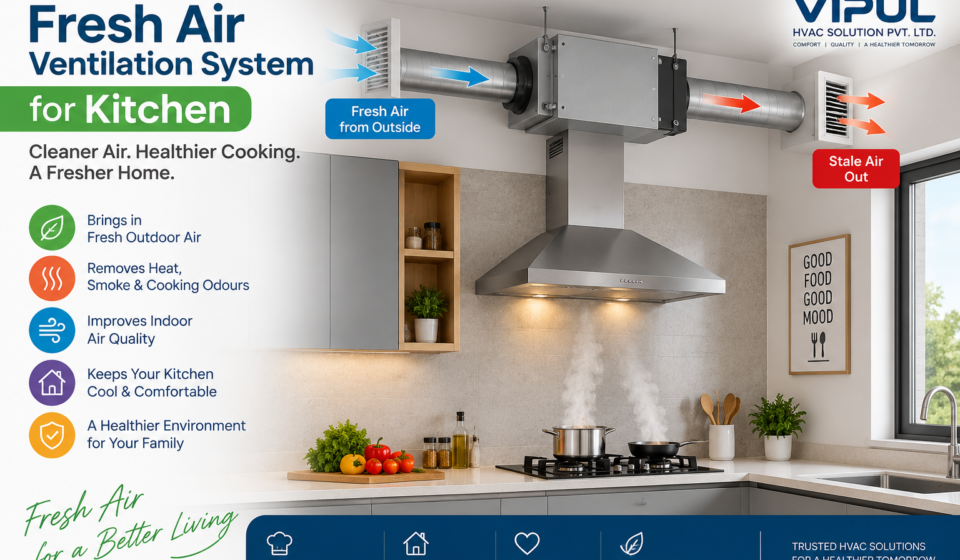
A simplified airflow arrangement can look like:
Outdoor Air → Filter → Fresh Air Unit → Duct → Kitchen/Home → Exhaust Hood → Duct → Outdoor
The actual design depends on the size of the kitchen, cooking equipment, home layout, occupancy, duct length and required airflow.
ASHRAE identifies local exhaust as an important source-control method in homes and recommends that kitchen exhaust be properly vented outdoors.
Why Does Your Home Kitchen Need Proper Ventilation?
Cooking creates more than just visible smoke.
Depending on the cooking method, the kitchen can generate:
- Cooking odors
- Heat
- Steam and moisture
- Grease particles
- Fine airborne particles
- Combustion products from gas cooking
- Carbon dioxide and other gases
- Airborne contaminants from frying, grilling and high-temperature cooking
Without adequate ventilation, these pollutants may remain indoors or travel to other rooms.
A properly designed kitchen ventilation system helps capture and remove cooking pollutants at or near their source.
ASHRAE notes that residential kitchen ventilation commonly uses range hoods and other exhaust systems to remove cooking effluent.
Fresh Air Ventilation vs Kitchen Exhaust: What Is the Difference?
Many homeowners use the terms fresh air ventilation and kitchen exhaust interchangeably, but they are not exactly the same.
| Kitchen Exhaust System | Fresh Air Ventilation System |
|---|---|
| Removes polluted kitchen air | Introduces outdoor air |
| Mainly handles smoke, odor, heat and moisture | Helps provide replacement/outdoor air |
| Usually connected to hood or exhaust fan | May use a dedicated fresh-air unit and ductwork |
| Discharges air outside | Supplies air into the building |
| Primarily an extraction system | Primarily an air-supply/ventilation system |
For some homes, a kitchen exhaust hood may be sufficient for source capture. For tightly constructed homes or homes with larger exhaust requirements, a properly designed fresh-air strategy may also be beneficial.
How Does a Fresh Air Kitchen Ventilation System Work?
A properly designed system can contain several components.
1. Fresh Air Intake
Outdoor air enters through a dedicated intake point.
The intake location should be selected carefully to reduce the possibility of drawing contaminated air from nearby exhaust outlets or other pollution sources.
2. Air Filter
A filter can be installed to reduce dust and airborne particles entering through the fresh-air system.
Filter selection should be based on the required indoor-air-quality objectives and system design.
3. Fresh Air Fan or Fresh Air Unit
A fan moves outdoor air into the home.
Depending on the project, the system may use a dedicated fresh-air fan, air handling unit, energy-recovery system or another suitable ventilation arrangement.
4. Ductwork
Ducts distribute fresh air to the desired location.
Correct duct sizing is important because undersized ducts can increase pressure losses, noise and fan energy requirements.
5. Kitchen Exhaust Hood
The kitchen hood captures cooking pollutants close to the cooking surface.
Residential kitchens commonly use wall-mounted or other types of range hoods.
6. Exhaust Fan
The exhaust fan moves contaminated air through the duct and discharges it outside.
7. Outdoor Exhaust Point
The extracted air should be discharged safely outdoors and positioned appropriately relative to outdoor-air intakes.
Benefits of Fresh Air Ventilation for a Home Kitchen
1. Better Indoor Air Quality
One of the biggest benefits is improved indoor air quality.
Kitchen pollutants can spread throughout a house when they are not captured effectively. Controlled ventilation helps remove contaminated air from the source.
2. Reduction in Cooking Oduors
Strong food smells can remain indoors for hours.
A properly designed exhaust system helps remove cooking odors before they spread throughout the home.
3. Better Control of Heat
Cooking appliances generate considerable heat.
Exhaust ventilation can help remove hot air from the kitchen and improve thermal comfort.
4. Helps Control Steam and Moisture
Cooking produces water vapor.
Excessive moisture can contribute to condensation and an uncomfortable indoor environment. Kitchen exhaust helps remove moisture generated during cooking.
5. Helps Remove Smoke and Cooking Effluent
A range hood or local exhaust system can capture smoke, grease and other cooking effluent close to the source.
6. Supports a More Comfortable Home
A kitchen with poor ventilation can become hot, humid and uncomfortable.
Good ventilation helps maintain a more comfortable environment, especially during intensive cooking.
7. Helps Modern Airtight Homes
Modern homes can be relatively airtight compared with older buildings.
ASHRAE notes that continuous low-level ventilation is increasingly used in modern, tightly built houses where natural infiltration may be lower.
Do You Need Fresh Air Along With a Kitchen Exhaust Fan?
Sometimes, yes.
When an exhaust fan removes air from a home, replacement air must come from somewhere. Depending on the home’s construction and exhaust airflow, replacement air may enter through designed ventilation openings, transfer pathways or a dedicated fresh-air system.
If a home is relatively airtight and a powerful exhaust system operates without an appropriate replacement-air strategy, the resulting pressure difference can affect airflow performance and potentially create undesirable air movement.
This is why fresh-air and exhaust-air design should be considered together, particularly for larger or more sophisticated residential HVAC systems.
Kitchen Exhaust Hood vs Exhaust Fan
A common question is:
Which is better for a home kitchen: a chimney/range hood or an exhaust fan?
The answer depends on the kitchen design.
A range hood is positioned close to the cooking surface and is designed to capture cooking effluent at the source.
A general exhaust fan removes air from the kitchen space but may not capture pollutants as effectively at the cooking surface.
ASHRAE explains that residential kitchens commonly use range hoods and that whole-kitchen exhaust fans ventilate the kitchen volume rather than capturing contaminants directly at the cooking source.
For this reason, source capture through an appropriately designed hood is often an important part of residential kitchen ventilation.
How Much Airflow Does a Kitchen Ventilation System Need?
There is no single airflow number that is correct for every home kitchen.
The required airflow depends on factors such as:
- Kitchen size
- Kitchen layout
- Type of cooking appliances
- Gas or electric cooking
- Cooking frequency
- Hood design
- Duct length
- Number of duct bends
- Building airtightness
- Exhaust fan characteristics
- Local building requirements
- Desired indoor air quality
ASHRAE’s residential ventilation guidance includes local kitchen exhaust requirements and distinguishes between vented range hoods and other kitchen exhaust approaches.
Therefore, homeowners should avoid choosing a ventilation fan purely because it has a high CFM or m³/h rating.
The complete system—not just the fan—determines actual performance.
Fresh Air Ventilation for Gas Kitchens
Gas cooking requires particular attention because combustion can generate additional pollutants.
A properly designed exhaust hood should capture cooking emissions and combustion-related contaminants and discharge them outdoors.
For homes using gas cooking appliances, ventilation design should also consider combustion safety, replacement air and pressure relationships.
ASHRAE specifically identifies residential kitchen ventilation with gas stoves as an area requiring careful operational consideration.
Can Fresh Air Ventilation Be Connected to Home AC?
Yes, depending on the HVAC design.
A fresh-air ventilation system can potentially be integrated with:
- Central air conditioning
- Ducted split AC
- VRF/VRV systems
- Air handling units
- Heat-recovery ventilation systems
- Dedicated outdoor-air systems
However, fresh outdoor air should not simply be introduced into an air-conditioned room without considering temperature, humidity, filtration, airflow and cooling load.
A professional HVAC designer can determine the appropriate method for introducing outdoor air while maintaining indoor comfort.
Fresh Air Ventilation System for Kitchen in Apartments
Apartment kitchens can present special challenges because:
- There may be limited space for ductwork.
- External walls may be restricted.
- Exhaust shafts may already exist.
- Duct routes can be long.
- Multiple bends may be unavoidable.
- Neighboring apartments may be close to exhaust discharge points.
For apartments, the ventilation design should be coordinated with the building’s existing HVAC and exhaust infrastructure.
A compact fresh-air system combined with an appropriately selected kitchen exhaust system may be suitable in some cases.
Fresh Air Ventilation for Villas and Independent Homes
Independent homes generally provide more flexibility for ventilation design.
A system can potentially include:
Fresh Air Unit + Filter + Ducting + Kitchen Hood + Exhaust Fan + Outdoor Discharge
For larger villas, the ventilation system can also be coordinated with central AC, bathrooms, utility rooms and other areas requiring ventilation.
Important Factors When Designing Kitchen Ventilation
1. Correct Fan Selection
Fan selection should consider both airflow and static pressure.
A fan that appears powerful on paper may not deliver the required airflow after duct resistance, filters, bends and grilles are considered.
2. Correct Duct Size
Undersized ductwork can increase pressure loss and noise.
Proper duct sizing is therefore essential.
3. Short and Efficient Duct Route
Where possible, duct routes should be planned to minimize unnecessary bends and restrictions.
4. Proper Exhaust Location
Exhaust air should be discharged outdoors at an appropriate location.
The fresh-air intake should also be positioned to minimize the risk of drawing exhaust air back into the building.
5. Noise Control
Kitchen fans can become annoying if the motor, ductwork or airflow generates excessive noise.
Fan selection, duct velocity, vibration isolation and installation quality all matter.
6. Easy Maintenance
Filters, fans, grilles and accessible components should be designed so that maintenance can be performed conveniently.
Common Mistakes in Home Kitchen Ventilation
Mistake 1: Selecting a Fan Only by Size
A larger fan is not automatically a better ventilation solution.
Mistake 2: Using Very Small Ducts
A powerful fan connected to an undersized duct can experience excessive resistance and noise.
Mistake 3: Exhausting Into the Ceiling or Attic
Kitchen exhaust should generally be discharged to the outdoors rather than simply releasing polluted air into an enclosed building cavity.
Mistake 4: Ignoring Replacement Air
Large exhaust airflow can create pressure imbalance if replacement air is not considered.
Mistake 5: Installing the Hood Incorrectly
Hood location and installation geometry affect pollutant capture.
Mistake 6: Ignoring Maintenance
Grease, dust and contaminants can accumulate in ventilation components.
Regular cleaning and maintenance help maintain system performance.
Mistake 7: Treating Fresh Air and Exhaust as the Same Thing
Fresh-air supply and exhaust-air removal perform different functions and should be designed accordingly.
How to Choose the Best Fresh Air Ventilation System for Your Kitchen
Before selecting a system, consider the following questions:
- What is the size of the kitchen?
- Is the kitchen open-plan or enclosed?
- What type of cooking appliances are used?
- Is cooking done with gas or electricity?
- Does the kitchen already have a chimney/range hood?
- Where can the exhaust duct terminate?
- Is there an existing HVAC system?
- How long will the duct be?
- How many bends are required?
- Is fresh-air replacement required?
- What level of filtration is appropriate?
- How important are noise and energy efficiency?
- How will the system be cleaned and maintained?
A professional site assessment can answer these questions before equipment is selected.
Fresh Air Ventilation System Installation Process
A professional installation normally involves several stages.
Step 1: Site Inspection
The HVAC team evaluates the kitchen, building layout, available duct routes and outdoor-air/exhaust locations.
Step 2: Airflow Assessment
Required supply and exhaust airflow are determined based on the application.
Step 3: Equipment Selection
Suitable fans, fresh-air units, filters, grilles and other components are selected.
Step 4: Duct Design
Duct size and routing are planned to minimize unnecessary pressure losses.
Step 5: Installation
Equipment, ductwork, grilles, controls and other components are installed.
Step 6: Testing and Commissioning
Airflow, fan operation, noise and system performance should be checked after installation.
Step 7: Maintenance Guidance
The homeowner should receive guidance on filter replacement, hood cleaning and general maintenance.
Fresh Air Ventilation System Maintenance
Regular maintenance is essential for long-term performance.
Depending on the system, maintenance may include:
- Cleaning kitchen hood filters
- Cleaning accessible duct components
- Checking exhaust fan operation
- Inspecting fresh-air filters
- Replacing filters when required
- Checking electrical connections
- Checking unusual vibration or noise
- Inspecting grilles and diffusers
- Checking outdoor intake and exhaust points
The maintenance frequency depends on cooking frequency, pollution levels, system type and manufacturer recommendations.
Is a Fresh Air Ventilation System Worth It for a Home Kitchen?
For many modern homes, proper kitchen ventilation is a worthwhile investment because the kitchen is a significant source of heat, moisture, odours and cooking-related pollutants.
However, the best solution is not necessarily the most expensive system.
A well-designed ventilation system should be:
Effective + Quiet + Energy-conscious + Easy to Maintain + Properly Sized
The objective is to achieve the required ventilation performance without unnecessarily increasing energy consumption or noise.
Why Choose VIPUL HVAC Solution Pvt. Ltd.?
At VIPUL HVAC Solution Pvt. Ltd., we focus on practical, engineered HVAC and ventilation solutions rather than one-size-fits-all equipment selection.
Our approach can include:
- Residential kitchen ventilation
- Fresh-air ventilation systems
- Exhaust ventilation
- HVAC ducting
- Fresh-air units
- Air filtration solutions
- Kitchen exhaust systems
- Ventilation design
- HVAC installation
- System testing and commissioning
- Maintenance and service
We understand that every home has different requirements. Our objective is to recommend a ventilation solution based on the kitchen layout, airflow requirement, duct route, equipment and overall HVAC design.
Frequently Asked Questions About Fresh Air Ventilation for Kitchen
What is a fresh air ventilation system for a kitchen?
A fresh air ventilation system introduces outdoor air into a home while the exhaust system removes stale, hot or polluted indoor air. In a kitchen, it can work together with a range hood or exhaust fan to improve air exchange.
Is a kitchen exhaust fan enough for a home?
It depends on the kitchen and building. A properly installed range hood or exhaust fan may provide local kitchen exhaust, but some homes may benefit from a broader fresh-air or whole-house ventilation strategy.
Does kitchen ventilation remove cooking smell?
Yes, a properly designed and installed exhaust system can significantly reduce cooking odours by capturing and exhausting contaminated air outdoors.
Does a kitchen need fresh air when an exhaust fan is running?
Potentially. When air is exhausted, replacement air must enter the building. The appropriate replacement-air strategy depends on the exhaust airflow, building airtightness and HVAC design.
Is fresh air ventilation required in an airtight home?
A tightly constructed home may have less natural air infiltration, making controlled mechanical ventilation more important. The appropriate system should be determined based on the building and ventilation requirements.
Can fresh air ventilation work with split AC?
Yes. A fresh-air system can be designed alongside split or ducted air-conditioning systems, but outdoor-air temperature, humidity and cooling load should be considered.
What is better: a kitchen chimney or exhaust fan?
A range hood/chimney positioned over the cooking surface can provide source capture, while a general exhaust fan ventilates the kitchen space. The best choice depends on the kitchen layout and cooking requirements.
How often should a kitchen ventilation system be cleaned?
Cleaning frequency depends on cooking frequency, grease production and system design. Hood filters and grease-collecting components generally require more frequent attention than the main ventilation equipment.
Can kitchen exhaust be connected to a common building shaft?
It may be possible in some buildings, but this depends on the building’s design, regulations and existing ventilation arrangement. A qualified HVAC professional should evaluate the system before connecting a new exhaust.
How much does a fresh air ventilation system for a home kitchen cost?
There is no fixed price because the cost depends on airflow, equipment, duct length, filters, installation complexity, controls and the type of home. A site assessment provides a more accurate quotation.
Final Thoughts
A kitchen is not simply a place where food is prepared—it is one of the major sources of heat, moisture, odor and airborne pollutants inside a home.
A properly designed fresh air ventilation system for a kitchen can work together with kitchen exhaust to create controlled air movement, remove polluted air and improve overall indoor comfort.
The key is to design the complete system rather than selecting an exhaust fan in isolation.
If you are constructing a new home, renovating your kitchen or experiencing smoke, strong cooking odors, excessive heat, humidity or poor air circulation, professional HVAC assessment can help determine the right ventilation solution.
VIPUL HVAC Solution Pvt. Ltd. provides customized HVAC and ventilation solutions designed around the requirements of each project.
Need a Fresh Air Ventilation System for Your Home Kitchen?
Contact VIPUL HVAC Solution Pvt. Ltd. for professional consultation, ventilation design, installation and HVAC solutions.
Important Links:
- fresh air ventilation system for home kitchen
- kitchen ventilation system for home
- fresh air system for kitchen
- home kitchen ventilation
- kitchen exhaust ventilation system
- kitchen fresh air system
- residential kitchen ventilation
- kitchen exhaust system
- fresh air ventilation system
- kitchen ventilation design
- kitchen exhaust fan system
- HVAC ventilation system for home
- kitchen air ventilation system
- fresh air system for home
- residential HVAC ventilation
Technical note: Airflow requirements should be treated as design values rather than universal numbers. Applicable local building requirements and the specific HVAC design should be checked for each project. ASHRAE Standard 62.2-2025 addresses residential ventilation, local mechanical exhaust and source-control measures for dwelling units.