
Haima Panel AC: 7 Powerful Benefits for Industrial Cooling
Industrial electrical panels contain critical components such as variable frequency drives (VFDs), programmable logic controllers (PLCs), motor-control equipment, power supplies and automation devices. These components generate heat during operation. If the heat is not removed effectively, the temperature inside the enclosure can exceed the limits recommended for the installed equipment.
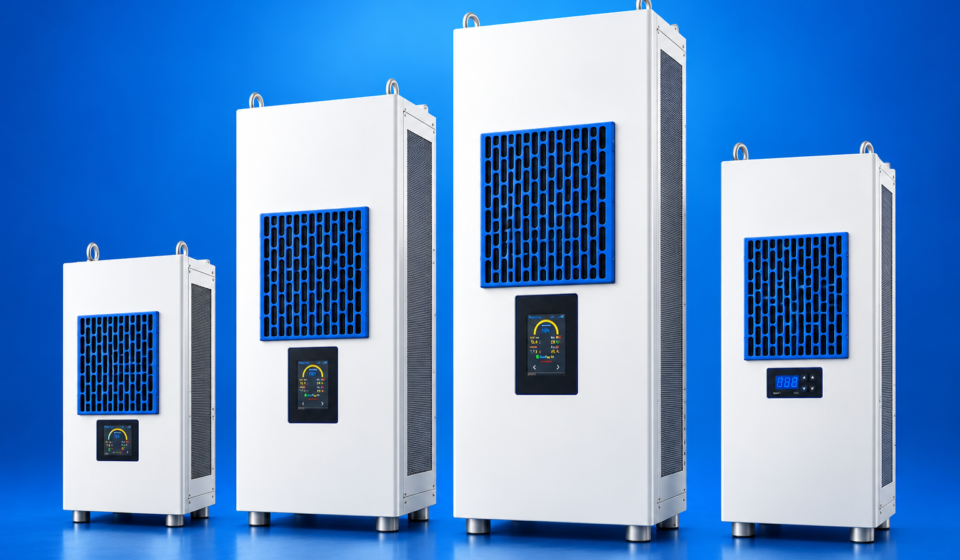
Haima Panel AC is an industrial enclosure-cooling solution developed by Pima Controls Pvt Ltd. Its product range features automatic air-filter-cleaning technology, multiple cooling capacities and advertised smart connectivity features for suitable industrial applications.
For manufacturers, machine builders, electrical panel manufacturers and industrial maintenance teams, selecting the right panel air conditioner involves more than checking its cooling capacity. Buyers should evaluate heat load, ambient temperature, energy consumption, filter maintenance, environmental protection and installation requirements.
Vipul HVAC Solution Pvt Ltd presents this guide to Haima Panel AC, its published model range, key features, industrial applications and practical selection criteria.
What Is Haima Panel AC?
Haima Panel AC is a dedicated air-conditioning system designed to cool electrical enclosures and industrial control cabinets. Unlike a conventional room air conditioner, a panel AC is designed for enclosure-mounted applications where sensitive electrical and electronic components need suitable operating temperatures.
Many industrial panel air conditioners use separate internal and external air circuits. The internal circuit removes heat from the enclosure, while the external circuit releases that heat into the surrounding environment. This design can reduce the entry of untreated ambient air into the cabinet, depending on the unit’s construction and installation.
Haima’s distinguishing feature is its automatic air-filter-cleaning mechanism, developed to reduce routine manual filter-cleaning work associated with dust accumulation.
Official product information: Haima Industrial Panel AC.
7 Key Benefits of Haima Panel AC
1. Automatic Filter-Cleaning Technology
Dust accumulation on a conventional panel AC filter can restrict airflow through the condenser. Restricted airflow may reduce heat-rejection performance and increase maintenance requirements.
Haima promotes an automatic filter-cleaning mechanism designed to reduce manual filter-cleaning work.
Potential benefits include:
- Reduced dependence on routine manual filter cleaning
- Easier maintenance planning in dusty industrial environments
- Support for condenser airflow when the system operates correctly
- Less time spent on repetitive filter-cleaning tasks
The actual benefit depends on the contamination type, operating conditions and product configuration. Automatic filter cleaning does not eliminate all inspection and servicing requirements.
2. Multiple Cooling-Capacity Options
Different electrical cabinets generate different amounts of heat. A small PLC enclosure may have a very different cooling requirement from a large cabinet containing several drives.
Haima’s published PAC range includes five models with different cooling capacities.
| Haima model | Published cooling capacity | Approximate capacity |
|---|---|---|
| PAC0500 | 505 W | 1,723 BTU/h |
| PAC1000 | 1,070 W | 3,651 BTU/h |
| PAC1500 | 1,580 W | 5,391 BTU/h |
| PAC2500 | 2,500 W | 8,530 BTU/h |
| PAC3500 | 3,660 W | 12,488 BTU/h |
Source: Haima official product range.
These are published model ratings. The cooling capacity available at a particular site can depend on ambient temperature and test conditions. Confirm the latest datasheet for the selected model before ordering.
Selection tip: Do not choose a panel AC solely from the model number. Calculate the cabinet’s heat load and check the unit’s cooling performance at the expected operating temperature.
3. Industrial Enclosure Cooling for Sensitive Equipment
VFDs, PLCs, power supplies and control components can generate substantial heat, particularly in continuously operating machinery.
A correctly selected panel air conditioner helps maintain the enclosure temperature required by the equipment manufacturer.
Haima Panel AC may be evaluated for applications such as:
- PLC and automation cabinets
- VFD and motor-drive panels
- MCC and electrical control panels
- CNC machine control cabinets
- Industrial machinery and production equipment
- Packaging and process-control systems
The suitable model depends on component heat dissipation, enclosure design, ambient temperature, desired internal temperature and installation conditions.
4. Smart Connectivity and Monitoring Features
Modern industrial facilities often need equipment status and cooling-system information to be available to maintenance teams or plant automation systems.
Haima advertises connectivity features across its product information, including:
- Modbus TCP
- Wi-Fi
- Bluetooth
- MQTT
These features may be useful for monitoring and integration, but the available interfaces and functions must be confirmed for the exact model and configuration.
If PLC or SCADA integration is required, request the relevant communication documentation, supported data points, alarm details and network requirements before finalising the design.
5. Energy Efficiency Considerations
The cost of operating a panel AC depends on its electrical power consumption, annual operating hours, electricity tariff and cooling requirements.
A useful efficiency measure is the Energy Efficiency Ratio (EER), calculated as:
EER = Cooling capacity (W) ÷ Electrical power input (W)
A higher EER generally indicates more cooling output per watt of electricity when ratings are compared under equivalent conditions.
When evaluating Haima Panel AC, check the published EER and electrical power input for the selected model. Also confirm whether the rating conditions match those used for competing products.
Important: Do not estimate electricity savings from cooling capacity alone. Use verified electrical input and realistic annual operating hours.
6. Construction Options for Different Environments
Industrial environments vary considerably. A dry manufacturing room may have different enclosure-cooling requirements from a coastal installation or a plant exposed to moisture and corrosive chemicals.
Haima’s published product information lists construction options including:
- Powder-coated GI
- Stainless steel SS304
- Stainless steel SS316
The correct material depends on the environmental exposure, corrosion risk, cleaning procedures and the manufacturer’s available model configurations.
Do not assume that a particular material is suitable for every chemical, washdown or outdoor application. Confirm the model-specific construction details and environmental limitations before procurement.
7. Maintenance Planning and Product Support
An industrial panel AC should be evaluated over its operating life, not just by its initial purchase price.
Important factors include:
- Filter-cleaning requirements
- Condenser and fan inspection
- Electrical and controller checks
- Condensate management
- Availability of spare parts
- Warranty coverage
- Service and maintenance arrangements
Haima’s automatic filter-cleaning feature is intended to reduce manual filter maintenance. However, other parts of the cooling unit still require inspection and servicing in accordance with the manufacturer’s instructions.
For critical production equipment, also consider the impact of cooling failure and the plant’s response procedures for high-temperature alarms.
Haima Panel AC Applications Across Industries
Electrical panel manufacturers
Panel builders can evaluate enclosure cooling during the design stage to help maintain the operating conditions required for installed electrical components.
Textile and spinning industries
Textile machinery can use VFDs, PLCs and automated controls. The appropriate cooling system depends on the cabinet heat load and the amount and type of airborne fibre present.
Engineering and CNC machining
CNC machines and production equipment may contain compact electrical cabinets with drives, controllers and power electronics. Correct cooling selection helps manage heat generated during operation.
Chemical and process industries
Electrical panels may operate in hot or demanding environments. Check the ambient-temperature rating, enclosure protection, material compatibility and any applicable area-classification requirements.
Packaging and manufacturing
Packaging lines, conveyors, automated machines and production systems can use multiple electrical cabinets. A consistent approach to heat-load calculation and panel cooling can simplify equipment selection and maintenance planning.
Water treatment and utilities
Pump controls, automation panels and utility systems may operate in locations where access is difficult. Automatic filter cleaning may be worth evaluating where routine manual cleaning is a recurring maintenance task.
These are potential application categories, not a guarantee that every Haima model is suitable for every environment. Always confirm the product’s technical limits.
How to Choose the Right Haima Panel AC Model
Before selecting a model, collect the following information.
Step 1: Calculate the enclosure heat load.
Identify the heat dissipated by VFDs, PLCs, power supplies, transformers and other components. Use component heat-loss data wherever available.
Step 2: Establish the temperature requirements.
Record the maximum ambient temperature near the cooling unit and the desired internal cabinet temperature.
Step 3: Check the required cooling capacity.
Compare the calculated heat load with the model’s available cooling capacity at the actual operating conditions.
Step 4: Confirm electrical compatibility.
Verify supply voltage, phase, frequency, rated current, electrical input and required circuit protection.
Step 5: Review environmental conditions.
Identify dust, fibre, oil mist, moisture, chemical exposure and outdoor conditions.
Step 6: Check mounting and enclosure protection.
Confirm dimensions, cut-out requirements, clearance, condensate arrangements and the protection rating of the complete installed assembly.
Step 7: Verify controls and support.
Check communication requirements, alarms, warranty terms, maintenance instructions and spare-parts availability.
A technically suitable model is one that meets the actual enclosure requirements—not simply the one with the largest capacity.
Haima Panel AC vs Conventional Panel AC
| Evaluation factor | Conventional panel AC | Haima Panel AC |
|---|---|---|
| Filter maintenance | Depends on the filter design and manual servicing requirements | Automatic filter-cleaning technology is advertised |
| Cooling capacity | Varies by model | Multiple published PAC capacities |
| Monitoring | Depends on the model | Connectivity features are advertised; verify exact configuration |
| Energy efficiency | Compare model-specific ratings | Check published EER and electrical input |
| Environmental suitability | Verify model and enclosure requirements | Verify model-specific materials and operating limits |
| Routine servicing | Follow manufacturer instructions | Follow manufacturer instructions; self-cleaning does not eliminate all maintenance |
This is a feature comparison, not an independent performance test. Buyers should compare equivalent cooling capacities, operating conditions and complete technical specifications.
Why Consider Vipul HVAC Solution Pvt Ltd?
Vipul HVAC Solution Pvt Ltd supports industrial and commercial HVAC enquiries, including equipment-cooling requirements for electrical cabinets and automation systems.
If you are evaluating Haima Panel AC for a new project or an existing plant, prepare the cabinet dimensions, estimated heat load, ambient temperature, required internal temperature and environmental conditions.
These details help make the technical discussion and model-selection process more productive.
For enquiries, call +91 8000392000.
Website: Vipul HVAC Solution Pvt Ltd
Please confirm current product availability, sourcing arrangements, warranty and any authorised-dealer status before placing an order.
Frequently Asked Questions
1. What is Haima Panel AC used for?
Haima Panel AC is designed for industrial enclosure cooling applications, including suitable PLC cabinets, VFD panels, MCC panels and industrial automation enclosures.
2. What is the cooling capacity of Haima Panel AC?
The published PAC series includes PAC0500 at 505 W, PAC1000 at 1,070 W, PAC1500 at 1,580 W, PAC2500 at 2,500 W and PAC3500 at 3,660 W. Confirm the latest datasheet and rating conditions before selecting a model.
3. What makes Haima Panel AC different?
Haima promotes automatic air-filter-cleaning technology designed to reduce routine manual filter-cleaning work. It also advertises connectivity features across its product information.
4. Can Haima Panel AC be used for VFD and PLC panels?
It may be suitable for these applications when the selected model meets the cabinet’s heat load, ambient temperature, internal temperature and installation requirements.
5. Does automatic filter cleaning mean no maintenance is required?
No. The feature is intended to reduce manual filter-cleaning work. Other inspections and servicing remain necessary according to the manufacturer’s instructions.
6. Is Haima Panel AC suitable for high-ambient industrial environments?
Haima publishes product information for ambient temperatures up to 50°C. Confirm the precise operating limits and available cooling performance of the model being considered.
7. How do I select the right Haima Panel AC model?
Calculate the enclosure heat load, establish the required internal temperature and maximum ambient temperature, and compare those requirements with the model-specific performance data.
8. How can I enquire about Haima Panel AC through Vipul HVAC Solution Pvt Ltd?
Call +91 8000392000 and provide your cabinet dimensions, estimated heat load, site ambient temperature, environment and preferred mounting arrangement.
Conclusion
Haima Panel AC is an industrial enclosure-cooling option worth evaluating for electrical cabinets, VFD panels, PLC systems and automation equipment. Its published PAC range offers multiple cooling capacities, while its automatic filter-cleaning technology is designed to reduce routine manual filter maintenance.
The best model depends on accurate heat-load calculations, operating ambient temperature, electrical compatibility, environmental protection and maintenance requirements.
For technical and commercial enquiries, contact Vipul HVAC Solution Pvt Ltd at +91 8000392000 and share your panel-cooling requirements.
Important links: