

Self-Cleaning Panel Air Conditioner: How Auto Filter Cleaning Keeps Panels Cool
In a dusty industrial plant, a panel air conditioner’s filter can become a maintenance weak point. As dust accumulates, airflow across the condenser may become restricted, affecting heat rejection and potentially reducing cooling performance. If the problem goes unnoticed, electrical cabinets can become hotter even while the cooling unit continues to run.
A self-cleaning panel air conditioner is designed to address this problem by automatically cleaning its filter and reducing the need for routine manual filter cleaning.
For facilities operating VFD panels, PLC cabinets, MCC panels, CNC machines and industrial automation systems, this technology can help simplify maintenance and support consistent enclosure cooling.
Haima Panel AC features an automatic air-filter-cleaning mechanism designed for industrial environments. In this guide, Vipul HVAC Solution Pvt Ltd explains how automatic filter cleaning works, why condenser airflow matters, and what industrial buyers should evaluate before choosing a self-cleaning panel AC.
What Is a Self-Cleaning Panel Air Conditioner?
A self-cleaning panel air conditioner is an industrial enclosure cooling unit equipped with a mechanism designed to clean its filter automatically.
A conventional panel AC commonly relies on periodic manual filter inspection, cleaning or replacement, depending on its design. In a dusty environment, delaying this work can allow contamination to build up and restrict airflow.
A self-cleaning design aims to reduce this dependence on manual filter cleaning.
The unit still performs the primary function of an industrial panel AC: removing heat from an electrical enclosure and rejecting that heat into the surrounding environment.
Common applications
Self-cleaning panel air conditioners may be worth evaluating for:
- VFD panels and variable-speed drive cabinets
- PLC and industrial automation panels
- MCC and motor-control cabinets
- CNC machine control enclosures
- Textile machinery and spinning plants
- Cement, steel and manufacturing facilities
- Packaging and process-control equipment
- Remote electrical cabinets where maintenance access is difficult
The suitability of any model depends on the heat load, ambient temperature, dust characteristics and installation conditions.
Why Is the Filter a Critical Part of Panel AC Performance?
Many industrial panel air conditioners use separate internal and external air circuits. The internal circuit circulates air through the enclosure and removes heat. The external circuit passes ambient air across the condenser to release that heat.
The external filter helps limit the entry of airborne contaminants into the relevant airflow path, depending on the unit’s design.
When the filter becomes clogged, airflow can fall. Reduced airflow can make it harder for the condenser to reject heat, potentially increasing refrigeration-system operating pressure and reducing cooling performance.
The resulting problems may include:
- Higher operating temperatures
- Reduced heat rejection
- Increased compressor operating stress
- More frequent maintenance interventions
- Cooling alarms or protective shutdowns in some operating conditions
A clogged filter is not the only possible cause of poor cooling. Dirty condenser surfaces, blocked air outlets, excessive heat load, refrigerant problems, faulty fans and high ambient temperatures can also affect performance.
The key point: Filter cleaning is an important part of panel AC maintenance, especially where airborne contamination is heavy.
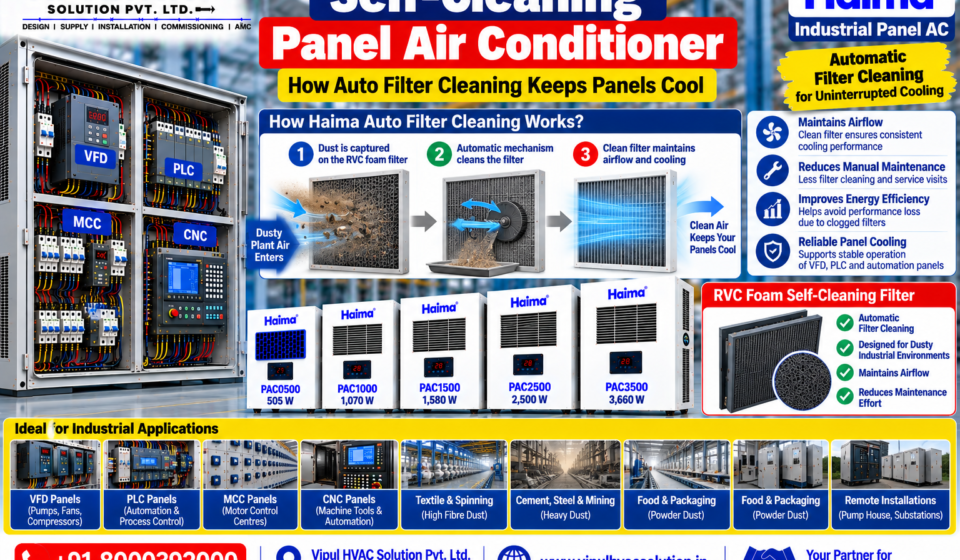
How Does Haima’s Automatic Filter-Cleaning Technology Work?
Haima’s official product information describes an RVC foam self-cleaning filter mechanism intended to address dust accumulation on the condenser air path.
The purpose is to reduce the need for routine manual filter cleaning and help maintain airflow during operation.
The exact cleaning sequence, operating conditions and handling of collected dust should be confirmed in the current model documentation.
1. Automatic filter cleaning
The self-cleaning mechanism is designed to clean the filter automatically rather than relying entirely on a technician to remove and clean it on a schedule.
This can be useful in facilities where dust accumulates regularly and manual cleaning requires repeated maintenance visits.
2. Support for consistent condenser airflow
A cleaner filter can help the condenser maintain the airflow required for heat rejection. The actual cooling result still depends on condenser cleanliness, ambient temperature, fan performance and correct equipment sizing.
3. Reduced routine filter-cleaning work
When automatic cleaning operates as intended, technicians may spend less time carrying out manual filter-cleaning tasks.
The unit must still be inspected and maintained according to the manufacturer’s instructions.
4. Potentially simpler maintenance planning
Automatic filter cleaning can reduce dependence on fixed manual filter-cleaning intervals. Maintenance teams can use their time for inspections and other servicing activities rather than repeatedly removing filters.
Read more about the product range on the official Haima industrial panel AC website.
7 Key Benefits of a Self-Cleaning Panel Air Conditioner
1. Helps maintain condenser airflow
Airflow is essential for transferring heat from the condenser to the surrounding environment. A filter-cleaning mechanism is designed to reduce the accumulation of dust that can restrict this airflow.
Actual airflow performance should be confirmed under the site’s operating conditions.
2. Reduces manual filter-cleaning requirements
Conventional filters may need regular inspection and cleaning, particularly in dusty plants. Automatic cleaning can reduce the number of manual filter-cleaning tasks, depending on contamination levels and the equipment’s design.
This is especially relevant when many electrical cabinets are distributed across a large factory.
3. Supports reliable electrical panel cooling
VFDs, PLCs, power supplies and other electronic components generate heat. Maintaining appropriate enclosure temperatures helps equipment operate within its specified environmental limits.
A self-cleaning filter can help support the cooling system, but it cannot compensate for an undersized AC, excessive heat load or a blocked condenser outlet.
4. May reduce maintenance costs
Filter servicing involves technician time, access arrangements and sometimes production coordination.
Reducing routine filter-cleaning work can lower the labour associated with that task. The actual savings depend on the existing cleaning frequency, labour rates, number of units and site conditions.
Haima advertises maintenance-cost reductions associated with its automatic filter-cleaning technology. Treat these as manufacturer claims rather than guaranteed savings for every installation.
5. Helps maintenance teams manage remote panels
Some electrical cabinets are installed in remote pump houses, substations, utility areas or locations with restricted access.
Automatic filter cleaning can reduce the need for routine visits specifically to clean the filter. Other inspections and maintenance activities may still require site access.
6. Can support operating efficiency
A restricted condenser airflow path can impair heat rejection. Keeping the filter clean can help the cooling unit operate closer to its intended performance, provided other operating conditions remain suitable.
However, energy savings should not be assumed from the filter feature alone. Compare actual or documented power consumption under equivalent conditions.
7. Adds value to industrial panel cooling design
When selecting a panel AC, buyers should consider not only cooling capacity but also maintenance requirements, operating conditions and monitoring features.
A self-cleaning design can be a useful advantage in dusty environments where manual filter servicing is frequent or difficult to organise.
Conventional Panel AC vs Self-Cleaning Panel AC
| Comparison factor | Conventional filter design | Self-cleaning filter design |
|---|---|---|
| Filter cleaning | Usually manual, as specified by the manufacturer | Automatic cleaning mechanism reduces routine manual cleaning |
| Maintenance planning | Depends on inspections and cleaning intervals | Less dependence on manual filter-cleaning schedules |
| Airflow management | Filter restriction may occur if cleaning is delayed | Designed to reduce dust-related filter restriction |
| Technician access | May be needed for routine filter cleaning | May be reduced for filter cleaning |
| Other servicing | Still required | Still required |
| Cooling capacity | Depends on model and operating conditions | Depends on model and operating conditions |
| Energy consumption | Depends on actual operating conditions | Must be verified using comparable performance data |
Automatic filter cleaning does not make all self-cleaning panel ACs identical. Buyers should compare the cooling capacity, electrical input, ambient limits, protection rating, controls, dimensions and maintenance requirements of each model.
Where Does Automatic Filter Cleaning Make the Most Sense?
The value of self-cleaning technology is often greatest where filter contamination or maintenance access creates recurring problems.
Textile and spinning plants
Fibre and lint can accumulate on filters and heat-exchanger surfaces. Evaluate the filter technology against the actual fibre characteristics and plant cleaning procedures.
Cement and building-material facilities
Dust can be heavy in cement handling, grinding and material-processing areas. Consider the entire cooling unit’s environmental suitability, including its condenser and installation location.
Steel and metalworking plants
Grinding particles, dust and other contaminants may affect cooling equipment. Where oil mist or metal particles are present, confirm that the filter mechanism is suitable for those specific contaminants.
CNC and machining facilities
Machining environments can include coolant mist, lubricant vapour and metallic particles. Do not assume that a filter designed for ordinary dust will handle oil mist or every machining contaminant.
Packaging and food-processing facilities
Powder, paper fibres and packaging debris may affect filters. Confirm the cleaning method, hygiene requirements and environmental suitability before specifying the equipment.
Remote installations
Substations, pump houses and isolated cabinets may require extra travel and access coordination for routine filter cleaning. Reducing those tasks may help simplify the maintenance schedule.
Haima Panel AC: Models and Cooling Capacities
Haima’s published PAC series includes five cooling capacities for different enclosure heat loads.
| Haima model | Published cooling capacity | Approximate BTU/h |
|---|---|---|
| PAC0500 | 505 W | 1,723 |
| PAC1000 | 1,070 W | 3,651 |
| PAC1500 | 1,580 W | 5,391 |
| PAC2500 | 2,500 W | 8,530 |
| PAC3500 | 3,660 W | 12,488 |
Source: Haima official product range.
These are published model ratings, not guaranteed cooling outputs at every ambient temperature. Check the latest datasheet for the selected model and its rated operating conditions.
What makes Haima worth evaluating?
Haima’s product information highlights:
- Automatic air-filter-cleaning technology
- A range of cooling capacities
- Built-in connectivity features, including Modbus TCP, Wi-Fi, Bluetooth and MQTT
- A design intended for industrial enclosure cooling
- Published ambient-temperature capability up to 50°C
Confirm the exact configuration, interfaces and operating limits for the model being quoted. Automatic filter cleaning is one part of the product specification, not a substitute for checking the unit’s full engineering suitability.
How to Select the Right Self-Cleaning Panel AC
Use the following checklist before purchasing.
- Calculate the heat load. Estimate the heat dissipated by drives, power supplies, contactors, transformers and other components.
- Record the maximum ambient temperature. Use realistic measurements near the installation, including hot-season conditions.
- Verify cooling capacity at the required conditions. Do not rely on the headline capacity alone.
- Identify the contaminants. Describe whether the environment contains fibre, fine dust, abrasive particles, oil mist or chemical vapours.
- Confirm filter compatibility. Ask the manufacturer how the automatic cleaning mechanism handles your contaminant type.
- Check electrical specifications. Verify supply voltage, phase, frequency, current and power input.
- Review enclosure protection. Confirm the required IP rating and whether the complete installed assembly will meet it.
- Check controls and alarms. Confirm any required temperature monitoring, fault outputs and PLC/SCADA interfaces.
- Review servicing requirements. Automatic filter cleaning does not remove the need for inspections and other maintenance.
Calculate the Potential Maintenance Benefit
You can estimate the current labour spent on manual filter cleaning before comparing a conventional unit with a self-cleaning alternative.
Formula:
Annual filter-cleaning labour hours = Number of panel AC units × Annual cleaning visits per unit × Labour hours per visit
Illustrative example
Assume a factory has 40 panel AC units. Each filter is manually cleaned 17 times per year, and each cleaning takes 20 minutes.
Annual labour hours:
40 × 17 × (20 ÷ 60) = approximately 227 labour hours per year.
This estimate represents filter-cleaning labour only. It does not include travel, permits, shutdown coordination or other maintenance activities.
To estimate the potential benefit of a self-cleaning unit, compare the current cleaning workload with the actual remaining maintenance tasks specified by the manufacturer. Do not assume all 227 hours will be eliminated.
What Automatic Filter Cleaning Cannot Fix
A self-cleaning panel AC is not a solution to every cooling problem.
Incorrect cooling capacity: If the unit is undersized for the enclosure’s heat load, cleaning the filter will not make up the capacity shortfall.
Blocked condenser airflow: Obstructed air inlets or outlets and dirty heat-exchanger surfaces can still impair cooling.
Poor enclosure sealing: Damaged gaskets, open doors and unsealed cable entries can allow dust and moisture to enter the cabinet.
Unsuitable environmental conditions: Oil mist, corrosive vapours or special washdown requirements need separate suitability checks.
Other equipment faults: A failed fan, sensor, compressor or control component may require diagnosis and repair.
Automatic filter cleaning should therefore be treated as a maintenance feature within a properly sized and correctly installed cooling system.
Why Choose Vipul HVAC Solution Pvt Ltd for Your Panel AC Enquiry?
Vipul HVAC Solution Pvt Ltd supports industrial HVAC and equipment-cooling enquiries. If you are considering Haima Panel AC for VFD, PLC, MCC, CNC or automation cabinets, prepare your application details before requesting a quotation.
Share:
- Number of panels requiring cooling
- Cabinet dimensions and estimated heat load
- Maximum ambient temperature at the installation
- Dust, fibre, oil mist or other contaminants
- Current filter-cleaning interval
- Electrical supply and mounting requirements
- Required monitoring and communication features
These details help establish the required cooling capacity and identify which product features matter most for the application.
For industrial panel AC enquiries, call +91 8000392000.
Website: Vipul HVAC Solution Pvt Ltd
You can also review the Haima product range for published model information.
Frequently Asked Questions
1. What is a self-cleaning panel air conditioner?
It is an industrial enclosure air conditioner equipped with a mechanism designed to clean its filter automatically and reduce the need for routine manual filter cleaning.
2. How does automatic filter cleaning help keep panels cool?
By reducing dust accumulation on the filter, the mechanism is designed to help maintain airflow through the condenser. Actual cooling performance still depends on correct sizing, ambient temperature, condenser condition and installation.
3. Does Haima Panel AC have automatic filter cleaning?
Yes. Haima’s official product information describes an RVC foam self-cleaning filter mechanism for its industrial panel AC range.
4. Does a self-cleaning panel AC eliminate all maintenance?
No. It can reduce routine manual filter-cleaning requirements, but the unit still needs inspection and servicing according to the manufacturer’s instructions.
5. Can automatic filter cleaning reduce electricity consumption?
A clean filter can help avoid airflow restrictions that may impair heat rejection. However, energy savings depend on the operating conditions and the unit’s actual power consumption. Request comparable performance data before estimating savings.
6. Which Haima Panel AC model should I choose?
Haima’s published models range from PAC0500 at 505 W to PAC3500 at 3,660 W. The correct choice depends on the enclosure heat load, maximum ambient temperature and required internal temperature.
7. Is a self-cleaning panel AC suitable for oil mist?
Suitability depends on the filter design and the specific contaminant. Ask the manufacturer to confirm whether the cleaning mechanism and materials are suitable for the oil mist or coolant present at your site.
8. How can I request a quotation from Vipul HVAC Solution Pvt Ltd?
Call +91 8000392000 and share the panel dimensions, heat load, ambient temperature, environmental conditions and number of units required.
Conclusion
A self-cleaning panel air conditioner can help reduce the maintenance burden associated with dust accumulation on conventional filters. By automatically cleaning the filter, the system is designed to support condenser airflow and reduce the need for repeated manual filter servicing.
Haima Panel AC combines an automatic filter-cleaning mechanism with a range of industrial cooling capacities and advertised connectivity features. The right model should still be selected using verified heat-load calculations, ambient performance data and environmental requirements.
For industrial panel cooling enquiries, contact Vipul HVAC Solution Pvt Ltd at +91 8000392000.

[…] Self-Cleaning Panel Air Conditioner […]