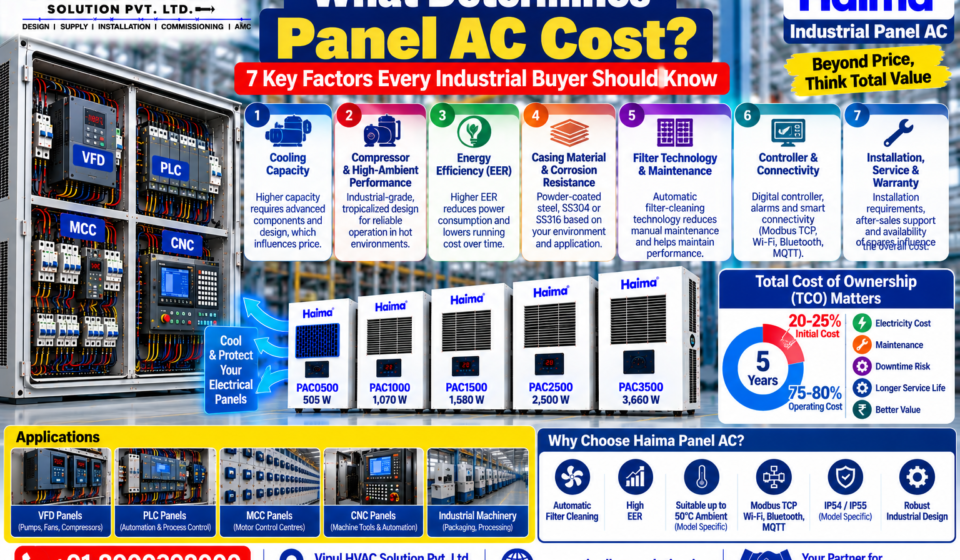

What Determines Panel AC Cost? 7 Key Factors Every Industrial Buyer Should Know
When comparing quotations for an industrial panel air conditioner, the lowest purchase price does not always represent the best value. Two units may appear similar in cooling capacity, electrical supply and controller features, yet differ in energy efficiency, maintenance requirements, environmental suitability and long-term operating costs.
For industrial facilities, choosing the right panel AC is important because excessive heat inside an electrical enclosure can affect drives, PLCs, power supplies, automation equipment and production reliability.
So, what determines panel AC cost? The answer includes more than the compressor or cooling capacity. The final price depends on the unit’s engineering, performance ratings, construction materials, filter technology, control features, installation requirements and after-sales support.
This guide from Vipul HVAC Solution Pvt Ltd explains the seven major factors that influence industrial panel AC cost and how Haima Panel AC can be evaluated when comparing products for industrial applications.
What Is an Industrial Panel AC?
An industrial panel air conditioner is a specialised cooling unit designed to remove heat from electrical cabinets and industrial control enclosures.
Unlike a conventional room air conditioner, a panel AC is designed around the thermal requirements of electrical equipment. Many models use separate internal and external air circuits to cool the enclosure while rejecting heat into the surrounding environment.
Common applications include:
- VFD panels and motor-drive cabinets
- PLC and automation control panels
- MCC and electrical distribution panels
- CNC machine cabinets
- Robotic production lines
- Industrial machinery and process-control systems
- SCADA and communication enclosures
The correct unit must provide enough cooling at the actual site ambient temperature while meeting the enclosure’s environmental and electrical requirements.
1. Cooling Capacity: The First Factor Affecting Panel AC Cost
Cooling capacity is one of the main factors influencing the price of an industrial panel air conditioner. Higher-capacity models generally require different component sizing, heat exchangers and airflow arrangements.
Cooling capacity is commonly expressed in watts (W), kilowatts (kW) or BTU/h.
Useful conversions:
- 1 kW = 1,000 W
- 1 W ≈ 3.412 BTU/h
- 1,000 W ≈ 3,412 BTU/h
A small PLC enclosure with a relatively low heat load may need a different cooling solution from a large VFD cabinet containing several drives.
Haima Panel AC cooling capacity range
Haima’s published PAC series includes the following models and cooling capacities.
| Haima model | Published cooling capacity | Approximate cooling output |
|---|---|---|
| PAC0500 | 505 W | 1,723 BTU/h |
| PAC1000 | 1,070 W | 3,651 BTU/h |
| PAC1500 | 1,580 W | 5,391 BTU/h |
| PAC2500 | 2,500 W | 8,530 BTU/h |
| PAC3500 | 3,660 W | 12,488 BTU/h |
Source: Official Haima industrial panel AC product range.
These ratings are useful for comparing model sizes, but they do not determine the purchase price on their own.
Before selecting a model, calculate the enclosure heat load and check the cooling capacity available at the expected operating ambient temperature. A unit’s nominal capacity should not automatically be assumed to remain unchanged in a very hot factory.
Buying tip: Do not purchase a larger or smaller panel AC based only on the model number. Ask for technical sizing support using your cabinet dimensions, heat load, maximum ambient temperature and desired internal temperature.
2. Compressor, Refrigeration System and High-Ambient Performance
The compressor and refrigeration circuit are central to an industrial panel AC’s cooling performance. Their design, operating limits and serviceability can influence the price.
When comparing quotations, evaluate:
- Compressor type and manufacturer documentation
- Permitted operating ambient temperature
- Cooling performance at high ambient conditions
- Condenser and evaporator design
- Refrigerant and service requirements
- Availability of replacement components
- Protection against abnormal operating conditions
A panel AC installed in a hot industrial shed may face different operating conditions from one installed in a temperature-controlled electrical room.
As surrounding temperatures increase, the refrigeration system may have to work harder to reject heat. The actual available cooling capacity and operating power should therefore be checked at the intended site conditions.
Haima Panel AC for industrial environments
Haima describes its PAC series as designed for industrial enclosure cooling, with heat-exchanger components intended for high heat exchange at ambient temperatures up to 50°C. Confirm the exact model’s operating limits and performance data before finalising a purchase.
Do not assume that every industrial panel AC can operate continuously at 55°C. Any higher-temperature capability should be supported by the manufacturer’s documentation.
3. Energy Efficiency Ratio (EER) and Electricity Cost
The initial purchase price is only one part of the cost of owning an industrial panel AC. Electricity consumption can be significant when the unit operates for long shifts or around the clock.
Energy Efficiency Ratio (EER) expresses the relationship between cooling output and electrical power input under specified rating conditions.
Formula:
EER = Cooling capacity (W) ÷ Electrical power input (W)
For example, a unit delivering 1,500 W of cooling with an electrical input of 1,000 W has an EER of 1.5 at those conditions.
A unit with a higher EER generally provides more cooling output per watt of electricity when compared under equivalent test conditions.
Haima PAC model EER values
Haima’s official product page publishes these EER values for its PAC models.
| Haima model | Published cooling capacity | Published EER |
|---|---|---|
| PAC0500 | 505 W | 1.68 |
| PAC1000 | 1,070 W | 2.10 |
| PAC1500 | 1,580 W | 2.32 |
| PAC2500 | 2,500 W | 2.29 |
| PAC3500 | 3,660 W | 2.85 |
Source: Haima official product page.
These are published product values. For a cost comparison, verify that the EER ratings use comparable test conditions and check the latest model datasheet.
How to estimate annual running cost
Use this formula:
Annual electricity cost = Power input (kW) × Annual operating hours × Electricity tariff (₹/kWh)
Illustrative example
Assume a panel AC consumes 0.70 kW, operates for 6,500 hours annually and electricity costs ₹9.50 per kWh.
Annual electricity consumption:
0.70 × 6,500 = 4,550 kWh
Annual electricity cost:
4,550 × ₹9.50 = ₹43,225
This is an example calculation, not a verified power-consumption figure for a specific Haima model. Actual consumption depends on the unit, ambient temperature, thermostat operation and load conditions.
Why EER matters when comparing quotations
A lower-priced model may not be the least expensive option over its operating life. Compare the purchase price alongside verified electrical input, annual operating hours, maintenance needs and expected service life.
Do not calculate savings from EER alone if the units have different cooling capacities or rating conditions.
4. Casing Material and Corrosion Resistance
The material used for the cooling unit’s cabinet and external components can affect its price and suitability for the installation environment.
Common materials to evaluate include:
Powder-coated steel
Powder-coated steel may suit many general industrial environments where exposure to corrosive chemicals and frequent washdown is limited. The quality of surface preparation, coating and finishing affects corrosion resistance.
Stainless steel SS304
SS304 may be appropriate for certain food-processing, pharmaceutical and washdown applications, depending on the chemicals and cleaning procedures used.
Stainless steel SS316
SS316 may be considered for more demanding corrosive environments, including certain coastal or chemical-process applications. Actual suitability depends on the specific contaminants, concentration, temperature and cleaning method.
Haima’s published product information lists construction options including powder-coated GI, SS304 and SS316. Confirm which material is available for the model being quoted and whether it applies to the complete relevant assembly.
Important: Do not assume that stainless-steel construction is always necessary. Select the material according to the actual environment, required corrosion resistance and maintenance plan.
5. Filter Technology and Maintenance Requirements
Dust, fibres, oil mist and other airborne contaminants can restrict condenser airflow. Poor heat rejection can affect cooling performance and may increase maintenance requirements.
A conventional panel AC may use a filter that requires periodic inspection, cleaning or replacement. The frequency depends on the operating environment and the manufacturer’s instructions.
When comparing units, ask about:
- Filter material and construction
- Ease of filter access
- Cleaning and replacement procedure
- Recommended inspection intervals
- Suitability for dust or oil mist
- Availability of replacement parts
- Condenser cleaning requirements
Haima’s automatic filter-cleaning technology
Haima promotes an automatic air-filter-cleaning mechanism intended to address filter clogging and reduce routine manual cleaning work.
Potential advantages include reduced manual filter servicing and support for consistent airflow when the mechanism operates as intended. The actual benefit depends on the contaminants present, installation conditions and the maintenance instructions for the selected model.
Automatic filter cleaning should not be interpreted as a guarantee that the entire panel AC will never require maintenance. Other components still need inspection and servicing as recommended by the manufacturer.
For industrial buyers, this feature is worth considering when comparing lifecycle costs, especially in dusty environments where manual filter servicing can require repeated technician visits.
6. Controller, Connectivity and Alarm Features
The controller determines how the panel AC monitors temperature and manages cooling operation. More advanced control and communication features can affect the overall product specification and price.
Features to evaluate include:
- Digital temperature display
- Adjustable temperature setpoint
- Temperature sensor accuracy
- Compressor protection functions
- High-temperature and fault alarms
- Relay outputs for external monitoring
- Communication interfaces for PLC or SCADA integration
Not every application needs every feature. A small standalone cabinet may require only local temperature control, while a critical automated production line may benefit from remote monitoring and fault alerts.
Haima smart connectivity
Haima advertises built-in Modbus TCP, Wi-Fi, Bluetooth and MQTT connectivity across its product range. These features may be useful where plant monitoring, remote status checks or integration with automation systems is required.
Before including these capabilities in a project specification, confirm the exact model’s supported interfaces, data points, alarm functions and network requirements.
When comparing quotations, ask whether the required communication functionality is included in the quoted configuration or requires additional equipment or integration work.
7. Installation, Service Support and Warranty
The quoted price may exclude installation work, electrical protection, enclosure modifications or commissioning. These items should be reviewed before comparing supplier quotations.
Check whether the quotation includes:
- Cooling unit and standard accessories
- Mounting cut-out and installation work
- Electrical wiring and protection
- Condensate drain or evaporation arrangements
- Commissioning and functional checks
- Warranty terms and exclusions
- Service response arrangements
- Spare parts and ongoing maintenance support
The final installation cost depends on the cabinet design, mounting position, accessibility, wiring requirements and site conditions.
Also check that installing the unit will not compromise the cabinet’s required ingress protection rating. The complete installed assembly must meet the environmental requirements of the application.
Compare the full quotation, not only the equipment price
Ask each supplier to separate equipment cost, installation cost, optional features, taxes, transport and commissioning charges. This helps identify differences between quotations that may otherwise appear similar.
Initial Price vs Total Cost of Ownership
Total Cost of Ownership (TCO) considers the costs associated with purchasing and operating equipment over a defined period.
For an industrial panel AC, relevant costs can include:
| Cost category | What to consider |
|---|---|
| Purchase price | Base unit, selected model and optional features |
| Installation | Mounting, cut-outs, electrical work and commissioning |
| Electricity | Measured or documented power input and annual operating hours |
| Maintenance | Inspection, cleaning, consumables and service labour |
| Repairs | Parts, labour and repair-related downtime |
| Production risk | Potential impact of enclosure overheating or cooling failure |
The relative share of each category varies by site. There is no universal rule that purchase price accounts for a fixed percentage of lifecycle cost.
Calculate a simple five-year ownership estimate
Use the following structure:
Five-year TCO = Purchase price + Installation cost + Five-year electricity cost + Five-year maintenance cost + Expected repair cost
If production downtime is included, estimate it separately using realistic plant-specific data. Avoid treating hypothetical downtime figures as guaranteed savings.
This approach makes it easier to compare a low-cost model with a higher-efficiency or lower-maintenance alternative.
How to Compare Two Industrial Panel AC Quotations
Use this practical checklist when evaluating conventional panel AC models and Haima Panel AC.
| Parameter | What to verify |
|---|---|
| Cooling capacity | Rated watts and test conditions |
| High-ambient performance | Available capacity at the actual site temperature |
| Electrical input | Power consumption under comparable conditions |
| EER | Published efficiency rating and test conditions |
| Filter design | Cleaning method and maintenance requirements |
| Casing material | Suitability for dust, moisture and corrosion |
| Controller | Temperature control, protection and alarms |
| Connectivity | Required communication interfaces and integration |
| Installation | Mounting, sealing, wiring and condensate arrangements |
| Warranty | Coverage, exclusions and service process |
| Total cost | Purchase, installation, energy and maintenance |
For an accurate comparison, request the same information from each supplier. If the test conditions or included features differ, the quotations are not directly equivalent.
What Information Is Needed for an Industrial Panel AC Quote?
To help a supplier recommend a suitable unit, prepare the following details:
- Cabinet dimensions: Height, width and depth.
- Heat load: Heat dissipated by VFDs, drives, power supplies, transformers and other components.
- Site location: City and maximum expected ambient temperature around the enclosure.
- Required internal temperature: Based on the operating limits of the installed components.
- Environment: Dust, oil mist, moisture, chemicals or outdoor exposure.
- Electrical supply: Available voltage, phase and frequency.
- Mounting arrangement: Door-mounted, side-mounted or roof-mounted, as applicable.
- Control requirements: Local control, alarm relay, PLC integration or remote monitoring.
- Service requirements: Warranty, maintenance and spare-parts expectations.
Providing this information reduces uncertainty and helps the supplier recommend a model based on engineering requirements rather than price alone.
Why Consider Haima Panel AC?
Haima’s published PAC series offers five cooling capacities from 505 W to 3,660 W. The product range also advertises automatic filter cleaning and built-in connectivity features.
These features may be relevant for plants seeking to manage filter maintenance and monitor electrical enclosure cooling. The best choice depends on the application, actual heat load, ambient temperature, environmental conditions and required controls.
Before placing an order, request the latest datasheet and quotation for the exact model. Confirm cooling capacity, electrical input, ambient operating limits, casing options, warranty and included features.
You can explore the official Haima industrial panel AC range.
Industrial Panel AC Enquiries from Vipul HVAC Solution Pvt Ltd
Vipul HVAC Solution Pvt Ltd supports industrial HVAC and equipment-cooling enquiries. If you are comparing panel AC quotations for PLC, VFD, MCC or CNC cabinets, provide your enclosure details and operating conditions so that the required specifications can be reviewed.
For enquiries, call: +91 8000392000
Website: Vipul HVAC Solution Pvt Ltd
Discuss your application requirements, preferred model, installation conditions and service expectations before finalising the purchase.
Frequently Asked Questions
1. What determines industrial panel AC cost?
The main factors include cooling capacity, refrigeration-system design, high-ambient performance, energy efficiency, casing material, filter technology, controller features, installation requirements and after-sales support.
2. Is a higher-capacity panel AC always more expensive?
Higher-capacity models often require different components and heat exchangers, but the final price depends on the complete specification, construction and included features. Compare the required cooling duty rather than capacity alone.
3. Does Haima Panel AC have different cooling capacities?
Yes. Haima’s published PAC series includes PAC0500 at 505 W, PAC1000 at 1,070 W, PAC1500 at 1,580 W, PAC2500 at 2,500 W and PAC3500 at 3,660 W. Confirm current specifications and availability before ordering.
4. Does EER affect panel AC running cost?
Yes. EER relates cooling output to electrical input under specified conditions. A higher EER generally indicates better efficiency when ratings are compared under equivalent conditions. Actual running costs depend on power draw, operating hours and the electricity tariff.
5. How does automatic filter cleaning affect maintenance cost?
Automatic filter cleaning is intended to reduce manual filter-cleaning work. The actual benefit depends on site contamination, operating conditions and the maintenance requirements of the selected unit. It does not eliminate all servicing.
6. Does stainless steel increase panel AC cost?
Stainless-steel construction can affect price compared with powder-coated steel. The correct material depends on corrosion exposure, cleaning procedures and the environmental requirements of the installation.
7. What should I check before accepting a panel AC quotation?
Check the cooling capacity at the required ambient temperature, electrical input, EER, casing material, filter system, controller functions, mounting requirements, warranty and total installation cost.
8. How can I request a panel AC quotation from Vipul HVAC Solution Pvt Ltd?
Call +91 8000392000 and share the cabinet dimensions, heat load, site ambient temperature, required internal temperature, environment and preferred mounting arrangement.
Conclusion
Understanding what determines panel AC cost helps industrial buyers compare quotations more accurately and avoid selecting equipment based on purchase price alone.
Cooling capacity, high-ambient performance, energy efficiency, construction materials, filter technology, controller features and installation support all contribute to the overall value of an industrial panel air conditioner.
Haima Panel AC is one option to evaluate, with published PAC models, automatic filter-cleaning technology and built-in connectivity features. Confirm the exact model specifications and calculate expected ownership costs before making the final decision.
For industrial panel cooling enquiries, contact Vipul HVAC Solution Pvt Ltd at +91 8000392000.
Important links: