

Table of Contents
ToggleIndustrial Chiller Systems: Complete Guide to Types, Working, Applications, Selection & Maintenance
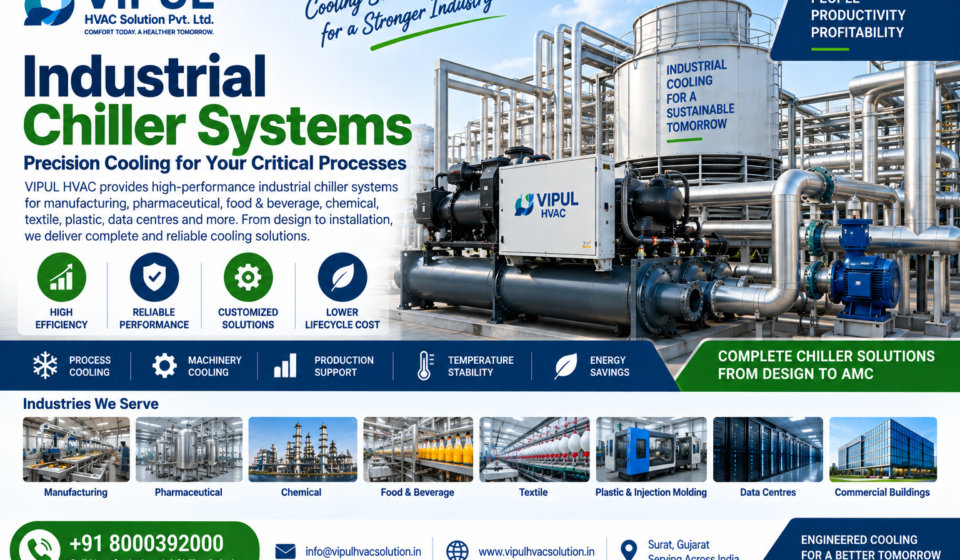
Industrial Chiller Systems are essential for factories and process industries where controlled cooling is required for machinery, production processes, equipment, raw materials, HVAC systems or temperature-sensitive operations.
Unlike a conventional comfort-cooling system, an industrial chiller is often selected around the actual process heat load, required fluid temperature, operating schedule, flow rate, redundancy, water quality, environmental conditions and lifecycle cost. ASHRAE identifies liquid-chilling systems as systems used to cool water, brine and other secondary coolants for air conditioning, refrigeration and industrial processes.
VIPUL HVAC SOLUTION PVT. LTD. provides engineered chiller solutions for commercial and industrial applications, including chiller plant design, equipment selection, chilled-water piping, pump and cooling-tower selection, controls, testing, commissioning, optimization and AMC. Its current chiller portfolio includes air-cooled and water-cooled systems from 20 TR to 1000+ TR, with scroll, screw and centrifugal compressor options depending on the application.
What Is an Industrial Chiller System?
An industrial chiller system is a centralized cooling system that removes heat from a liquid and transfers that heat to another medium, allowing cooled water, glycol solution, brine or another secondary fluid to be circulated to an industrial process or HVAC load.
A simplified system is:
Industrial Process → Heat Exchanger → Chilled Fluid → Chiller → Cooled Fluid → Process
Depending on the application, the chilled fluid can be supplied to:
- Manufacturing machinery
- Process heat exchangers
- Injection molding machines
- Laser equipment
- Pharmaceutical processes
- Food-processing equipment
- Chemical processes
- Textile machinery
- Data-center cooling systems
- Industrial HVAC systems
ASHRAE notes that liquid chilling is commonly used not only for air conditioning but also for chilling fluids in industrial processes.
Why Are Industrial Chiller Systems Important?
Industrial processes frequently generate significant amounts of heat.
If that heat is not removed properly, it can affect:
- Production quality
- Equipment reliability
- Product consistency
- Operating temperature
- Production speed
- Energy consumption
- Equipment life
- Workplace conditions
An appropriately designed industrial chiller provides a controlled cooling source that can operate according to the requirements of the process.
The important point is that industrial cooling should be designed around the process rather than simply around the size of the building.
How Does an Industrial Chiller Work?
The exact arrangement depends on whether the chiller is air-cooled, water-cooled, vapor-compression, absorption or another technology.
For a typical vapor-compression chiller, the refrigeration system contains major components such as:
- Compressor
- Evaporator
- Condenser
- Expansion device
- Refrigerant circuit
- Controls
ASHRAE identifies these as fundamental components of vapor-compression liquid-chilling systems.
Basic Working Sequence
1. Heat is generated by the industrial process
↓
2. Chilled water or process fluid absorbs the heat
↓
3. Warm fluid returns to the chiller
↓
4. The evaporator transfers heat from the fluid to the refrigerant
↓
5. Compressor raises refrigerant pressure and temperature
↓
6. Condenser rejects the heat
↓
7. Expansion device reduces refrigerant pressure
↓
8. Refrigerant returns to the evaporator
↓
9. Cooled fluid returns to the industrial process
The cycle continues as long as cooling is required.
Industrial Chiller System Components
A complete industrial cooling plant can contain considerably more equipment than the chiller itself.
1. Chiller
The central refrigeration equipment that removes heat from the process fluid.
2. Chilled-Water Pump
Circulates chilled water between the chiller and the process or HVAC load.
3. Process Heat Exchanger
Transfers heat from the industrial process to the chilled fluid where indirect cooling is required.
4. Cooling Tower
Water-cooled systems may use cooling towers to reject condenser heat to the atmosphere.
5. Condenser-Water Pumps
Used in conventional water-cooled chiller plants to circulate condenser water.
6. Piping System
Includes:
- Chilled-water piping
- Condenser-water piping where applicable
- Process piping
- Valves
- Strainers
- Flexible connections
- Flow-control devices
7. Expansion Tank
May be required depending on the hydronic system arrangement.
8. Filters & Strainers
Help protect pumps, heat exchangers and other equipment from contaminants.
9. Sensors
Can monitor:
- Temperature
- Pressure
- Flow
- Equipment status
10. Control System
Industrial chiller controls can coordinate equipment operation according to process requirements.
11. BMS / Automation
For suitable projects, the chiller system can be integrated with building or plant automation.
VIPUL’s current chiller offering includes PLC/BMS-compatible controls and electrical, control and automation integration.
Types of Industrial Chiller Systems
There is no single chiller configuration suitable for every industrial application.
1. Air Cooled Industrial Chiller
An air-cooled chiller rejects heat directly to outdoor air through condenser coils and fans.
Advantages
- No cooling tower required
- No condenser-water loop
- Lower water dependency
- Simpler plant arrangement
- Suitable for applications where water availability is limited
Applications
- Manufacturing facilities
- Small and medium industrial processes
- Commercial-industrial buildings
- Process cooling
- Machinery cooling
2. Water Cooled Industrial Chiller
A water-cooled chiller transfers condenser heat to condenser water, which normally carries the heat to a cooling tower.
Typical arrangement:
Chiller → Condenser Water Pump → Cooling Tower → Chiller
Advantages
- Suitable for large cooling plants
- Strong heat-transfer performance
- Suitable for many continuous-duty applications
- Can be configured for large centralized plants
Considerations
- Cooling tower required in conventional systems
- Water treatment required
- Condenser-water pumps required
- More components to maintain
- Water consumption must be considered
3. Screw Chiller
Screw compressors are commonly used in medium-to-large cooling applications.
Potential advantages include:
- Robust operation
- Good capacity control
- Suitable for industrial applications
- Continuous-duty suitability
VIPUL’s current chiller specifications list screw compressors among its available compressor technologies.
4. Scroll Chiller
Scroll technology can be used for applications where modular or smaller-capacity cooling is appropriate.
The correct choice depends on:
- Required capacity
- Number of compressors
- Operating conditions
- Redundancy
- Efficiency
- Manufacturer/model
5. Centrifugal Chiller
Centrifugal chillers are generally considered for large cooling capacities and central plants.
They can be appropriate where the project requires:
- Large cooling capacity
- Centralized cooling
- Efficient operation at suitable loads
- Multiple-chiller plant configurations
VIPUL’s current chiller portfolio lists centrifugal compressors along with screw and scroll options.
6. Glycol Chiller
Some industrial processes require temperatures or operating conditions where a glycol-water solution is more appropriate than plain chilled water.
The glycol concentration should be selected according to the required operating temperature and heat-transfer requirements.
Important considerations include:
- Fluid concentration
- Viscosity
- Flow rate
- Pump head
- Heat-transfer performance
- Minimum operating temperature
Industrial Chiller vs Commercial Chiller
| Feature | Industrial Chiller | Commercial Chiller |
|---|---|---|
| Main purpose | Process/equipment cooling and HVAC | Building comfort cooling |
| Load pattern | Often process-dependent | Often occupancy/weather-dependent |
| Temperature | Application-specific | Usually comfort HVAC conditions |
| Operation | Can be continuous | Often schedule-based |
| Redundancy | May be critical for production | Depends on building |
| Process integration | Common | Usually limited |
| Heat exchanger | Often process HX | AHU/FCU coils |
| Controls | Process-oriented | Building/HVAC-oriented |
| Fluid | Water/glycol/brine depending on application | Usually chilled water |
| Selection | Process heat load + HVAC load | Building cooling load |
The distinction is important because an industrial process may require specific fluid temperatures, flow rates and operating stability that differ significantly from conventional comfort cooling.
Industrial Chiller Applications
1. Manufacturing Industry
Industrial chillers can support:
- Machinery cooling
- Process cooling
- Hydraulic equipment
- Production lines
- HVAC
- Temperature-sensitive manufacturing
2. Pharmaceutical Industry
Pharmaceutical facilities may require carefully controlled environmental conditions.
Chilled water can support:
- AHUs
- Process cooling
- Cleanroom HVAC
- Temperature and humidity control
The chiller itself is only one component of a pharmaceutical HVAC system; the complete system must be designed according to the facility’s process and applicable requirements.
3. Chemical Industry
Chemical processes can generate significant heat.
Industrial chillers can support:
- Process heat exchangers
- Reactor cooling
- Equipment cooling
- Condensation-related processes
- Controlled process temperatures
The appropriate cooling fluid and temperature should be selected according to the process requirements.
4. Food & Beverage Industry
Chilled-water systems may support:
- Food-processing equipment
- Production machinery
- Process cooling
- Cold-room-related systems
- HVAC
- Temperature-sensitive production
Hygiene, fluid quality and process requirements should be considered when designing the system.
5. Textile Industry
Industrial chillers may support:
- Textile machinery
- Process cooling
- Production equipment
- HVAC systems
- Temperature control
6. Plastic & Injection Molding
Plastic-processing equipment can generate substantial heat.
A chiller can provide controlled cooling for:
- Injection molding
- Extrusion
- Hydraulic systems
- Mold cooling
- Process heat exchangers
Consistent cooling can be important for maintaining process conditions and product quality.
7. Data Centers
Data centers require continuous heat removal from IT equipment.
Chilled-water systems can be integrated with:
- CRAH units
- Chilled-water pumps
- Cooling towers
- BMS
- Redundant cooling equipment
For critical facilities, redundancy and continuous operation should be central to the system design.
8. Hospitals
Large healthcare facilities may use centralized chillers to support:
- AHUs
- Patient areas
- Operating areas
- Diagnostic areas
- Administrative spaces
Healthcare HVAC requirements should be designed according to the specific facility and applicable standards.
9. Hotels and Large Commercial Buildings
Industrial-scale chiller technology may also be appropriate for:
- Hotels
- Shopping malls
- Large offices
- Convention centers
- Institutional buildings
VIPUL identifies chillers as a solution for large commercial and industrial applications.
Industrial Chiller Selection: What Should You Consider?
Selecting a chiller based only on TR capacity is not enough.
1. Calculate the Actual Heat Load
The first step is determining:
Process Heat Load + HVAC Load + Equipment Heat + Other Relevant Loads
For industrial processes, the process heat load can be the most important factor.
2. Determine Required Fluid Temperature
Ask:
- What temperature does the process require?
- What is the return-fluid temperature?
- What temperature difference is acceptable?
- Is glycol required?
- Is brine required?
The answer can significantly affect chiller selection.
3. Determine Required Flow
Required flow depends on:
- Cooling capacity
- Fluid properties
- Supply temperature
- Return temperature
- Process requirements
4. Consider Operating Hours
A chiller operating:
8 hours/day
has a very different lifecycle profile from one operating:
24 hours/day, 365 days/year.
For continuous operation, part-load efficiency, reliability and maintenance support become especially important.
5. Select Air-Cooled or Water-Cooled
Consider:
- Water availability
- Climate
- Space
- Cooling-tower requirements
- Maintenance
- Energy targets
- Project lifecycle cost
VIPUL provides both air-cooled and water-cooled chiller solutions.
6. Consider Redundancy
Critical industrial processes may require standby capacity.
Common strategies can include:
- Multiple chillers
- N+1 arrangements
- Standby pumps
- Multiple cooling towers
- Independent cooling circuits
The appropriate strategy depends on the consequences of cooling failure and the process requirements.
7. Evaluate Part-Load Efficiency
Industrial loads are not always constant.
A chiller may operate at:
- 100%
- 75%
- 50%
- 25%
of its capacity at different times.
Therefore, part-load performance can be important when evaluating lifecycle energy consumption.
VIPUL’s current chiller offering specifically highlights high COP and part-load efficiency as design considerations.
8. Consider Maintenance Requirements
Before purchasing a chiller, consider:
- Local technical support
- Spare-parts availability
- Preventive maintenance
- Service response
- AMC availability
- Equipment accessibility
A technically efficient chiller that is difficult to maintain may not be the best lifecycle choice.
Industrial Chiller Installation Process
A professional industrial chiller installation can follow this workflow:
Step 1 — Site Survey
Evaluate:
- Available space
- Process connection points
- Equipment access
- Electrical supply
- Piping routes
- Maintenance access
Step 2 — Heat-Load Calculation
Determine actual process and HVAC cooling requirements.
Step 3 — Chiller Selection
Select:
- Capacity
- Type
- Compressor
- Fluid
- Temperature
- Efficiency
Step 4 — System Design
Develop:
- Chiller layout
- Pump arrangement
- Piping
- Cooling tower where applicable
- Heat exchangers
- Controls
Step 5 — Equipment Supply
Supply chiller and associated equipment.
Step 6 — Installation
Install:
- Chiller
- Pumps
- Piping
- Valves
- Heat exchangers
- Cooling towers where applicable
Step 7 — Electrical & Controls
Connect:
- Power
- Panels
- VFDs
- Sensors
- PLC
- BMS/automation
Step 8 — Testing
Check:
- Flow
- Pressure
- Temperature
- Electrical parameters
- Refrigeration system
- Controls
Step 9 — Balancing
Balance water flow and verify process requirements.
Step 10 — Commissioning
Operate and test the complete system under appropriate conditions.
VIPUL’s listed chiller capabilities include plant design, chiller/pump/cooling-tower selection, piping, electrical/control integration, testing, commissioning and optimization.
Industrial Chiller Maintenance
Regular maintenance is critical for industrial cooling systems.
Chiller Maintenance
Inspect:
- Compressor
- Refrigerant circuit
- Evaporator
- Condenser
- Oil system
- Electrical components
- Sensors
- Controls
Pump Maintenance
Check:
- Vibration
- Alignment
- Bearings
- Seals
- Motor
- Flow
- Pressure
Cooling Tower Maintenance
For water-cooled plants, inspect:
- Fans
- Motors
- Fill
- Nozzles
- Basin
- Drift eliminators
- Water distribution
Water Treatment
Condenser-water systems should have appropriate water-quality management to control:
- Scale
- Corrosion
- Fouling
- Biological growth
ASHRAE emphasizes that proper operation and maintenance are essential for the reliability, longevity and safety of liquid-chilling systems.
Common Industrial Chiller Problems
Problem 1: Chiller Not Providing Required Cooling
Possible causes include:
- Incorrect load calculation
- Insufficient water flow
- Fouling
- Refrigeration problems
- Incorrect setpoints
- Process load higher than expected
Problem 2: High Energy Consumption
Possible causes include:
- Oversized or poorly selected equipment
- Dirty heat exchangers
- Inefficient pumps
- Poor condenser conditions
- Incorrect controls
- Operating outside design conditions
Problem 3: High Condenser Pressure
Possible causes can include:
- High condenser-water temperature
- Poor cooling-tower performance
- Insufficient condenser-water flow
- Fouled condenser
Problem 4: Low Chilled-Water Flow
Possible causes include:
- Pump problems
- Blocked strainer
- Incorrect valve position
- Air in the system
- Piping restrictions
Problem 5: Uneven Process Cooling
Possible causes include:
- Incorrect hydraulic balancing
- Incorrect pipe sizing
- Poor flow distribution
- Inadequate heat-exchanger capacity
- Control problems
How to Improve Industrial Chiller Efficiency
Industrial chiller efficiency should be considered at the plant level, not just at the chiller level.
Important strategies include:
1. Correct Chiller Sizing
Avoid selecting capacity based only on approximate area calculations.
2. Optimize Chilled-Water Temperature
Use an appropriate setpoint for the actual process.
3. Improve Pump Efficiency
Use appropriately selected pumps and variable-speed control where suitable.
4. Maintain Heat-Transfer Surfaces
Keep evaporators, condensers and heat exchangers clean.
5. Optimize Cooling Towers
For water-cooled systems, cooling-tower performance directly affects condenser conditions.
6. Use Automation
PLC/BMS controls can coordinate chillers, pumps and cooling towers.
7. Monitor Performance
Track parameters such as:
- Supply temperature
- Return temperature
- Flow
- Pressure
- Power
- Operating hours
- Alarm history
8. Maintain Equipment
Preventive maintenance helps identify problems before they become major breakdowns.
VIPUL states that its chiller solutions include performance monitoring and optimization, alongside design, installation and maintenance.
Industrial Chiller System Cost
There is no universal price for an industrial chiller system.
The total project cost depends on:
- Cooling capacity
- Air-cooled or water-cooled configuration
- Compressor type
- Chiller brand/model
- Required process temperature
- Pumps
- Cooling towers
- Heat exchangers
- Piping
- Electrical system
- Controls
- BMS
- Installation
- Testing and commissioning
- Civil/structural requirements
- Redundancy
- Location
For this reason, an industrial chiller quotation should be prepared after understanding the actual process and site conditions.
Industrial Chiller Supplier & Contractor in Gujarat
When selecting an industrial chiller supplier in Gujarat, do not compare companies only on equipment price.
Evaluate:
- Engineering capability
- Cooling-load calculation
- Process understanding
- Equipment selection
- Installation expertise
- Piping capability
- Controls integration
- Commissioning
- Maintenance
- AMC
- Local service support
VIPUL HVAC SOLUTION PVT. LTD. provides high-capacity chiller systems for industrial and commercial applications and supports the project through design, equipment integration, piping, controls, testing, commissioning and maintenance.
Why Choose VIPUL HVAC for Industrial Chiller Systems?
VIPUL HVAC SOLUTION PVT. LTD. focuses on engineered HVAC solutions rather than simply supplying equipment.
Industrial Chiller Capabilities
- Cooling Load Analysis
- Chiller Plant Design
- Air-Cooled Chillers
- Water-Cooled Chillers
- Screw Chillers
- Scroll Chillers
- Centrifugal Chillers
- Pump Selection
- Cooling Tower Selection
- Chilled-Water Piping
- Condenser-Water Piping
- Process Cooling Integration
- Electrical & Control Integration
- PLC/BMS Integration
- Testing & Commissioning
- Performance Optimization
- AMC & Maintenance
These capabilities are reflected in VIPUL’s current chiller systems offering.
VIPUL HVAC Industrial Chiller Project Workflow
Client Requirement
↓
Site Survey
↓
Process & Cooling Load Analysis
↓
Chiller Selection
↓
System & Plant Design
↓
Pump / Cooling Tower / Heat Exchanger Selection
↓
BOQ & Proposal
↓
Equipment Supply
↓
Installation
↓
Piping & Electrical Integration
↓
Controls & BMS
↓
Testing & Balancing
↓
Commissioning
↓
Performance Optimization
↓
AMC & Maintenance
This end-to-end approach helps ensure that the chiller is evaluated as part of the complete cooling system, rather than as a standalone machine.
Industrial Chiller Systems in Gujarat
VIPUL HVAC supports HVAC projects across Gujarat and nearby regions.
Industrial chiller applications can be considered for facilities in:
- Surat
- Ahmedabad
- Vadodara
- Bharuch
- Ankleshwar
- Vapi
- Rajkot
- Junagadh
- Talala
- Other Gujarat locations
VIPUL’s website states that it provides HVAC services across Surat, Gujarat and nearby regions and serves industrial facilities, factories and other specialized environments.
Frequently Asked Questions
What is an industrial chiller system?
An industrial chiller system is a cooling system designed to remove heat from industrial processes, machinery, equipment or HVAC systems by circulating chilled water or another secondary cooling fluid.
What industries use industrial chillers?
Industrial chillers can be used in manufacturing, pharmaceutical, chemical, food and beverage, textile, plastics, process industries, data centers and other facilities requiring controlled cooling.
What is the difference between an industrial chiller and an HVAC chiller?
The main difference is the application. An HVAC chiller primarily supports building comfort cooling, while an industrial chiller may be designed around a specific process, equipment load or production requirement.
Which is better: air-cooled or water-cooled industrial chiller?
Neither is universally better. Air-cooled systems can simplify infrastructure and reduce condenser-water requirements, while water-cooled systems can be attractive for large plants where cooling towers and water treatment are practical.
How do I calculate industrial chiller capacity?
Capacity should be determined from the actual process heat load, fluid temperatures, flow rate, operating conditions and any additional HVAC load. A professional engineering assessment is preferable to using a simple area-based estimate.
Can an industrial chiller operate continuously?
Yes, industrial chiller systems can be designed for continuous operation, but equipment selection, redundancy, controls and preventive maintenance should reflect the required duty cycle.
Can industrial chillers use glycol?
Yes, glycol-water mixtures can be used for applications requiring lower fluid temperatures or specific freeze-protection requirements. The concentration must be selected based on the design conditions.
Does VIPUL HVAC provide industrial chiller installation?
Yes. VIPUL’s current chiller offering includes system design, equipment integration, piping, electrical/control integration, testing, commissioning, optimization and AMC.
Does VIPUL HVAC provide both air-cooled and water-cooled chillers?
Yes. Both air-cooled and water-cooled chiller systems are listed in VIPUL’s current portfolio.
Conclusion
An Industrial Chiller System is more than a refrigeration machine. It is a complete engineered cooling infrastructure that can include the chiller, pumps, heat exchangers, cooling towers, piping, controls, automation and process connections.
The right system should be selected after evaluating:
Process Heat Load + Required Temperature + Flow + Operating Hours + Chiller Type + Redundancy + Efficiency + Maintenance + Lifecycle Cost
For industrial facilities, proper engineering, installation, commissioning and preventive maintenance are essential for dependable long-term cooling.
VIPUL HVAC SOLUTION PVT. LTD. provides industrial and commercial chiller solutions covering design, selection, supply, installation, piping, controls, testing, commissioning, optimization and AMC.
Planning an Industrial Chiller Project?
Contact VIPUL HVAC SOLUTION PVT. LTD.
📞 +91 8000392000
📧 info@vipulhvacsolution.in

Vipul HVAC House
At Vipul hvac solution pvt.ltd., we take great pride in delivering high-quality HVAC solutions that ensure comfort and efficiency in both residential and commercial spaces. As a trusted HVAC of reliable, energy-efficient systems, and we are dedicated to providing you with the best products and services to meet your needs
Other Articles
[…] Chiller Systems […]
[…] Industrial Chiller Systems […]