
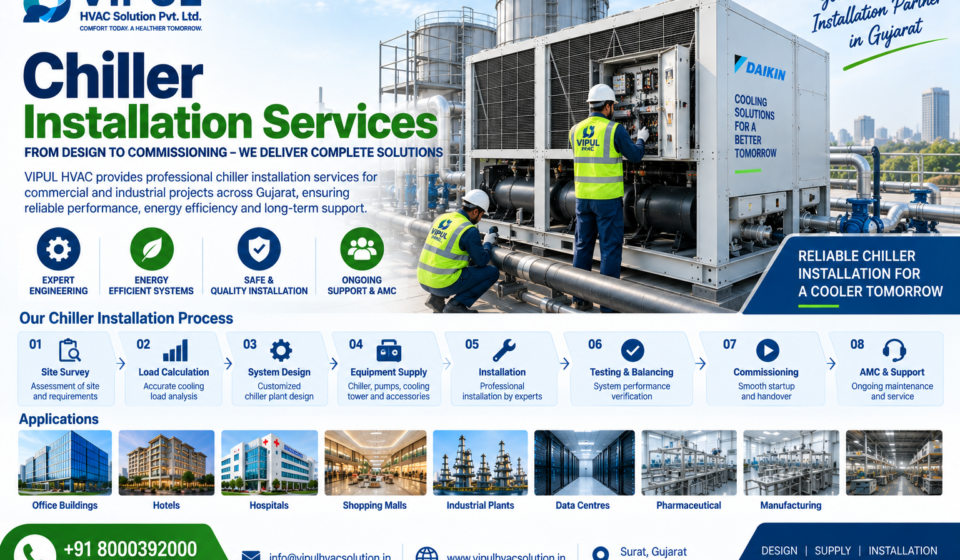

Chiller Installation Services: Complete Guide to Chiller Installation, Testing & Commissioning
If you are planning a chiller installation project for a commercial building, hospital, hotel, mall, pharmaceutical facility, data center or industrial plant, professional engineering is essential for achieving reliable cooling, efficient operation and long equipment life.
VIPUL HVAC SOLUTION PVT. LTD. provides end-to-end chiller solutions covering cooling-load analysis, chiller selection, plant design, pumps and cooling-tower selection, chilled-water and condenser-water piping, electrical/control integration, installation, testing, commissioning, optimization and AMC. Its current chiller portfolio includes air-cooled and water-cooled systems from 20 TR to 1000+ TR, depending on application and configuration.
What Are Chiller Installation Services?
Chiller installation services involve much more than positioning a chiller and connecting pipes.
A complete professional installation may include:
- Site survey
- Cooling-load calculation
- Chiller selection
- Plant-room planning
- Equipment positioning
- Chilled-water piping
- Condenser-water piping
- Cooling-tower installation where applicable
- Pump installation
- AHU/FCU connection
- Electrical installation
- Control and automation integration
- BMS integration
- Insulation
- Testing
- Water-flow balancing
- Commissioning
- Operator training
- Documentation
- Maintenance and AMC
For a central chilled-water plant, the chiller, pumps, cooling tower, piping, controls and terminal equipment must operate as one coordinated system.
ASHRAE’s central chilled-water plant guidance specifically addresses piping, plant optimization, equipment selection, controls and commissioning as interconnected parts of the overall plant.
Why Professional Chiller Installation Matters
A chiller can be technically excellent but still deliver poor performance if the installation is incorrectly engineered.
Improper installation can result in:
- Insufficient cooling
- High electricity consumption
- Poor chilled-water flow
- High condenser pressure
- Pumping problems
- Uneven cooling
- Frequent equipment trips
- Excessive vibration
- Water leakage
- Control problems
- Difficult maintenance
- Reduced equipment life
Professional installation helps ensure that the equipment operates according to its intended design.
ASHRAE describes commissioning as a quality-focused process used to verify and document that systems are planned, designed, installed, tested, operated and maintained according to defined requirements.
Types of Chiller Installation Services
1. Air Cooled Chiller Installation
An air-cooled chiller rejects heat directly to outdoor air through condenser coils and fans.
It can be suitable for:
- Commercial buildings
- Offices
- Hotels
- Hospitals
- Industrial facilities
- Manufacturing units
- Projects where cooling-tower infrastructure is undesirable
A typical installation includes:
Air-Cooled Chiller → Chilled-Water Pump → AHU/FCU → Return Water → Chiller
2. Water Cooled Chiller Installation
A water-cooled chiller normally works with a condenser-water loop and cooling tower.
The system can include:
- Water-cooled chiller
- Cooling tower
- Chilled-water pumps
- Condenser-water pumps
- Chilled-water piping
- Condenser-water piping
- AHUs/FCUs
- Controls
- Water-treatment system
Typical flow:
Chiller → Condenser Water Pump → Cooling Tower → Chiller
Water-cooled plants are commonly considered for larger commercial and industrial cooling requirements.
3. Industrial Chiller Installation
Industrial facilities may require chilled water for:
- Process cooling
- Machinery
- Production equipment
- Manufacturing areas
- Temperature-controlled processes
- Industrial HVAC
Industrial chiller installation should consider the actual process heat load, operating schedule, required water temperature and redundancy requirements.
4. Commercial Chiller Installation
Commercial applications may include:
- Corporate offices
- Shopping malls
- Hotels
- Hospitals
- Educational buildings
- Convention centers
- Large retail facilities
The system may distribute chilled water to multiple AHUs and FCUs throughout the building.
VIPUL HVAC specifically lists chiller installation and AHU setup among its commercial HVAC installation capabilities.
Chiller Installation Process — Step by Step
A professional chiller installation normally follows a structured sequence.
Step 1: Understand the Project Requirement
Before equipment selection, the HVAC engineer should understand:
- Building type
- Cooling requirement
- Operating hours
- Occupancy
- Process load
- Future expansion
- Available space
- Energy-efficiency objectives
- Redundancy requirements
This prevents selecting equipment based only on floor area.
Step 2: Site Survey
A detailed site survey should examine:
Equipment Location
- Chiller room
- Outdoor area
- Cooling tower location
- Pump room
- AHU areas
Access
The team should consider how the equipment will reach its final location.
Important factors include:
- Door dimensions
- Lifting access
- Crane requirements
- Service routes
- Maintenance clearance
Building Structure
Large chillers can be heavy, so structural requirements must be coordinated with the relevant project team.
Step 3: Cooling Load Calculation
Correct chiller capacity begins with a proper cooling-load calculation.
The calculation may consider:
- Building envelope
- Solar heat gain
- Occupancy
- Lighting
- Equipment
- Ventilation
- Fresh air
- Process heat
- Operating schedules
The objective is to determine the actual cooling demand rather than simply selecting an oversized machine.
ASHRAE notes that central chilled-water plant design should account not only for peak load but also for the time pattern of loads because load variation can significantly affect plant design and lifecycle performance.
Step 4: Chiller Selection
The appropriate chiller is selected based on:
- Required TR
- Chilled-water temperature
- Flow rate
- Design ambient conditions
- Air-cooled or water-cooled configuration
- Compressor technology
- Efficiency
- Part-load performance
- Operating hours
- Redundancy
- Available space
- Lifecycle cost
VIPUL’s current chiller offering includes air-cooled and water-cooled chillers, with scroll, screw and centrifugal compressor options depending on the application.
Step 5: Plant Layout & Equipment Positioning
Proper positioning is important for:
- Airflow
- Maintenance
- Piping
- Electrical connections
- Service access
- Noise management
- Equipment replacement
- Safety
For water-cooled systems, the cooling tower must also be positioned appropriately to allow adequate airflow and maintenance access.
Step 6: Chilled-Water Piping Installation
Chilled-water piping connects the chiller to the building cooling system.
The system may include:
- Supply piping
- Return piping
- Pumps
- Isolation valves
- Control valves
- Strainers
- Flexible connections
- Flow meters
- Temperature sensors
- Pressure gauges
- Air vents
- Drain connections
Pipe sizing should be based on the required water flow and acceptable pressure loss.
Step 7: Condenser-Water Piping
For water-cooled chillers, condenser-water piping connects:
Chiller ↔ Condenser Water Pump ↔ Cooling Tower
The installation should consider:
- Correct pipe sizing
- Flow requirements
- Valves
- Strainers
- Pumps
- Cooling-tower connection
- Water treatment
- Expansion and flexibility
- Drainage
VIPUL’s chiller services specifically include chilled-water and condenser piping along with pump and cooling-tower selection.
Step 8: Pump Installation
Chilled-water and condenser-water pumps must be selected according to:
- Flow
- Head
- System resistance
- Operating conditions
- Efficiency
- Control strategy
Where appropriate, variable-speed drives can help match pumping energy to changing system demand.
ASHRAE’s central chilled-water plant guidance includes variable-speed pumping and control strategies as important elements of plant design and optimization.
Step 9: Cooling Tower Installation
For water-cooled systems, cooling-tower installation is a critical part of the project.
The installation team should verify:
- Tower capacity
- Water flow
- Fan operation
- Water distribution
- Piping
- Basin connections
- Drainage
- Electrical supply
- Controls
- Maintenance access
A cooling tower that is incorrectly selected or poorly integrated can affect the entire chiller plant.
Step 10: AHU & FCU Connection
Chilled water is distributed to:
- AHUs
- FCUs
- Process heat exchangers
- Other cooling terminals
The AHU/FCU coil transfers heat from the air to chilled water.
The system therefore works as:
Chiller → Pump → AHU/FCU → Conditioned Space → Return Water → Chiller
Correct water flow and air-side balancing are important for achieving the required cooling performance.
Step 11: Electrical Installation
The chiller plant may require electrical integration for:
- Chiller
- Pumps
- Cooling towers
- AHUs
- Control panels
- VFDs
- Sensors
- Automation systems
Electrical design and installation should be coordinated with the project’s electrical engineering requirements.
Step 12: Control & BMS Integration
Modern chiller plants can integrate with a Building Management System (BMS).
BMS integration can provide monitoring and control of:
- Chiller status
- Supply-water temperature
- Return-water temperature
- Pump status
- Flow
- Pressure
- Cooling-tower operation
- Alarms
- Energy-related parameters
- Operating schedules
VIPUL’s current chiller systems are described as PLC/BMS compatible, with electrical, control and automation integration capabilities.
Step 13: Insulation
Chilled-water pipes normally require appropriate insulation to reduce unwanted heat gain and condensation.
Insulation quality matters because damaged or inadequate insulation can result in:
- Condensation
- Energy losses
- Water dripping
- Ceiling damage
- Reduced system efficiency
The exact insulation specification should follow the project design and applicable requirements.
Step 14: Pressure Testing
Before final commissioning, the installed piping system may require appropriate testing.
Typical checks can include:
- Leakage inspection
- Pressure testing
- Valve operation
- Joint inspection
- Drainage verification
- Insulation inspection
Testing procedures should follow the project’s approved specifications and applicable codes.
Step 15: Flushing & Cleaning
Before operating a chilled-water system, the piping network may require appropriate flushing and cleaning to remove:
- Welding debris
- Dust
- Metal particles
- Construction materials
- Other contaminants
Clean water circuits help protect pumps, valves, heat exchangers and other components.
Step 16: Testing, Adjusting & Balancing
TAB is an important stage of chiller plant commissioning.
The team may verify:
- Chilled-water flow
- Condenser-water flow
- Pump performance
- Temperature difference
- Pressure
- AHU/FCU flow
- Airflow
- Control operation
ASHRAE notes that initial testing, adjusting and balancing contribute to sustainable central-plant operation and recommends periodic attention to TAB to maintain performance.
Step 17: Chiller Commissioning
Commissioning verifies whether the complete system performs according to its design intent.
Important activities can include:
Equipment Checks
- Chiller operation
- Compressor operation
- Pump operation
- Cooling-tower operation
- AHU operation
Control Checks
- Sensors
- Setpoints
- Interlocks
- Safety controls
- Control sequences
- Alarms
Performance Checks
- Chilled-water temperature
- Condenser-water temperature
- Water flow
- Cooling capacity
- Electrical parameters
- System stability
ASHRAE identifies sequence-of-operation review, point-to-point checkout, functional testing and trend reviews as key elements of chilled-water plant commissioning.
Step 18: Operator Training & Handover
A professional chiller installation should not end when the machine starts.
The operating team should understand:
- Start/stop procedure
- Normal operating parameters
- Alarm conditions
- Emergency shutdown
- Basic troubleshooting
- Maintenance requirements
- BMS operation
- Preventive maintenance schedule
ASHRAE emphasizes documentation and training of operations and maintenance personnel as part of effective commissioning.
Chiller Installation for Different Industries
1. Hospitals
Hospital HVAC systems can require dependable centralized cooling for:
- Patient areas
- Operating areas
- Diagnostic spaces
- Laboratories
- Administrative areas
Chiller capacity and redundancy should be determined from the specific healthcare facility requirements.
2. Pharmaceutical Industry
Pharmaceutical facilities may require precise:
- Temperature
- Humidity
- Air filtration
- Pressure control
- Airflow
Chillers can support AHUs and other HVAC equipment serving controlled environments.
VIPUL provides specialized pharmaceutical HVAC solutions in addition to its chiller and AHU capabilities.
3. Hotels
Hotel cooling loads can vary significantly between:
- Guest rooms
- Restaurants
- Kitchens
- Lobbies
- Banquet halls
- Meeting rooms
A properly designed centralized chiller system can distribute cooling according to the requirements of different zones.
4. Shopping Malls
Large retail buildings often have substantial cooling loads due to:
- High occupancy
- Lighting
- Shops
- Food courts
- Large glazed areas
- Long operating hours
Centralized chilled-water systems can provide cooling to multiple AHUs.
5. Industrial Plants
Industrial chiller installation may support both:
Process Cooling + Building HVAC
The system should be designed according to the actual production process and operating conditions.
6. Data Centers
Data centers have highly continuous and critical cooling requirements.
Chiller installation may be integrated with:
- CRAH systems
- Chilled-water loops
- Pumps
- Cooling towers
- Controls
- BMS/DCIM
- Redundant equipment
Reliability and redundancy should be key design considerations.
Common Chiller Installation Mistakes
Mistake 1: Selecting Capacity Only by Building Area
A simple “TR per square foot” approach can result in incorrect sizing.
Better approach: Perform a detailed cooling-load calculation.
Mistake 2: Oversizing the Chiller
Oversizing may increase initial cost and can negatively affect operating performance depending on equipment and control strategy.
Mistake 3: Ignoring Part-Load Performance
Many buildings do not operate at peak load throughout the year.
Chiller selection should therefore consider actual load patterns.
Mistake 4: Poor Piping Design
Incorrect pipe sizing or excessive pressure loss can affect:
- Flow
- Pump energy
- Cooling performance
Mistake 5: Incorrect Pump Selection
An incorrectly selected pump can increase energy consumption or fail to provide the required flow.
Mistake 6: Ignoring Maintenance Access
Equipment should have sufficient space for:
- Filter/service access
- Compressor work
- Tube cleaning where applicable
- Electrical maintenance
- Pump servicing
Mistake 7: Poor Commissioning
Starting the chiller does not mean the installation is complete.
The entire plant needs to be checked under appropriate operating conditions.
How Much Does Chiller Installation Cost?
There is no universal chiller installation cost.
The total project cost depends on:
- Chiller capacity
- Air-cooled or water-cooled configuration
- Chiller brand/model
- Number of chillers
- Cooling towers
- Pumps
- Piping length
- Pipe size
- AHUs/FCUs
- Electrical work
- Controls
- BMS
- Insulation
- Structural work
- Equipment lifting
- Installation location
- Testing and commissioning
- Project complexity
For this reason, a professional site survey and project-specific quotation are preferable to an online fixed-price estimate.
Chiller Installation vs Chiller Replacement
Chiller installation usually refers to installing a new system in a new project or adding capacity.
Chiller replacement involves removing an existing unit and integrating the new equipment into an existing plant.
Replacement projects require additional evaluation of:
- Existing piping
- Existing pumps
- Electrical capacity
- Cooling tower
- Controls
- Existing AHUs
- Plant-room access
- Equipment foundation
- Existing BMS
A replacement can sometimes provide an opportunity to improve plant efficiency through better controls and equipment sequencing.
Why Choose VIPUL HVAC for Chiller Installation Services?
VIPUL HVAC SOLUTION PVT. LTD. provides complete HVAC project support rather than treating the chiller as an isolated piece of equipment.
Its current chiller capabilities include:
- Cooling-load analysis
- Chiller plant design
- Chiller selection
- Pump selection
- Cooling-tower selection
- Chilled-water piping
- Condenser-water piping
- Electrical integration
- Control & automation
- Testing
- Commissioning
- Performance optimization
- AMC & performance monitoring
VIPUL’s broader HVAC offering covers residential, commercial and industrial applications, with the company stating 26+ years of experience and end-to-end support from design through installation, testing and commissioning.
VIPUL HVAC Chiller Installation Workflow
01 — Client Requirement
Understand the project’s cooling requirements.
↓
02 — Site Survey
Evaluate building, plant-room, access and installation conditions.
↓
03 — Cooling Load Calculation
Determine required cooling capacity.
↓
04 — System Selection
Select air-cooled or water-cooled technology.
↓
05 — Engineering & Design
Develop plant layout, piping and control strategy.
↓
06 — Equipment Supply
Supply chiller and associated equipment.
↓
07 — Installation
Install chillers, pumps, piping, cooling towers and associated systems.
↓
08 — Electrical & Controls
Integrate electrical systems, controls and BMS.
↓
09 — Testing & Balancing
Verify water flow, temperatures, pressures and system performance.
↓
10 — Commissioning
Test the complete plant according to the approved design intent.
↓
11 — Handover
Provide documentation and operational guidance.
↓
12 — AMC & Support
Continue with preventive maintenance and performance support.
Chiller Installation Services in Gujarat
VIPUL HVAC provides HVAC solutions across Gujarat and nearby regions.
Chiller projects can be supported in locations including:
- Surat
- Ahmedabad
- Vadodara
- Bharuch
- Ankleshwar
- Vapi
- Junagadh
- Talala
- Other Gujarat locations
The company’s official website specifically states that it provides HVAC services across Surat, Gujarat and nearby regions.
Frequently Asked Questions About Chiller Installation
What are chiller installation services?
Chiller installation services cover the engineering, equipment placement, piping, pumps, electrical connections, controls, testing and commissioning required to make a chiller plant operational.
How long does chiller installation take?
The duration depends on project size, chiller capacity, piping scope, equipment access, civil work, electrical work and commissioning requirements. A small replacement project and a large central plant can have very different schedules.
What is required before installing a chiller?
Important preparation can include cooling-load calculations, equipment selection, site survey, foundation/structural planning, access planning, piping design, electrical planning and control-system design.
Does a water-cooled chiller need a cooling tower?
A conventional water-cooled chiller plant normally uses a cooling tower for heat rejection, along with condenser-water pumps and piping.
Does an air-cooled chiller need a cooling tower?
No. An air-cooled chiller normally rejects heat directly to outdoor air through its condenser coils and fans.
Why is commissioning important after chiller installation?
Commissioning verifies that the installed system operates according to the intended design and that controls, equipment, water flow and operating sequences function correctly. ASHRAE identifies commissioning as an important process for verifying and documenting HVAC system performance.
Can VIPUL HVAC install both air-cooled and water-cooled chillers?
Yes. VIPUL’s current chiller offering includes both air-cooled and water-cooled chiller systems.
Does VIPUL HVAC provide chiller AMC?
Yes. VIPUL lists AMC and performance monitoring as part of its chiller capabilities.
Conclusion
A successful chiller installation is an engineered process that starts long before the chiller reaches the site.
The best results come from coordinating the complete system:
Cooling Load → Chiller → Pumps → Piping → Cooling Tower → AHUs/FCUs → Controls → Testing → Commissioning → Maintenance
Professional design, correct equipment selection, proper installation, hydraulic balancing and commissioning can help achieve reliable cooling and better lifecycle performance.
For commercial, industrial, pharmaceutical, hospital, hotel and other large HVAC projects, VIPUL HVAC SOLUTION PVT. LTD. provides complete chiller solutions from design and equipment selection through installation, testing, commissioning and AMC.
Planning a Chiller Installation Project?
Contact VIPUL HVAC SOLUTION PVT. LTD.
📞 +91 8000392000
📧 info@vipulhvacsolution.in

[…] Maintenance […]
[…] Chiller Installation Services […]
[…] Chiller Installation Services […]
[…] Chiller Installation Services […]