

Table of Contents
ToggleWater Cooled Chiller: Complete Guide to Working, Benefits, Applications, Installation & Maintenance
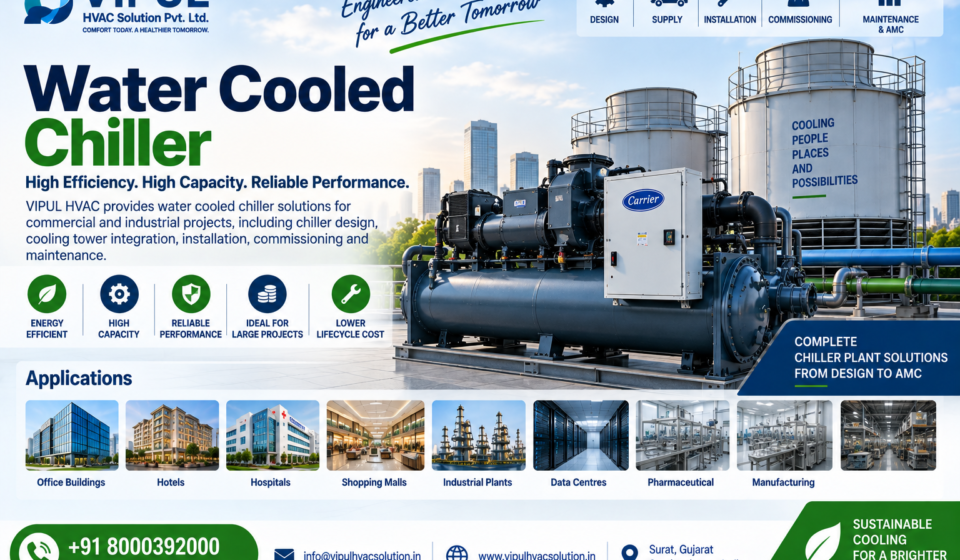
If you are looking for a Water Cooled Chiller for a commercial building, industrial plant, hospital, hotel, mall, pharmaceutical facility or other large cooling application, the most important factors are not only chiller capacity but also cooling-tower selection, chilled-water flow, condenser-water system, pumps, controls, efficiency and long-term maintenance.
VIPUL HVAC SOLUTION PVT. LTD. provides engineered chiller solutions including water-cooled and air-cooled chillers, cooling-tower selection, chilled-water and condenser-water piping, controls, testing, commissioning and maintenance. Its current chiller offering covers systems from 20 TR to 1000+ TR, with screw, scroll and centrifugal compressor options depending on the application.
What Is a Water Cooled Chiller?
A water cooled chiller is a centralized refrigeration system that removes heat from chilled water and rejects that heat through a condenser-water loop and cooling tower.
The chilled water is circulated to equipment such as:
- Air Handling Units (AHUs)
- Fan Coil Units (FCUs)
- Process heat exchangers
- Industrial cooling equipment
- Other hydronic cooling terminals
Unlike an air-cooled chiller, a water-cooled chiller uses water to transfer condenser heat and normally requires a cooling tower or another heat-rejection arrangement. Trane describes water-cooled chillers as systems designed for large-scale commercial and industrial cooling and explains the refrigeration cycle from evaporator through compressor, condenser and expansion device.
How Does a Water Cooled Chiller Work?
A water-cooled chiller generally involves two separate water circuits:
1. Chilled-Water Circuit
The chilled-water circuit serves the building or process.
Chiller → Chilled Water Pump → AHU/FCU/Process Load → Return Chilled Water → Chiller
The chiller removes heat from the returning water and sends cooler water back to the building.
2. Condenser-Water Circuit
The condenser-water circuit removes heat from the refrigerant.
Chiller Condenser → Condenser Water Pump → Cooling Tower → Cooled Condenser Water → Chiller
The cooling tower rejects the heat to the atmosphere.
ASHRAE explains that cooling towers reject heat by transferring heat from condenser water to outdoor air, with evaporative cooling providing the heat-rejection mechanism.
Water Cooled Chiller Working Principle — Step by Step
Step 1: Cooling Load Is Generated
Heat enters the building or industrial process from:
- People
- Lighting
- Machinery
- Computers
- Solar radiation
- Production equipment
- Process operations
This heat must be removed.
Step 2: Chilled Water Absorbs Heat
Chilled water travels through AHU cooling coils, FCUs or process heat exchangers.
The water absorbs heat and returns to the chiller at a higher temperature.
Step 3: Refrigerant Absorbs Heat
Inside the evaporator, refrigerant absorbs heat from the returning chilled water.
The refrigerant changes state as part of the refrigeration cycle.
Step 4: Compressor Raises Refrigerant Pressure
The compressor increases the refrigerant pressure and temperature.
Step 5: Heat Moves to Condenser Water
The hot refrigerant enters the water-cooled condenser.
Condenser water absorbs heat from the refrigerant.
Step 6: Cooling Tower Rejects Heat
The heated condenser water flows to the cooling tower.
The cooling tower rejects heat to outdoor air through heat and mass transfer.
Step 7: Refrigerant Expansion
The condensed refrigerant passes through an expansion device, where its pressure and temperature decrease.
Step 8: Cycle Repeats
The refrigerant returns to the evaporator and the cooling cycle continues.
Main Components of a Water Cooled Chiller System
A complete water-cooled chiller plant contains more than just the chiller.
1. Water Cooled Chiller
The main refrigeration equipment responsible for producing chilled water.
2. Cooling Tower
Rejects heat from the condenser-water circuit to the atmosphere.
3. Chilled Water Pumps
Circulate chilled water between the chiller and cooling loads.
4. Condenser Water Pumps
Circulate condenser water between the chiller and cooling tower.
5. AHUs
Air Handling Units transfer cooling from chilled water to conditioned air.
6. FCUs
Fan Coil Units provide localized cooling using chilled water.
7. Chilled-Water Piping
Connects the chiller with AHUs, FCUs and other cooling loads.
8. Condenser-Water Piping
Connects the chiller condenser with the cooling tower.
9. Valves and Flow-Control Devices
Used to control, isolate and balance water flow.
10. Electrical & Control System
Includes starters, panels, sensors, VFDs, PLCs and other controls depending on the design.
11. BMS Integration
A properly designed system can integrate chiller, pumps, cooling towers and HVAC equipment with a Building Management System (BMS).
VIPUL HVAC states that its chiller solutions can include PLC/BMS-compatible controls, electrical/control integration, testing, commissioning and optimization.
Water Cooled Chiller vs Air Cooled Chiller
Both technologies can provide centralized cooling, but their heat-rejection methods are different.
| Feature | Water Cooled Chiller | Air Cooled Chiller |
|---|---|---|
| Heat rejection | Water + cooling tower | Ambient air |
| Cooling tower | Normally required | Not required |
| Condenser water pumps | Required | Not required |
| Water treatment | Required for cooling-tower systems | Much less dependent on condenser-water treatment |
| Typical application | Large commercial/industrial plants | Small to large commercial/industrial applications |
| Efficiency potential | Generally strong at large scale | Simpler system with potentially higher peak condensing temperature |
| Plant complexity | Higher | Lower |
| Water consumption | Yes | Minimal condenser-water consumption |
| Space | Chiller plant + tower infrastructure | More compact overall infrastructure |
| Maintenance | Chiller + pumps + tower + water treatment | Chiller + condenser coils/fans |
Water-cooled systems can achieve strong efficiency because water provides effective heat transfer and cooling towers can reject heat through evaporative cooling. Trane notes that water-cooled chillers are generally more energy efficient than air-cooled chillers, while ASHRAE emphasizes the importance of cooling-tower design and operating conditions.
The best choice depends on the project’s load, climate, water availability, operating profile, space, efficiency target and lifecycle cost.
Advantages of Water Cooled Chillers
1. High Cooling Capacity
Water-cooled chillers are well suited to large cooling loads.
They can be used in:
- Large office buildings
- Hospitals
- Hotels
- Shopping malls
- Manufacturing facilities
- Pharmaceutical plants
- Industrial processes
VIPUL’s current chiller offering lists capacities from 20 TR to 1000+ TR, depending on the system configuration and application.
2. High Efficiency Potential
Water is an effective heat-transfer medium, and cooling towers can provide relatively low condenser-water temperatures under suitable outdoor conditions.
This can help reduce compressor energy consumption.
However, overall plant efficiency depends on the complete system, including:
- Chiller efficiency
- Cooling tower efficiency
- Pump efficiency
- Water temperature
- Flow control
- Part-load operation
- Controls
- Maintenance
3. Suitable for Continuous Operation
Industrial facilities often operate for long hours.
A properly designed water-cooled chiller plant can provide dependable centralized cooling for applications requiring extended operating periods.
4. Suitable for Large Cooling Loads
For high-capacity projects, water-cooled technology can be an attractive option because the cooling plant can be engineered around multiple chillers and cooling towers.
5. Better Part-Load Plant Optimization
Multiple chillers, variable-speed pumps and cooling-tower controls can be coordinated to match changing building loads.
This can improve plant efficiency when properly designed and commissioned.
6. Compact Chiller Equipment
For large capacities, the chiller itself can have a relatively compact footprint compared with an equivalent air-cooled heat-rejection arrangement.
However, the complete plant must still provide space for:
- Cooling towers
- Pumps
- Piping
- Water-treatment equipment
- Maintenance access
Limitations of Water Cooled Chillers
Water-cooled chillers also require more infrastructure than air-cooled systems.
Important considerations include:
- Cooling tower installation
- Condenser-water pumps
- Water treatment
- Water consumption
- Regular tower cleaning
- Scaling and fouling control
- Corrosion control
- Legionella risk management
- Additional piping
- More complex commissioning
Therefore, choosing a water-cooled chiller simply because it can be more efficient is not enough.
The complete lifecycle cost should be evaluated.
Cooling Tower: Why Is It Important?
The cooling tower is a critical part of a water-cooled chiller plant.
The condenser water receives heat from the chiller condenser and carries that heat to the cooling tower.
Inside the tower, water is distributed over heat-transfer surfaces while air passes through the tower.
A portion of the water evaporates, carrying heat away.
ASHRAE notes that cooling towers can cool water toward the entering-air wet-bulb temperature through evaporative heat and mass transfer, which is a major reason they are effective for heat rejection.
Cooling tower selection should consider:
- Heat rejection capacity
- Entering/leaving water temperature
- Outdoor wet-bulb temperature
- Water flow
- Fan power
- Sound
- Drift
- Plume
- Water quality
- Maintenance access
- Location
- Building air intakes
ASHRAE specifically identifies entering/leaving water temperatures, entering-air wet-bulb temperature and water flow as important cooling-tower design parameters.
Water Cooled Chiller Applications
Commercial Buildings
Water-cooled chillers can serve:
- Corporate offices
- Business parks
- Shopping malls
- Retail complexes
- Convention centers
Hospitals
Hospitals may require reliable centralized cooling for:
- Patient areas
- Operating areas
- Diagnostic areas
- Administrative spaces
- AHUs
- Specialized HVAC zones
The chiller plant should be designed according to the hospital’s individual HVAC requirements and applicable healthcare standards.
Hotels
Hotels can have substantial and variable cooling loads because of:
- Guest rooms
- Restaurants
- Banquet halls
- Kitchens
- Lobbies
- Meeting rooms
A centralized chilled-water system can serve different areas through AHUs and FCUs.
Pharmaceutical Industry
Pharmaceutical facilities can require carefully controlled:
- Temperature
- Humidity
- Filtration
- Air pressure
- Airflow
- Cleanroom conditions
The water-cooled chiller may form part of the larger HVAC infrastructure supporting AHUs and cleanroom systems.
VIPUL HVAC lists pharmaceutical HVAC among its capabilities and provides HVAC design, chiller systems, AHUs, ventilation and airflow-related solutions.
Industrial Plants
Water-cooled chillers are commonly considered for industrial facilities requiring:
- Process cooling
- Machinery cooling
- Production-area cooling
- HVAC cooling
- Continuous operation
Examples include:
- Manufacturing
- Chemical
- Pharmaceutical
- Textile
- Food processing
- Engineering industries
Water Cooled Chiller for Process Cooling
HVAC cooling is not the only application.
A water-cooled chiller can provide chilled water to a process heat exchanger.
For example:
Chiller → Chilled Water Pump → Process Heat Exchanger → Return Water → Chiller
The exact temperature, flow rate and redundancy requirements depend on the industrial process.
Therefore, process cooling should be designed from the actual process heat load rather than selecting a chiller based only on building area.
How to Select the Right Water Cooled Chiller
Choosing the right chiller starts with engineering.
1. Calculate the Cooling Load
Consider:
Building Heat Load + Equipment Heat + Occupancy + Lighting + Solar Load + Ventilation + Process Load
The final calculation should be performed using appropriate engineering methods rather than a simple area-based rule.
2. Determine Required Chilled-Water Conditions
The design should establish:
- Supply water temperature
- Return water temperature
- Flow rate
- Required cooling capacity
- Operating hours
3. Evaluate Condenser-Water Conditions
Cooling-tower performance depends on:
- Design wet-bulb temperature
- Condenser-water entering temperature
- Condenser-water leaving temperature
- Water flow
- Tower capacity
4. Select Compressor Technology
Depending on capacity and application, options may include:
- Scroll
- Screw
- Centrifugal
VIPUL’s current chiller page lists screw, scroll and centrifugal compressor options.
5. Consider Redundancy
Critical facilities may require multiple chillers rather than one large machine.
Possible strategies include:
- N+1
- Multiple operating chillers
- Standby capacity
- Modular plant design
The appropriate arrangement depends on the project’s criticality and operating requirements.
Water Cooled Chiller Installation Process
A professional installation typically follows a structured process.
Step 1 — Site Survey
Evaluate:
- Plant-room space
- Equipment access
- Structural requirements
- Piping routes
- Electrical requirements
- Cooling-tower location
Step 2 — Cooling Load Calculation
Determine the actual cooling requirement.
Step 3 — Chiller Selection
Select capacity and configuration according to the load profile.
Step 4 — Cooling Tower Selection
Match the tower to the condenser heat rejection requirement and site conditions.
Step 5 — Pump Selection
Select:
- Chilled-water pumps
- Condenser-water pumps
Step 6 — Piping Design
Design:
- Chilled-water piping
- Condenser-water piping
- Valves
- Strainers
- Balancing devices
- Insulation
Step 7 — Electrical & Controls
Integrate:
- Power supply
- MCC/panels
- VFDs where applicable
- Sensors
- PLC
- BMS
Step 8 — Equipment Installation
Install the chiller, pumps, cooling tower and associated equipment.
Step 9 — Testing & Balancing
Check:
- Water flow
- Pressure
- Temperature
- Electrical parameters
- Pump performance
- Cooling-tower performance
- Control sequences
Step 10 — Commissioning
The complete plant is operated under appropriate conditions and performance is verified.
ASHRAE’s central chilled-water plant guidance treats chillers, cooling towers, pumps and variable-speed drives as interconnected plant equipment and emphasizes optimization of chilled-water and condenser-water design conditions.
Water Cooled Chiller Maintenance
Regular maintenance is essential for reliable operation.
Chiller Maintenance
Check:
- Compressor
- Refrigerant circuit
- Evaporator
- Condenser
- Oil system
- Sensors
- Electrical connections
- Controls
Cooling Tower Maintenance
Check:
- Fill
- Nozzles
- Basin
- Fans
- Motors
- Water distribution
- Drift eliminators
- Water quality
Pump Maintenance
Inspect:
- Bearings
- Mechanical seals
- Alignment
- Vibration
- Motor
- Flow
- Pressure
Water Treatment
Condenser-water systems require appropriate water-quality management to reduce problems such as:
- Scaling
- Corrosion
- Fouling
- Biological growth
Water quality and cooling-tower maintenance are therefore important parts of the overall chiller plant strategy.
Common Water Cooled Chiller Problems
1. High Condenser Pressure
Possible causes may include:
- Dirty condenser
- Poor condenser-water flow
- High cooling-tower temperature
- Cooling-tower problems
2. Low Cooling Capacity
Possible causes:
- Incorrect water flow
- Fouling
- Refrigeration-system issues
- Incorrect controls
- Load changes
3. High Energy Consumption
Possible causes:
- Poor chiller loading
- Inefficient pumps
- Cooling-tower problems
- Incorrect setpoints
- Fouling
- Poor controls
- Equipment ageing
4. Cooling Tower Performance Problems
Possible causes:
- Dirty fill
- Blocked nozzles
- Incorrect water flow
- Fan problems
- Poor water distribution
- High ambient wet-bulb conditions
5. Uneven Cooling
This may be caused by:
- Incorrect water balancing
- Improper pump operation
- Air distribution problems
- AHU/FCU issues
- Incorrect control settings
How to Improve Water Cooled Chiller Efficiency
A high-efficiency chiller alone does not guarantee an efficient plant.
Consider the complete system.
Improve efficiency through:
- Correct chiller sizing
- High-efficiency equipment
- Variable-speed pumping
- Efficient cooling towers
- Proper condenser-water temperature control
- Chilled-water reset where appropriate
- BMS-based sequencing
- Regular condenser cleaning
- Proper water treatment
- Hydraulic balancing
- Part-load optimization
- Performance monitoring
ASHRAE’s central chilled-water plant guidance specifically addresses optimization of plant equipment, chilled-water and condenser-water design conditions, pumping arrangements and variable-speed drives.
Water Cooled Chiller Cost in India
There is no single fixed price for a water-cooled chiller system.
The project cost can depend on:
- Chiller capacity
- Compressor type
- Chiller efficiency
- Brand/model
- Number of chillers
- Cooling-tower capacity
- Pumps
- Chilled-water piping
- Condenser-water piping
- AHUs/FCUs
- Electrical infrastructure
- BMS
- Water-treatment system
- Installation
- Testing and commissioning
- Civil/structural requirements
Therefore, a proper quotation should be prepared after understanding the project’s cooling load and system requirements.
Water Cooled Chiller Supplier & Contractor in Gujarat
If you are searching for a water cooled chiller supplier, contractor or HVAC company in Gujarat, consider the complete project capability rather than looking only for equipment supply.
VIPUL HVAC SOLUTION PVT. LTD. provides chiller-based HVAC solutions including:
- Cooling-load analysis
- Chiller plant design
- Water-cooled chiller solutions
- Air-cooled chiller solutions
- Cooling-tower selection
- Pump selection
- Chilled-water piping
- Condenser-water piping
- Electrical integration
- Control & automation
- BMS integration
- Testing
- Commissioning
- Performance optimization
- AMC
- Maintenance
These capabilities are listed on VIPUL’s current chiller systems page.
Why Choose VIPUL HVAC for Water Cooled Chiller Solutions?
VIPUL HVAC SOLUTION PVT. LTD. focuses on HVAC engineering and complete climate-control solutions for commercial and industrial projects.
Key capabilities include:
- HVAC Design & Engineering
- Cooling Load Calculation
- Chiller Plant Design
- Water Cooled & Air Cooled Chillers
- Cooling Tower Selection
- AHU & FCU Integration
- Chilled-Water Piping
- Condenser-Water Piping
- BMS & HVAC Automation
- Testing & Commissioning
- Maintenance & AMC
The company’s current chiller offering emphasizes equipment selection based on load profile, redundancy requirements and lifecycle cost, rather than only initial equipment cost.
Water Cooled Chiller Project Workflow by VIPUL HVAC
A typical project can follow this sequence:
Client Requirement
↓
Site Survey
↓
Cooling Load Calculation
↓
System Selection
↓
Water Cooled Chiller & Cooling Tower Selection
↓
Pump & Piping Design
↓
BOQ & Commercial Proposal
↓
Equipment Supply
↓
Installation
↓
Electrical & Controls Integration
↓
Testing & Balancing
↓
Commissioning
↓
Performance Optimization
↓
AMC & Maintenance
Water Cooled Chiller for Gujarat Industries
Gujarat has a significant concentration of commercial and industrial facilities where centralized cooling can be an important part of building or process infrastructure.
Water-cooled chiller solutions may be considered for:
- Surat
- Ahmedabad
- Vadodara
- Bharuch
- Ankleshwar
- Vapi
- Rajkot
- Junagadh
- Talala
- Other Gujarat locations
The final system should always be selected according to actual cooling load, operating conditions, water availability, site constraints and lifecycle economics.
Frequently Asked Questions
What is a water cooled chiller?
A water-cooled chiller is a refrigeration system that uses water to transfer heat from the refrigerant to a condenser-water circuit, with the heat normally rejected through a cooling tower.
Does a water cooled chiller require a cooling tower?
A conventional water-cooled chiller plant normally uses a cooling tower for heat rejection. Other heat-rejection arrangements can be used depending on system design.
Is a water cooled chiller better than an air cooled chiller?
Not necessarily. Water-cooled systems can offer strong efficiency and are often attractive for large cooling loads, while air-cooled systems are simpler and reduce water-system infrastructure. The correct choice depends on the project.
Where are water cooled chillers used?
They are commonly considered for large commercial buildings, hospitals, hotels, malls, industrial plants, pharmaceutical facilities and process-cooling applications.
What maintenance does a water cooled chiller require?
Maintenance includes chiller inspection, condenser and evaporator checks, pump maintenance, cooling-tower cleaning, water treatment, electrical inspection, controls checking and performance monitoring.
How is a water cooled chiller sized?
Sizing should start with a proper cooling-load calculation. The design should also consider chilled-water temperature, flow rate, condenser-water conditions, operating hours and redundancy.
Can a water cooled chiller be connected to AHUs?
Yes. Chilled water can be circulated to AHUs, which use cooling coils to transfer the cooling effect to supply air.
Can VIPUL HVAC install a water cooled chiller?
VIPUL HVAC’s current chiller offering includes chiller design, equipment integration, chilled-water piping, cooling-tower and pump selection, electrical/control integration, testing, commissioning and maintenance.
Conclusion
A Water Cooled Chiller can be an effective solution for large commercial, industrial and process-cooling applications where centralized cooling, high capacity and plant efficiency are important.
However, the chiller should never be evaluated as an isolated piece of equipment. The chiller, cooling tower, pumps, piping, AHUs, controls, water treatment and operating strategy must work together.
For a successful project, start with the actual cooling load and evaluate efficiency, redundancy, water availability, space, maintenance requirements and lifecycle cost.
VIPUL HVAC SOLUTION PVT. LTD. provides engineered chiller solutions covering design, selection, supply, installation, testing, commissioning and maintenance for commercial and industrial HVAC projects.
Planning a Water Cooled Chiller Project?
Call VIPUL HVAC SOLUTION PVT. LTD.
📞 +91 8000392000
📧 info@vipulhvacsolution.in

Vipul HVAC House
At Vipul hvac solution pvt.ltd., we take great pride in delivering high-quality HVAC solutions that ensure comfort and efficiency in both residential and commercial spaces. As a trusted HVAC of reliable, energy-efficient systems, and we are dedicated to providing you with the best products and services to meet your needs
Other Articles
-
-
-
-
-
-
-
Show Comments[…] water-cooled chiller transfers condenser heat to condenser water, which normally carries the heat to a cooling […]
[…] Water Cooled Chiller […]
[…] Water Cooled Chiller […]
[…] Water Cooled Chiller […]
[…] Water Cooled Chiller […]
[…] Water Cooled Chiller […]
[…] Water Cooled Chiller […]