

Air Cooled Chiller: Complete Guide to Working, Benefits, Applications, Installation & Maintenance
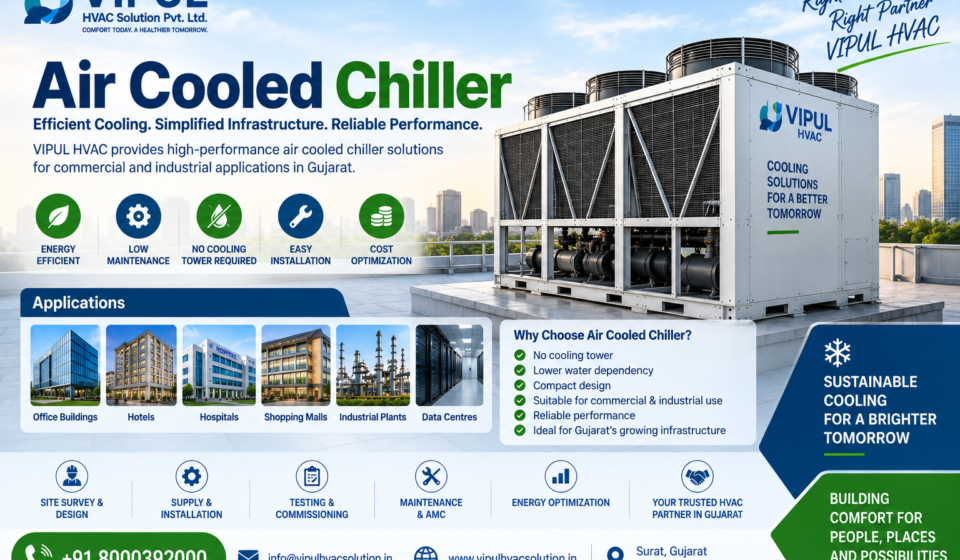
An air cooled chiller is a centralized cooling system that uses outdoor air to reject heat from the refrigeration cycle. Unlike a water-cooled chiller, it does not normally require a cooling tower or condenser-water circuit, which can simplify installation and reduce water-related infrastructure.
For commercial and industrial projects, choosing the right chiller requires more than comparing equipment prices. Cooling load, ambient conditions, operating hours, energy efficiency, installation space, maintenance requirements and lifecycle cost should all be evaluated.
VIPUL HVAC Solution Pvt. Ltd. provides chiller solutions for commercial and industrial applications, including cooling-load analysis, plant design, chiller selection, installation, testing, commissioning, optimization and AMC support.
What Is an Air Cooled Chiller?
An air cooled chiller is a refrigeration machine that removes heat from chilled water or another secondary fluid and rejects that heat directly to the surrounding outdoor air.
In a typical air cooled chiller:
Building / Process Load
↓
AHU / FCU / Heat Exchanger
↓
Return Chilled Water
↓
Chiller Evaporator
↓
Cooled Water
↓
AHU / FCU / Process Equipment
On the refrigeration side:
Evaporator → Compressor → Condenser Coil → Expansion Device → Evaporator
The condenser fans move outdoor air across the condenser coils, allowing heat to be rejected to the atmosphere. ASHRAE describes air-cooled condensers as using outdoor air over a dry coil to condense refrigerant.
How Does an Air Cooled Chiller Work?
Understanding the operating cycle makes it easier to understand why an air cooled chiller can be attractive for many commercial and industrial applications.
Step 1 — Heat Is Collected From the Building
Warm return chilled water enters the chiller after absorbing heat from the building through AHU or FCU cooling coils.
For process cooling, the return fluid may instead come from manufacturing equipment or a heat exchanger.
Step 2 — Refrigerant Absorbs the Heat
Inside the evaporator, the refrigeration cycle removes heat from the chilled-water circuit.
The chilled water is then circulated back toward the building or process.
ASHRAE identifies the evaporator, compressor, condenser and expansion/control device as fundamental components of a vapor-compression chiller.
Step 3 — Compressor Raises Refrigerant Pressure
The compressor increases the pressure and temperature of the refrigerant vapor.
Depending on the chiller design, different compressor technologies may be used, including scroll, screw and other configurations.
Step 4 — Condenser Rejects Heat
The hot refrigerant reaches the air-cooled condenser.
Fans move ambient air across the condenser coil.
The heat is transferred:
Refrigerant → Condenser Coil → Outdoor Air
Step 5 — Refrigerant Expands
The refrigerant passes through the expansion device, reducing its pressure and preparing it to absorb heat again.
The cycle then repeats.
Main Components of an Air Cooled Chiller
A typical air cooled chiller can contain:
1. Compressor
The compressor circulates and compresses the refrigerant.
2. Evaporator
Transfers heat from chilled water or another secondary fluid to the refrigerant.
3. Air-Cooled Condenser
Rejects heat directly to outdoor air.
4. Condenser Fans
Move ambient air through the condenser coils.
5. Expansion Device
Controls refrigerant flow and reduces pressure before the evaporator.
6. Chilled-Water Pump
Moves chilled water between the chiller and the building/process.
7. Controls
Monitor and control operating parameters.
8. Sensors
Temperature, pressure, flow and other sensors support system protection and control.
9. Electrical System
Provides power and protection for compressors, fans, pumps and controls.
Air Cooled Chiller vs Water Cooled Chiller
One of the most common questions from building owners is:
Which is better: air cooled or water cooled chiller?
There is no universal answer.
The correct choice depends on the application.
| Factor | Air Cooled Chiller | Water Cooled Chiller |
|---|---|---|
| Heat rejection | Outdoor air | Condenser water |
| Cooling tower | Normally not required | Normally required |
| Condenser-water pumps | Not required | Required |
| Water consumption | Lower plant water requirement | Requires condenser-water system |
| Installation | Generally simpler | More complex |
| Plant infrastructure | Simpler | More extensive |
| Maintenance | Generally simpler | Includes cooling-tower/water-system maintenance |
| Large central plants | Project dependent | Often suitable |
| Water availability | Less dependent | Important consideration |
| Selection | Application dependent | Application dependent |
ASHRAE notes that air-cooled equipment can have higher peak power input than water-cooled equipment because air-cooled condensers reject heat using outdoor dry-bulb conditions, while also noting the lower maintenance/infrastructure advantages of air-cooled systems.
Simple rule:
Choose an air cooled chiller when simplicity, reduced water infrastructure and easier installation are important.
Consider a water cooled chiller when the project justifies the additional cooling-tower and condenser-water infrastructure and the operating conditions favor it.
A professional engineering comparison should be performed before final selection.
Advantages of Air Cooled Chillers
1. No Cooling Tower Required
One of the biggest advantages is that a typical air cooled chiller does not need a separate cooling tower.
This can simplify the plant arrangement.
2. Lower Water Dependency
Because heat is rejected directly to outdoor air, the system does not require a conventional condenser-water loop.
This can be particularly useful where water availability or water-treatment infrastructure is a concern.
3. Simpler Installation
Compared with a water-cooled plant, an air cooled configuration can eliminate:
- Cooling tower
- Condenser-water pumps
- Condenser-water piping
- Some associated water-treatment infrastructure
This can reduce system complexity.
4. Easier Maintenance
There are fewer water-side components on the condenser side.
However, air cooled chillers still require proper maintenance of:
- Condenser coils
- Fans
- Compressors
- Electrical components
- Refrigeration circuit
- Controls
- Chilled-water system
ASHRAE specifically notes lower maintenance requirements as one characteristic of air-cooled heat rejection equipment.
5. Suitable for Many Commercial Applications
Air cooled chillers can be used for:
- Offices
- Hotels
- Retail buildings
- Hospitals
- Institutional buildings
- Industrial facilities
- Process cooling
The appropriate capacity and configuration depend on the project.
Limitations of Air Cooled Chillers
Air cooled chillers also have limitations that should be considered.
Higher Condensing Temperature
Because heat is rejected directly against outdoor air, performance is strongly affected by ambient temperature.
ASHRAE notes that air-cooled condensers can operate at higher condensing temperatures than water-cooled systems, which can increase power input under peak conditions.
Outdoor Temperature Matters
As outdoor temperature rises, the chiller may have to work harder to reject heat.
Therefore, selection should consider the design ambient temperature of the project location, rather than relying only on nominal catalogue capacity.
Outdoor Installation Space
The chiller requires suitable outdoor space with:
- Adequate airflow
- Service access
- Structural support
- Proper clearances
- Safe electrical connections
- Appropriate drainage
Condenser Coil Cleaning Is Important
Dust, dirt and debris on condenser coils can restrict airflow and reduce heat-transfer performance.
This is particularly important in industrial and dusty environments.
Where Are Air Cooled Chillers Used?
Commercial Buildings
Air cooled chillers can provide centralized cooling for:
- Corporate offices
- Business centres
- Commercial complexes
- IT offices
- Showrooms
Hotels
Applications can include cooling for:
- Guest areas
- Lobby
- Restaurants
- Banquet halls
- Meeting spaces
- Back-of-house areas
Ventilation and fresh-air requirements should be designed separately as part of the complete HVAC system.
Hospitals
Chillers can form part of a hospital’s centralized HVAC plant.
However, healthcare HVAC requires application-specific engineering involving:
- Filtration
- Outdoor air
- Temperature
- Humidity
- Pressure relationships
- Airflow
- Infection-control requirements
Shopping Malls
Large retail buildings may have substantial cooling loads due to:
- Occupancy
- Lighting
- Retail equipment
- Large floor areas
- Entrance heat gain
- Extended operating hours
Industrial Facilities
Air cooled chillers can be used for:
- Process cooling
- Manufacturing
- Machinery cooling
- Pharmaceutical facilities
- Food processing
- Textile applications
- Industrial HVAC
ASHRAE notes that chilled-liquid systems are widely used for both air conditioning and industrial-process applications.
Air Cooled Chiller for Industrial Process Cooling
Industrial cooling requirements can be very different from comfort air conditioning.
Before selecting an industrial air cooled chiller, consider:
- Process cooling load
- Required supply-fluid temperature
- Return-fluid temperature
- Flow rate
- Operating hours
- Process-criticality
- Ambient temperature
- Redundancy
- Future expansion
- Fluid type
- Glycol requirements where applicable
A process chiller should therefore be selected based on the actual process requirement, not simply the floor area.
Air Cooled Chiller for HVAC Applications
For a commercial building, the basic arrangement can be:
Air Cooled Chiller
↓
Chilled-Water Pump
↓
Chilled-Water Piping
↓
AHU / FCU
↓
Cooling Coil
↓
Conditioned Space
↓
Return Chilled Water
↓
Air Cooled Chiller
This allows one centralized cooling plant to serve multiple areas.
Air Cooled Chiller and AHU
An air cooled chiller does not directly distribute conditioned air throughout a building.
The chilled water normally reaches a cooling coil inside an Air Handling Unit (AHU) or Fan Coil Unit (FCU).
The AHU then conditions and distributes air through ductwork.
Therefore, a complete HVAC project may involve:
Chiller + Pumps + Piping + AHUs + Ductwork + Controls + BMS
VIPUL HVAC provides AHU, ductwork, chiller and broader HVAC solutions as part of its commercial and industrial HVAC offering.
Air Cooled Chiller Selection: What Should You Check?
Selecting a chiller only by TR capacity is not enough.
Consider the following.
1. Cooling Capacity
Determine the actual cooling load first.
2. Design Ambient Temperature
The selected chiller should be evaluated at the project’s actual design outdoor condition.
3. Chilled-Water Temperature
Specify the required supply and return water temperatures.
4. Flow Rate
The required chilled-water flow affects the selection of pumps, pipes and heat-transfer equipment.
5. Efficiency
Compare the manufacturer’s efficiency data at the actual operating conditions.
6. Part-Load Performance
Commercial buildings often operate at less than peak load.
Therefore, part-load behavior can be important.
7. Compressor Technology
Evaluate the compressor type and control strategy.
8. Sound Level
Noise may be important for:
- Hotels
- Hospitals
- Offices
- Residential developments
- Urban installations
9. Footprint
Check equipment dimensions and required service clearances.
10. Service Support
Evaluate:
- Spare parts
- Technical support
- Installation expertise
- Maintenance
- AMC
- Response time
Air Cooled Chiller Installation Process
Professional installation is essential for reliable operation.
Step 1 — Site Survey
Evaluate:
- Location
- Structural support
- Airflow
- Service access
- Electrical supply
- Piping routes
- AHU/FCU locations
Step 2 — Cooling Load Calculation
Calculate the required cooling capacity.
Step 3 — Chiller Selection
Select an appropriate model based on:
- Capacity
- Ambient temperature
- Chilled-water conditions
- Efficiency
- Space
- Operating profile
Step 4 — Equipment Placement
Install the chiller with suitable:
- Clearance
- Airflow
- Foundation
- Vibration control
- Service access
Step 5 — Chilled-Water Piping
Connect the chiller to the chilled-water network.
Step 6 — Pump Installation
Install and connect the required chilled-water pumps.
Step 7 — Electrical & Controls
Coordinate:
- Power supply
- Electrical protection
- Controls
- Sensors
- Communication
- BMS integration where applicable
Step 8 — Testing
Check:
- Piping
- Water flow
- Electrical systems
- Controls
- Sensors
- Pumps
- Chiller operation
Step 9 — Commissioning
The complete system is started, checked and optimized according to the approved design and manufacturer’s requirements.
Air Cooled Chiller Maintenance
Regular maintenance helps maintain heat-transfer performance and equipment reliability.
Maintenance checklist
Condenser
- Inspect condenser coils
- Clean accumulated dirt
- Check airflow
- Inspect fins
Fans
- Check fan motors
- Inspect bearings where applicable
- Check vibration
- Verify fan operation
Refrigeration System
- Check operating pressures
- Monitor temperatures
- Inspect for abnormal operating conditions
- Check controls and safety devices
Chilled-Water System
- Check flow
- Inspect pumps
- Check valves
- Inspect insulation
- Monitor supply/return temperatures
Electrical System
- Inspect connections
- Check protection devices
- Monitor current
- Inspect control panels
Controls
- Check sensors
- Check alarms
- Verify setpoints
- Review operating data
Common Air Cooled Chiller Problems
Chiller Not Cooling Properly
Possible causes include:
- Insufficient water flow
- Dirty condenser coils
- Incorrect operating conditions
- Refrigeration-system problems
- Sensor/control faults
- High ambient conditions
High Discharge Pressure
Possible contributing factors may include:
- Dirty condenser coil
- Restricted airflow
- High outdoor temperature
- Fan problems
- Refrigeration-system issues
Low Chilled-Water Flow
Possible causes can include:
- Pump problems
- Closed valve
- Air in the system
- Blocked filter/strainer
- Incorrect balancing
High Chiller Energy Consumption
Possible causes can include:
- Dirty condenser coils
- Poor water flow
- Incorrect setpoints
- Oversized equipment
- Part-load/control issues
- Poor maintenance
- High ambient conditions
A proper diagnostic process should identify the actual cause before corrective action.
Air Cooled Chiller Repair & Service
Professional chiller service can include:
- Breakdown diagnosis
- Compressor inspection
- Condenser cleaning
- Fan inspection
- Electrical troubleshooting
- Sensor checks
- Control-system diagnosis
- Pump inspection
- Water-flow verification
- Refrigeration-system diagnostics
- Performance testing
VIPUL HVAC provides HVAC maintenance and AMC services and positions its HVAC offering around diagnostics, system optimization and long-term performance.
Air Cooled Chiller AMC
An Annual Maintenance Contract (AMC) can help building owners establish a planned maintenance schedule.
A chiller AMC program may include:
Routine Inspection
- Cleaning
- Performance Monitoring
- Electrical Checks
- Mechanical Checks
- Control Checks
- Preventive Maintenance
- Breakdown Support
- Performance Review
The actual scope and frequency should be defined according to the equipment, operating conditions and manufacturer’s recommendations.
How Much Does an Air Cooled Chiller Cost?
There is no single price for an air cooled chiller.
The total project cost depends on:
- Cooling capacity
- Chiller model
- Compressor type
- Efficiency
- Number of chillers
- Pumps
- Piping
- AHUs/FCUs
- Electrical work
- Controls
- BMS
- Installation
- Testing
- Commissioning
- Structural requirements
- Project location
Therefore, a reliable quotation should follow:
Site Survey → Cooling Load Calculation → Chiller Selection → BOQ → Technical Proposal → Commercial Proposal
Why Choose VIPUL HVAC for Air Cooled Chillers?
VIPUL HVAC Solution Pvt. Ltd. provides HVAC solutions for commercial, industrial and institutional applications and currently lists chillers as one of its major HVAC product categories.
For chiller projects, VIPUL HVAC’s listed capabilities include:
- Cooling-load analysis
- Chiller plant design
- Chiller selection
- Pump selection
- Cooling-tower selection where applicable
- Chilled-water piping
- Electrical integration
- Control and automation
- Testing
- Commissioning
- Optimization
- AMC
- Performance monitoring
VIPUL HVAC Project Approach
Site Survey
↓
Cooling Load Calculation
↓
System Design
↓
Air Cooled Chiller Selection
↓
BOQ & Proposal
↓
Equipment Supply
↓
Installation
↓
Testing
↓
Commissioning
↓
AMC & Maintenance
This approach allows the chiller to be considered as part of the complete HVAC system, rather than as an isolated piece of equipment.
Air Cooled Chiller Services in Gujarat
VIPUL HVAC provides HVAC services across Gujarat and nearby regions, with current branch/service locations including Surat, Ahmedabad, Vadodara, Bharuch, Ankleshwar, Vapi, Junagadh and Talala.
For customers searching for:
- Air cooled chiller supplier Gujarat
- Air cooled chiller contractor Gujarat
- Air cooled chiller installation Gujarat
- Air cooled chiller service Gujarat
- Air cooled chiller maintenance Gujarat
- Chiller supplier Surat
- Chiller contractor Ahmedabad
- Chiller service Vadodara
- Chiller repair Bharuch
- Industrial chiller Gujarat
the important consideration should be the combination of equipment + engineering + installation + commissioning + service support.
Who Should Choose an Air Cooled Chiller?
An air cooled chiller can be a strong option when a project needs:
1. Centralized chilled-water cooling
2. No conventional cooling tower
3. Lower condenser-side water dependency
4.Simpler plant infrastructure
5. Commercial or industrial cooling
6.Easier installation compared with a water-cooled plant
7.Flexible application across HVAC and process cooling
However, final selection should always be based on engineering analysis.
Who May Need a Water Cooled Chiller Instead?
A water-cooled chiller may deserve consideration when:
- The project has a large continuous cooling load
- High efficiency is a major priority
- Cooling-tower infrastructure is practical
- Water availability and treatment can be managed
- Plant-room infrastructure supports the system
- Lifecycle economics justify the additional equipment
The correct choice should be based on a project-specific lifecycle comparison, not a general rule.
Final Verdict: Is an Air Cooled Chiller Right for Your Project?
An air cooled chiller can be an effective centralized cooling solution for many commercial and industrial applications because it rejects heat directly to outdoor air and normally avoids the need for a cooling tower and condenser-water circuit.
But the right chiller is not simply the one with the lowest purchase price or highest nominal capacity.
The right solution requires:
- Correct Cooling Load
- Correct Chiller Selection
- Correct Design
- Correct Piping
- Correct Installation
- Correct Commissioning
- Preventive Maintenance
For a new commercial building, industrial facility or process-cooling project in Gujarat, VIPUL HVAC can support the project from cooling-load assessment and chiller selection through installation, commissioning and AMC.
Planning an Air Cooled Chiller Project?
Contact VIPUL HVAC Solution Pvt. Ltd.
📞 +91 8000392000
📧 info@vipulhvacsolution.in
🌐 VIPUL HVAC Solution Pvt. Ltd. Visit VIPUL HVAC
Get a project-specific chiller consultation, cooling-load assessment and quotation for your Gujarat project.
Frequently Asked Questions About Air Cooled Chillers
What is an air cooled chiller?
An air cooled chiller is a refrigeration system that removes heat from chilled water or another fluid and rejects the heat directly to outdoor air through an air-cooled condenser.
How does an air cooled chiller work?
The chiller uses a refrigeration cycle to remove heat from the chilled-water circuit. The condenser then rejects the collected heat to outdoor air using condenser coils and fans.
Does an air cooled chiller need a cooling tower?
Normally, no. A conventional air cooled chiller rejects heat directly to outdoor air and therefore does not require a separate cooling tower.
Is an air cooled chiller energy efficient?
Efficiency depends on the equipment, ambient conditions, load profile, chilled-water temperatures, controls and maintenance. Air cooled systems can have higher peak power requirements than water-cooled systems under some conditions.
What is the difference between air cooled and water cooled chillers?
An air cooled chiller rejects heat directly to outdoor air. A water cooled chiller uses a condenser-water circuit and normally a cooling tower for heat rejection.
Is an air cooled chiller suitable for industrial applications?
Yes. Air cooled chillers can be used for industrial HVAC and process-cooling applications, subject to the required temperatures, flow rates, operating conditions and cooling load.
Is an air cooled chiller suitable for hospitals?
It can form part of a hospital HVAC plant, but healthcare areas require application-specific ventilation, filtration, pressure and environmental-control design.
How often should an air cooled chiller be serviced?
The maintenance schedule should follow the manufacturer’s recommendations and the site’s operating conditions. High-use or critical systems may require more frequent inspections.
What causes an air cooled chiller to lose cooling performance?
Potential causes include dirty condenser coils, inadequate chilled-water flow, fan problems, high ambient conditions, control faults and refrigeration-system issues. Proper diagnosis is required to identify the actual cause.
Does VIPUL HVAC provide air cooled chiller installation?
VIPUL HVAC provides chiller design, selection, supply, installation, testing, commissioning, optimization and maintenance support as part of its HVAC services.

-
-
-
-
-
-
-
-
-
-
-
Show Comments[…] air-cooled chiller rejects heat directly to the surrounding air through condenser coils and […]
[…] air-cooled chiller rejects heat directly to outdoor air through condenser coils and […]
[…] controls, testing, commissioning, optimization and AMC. Its current chiller offering includes air-cooled and water-cooled chillers, 20 TR to 1000+ TR capacity ranges, screw/scroll/centrifugal compressor […]
[…] Air Cooled Chiller […]
[…] Air Cooled Chiller […]
[…] Air Cooled Chiller […]
[…] Air Cooled Chiller […]
[…] Air Cooled Chiller […]
[…] Air Cooled Chiller […]
[…] Air Cooled Chiller […]
[…] Air Cooled Chiller […]