
What Is 1S, 2S, and 3S in BMS? Complete HVAC & Building Automation Guide
What is 1S, 2S, and 3S in BMS? The meaning of 1S, 2S and 3S depends on the context in which the term is used. In HVAC controls, these labels can refer to one-, two- or three-speed fan control, while in some HVAC controllers, “stage” notation can describe the number of heating or cooling stages. In a battery management system, however, 1S, 2S and 3S mean the number of battery-cell groups connected in series.
For a Building Management System (BMS) article, it is important not to confuse these meanings. VIPUL HVAC Solution focuses on BMS and HVAC automation, including HVAC monitoring and control, energy tracking, alarms, remote access and integration with VRF, chillers and AHUs.
Quick Answer: What Do 1S, 2S and 3S Mean in HVAC BMS?
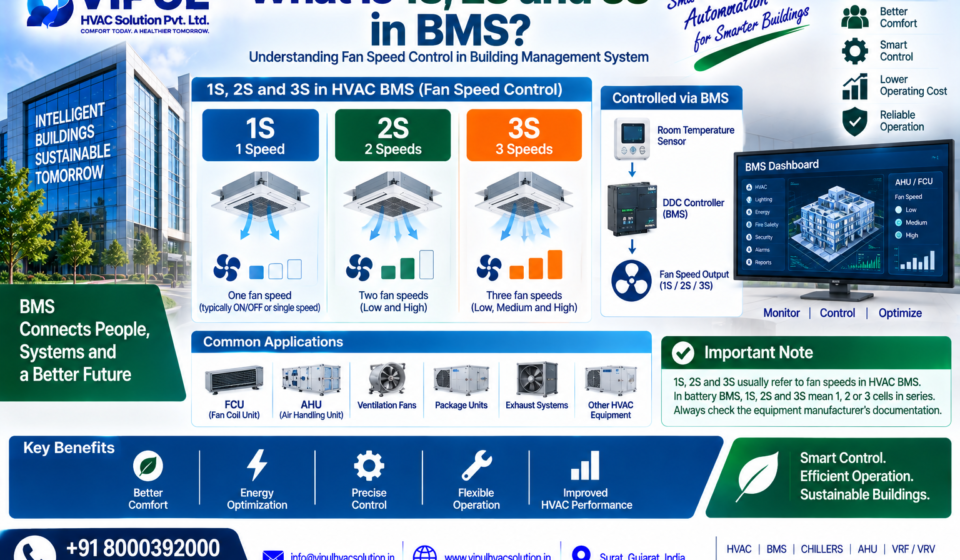
In HVAC control terminology, 1S, 2S and 3S can indicate 1-speed, 2-speed and 3-speed fan control.
| Term | Common HVAC meaning | Example |
|---|---|---|
| 1S | 1 fan speed | Low/High or one fixed speed |
| 2S | 2 fan speeds | Low + High |
| 3S | 3 fan speeds | Low + Medium + High |
| 1-stage | One heating/cooling stage | Single-stage operation |
| 2-stage | Two heating/cooling stages | Stage 1 + Stage 2 |
| 3-stage | Three heating/cooling stages | Stage 1 + Stage 2 + Stage 3 |
However, 1S/2S/3S is not a universal BMS classification. The exact meaning should always be checked against the controller, thermostat, HVAC equipment or project control specification.
For example, Meitav-tec’s HVAC controller documentation explicitly defines 1S / 2S / 3S as 1 fan speed / 2 fan speeds / 3 fan speeds.
What Does the “S” Mean?
In HVAC controller terminology, S can refer to speed, particularly when used as:
- 1S
- 2S
- 3S
In this context:
1S = 1 Speed
2S = 2 Speeds
3S = 3 Speeds
For example, a three-speed fan-coil controller may provide:
Low → Medium → High
The controller can select one of these fan speeds based on the control design.
Meitav-tec’s product documentation uses exactly this 1S/2S/3S convention for fan speed.
1S in HVAC BMS
What Is 1S?
1S generally means one fan speed when used as a fan-speed designation.
A 1-speed fan has essentially one controlled operating speed rather than separate low, medium and high speed outputs.
A simplified arrangement is:
BMS / Controller
↓
Fan Command
↓
Fan
The actual control could be:
- ON/OFF
- One fixed speed
- One available speed command
The exact implementation depends on the HVAC equipment.
2S in HVAC BMS
What Is 2S?
2S generally means two fan speeds.
For example:
Low Speed
↓
High Speed
The controller can select between two defined fan-speed outputs.
A simplified control sequence could be:
Low Cooling Demand
→ Low Fan Speed
Higher Cooling Demand
→ High Fan Speed
This type of control can be used with suitable fan-coil units, ventilation equipment and other HVAC applications.
3S in HVAC BMS
What Is 3S?
3S generally means three fan speeds.
A common arrangement is:
Low → Medium → High
The controller can select the appropriate speed according to the equipment’s control strategy.
For example:
| Cooling Demand | Fan Speed |
|---|---|
| Low | Low |
| Medium | Medium |
| High | High |
A three-speed controller can therefore provide more discrete operating choices than a two-speed controller.
1S vs 2S vs 3S in HVAC
| Feature | 1S | 2S | 3S |
|---|---|---|---|
| Fan-speed options | 1 | 2 | 3 |
| Control flexibility | Basic | Moderate | Higher |
| Typical example | Fixed/one speed | Low + High | Low + Medium + High |
| Control outputs | 1 speed command | 2 speed commands | 3 speed commands |
| Suitable for | Simple HVAC | Basic zoning/control | More flexible fan control |
| BMS integration | Possible | Possible | Possible |
Important: More fan speeds do not automatically mean a better HVAC system. The appropriate control depends on the fan motor, equipment design, airflow requirement and control strategy.
1S, 2S and 3S Are Not the Same as BMS Types
This is an important distinction.
You may see:
1S BMS
2S BMS
3S BMS
But these terms can mean completely different things depending on the industry.
In HVAC
They may indicate:
1S = 1 fan speed
2S = 2 fan speeds
3S = 3 fan speeds
In Battery Management Systems
They normally indicate:
1S = 1 cell group in series
2S = 2 cell groups in series
3S = 3 cell groups in series
Battery references confirm that the “S” denotes the number of series-connected cell groups.
Therefore, an article about BMS in HVAC should not describe 1S/2S/3S as battery configurations unless the article is specifically discussing battery BMS.
What Is the Difference Between Speed and Stage?
This is where HVAC terminology can become confusing.
Speed
Speed normally refers to how fast a fan operates.
For example:
- Low
- Medium
- High
Therefore:
3-speed fan = Low + Medium + High
Stage
Stage normally refers to a discrete level of heating or cooling capacity or operation.
For example:
Single-stage cooling
The cooling equipment has one operating stage.
Two-stage cooling
The system has:
Stage 1 → Stage 2
Three-stage cooling
The system has:
Stage 1 → Stage 2 → Stage 3
Some HVAC controller manufacturers use separate notation for heating/cooling stages and fan speeds. Meitav-tec, for example, documents both heating/cooling-stage configurations and 1S/2S/3S fan-speed configurations.
How Does 1S/2S/3S Work With BMS?
Consider a fan-coil unit.
The BMS may receive:
- Room temperature
- Setpoint
- Fan status
- Valve status
The BMS/controller then sends an appropriate fan-speed command.
Example
Room temperature = 24°C
Setpoint = 22°C
↓
Cooling demand detected
↓
Controller selects:
High fan speed
↓
FCU fan operates at high speed.
As the room approaches the setpoint, the control sequence may select a lower speed.
The exact sequence should be defined by the project’s control philosophy.
3-Speed FCU Example
A three-speed FCU could operate like this:
Step 1 — Low Demand
Room temperature is close to setpoint.
Fan → LOW
Step 2 — Medium Demand
Cooling demand increases.
Fan → MEDIUM
Step 3 — High Demand
Room temperature is significantly above setpoint.
Fan → HIGH
Step 4 — Setpoint Achieved
The controller may reduce fan speed or stop the fan according to the programmed sequence.
This provides discrete fan-speed control rather than simply ON/OFF operation.
1S, 2S and 3S in Fan Coil Units
Fan Coil Units are a common HVAC application where multiple fan speeds may be available.
A typical FCU includes:
- Fan
- Cooling coil
- Chilled-water connection
- Condensate drain
- Thermostat/controller
- Fan-speed control
VIPUL’s current FCU offering includes 0.5 TR to 5 TR units, ceiling-concealed/exposed configurations, chilled-water cooling, multi-speed airflow, thermostat/BMS-ready controls and condensate management.
This makes fan-speed terminology relevant when specifying FCU controls.
1S, 2S and 3S in AHU Controls
AHUs can also have different fan-control arrangements.
However, large AHUs frequently use more sophisticated control methods, such as:
- Variable Frequency Drives
- EC fans
- Variable airflow
- Static-pressure control
- VAV control
- Temperature-based modulation
Therefore, a large AHU should not automatically be described as a “3S system” simply because its fan can operate at different speeds.
The actual control architecture should be checked from the equipment and controls design.
1S, 2S and 3S vs Variable Speed
This is another important distinction.
3-Speed Fan
Provides discrete speeds:
Low → Medium → High
Variable-Speed Fan
Can operate across a continuous range of speeds.
For example:
30% → 40% → 50% → 60% → 70% → 80% → 90%
The actual range depends on the motor, drive and control system.
Therefore:
3S does not mean variable speed.
A three-speed fan has defined operating steps, while a variable-speed system can modulate over a range.
Can BMS Control a 3-Speed Fan?
Yes, if the fan/controller/equipment is designed for BMS integration.
A simplified architecture can be:
BMS
↓
DDC Controller
↓
Fan-Speed Outputs
↓
Low / Medium / High
↓
FCU / Fan
The actual wiring and control method depend on the selected controller and HVAC equipment.
Can BMS Control a 1-Speed Fan?
Yes.
A basic fan may have:
BMS → ON/OFF Command → Fan
The BMS can also monitor:
- Running status
- Fault status
- Operating schedule
depending on the available points.
Can BMS Control a 2-Speed Fan?
Yes.
A two-speed fan can have:
BMS / Controller
↓
Low-Speed Command
or
↓
High-Speed Command
The control sequence should prevent inappropriate simultaneous commands and should follow the equipment manufacturer’s requirements.
Can BMS Control a 3-Speed Fan?
Yes.
A compatible three-speed fan can have:
BMS / Controller
↓
Low
Medium
High
The controller can select the appropriate speed according to:
- Temperature
- Cooling demand
- Occupancy
- Schedule
- Pressure
- Other programmed conditions
The exact sequence depends on the HVAC design.
1S, 2S and 3S in BMS: Why Is It Important?
Understanding the terminology is important during:
- HVAC design
- BMS point-list preparation
- FCU selection
- Thermostat selection
- DDC controller selection
- Wiring
- Programming
- Testing
- Commissioning
For example, if the HVAC specification requires a 3-speed FCU, the BMS/control system needs to provide an appropriate method to command those speeds.
BMS Point List for a 3-Speed FCU
A simplified example might include:
Inputs
- Room temperature
- Fan status
- Alarm status
- Valve status
Outputs
- Fan Low
- Fan Medium
- Fan High
- Cooling-valve command
The actual point list can be different depending on whether the FCU uses:
- Relay outputs
- 0–10 V control
- EC fan control
- Modbus
- BACnet
- Manufacturer-specific communication
Therefore, point lists should be developed from the actual equipment selection.
BMS and 1S/2S/3S: Why Equipment Compatibility Matters
A common mistake is assuming that every HVAC controller uses the same terminology.
One manufacturer may use:
1S / 2S / 3S = fan speeds
Another system may describe:
Stage 1 / Stage 2 / Stage 3 = cooling stages
Another may use a completely different control convention.
For example, Meitav-tec explicitly uses 1S/2S/3S for fan speeds, while its product nomenclature separately describes heating/cooling stages.
Therefore:
Always check the manufacturer’s controller documentation and the project’s BMS point list before interpreting 1S, 2S or 3S.
What About 1S, 2S and 3S in Battery BMS?
Because Google users often search for “1S 2S 3S BMS” intending battery technology, this distinction is important.
In a Battery Management System:
1S
One cell group in series.
2S
Two cell groups connected in series.
3S
Three cell groups connected in series.
With common lithium-ion cells having a nominal voltage around 3.7 V:
| Battery BMS | Typical nominal pack voltage* |
|---|---|
| 1S | ~3.7 V |
| 2S | ~7.4 V |
| 3S | ~11.1 V |
| 4S | ~14.8 V |
*Illustrative values for common lithium-ion cells; actual voltage depends on cell chemistry and manufacturer specifications. Sources describing battery BMS terminology confirm that S refers to series-connected cell groups.
This is different from HVAC BMS terminology.
HVAC BMS vs Battery BMS
| Feature | HVAC BMS | Battery BMS |
|---|---|---|
| Full form | Building Management System | Battery Management System |
| Main purpose | Building/HVAC monitoring & control | Battery monitoring/protection |
| 1S/2S/3S | May refer to fan speeds or stages depending on controller | Series cell groups |
| Main equipment | Chillers, AHUs, VRF, FCUs, pumps, fans | Battery cells/packs |
| Typical communication | BACnet, Modbus and other building protocols | CAN, UART and other battery interfaces |
| Main measurements | Temperature, humidity, pressure, airflow, energy | Voltage, current, cell temperature |
| Main objective | Building operation and HVAC automation | Battery safety and management |
This distinction is especially important for SEO because “BMS” has two major technical meanings.
What Is the Role of BMS in HVAC Automation?
VIPUL HVAC Solution’s BMS service focuses on the Building Management System meaning of BMS.
Its current BMS & HVAC automation service includes:
- HVAC monitoring and control
- Energy consumption tracking
- Alarm and fault detection
- Remote access
- VRF integration
- Chiller integration
- AHU integration
- Control logic development
- Sensor and controller integration
- Testing and training
- System optimization.
Therefore, 1S/2S/3S should be interpreted within the specific HVAC equipment/control context, rather than treating it as a universal classification of Building Management Systems.
How to Specify 1S, 2S or 3S Correctly
Before specifying a controller, identify:
1. HVAC Equipment
Is it:
- FCU?
- AHU?
- Fan?
- Ventilation unit?
- Package unit?
2. Motor Type
Is it:
- Multi-speed motor?
- EC motor?
- AC motor?
- VFD-controlled motor?
3. Control Requirement
Does the project require:
- 1 speed?
- 2 speeds?
- 3 speeds?
- Variable speed?
4. Communication
Does the equipment support:
- BACnet?
- Modbus?
- Dry contacts?
- 0–10 V?
- Manufacturer gateway?
5. BMS Point List
Define exactly what needs to be monitored and controlled.
Example: 3S FCU BMS Control
A typical conceptual sequence could be:
Room Temperature Sensor
↓
DDC / FCU Controller
↓
Compare Temperature with Setpoint
↓
Cooling Demand
↓
Low Demand
LOW SPEED
Medium Demand
MEDIUM SPEED
High Demand
HIGH SPEED
↓
Room reaches desired condition
↓
Reduce speed / stop according to programmed sequence
This is only an example. The actual sequence should be engineered for the selected FCU and control system.
Benefits of Proper Fan-Speed Integration
Correct integration of fan-speed control can provide:
Better Comfort
Fan operation can respond to changing cooling requirements.
Better Control
Operators can manage fan operation through the control system.
Potential Energy Optimization
Lower fan operation can be used when demand is lower, subject to the equipment and control strategy.
Reduced Noise
Lower fan speed can reduce airflow noise in appropriate applications.
Better Automation
Fan operation can be coordinated with schedules and room conditions.
Actual energy and comfort results depend on equipment selection, control sequences and commissioning.
Common Mistakes
Mistake 1: Assuming 1S Always Means One Stage
It may mean one fan speed, depending on the controller terminology.
Mistake 2: Confusing HVAC BMS With Battery BMS
The two systems have completely different meanings.
Mistake 3: Calling a Variable-Speed Fan a 3S Fan
Three fixed speeds are not the same as continuously variable-speed control.
Mistake 4: Ignoring Manufacturer Documentation
Always verify the controller terminology.
Mistake 5: Not Defining the Point List
BMS integration should clearly define the required inputs and outputs.
Mistake 6: Ignoring Motor Type
EC motors and VFD-driven motors can require different control methods than traditional multi-speed motors.
Why Choose VIPUL HVAC Solution for BMS & HVAC Automation?
VIPUL HVAC Solution Pvt. Ltd. provides HVAC-focused BMS and automation solutions for commercial, industrial and institutional projects.
The company’s current BMS offering includes integration with:
- VRF systems
- Chillers
- AHUs
along with HVAC monitoring, energy tracking, alarm/fault detection, remote access, control logic development, sensor/controller integration, testing and system optimization.
For a BMS project involving FCUs, AHUs, chillers, VRF or ventilation equipment, VIPUL can help develop the control architecture around the actual HVAC equipment and project requirements.
BMS & HVAC Automation Consultation
📞 +91 8000392000
📧 info@vipulhvacsolution.in
🌐 vipulhvacsolution.in
Frequently Asked Questions
What is 1S in BMS?
In HVAC controller terminology, 1S can mean one fan speed. However, the exact meaning depends on the manufacturer’s terminology.
What is 2S in BMS?
In HVAC applications, 2S commonly means two fan speeds, such as low and high.
What is 3S in BMS?
In HVAC controller terminology, 3S commonly means three fan speeds, typically low, medium and high.
Is 1S 2S 3S a standard BMS classification?
No. It is not a universal classification of Building Management Systems. The meaning depends on the equipment or controller specification.
What does 1S mean in battery BMS?
In battery terminology, 1S means one cell group connected in series.
What does 2S mean in battery BMS?
2S means two cell groups connected in series.
What does 3S mean in battery BMS?
3S means three cell groups connected in series.
Is 3S better than 1S in HVAC?
Not necessarily. A 3-speed controller provides more discrete fan-speed options, but the appropriate configuration depends on the HVAC equipment and required control strategy.
Can BMS control 3-speed fans?
Yes, when the fan/controller and BMS architecture support the required speed commands.
Can BMS control variable-speed fans?
Yes. Compatible systems can use methods such as VFD or EC-fan control, depending on the equipment and control design.
Conclusion
1S, 2S and 3S do not have one universal meaning in BMS.
For HVAC BMS and controllers, they can commonly describe:
1S → 1 fan speed
2S → 2 fan speeds
3S → 3 fan speeds
Some HVAC documentation instead uses “stage” terminology for discrete heating or cooling stages, so the manufacturer’s documentation must be checked.
For battery BMS, the meaning is different:
1S → 1 series cell group
2S → 2 series cell groups
3S → 3 series cell groups.
For VIPUL HVAC’s context, the relevant meaning is the Building Management System used for HVAC monitoring, control and automation, including integration with VRF systems, chillers and AHUs.
The safest engineering practice is therefore:
Never select a BMS controller simply because it says 1S, 2S or 3S. First verify whether the S refers to fan speed, control stages, or another manufacturer-specific function, and then match the controller to the actual HVAC equipment and BMS point list.
Important Links: