

Fresh Air Ventilation System for Pharmaceutical Industry: Complete Guide to Pharma HVAC, Cleanrooms & Contamination Control
A Fresh Air Ventilation System for Pharmaceutical Industry is a critical part of pharmaceutical HVAC design. It helps provide controlled outdoor air, maintain suitable temperature and humidity, support filtration and pressure control, and reduce the risk of contamination and cross-contamination.
Unlike ordinary commercial HVAC, pharmaceutical ventilation must be designed around the product, manufacturing process, cleanroom requirements, contamination-control strategy and applicable GMP requirements.
The World Health Organization (WHO) specifically recognizes HVAC as an important element in pharmaceutical manufacturing because HVAC design affects contamination control, cross-contamination prevention, temperature, humidity, ventilation and building pressure. WHO also recommends a science- and risk-based approach throughout the HVAC lifecycle, from design through qualification and maintenance.
For this reason, a pharmaceutical fresh-air system should not be selected simply by room size or a generic air-change number. The system should be engineered for the actual process and applicable standards.
What Is a Fresh Air Ventilation System for Pharmaceutical Industry?
A fresh air ventilation system for pharmaceutical industry is an engineered HVAC system that introduces controlled outdoor air into pharmaceutical manufacturing and support areas while managing filtration, temperature, humidity, airflow direction, pressure and exhaust.
A simplified system can be represented as:
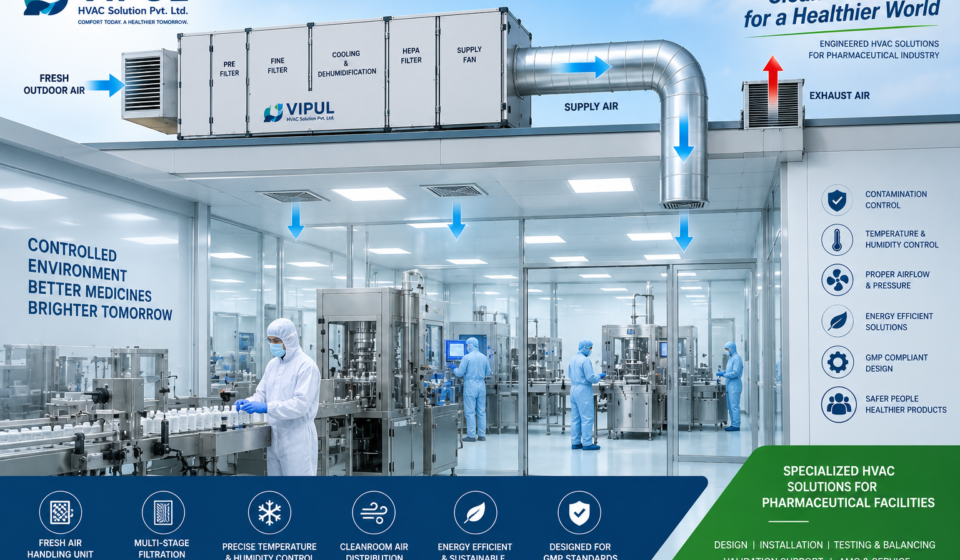
Outdoor Air → Fresh Air Intake → Pre-Filtration → Fine Filtration → FAHU/AHU → Cooling & Humidity Control → HEPA Filtration Where Required → Supply Air → Controlled Area → Return/Exhaust
Depending on the facility, the system may be:
- Full fresh-air HVAC
- Recirculation HVAC with controlled fresh-air intake
- Dedicated fresh-air system
- AHU-based cleanroom HVAC
- Specialized containment/exhaust system
- Hybrid HVAC architecture
WHO guidance allows both full fresh-air and recirculation approaches, provided the supplied air is appropriately treated and contamination/cross-contamination risks are controlled.
Why Is Fresh Air Ventilation Important in Pharmaceutical Manufacturing?
Pharmaceutical manufacturing requires much greater environmental control than a conventional office or commercial building.
The HVAC system may influence:
- Product quality
- Cleanroom conditions
- Airborne particulate levels
- Temperature
- Relative humidity
- Pressure differentials
- Airflow direction
- Cross-contamination risk
- Personnel protection
- Process performance
WHO states that HVAC design should be considered at the initial design stage because it influences architectural elements such as airlocks, doors, lobbies, room pressure and pressure cascades.
Major Objectives of Pharmaceutical Fresh Air Ventilation
A properly engineered pharma ventilation system can be designed to support several objectives.
1. Contamination Control
Controlled airflow and filtration help reduce the introduction and movement of airborne contaminants.
2. Cross-Contamination Control
Airflow direction and pressure relationships can help prevent materials or contaminants from moving between areas.
3. Temperature Control
Stable temperature can be important for pharmaceutical processes, materials, equipment and personnel.
4. Humidity Control
Relative humidity can affect certain pharmaceutical materials and processes.
For example, moisture-sensitive powders may require carefully controlled environmental conditions.
5. Pressure Control
Pressure cascades can help control the direction of airflow between adjacent rooms.
6. Air Filtration
Filtration helps remove particles and other contaminants from the air supplied to controlled environments.
7. Fresh-Air Supply
Outdoor air can provide ventilation and compensate for exhaust, leakage and occupancy requirements.
WHO recommends determining fresh-air requirements based on factors including facility leakage, exhaust losses, operator occupancy and other applicable design considerations.
Fresh Air Ventilation System vs Normal HVAC
A standard commercial HVAC system is generally designed primarily for occupant comfort.
A pharmaceutical HVAC system may need to control multiple environmental parameters simultaneously.
| Parameter | Commercial HVAC | Pharmaceutical HVAC |
|---|---|---|
| Temperature | Important | Precisely controlled where required |
| Humidity | Comfort-oriented | Process/product dependent |
| Fresh Air | Occupancy-based | Process + regulatory requirements |
| Filtration | General | Application-specific/high efficiency |
| Pressure | Usually limited | Often critical |
| Airflow Direction | General | Controlled where required |
| Particle Control | Limited | Often critical |
| Cleanroom | No | May be required |
| Qualification | Usually limited | Important for GMP applications |
| Documentation | Standard | Extensive, project-dependent |
| Contamination Control | General | Major design consideration |
Pharmaceutical Areas That May Require Controlled Ventilation
Different areas within a pharmaceutical facility can have different HVAC requirements.
1. Manufacturing Areas
Production areas may require controlled:
- Temperature
- Humidity
- Airflow
- Filtration
- Pressure
The exact requirements depend on the product and manufacturing process.
2. Cleanrooms
Cleanrooms are controlled environments designed to limit airborne particulate contamination.
HVAC design may involve:
- AHUs
- HEPA filters
- Controlled supply airflow
- Return-air systems
- Pressure cascades
- Temperature control
- Humidity control
- Airlocks
- Monitoring
Cleanroom classification should be established according to the applicable standard and intended process.
3. Sterile Manufacturing Areas
Sterile manufacturing requires especially stringent contamination-control strategies.
HVAC design may involve:
- High-efficiency filtration
- Appropriate pressure relationships
- Controlled airflow
- Specialized air distribution
- Unidirectional airflow in applicable critical areas
- Environmental monitoring
The exact design should be based on the applicable sterile-manufacturing requirements rather than generic cleanroom assumptions.
4. Tablet Manufacturing
Tablet and oral-solid-dose facilities can generate significant quantities of dust.
HVAC planning may therefore need to address:
- Dust containment
- Exhaust
- Filtration
- Pressure relationships
- Airflow direction
- Cross-contamination prevention
5. Capsule Manufacturing
Capsule production may also require controlled environmental conditions depending on materials and processes.
HVAC planning can consider:
- Temperature
- Humidity
- Dust
- Filtration
- Pressure
- Fresh air
- Exhaust
6. Liquid Manufacturing
Liquid pharmaceutical manufacturing may have different temperature, humidity and ventilation requirements.
The HVAC system should be designed around the specific process.
7. API Manufacturing
Active pharmaceutical ingredient facilities may require specialized containment and exhaust strategies.
Depending on the substance, HVAC may need to protect:
- Product
- Operators
- Adjacent areas
- Environment
Negative-pressure or dedicated exhaust strategies may be required for certain hazardous or potent materials.
8. Pharmaceutical Laboratories
Laboratories may require:
- Fresh-air supply
- Exhaust ventilation
- Fume extraction
- Temperature control
- Humidity control
- Specialized filtration
The ventilation strategy depends on the laboratory process and substances handled.
Main Components of a Pharmaceutical Fresh Air Ventilation System
1. Fresh Air Intake
The outdoor-air intake should be positioned to reduce the risk of introducing contaminated or polluted air.
The design should consider:
- Outdoor air quality
- Nearby exhaust outlets
- Vehicle emissions
- Dust
- Building surroundings
- Prevailing wind conditions
2. Fresh Air Handling Unit – FAHU
A FAHU can condition outdoor air before supplying it to the pharmaceutical facility.
Depending on the project, it may include:
- Pre-filter
- Fine filter
- Cooling coil
- Heating coil
- Dehumidification
- Humidification
- Fan
- Dampers
- Sensors
- Controls
3. Air Handling Unit – AHU
AHUs are central to many pharmaceutical HVAC systems.
A pharmaceutical AHU can be designed to manage:
- Fresh air
- Return air
- Filtration
- Cooling
- Heating
- Humidity
- Air circulation
- Supply airflow
The configuration should be determined by the process and contamination-control strategy.
4. HEPA Filtration
HEPA — High Efficiency Particulate Air — filtration may be required in applications where high-efficiency particle removal is part of the contamination-control strategy.
WHO guidance notes that HEPA filters can be used in supply or return air streams to help control contamination and cross-contamination, with H13 or equivalent cited for certain applications in its non-sterile pharmaceutical HVAC guidance.
However, HEPA filtration should not automatically be assumed to be necessary everywhere in a pharmaceutical facility. Filter selection should be based on risk assessment, process requirements, cleanroom classification and applicable standards.
5. Pre-Filters and Fine Filters
A multi-stage filtration arrangement can protect downstream filters and equipment.
Typical concepts can include:
Outdoor Air → Pre-Filter → Fine Filter → HEPA Where Required
The actual filter stages and efficiencies should be selected according to:
- Outdoor conditions
- Process requirements
- Cleanroom classification
- Required cleanliness
- Pressure drop
- Maintenance strategy
6. Ductwork
Pharmaceutical ductwork should be designed with attention to:
- Air leakage
- Cleanability
- Pressure loss
- Insulation
- Access
- Air velocity
- Material compatibility
- Airflow balancing
Poor duct design can result in uneven airflow and difficulty maintaining room conditions.
7. Dampers
Dampers can be used for:
- Airflow control
- Isolation
- Pressure balancing
- Fresh-air regulation
- Exhaust control
In critical systems, damper selection and accessibility should be carefully considered.
8. Diffusers and Grilles
Air-distribution devices determine how air enters and leaves controlled areas.
Their position should be coordinated with:
- Equipment
- Workstations
- Production processes
- Ceiling layouts
- Return-air points
- Cleanroom airflow requirements
9. Exhaust Systems
Pharmaceutical processes can generate:
- Dust
- Vapors
- Solvent fumes
- Heat
- Moisture
- Process contaminants
Dedicated exhaust systems may be required to control these sources.
Pressure Differential in Pharmaceutical HVAC
Pressure control is one of the most important features of pharmaceutical ventilation.
A pressure cascade establishes controlled pressure relationships between adjacent spaces.
For example:
Cleaner Area → Less Clean Area → Corridor
The objective is to control the direction of air movement.
WHO’s pharmaceutical HVAC guidance identifies pressure differentials and pressure cascades as important elements in contamination and cross-contamination control.
Positive Pressure in Pharmaceutical Facilities
Positive pressure can be used in areas where the primary objective is to prevent contaminants from entering a cleaner environment.
Air tends to move from the higher-pressure space toward the lower-pressure space when pathways are available.
This approach can be appropriate for certain clean manufacturing environments.
Negative Pressure in Pharmaceutical Facilities
Negative pressure may be appropriate where containment is the priority.
For example, certain potent or hazardous materials may require containment so that potentially contaminated air does not escape into adjacent areas.
The appropriate pressure strategy depends on the product, process and risk assessment.
Fresh Air and Air Changes in Pharmaceutical Facilities
Air Changes per Hour (ACH) describes the relationship between airflow and room volume.
However, there is no single universal ACH value for every pharmaceutical room.
The required airflow depends on:
- Cleanroom classification
- Process
- Particle-control requirements
- Heat load
- Occupancy
- Pressure cascade
- Filtration
- Equipment
- Contamination-control strategy
- Applicable standards
Therefore, pharmaceutical HVAC design should not simply apply an internet-sourced ACH table to every room.
WHO guidance emphasizes determining HVAC requirements based on the facility, process and environmental conditions.
Unidirectional Airflow in Pharmaceutical Cleanrooms
Some critical pharmaceutical applications may require unidirectional airflow.
In unidirectional airflow, filtered air moves in a controlled direction across the critical zone.
This can help sweep airborne particles away from sensitive areas.
WHO notes that modern guidance uses the term unidirectional airflow rather than the older term “laminar airflow.”
The design and performance criteria should be established according to the applicable cleanroom and sterile-manufacturing requirements.
Fresh Air Ventilation for Pharmaceutical Cleanrooms
A typical cleanroom HVAC concept can include:
Outdoor Air
↓
Pre-Filtration
↓
Fine Filtration
↓
FAHU / AHU
↓
Cooling & Dehumidification
↓
HEPA Filtration Where Required
↓
Supply Plenum / Terminal Filters
↓
Cleanroom
↓
Return Air
↓
Recirculation / Exhaust
The exact arrangement depends on the contamination-control strategy.
WHO states that both full fresh-air and recirculation systems may be used when appropriately designed and when contamination and cross-contamination risks are controlled.
Temperature and Humidity Control in Pharmaceutical HVAC
Temperature and humidity can directly affect pharmaceutical processes and materials.
For example, humidity can influence:
- Powder flow
- Material handling
- Tablet production
- Capsule manufacturing
- Product stability
- Equipment operation
WHO states that temperature, relative humidity and ventilation should be appropriate and should not adversely affect pharmaceutical product quality, equipment or instruments.
A pharmaceutical HVAC system may therefore require:
Cooling
To remove sensible heat.
Dehumidification
To control excessive moisture.
Humidification
To maintain minimum humidity where required.
Heating
To maintain required environmental conditions during colder periods.
Fresh Air Ventilation and Contamination Control
One of the most important benefits of a properly designed pharmaceutical HVAC system is controlled airflow.
The objective is to reduce uncontrolled movement of:
- Dust
- Particles
- Microorganisms
- Product residues
- Process contaminants
The HVAC system should work together with:
- Facility layout
- Airlocks
- Personnel flow
- Material flow
- Cleaning procedures
- Process controls
- Environmental monitoring
HVAC alone cannot guarantee contamination-free pharmaceutical manufacturing.
Cross-Contamination Control
Cross-contamination is a major consideration in pharmaceutical manufacturing.
A poorly designed HVAC system can potentially transfer contaminants between production areas.
Strategies can include:
- Pressure cascades
- Dedicated AHUs
- Appropriate filtration
- Controlled air movement
- Dedicated exhaust
- Airlocks
- Physical separation
- Appropriate zoning
WHO emphasizes preventing contamination and cross-contamination as a fundamental HVAC design consideration.
Pharmaceutical HVAC: Full Fresh Air vs Recirculation
There are two broad approaches.
Full Fresh-Air System
All supply air is treated outdoor air.
Potential advantages:
- Reduced recirculation-related cross-contamination risk
- Suitable for certain high-risk processes
- Direct control over outside-air supply
Considerations:
- Higher cooling load
- Higher heating load
- Higher fan energy
- Larger AHU capacity
Recirculation System
A portion of treated air is recirculated.
Potential advantages:
- Lower energy consumption
- Reduced cooling/heating requirements
- Smaller outdoor-air conditioning load
Considerations:
- Cross-contamination risk must be evaluated
- Appropriate filtration is important
- Airflow zoning is critical
WHO allows both approaches when the supplied air is appropriately treated and contamination risks are controlled.
Energy-Efficient Pharmaceutical HVAC
Pharmaceutical HVAC systems often operate continuously, so energy efficiency can have a significant impact on operating costs.
Important strategies include:
1. Efficient AHUs
Select appropriately sized and efficient fans and coils.
2. Variable Frequency Drives
VFDs can adjust fan speed according to system demand where appropriate.
3. Optimized Ductwork
Good duct design reduces unnecessary pressure loss.
4. Heat Recovery
Energy recovery can be considered where technically appropriate and where contamination risks are adequately controlled.
5. Efficient Chillers
Central chilled-water systems should be selected according to actual cooling load and operating profile.
6. BMS Integration
Automation can help monitor:
- Temperature
- Humidity
- Pressure
- Fan status
- Filter condition
- Energy consumption
- Alarms
7. Airflow Optimization
Avoid unnecessary over-ventilation while maintaining the required environmental conditions.
The 2024 second edition of the ISPE HVAC Good Practice Guide emphasizes lifecycle management, sustainability, energy efficiency and commissioning/qualification strategies for pharmaceutical HVAC.
BMS for Pharmaceutical HVAC
A Building Management System (BMS) can provide centralized monitoring of pharmaceutical HVAC systems.
It can monitor:
- Room temperature
- Relative humidity
- Pressure differential
- AHU status
- Fan status
- Filter differential pressure
- Chilled-water temperature
- Alarms
- Operating schedules
- Energy consumption
For critical pharmaceutical applications, monitoring and alarm strategies should be developed according to the validated system and applicable GMP requirements.
Pharmaceutical HVAC Qualification and Validation
Pharmaceutical HVAC is not simply an installation project.
It may involve qualification and verification activities such as:
Design Qualification – DQ
Confirms that the proposed design meets defined requirements.
Installation Qualification – IQ
Verifies that equipment and components have been installed according to approved specifications.
Operational Qualification – OQ
Verifies that the system operates within defined parameters.
Performance Qualification – PQ
Provides documented evidence that the system performs effectively under intended operating conditions.
The exact qualification strategy should be established according to the project’s validation plan and applicable GMP requirements.
WHO’s HVAC guidance explicitly addresses commissioning, qualification and maintenance as part of the HVAC lifecycle.
Pharmaceutical HVAC Testing and Balancing
Testing, Adjusting and Balancing (TAB) is essential for verifying actual airflow.
Testing can include:
- Supply airflow
- Return airflow
- Exhaust airflow
- Room pressure
- Filter differential pressure
- Temperature
- Humidity
- Airflow direction
- Air velocity where applicable
Testing should be documented and compared against approved design criteria.
Pharmaceutical HVAC Maintenance
A pharmaceutical HVAC system requires a structured maintenance program.
Important activities can include:
Filter Inspection
Monitor filter condition and differential pressure.
HEPA Filter Integrity Testing
Where HEPA filters are used, appropriate integrity testing should be performed according to the applicable qualification and testing requirements.
AHU Maintenance
Inspect:
- Fans
- Motors
- Coils
- Filters
- Dampers
- Drain pans
- Sensors
Duct Inspection
Check for:
- Leakage
- Insulation damage
- Contamination
- Access issues
Sensor Calibration
Incorrect sensors can result in incorrect temperature, humidity or pressure control.
Airflow Verification
Periodically confirm that required airflow conditions are maintained.
WHO emphasizes maintenance and lifecycle management as important elements of pharmaceutical HVAC management.
Common Pharmaceutical HVAC Problems
1. Unstable Room Pressure
Possible causes:
- Incorrect airflow balancing
- Fan problems
- Damper issues
- Door leakage
- Filter blockage
2. High Humidity
Possible causes:
- Insufficient dehumidification
- Excessive outdoor-air moisture
- Cooling-coil problems
- Poor control settings
3. Excessive Particle Levels
Possible causes:
- Filter leakage
- Poor cleanroom practices
- Inadequate airflow
- Poor pressure control
- Contamination sources
4. Uneven Temperature
Possible causes:
- Poor air distribution
- Incorrect diffuser placement
- Insufficient airflow
- Improper balancing
5. High Energy Consumption
Possible causes:
- Excessive airflow
- Dirty filters
- High pressure drop
- Poor duct design
- Inefficient fans
- Oversized equipment
6. Cross-Contamination Risk
Possible causes:
- Incorrect pressure cascade
- Shared air systems without adequate controls
- Poor airflow direction
- Inappropriate recirculation
- Door/airlock problems
How to Choose a Pharmaceutical HVAC Company
Before selecting an HVAC company for a pharmaceutical project, evaluate:
1. Pharmaceutical HVAC Experience
Pharmaceutical HVAC is more specialized than standard comfort air conditioning.
2. Cleanroom Knowledge
The HVAC team should understand:
- Cleanroom airflow
- Filtration
- Pressure cascades
- Air changes
- Temperature
- Humidity
3. Engineering Capability
Look for capabilities in:
- Heat-load calculations
- AHU selection
- Chiller selection
- Duct design
- Ventilation calculations
- Air balancing
- Controls
4. Qualification Support
For GMP facilities, understand the contractor’s ability to support required commissioning and qualification activities.
5. Maintenance
Long-term maintenance and system monitoring are essential.
Fresh Air Ventilation System for Pharmaceutical Industry by VIPUL HVAC Solution
VIPUL HVAC Solution Pvt. Ltd. provides specialized HVAC solutions for pharmaceutical facilities, including cleanroom-oriented HVAC, temperature and humidity control, filtration and contamination-control solutions. The company’s official pharma HVAC service page specifically lists cleanroom HVAC design, HEPA/ULPA filtration, laminar/unidirectional airflow systems, pressure-cascade design, temperature and humidity control, multi-stage filtration, airflow testing and balancing, and HVAC validation support.
VIPUL’s broader HVAC portfolio includes:
- Air Handling Units
- Chiller Systems
- Precision Air Conditioning
- Ductwork
- Ventilation Systems
- Indoor Air Quality Solutions
- Customized HVAC Design
- BMS & HVAC Automation
- HVAC Maintenance
- Pharmaceutical HVAC
The company’s official website identifies pharmaceutical facilities and cleanroom environments among its served applications.
For pharmaceutical projects, VIPUL’s HVAC engineering scope can be developed around:
Fresh Air → Filtration → AHU/FAHU → Cooling → Dehumidification → HEPA Filtration Where Required → Controlled Air Distribution → Pressure Management → Exhaust → Monitoring → Testing & Balancing
The final system must always be designed according to the specific manufacturing process, facility classification, contamination-control strategy and applicable regulatory requirements.
Pharmaceutical Fresh Air Ventilation Design Process
A professional project can follow these steps:
Step 1 – Understand the Manufacturing Process
Identify:
- Product type
- Manufacturing process
- Raw materials
- Dust generation
- Heat generation
- Moisture generation
- Hazardous substances
Step 2 – Facility & Room Classification
Identify the requirements of:
- Production rooms
- Cleanrooms
- Corridors
- Airlocks
- Warehouses
- Laboratories
- Utility rooms
Step 3 – Determine Environmental Requirements
Establish:
- Temperature
- Relative humidity
- Pressure
- Cleanliness
- Airflow direction
Step 4 – HVAC Load Calculation
Calculate:
- Room heat load
- Equipment load
- Occupancy load
- Outdoor-air load
- Process load
Step 5 – Fresh-Air Calculation
Determine the required outdoor air based on applicable standards, occupancy, leakage, exhaust and process requirements.
Step 6 – Filtration Strategy
Select:
- Pre-filters
- Fine filters
- HEPA filters where required
Step 7 – AHU / FAHU Selection
Select equipment based on:
- Airflow
- Cooling capacity
- Static pressure
- Filtration
- Humidity control
Step 8 – Ductwork Design
Design:
- Supply ducts
- Return ducts
- Exhaust ducts
- Pressure zones
Step 9 – Pressure Cascade Design
Establish the intended airflow direction between adjacent spaces.
Step 10 – Controls & BMS
Develop monitoring and alarm systems.
Step 11 – Installation
Install HVAC equipment, ductwork, filters, dampers, controls and associated components.
Step 12 – Testing, Commissioning & Qualification
Verify the system against approved design requirements and the applicable qualification strategy.
Benefits of a Proper Pharmaceutical Fresh Air Ventilation System
A professionally engineered system can help support:
- Contamination control
- Cross-contamination prevention
- Controlled temperature
- Humidity management
- Cleanroom performance
- Controlled pressure cascade
- Appropriate fresh-air supply
- Effective filtration
- Better product protection
- Personnel protection
- Energy-efficient operation
- Reliable HVAC performance
- Easier monitoring and maintenance
Frequently Asked Questions
1. What is a fresh air ventilation system for pharmaceutical industry?
It is an engineered HVAC system that supplies controlled outdoor air and manages filtration, temperature, humidity, airflow and pressure according to pharmaceutical manufacturing requirements.
2. Why is fresh air important in pharmaceutical manufacturing?
Fresh air can compensate for exhaust and leakage, support ventilation requirements and contribute to controlled environmental conditions. The required quantity must be determined according to the process and applicable standards.
3. Is HEPA filtration required in every pharmaceutical room?
No. HEPA filtration requirements depend on the room, process, cleanroom classification and contamination-control strategy. It should not be applied universally without engineering justification.
4. What is pressure cascade in pharmaceutical HVAC?
A pressure cascade is a planned sequence of pressure relationships between adjacent areas that helps control the direction of air movement.
5. What is the difference between FAHU and AHU?
A FAHU is primarily designed to handle outdoor/fresh air, while an AHU can handle combinations of outdoor and return air depending on the system design. In pharmaceutical facilities, the exact configuration depends on the contamination-control strategy.
6. What is ACH in a pharmaceutical cleanroom?
ACH means Air Changes per Hour. It describes the relationship between supplied/removed airflow and room volume. Required airflow must be determined from the applicable cleanroom and process requirements rather than a generic universal value.
7. Can a pharmaceutical facility use recirculated air?
Yes, recirculation can be used where appropriately designed and where contamination and cross-contamination risks are controlled. WHO guidance recognizes both recirculation and full fresh-air systems.
8. Why is humidity control important in pharmaceutical HVAC?
Humidity can affect pharmaceutical materials, processes and environmental conditions. The required range depends on the product and process.
9. What is unidirectional airflow?
It is a controlled airflow pattern in which filtered air moves in a predominantly single direction across a critical area. It may be used in specific cleanroom or sterile-processing applications.
10. Does pharmaceutical HVAC require qualification?
For GMP-regulated facilities, HVAC systems can be subject to documented commissioning, qualification and performance verification activities. The exact strategy depends on the project and applicable requirements.
11. Can VIPUL HVAC Solution provide pharma HVAC systems?
Yes. VIPUL HVAC Solution lists pharmaceutical HVAC services including cleanroom HVAC design, filtration, temperature and humidity control, pressure cascade, airflow testing and balancing and HVAC validation support.
12. Can VIPUL HVAC design a fresh-air ventilation system for a pharmaceutical cleanroom?
Yes, the company provides pharmaceutical HVAC and cleanroom-oriented solutions. The final design should be developed according to the specific manufacturing process, cleanroom requirements and applicable GMP/regulatory standards.
Conclusion
A Fresh Air Ventilation System for Pharmaceutical Industry is a critical engineering system that supports controlled manufacturing environments.
A successful pharmaceutical HVAC strategy must coordinate:
Fresh Air + Filtration + AHU/FAHU + Temperature + Humidity + Pressure + Airflow + Exhaust + Cleanroom Requirements + Monitoring + Qualification + Maintenance
The most important point is that pharmaceutical HVAC cannot be designed using a one-size-fits-all approach. A tablet manufacturing facility, sterile manufacturing area, API facility, laboratory and warehouse can have substantially different HVAC requirements.
WHO’s GMP guidance emphasizes contamination and cross-contamination control, suitable temperature and humidity, appropriate ventilation, filtration, pressure relationships, commissioning, qualification and maintenance.
For a new pharmaceutical plant, cleanroom project, facility expansion or HVAC upgrade, the ventilation system should be engineered from the manufacturing process and contamination-control strategy first, followed by equipment selection.
Planning a pharmaceutical fresh-air ventilation or cleanroom HVAC system? Contact VIPUL HVAC Solution Pvt. Ltd. for customized pharma HVAC design, AHU/FAHU, filtration, ventilation, ductwork, airflow balancing, controls and maintenance solutions.
Call: +91 8000392000
Email: info@vipulhvacsolution.in
Important Links:
- Fresh air ventilation system for pharmaceutical industry
- Pharmaceutical HVAC system
- Pharma HVAC system
- Pharmaceutical ventilation system
- Pharma cleanroom HVAC
- Pharmaceutical cleanroom ventilation
- Fresh air system for pharma industry
- Pharmaceutical AHU system
- Pharmaceutical FAHU system
- Pharmaceutical HVAC design
- GMP HVAC system
- Pharmaceutical air filtration
- Pharmaceutical HEPA filtration
- Pharmaceutical pressure cascade
- Pharmaceutical temperature and humidity control
- Cleanroom ventilation system
- Pharma HVAC contractor
- Pharmaceutical HVAC solutions
- HVAC for pharmaceutical industry
- Pharmaceutical cleanroom HVAC design


[…] HVAC in Pharma Industry […]
[…] Pharmaceutical HVAC […]