
Table of Contents
ToggleTon AC Coverage Area: Complete Room Size & Cooling Guide
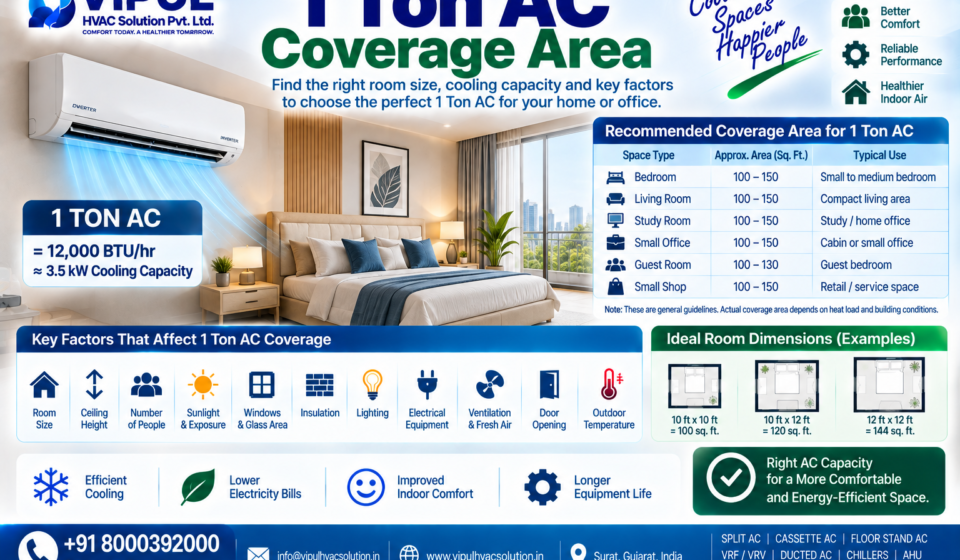
If you are searching for “1 ton AC coverage area”, a practical starting point for many Indian residential and light-load spaces is around 100–150 sq. ft., but there is no universal square-foot rule. The actual AC requirement depends on heat load, ceiling height, sunlight, windows, insulation, occupancy, electrical equipment, ventilation and outdoor temperature. Current Indian AC-sizing guidance also emphasizes adjusting capacity according to these heat-gain factors.
For reference, 1 ton of cooling is approximately 12,000 BTU/hr or 3.517 kW. VIPUL HVAC currently lists 1.0–3.0 TR for its wall-mounted split AC range, while its published cassette range starts at 1.5 TR.
1 Ton AC Coverage Area: How Much Space Can a 1 Ton AC Cool?
A 1 ton AC can typically be considered for approximately 100–150 sq. ft. in many Indian residential applications, subject to the actual heat load.
For a light-load, well-insulated room with moderate sunlight, a 1-ton AC may sometimes serve a larger area. Conversely, a top-floor room with direct afternoon sunlight, large glass windows or several occupants may require more than 1 ton even when the floor area is relatively small.
Quick reference
| Room Area | 1 Ton AC Suitability |
|---|---|
| 80–100 sq. ft. | Generally suitable |
| 100–120 sq. ft. | Often suitable |
| 120–150 sq. ft. | Depends on heat load |
| 150–180 sq. ft. | Requires careful calculation |
| 180+ sq. ft. | Often consider higher capacity |
Important: This is a preliminary planning guide, not a replacement for cooling-load calculation.
What Does 1 Ton AC Mean?
The word “ton” does not refer to the weight of the air conditioner.
In HVAC, tonnage represents cooling capacity.
1 Ton AC ≈ 12,000 BTU/hr ≈ 3.517 kW cooling
For comparison:
| AC Capacity | Approx. Cooling Capacity |
|---|---|
| 0.75 Ton | 9,000 BTU/hr |
| 1 Ton | 12,000 BTU/hr |
| 1.5 Ton | 18,000 BTU/hr |
| 2 Ton | 24,000 BTU/hr |
| 2.5 Ton | 30,000 BTU/hr |
| 3 Ton | 36,000 BTU/hr |
Actual rated capacity can vary by model and operating conditions.
How Much Area Does a 1 Ton AC Cover?
For a typical Indian room with approximately normal ceiling height, reasonable insulation and moderate heat gain:
100–150 sq. ft. is a useful preliminary range for a 1-ton AC.
For example:
- 10 ft × 10 ft = 100 sq. ft.
- 10 ft × 12 ft = 120 sq. ft.
- 12 ft × 10 ft = 120 sq. ft.
- 12 ft × 12 ft = 144 sq. ft.
- 12 ft × 13 ft = 156 sq. ft.
A 12 × 12 ft room may therefore be a reasonable candidate for a 1-ton AC under suitable conditions.
However, 144 sq. ft. in a shaded, insulated bedroom is not thermally equivalent to 144 sq. ft. in a west-facing glass-fronted room.
That is why professional HVAC sizing uses heat load rather than floor area alone.
1 Ton AC Coverage Area by Application
1. Bedroom
A 1-ton AC can be considered for a small or medium bedroom of approximately:
100–150 sq. ft.
Consider:
- Number of occupants
- Window size
- Sunlight exposure
- Ceiling height
- Insulation
- Floor level
- Room orientation
A bedroom with two occupants, moderate sunlight and normal construction may have a different requirement from a top-floor bedroom exposed to strong afternoon sun.
2. Small Office
For a small office or cabin, a 1-ton AC may be suitable for approximately:
100–150 sq. ft.
But offices often contain:
- Computers
- Monitors
- Printers
- Lighting
- Networking equipment
- Multiple occupants
All of these add heat to the room.
VIPUL HVAC states that AC capacity selection should consider heat load, occupancy and operating hours rather than simply selecting equipment by room size.
3. Study Room
A study room with one or two occupants may potentially work with a 1-ton AC when the area and heat load are appropriate.
For example:
10 ft × 12 ft = 120 sq. ft.
A room of this size can be a reasonable starting point for evaluating a 1-ton unit.
4. Guest Room
A small guest bedroom of around 100–130 sq. ft. may be suitable for 1 ton under normal conditions.
However, if the room has:
- Large windows
- Direct sunlight
- Poor insulation
- High ceiling
- Top-floor exposure
the required capacity may increase.
5. Small Retail Shop
A 1-ton AC may be considered for a small retail area, but retail spaces often have higher heat loads because of:
- Customers entering and leaving
- Frequent door opening
- Display lighting
- Glass frontage
- Electronic equipment
- Solar heat gain
Therefore, a 120-sq.-ft. shop does not necessarily have the same cooling requirement as a 120-sq.-ft. bedroom.
Can a 1 Ton AC Cool 150 Sq. Ft?
Yes, it can under suitable conditions.
For example, consider a:
12 ft × 12.5 ft room = 150 sq. ft.
If it has:
- Normal ceiling height
- Moderate occupancy
- Good insulation
- Limited direct sunlight
- Normal lighting
- Few electrical appliances
a 1-ton AC may be considered.
But if the same room is on the top floor with a large west-facing glass window, the required capacity could be higher.
Can a 1 Ton AC Cool 200 Sq. Ft?
This depends heavily on the heat load.
A 200-sq.-ft. room may require more than 1 ton in many Indian conditions, particularly where there is significant solar gain or occupancy.
Some general online sizing guidance places 1 ton around smaller room sizes, while other sources provide wider ranges depending on climate and building conditions.
Therefore, 200 sq. ft. should not automatically be assigned a 1-ton AC.
For a commercial project, perform a cooling-load calculation before selecting equipment.
Can a 1 Ton AC Cool 100 Sq. Ft?
Yes.
A 100-sq.-ft. room is generally within the range where a 1-ton AC can be considered, provided the heat load is appropriate.
Example:
10 ft × 10 ft = 100 sq. ft.
A small bedroom, study or office with normal occupancy and moderate solar exposure can potentially use a 1-ton unit.
However, an extremely hot top-floor room with poor insulation can have a substantially higher cooling requirement.
10 Factors That Affect 1 Ton AC Coverage Area
1. Room Size
Floor area is the starting point.
But it should not be the only input.
2. Ceiling Height
A room with an 8-ft ceiling and a room with a 12-ft ceiling have different air volumes and potentially different cooling requirements.
For commercial HVAC projects, ceiling height should therefore be included in the design calculation.
3. Number of People
People generate heat.
For example:
2 people in a bedroom
and
10 people in a meeting room
create very different internal heat loads.
4. Sunlight Exposure
Solar radiation can significantly affect cooling requirements.
Pay particular attention to:
- West-facing windows
- Large glass windows
- Unshaded windows
- Floor-to-ceiling glass
- Top-floor rooms
5. Windows and Glass
Large glass areas can increase solar heat gain.
A room with a small window may require less cooling than a similarly sized room with a large glass façade.
6. Building Insulation
Good insulation can reduce heat transfer.
Poorly insulated walls and roofs can increase cooling demand.
7. Electrical Equipment
Electrical equipment contributes heat.
Examples include:
- Computers
- Monitors
- Printers
- TVs
- Servers
- Lighting
- Commercial equipment
A computer-heavy office may therefore require more cooling than an otherwise identical room.
8. Outdoor Temperature
The outdoor design temperature affects the cooling requirement and equipment performance.
This becomes particularly important for HVAC design in hot climates.
9. Door Opening
Frequently opened doors allow warm outdoor air to enter.
This is especially important in:
- Shops
- Restaurants
- Clinics
- Reception areas
- Retail outlets
10. Fresh-Air and Ventilation Requirement
Outdoor air must often be cooled and dehumidified before entering an occupied space.
Therefore, ventilation can add to the overall cooling load.
This is one reason commercial HVAC design should not rely only on a simple square-foot calculation.
1 Ton AC Room Size Chart
Here is a practical preliminary reference:
| Room Size | Approx. Area | Initial Consideration |
|---|---|---|
| 8 × 10 ft | 80 sq. ft. | 1 Ton may be more than sufficient |
| 10 × 10 ft | 100 sq. ft. | 1 Ton commonly considered |
| 10 × 12 ft | 120 sq. ft. | 1 Ton may be suitable |
| 11 × 12 ft | 132 sq. ft. | Check heat load |
| 12 × 12 ft | 144 sq. ft. | Check heat load |
| 12 × 13 ft | 156 sq. ft. | Detailed assessment recommended |
| 12 × 15 ft | 180 sq. ft. | Consider higher capacity depending on load |
| 14 × 15 ft | 210 sq. ft. | 1 Ton generally should not be assumed |
These figures are planning references, not guaranteed equipment-sizing values.
Current Indian guidance similarly emphasizes that room area should be adjusted for factors such as sunlight, occupants and appliances.
1 Ton AC vs 1.5 Ton AC
| Factor | 1 Ton AC | 1.5 Ton AC |
|---|---|---|
| Cooling capacity | 12,000 BTU/hr | 18,000 BTU/hr |
| Approx. cooling | 3.5 kW | 5.3 kW |
| Typical application | Small rooms | Medium rooms |
| Room area | Often ~100–150 sq. ft. starting range | Often suitable for larger spaces |
| Heat-load tolerance | Lower | Higher |
| Initial equipment size | Smaller | Larger |
| Selection | Depends on calculated load | Depends on calculated load |
The right choice should be based on the actual cooling requirement, not simply on the difference in room area.
1 Ton Split AC vs 1 Ton Cassette AC
There is an important distinction for customers looking for a 1-ton AC.
1 Ton Wall-Mounted Split AC
Generally suitable for:
- Bedrooms
- Small offices
- Cabins
- Study rooms
- Small shops
VIPUL HVAC currently publishes a 1.0–3.0 TR wall-mounted cooling capacity range.
1 Ton Cassette AC
Cassette ACs are ceiling-mounted and commonly used for commercial applications.
However, VIPUL HVAC’s current published cassette range is 1.5–4.0 TR, not 1.0 TR. Therefore, customers specifically looking for a 1-ton cassette should confirm current model availability and approved-brand options with VIPUL.
How to Calculate the Required AC Capacity
A simple area-based estimate can be useful for preliminary planning:
Approximate AC capacity = Room area × applicable cooling-load factor
But a professional calculation considers multiple heat gains.
Conceptually:
Total Cooling Load = Building Heat Gain + Solar Gain + Occupancy + Lighting + Equipment + Ventilation + Infiltration + Other Loads
The final selected AC capacity should then be matched to the calculated load.
This is more reliable than simply saying:
“My room is 150 sq. ft., so I need exactly 1 ton.”
Example: 1 Ton AC Selection
Suppose an office measures:
10 ft × 12 ft
Area:
10 × 12 = 120 sq. ft.
The office contains:
- 2 employees
- 2 computers
- Normal LED lighting
- Moderate sunlight
- Standard ceiling height
- Reasonable insulation
A 1-ton AC could be considered as a preliminary option.
Now change the conditions:
- 8 employees
- 8 computers
- Large west-facing glass
- Top floor
- Poor insulation
- Frequent door opening
The same 120 sq. ft. may have a substantially higher cooling load.
Therefore, room area alone does not determine AC tonnage.
Common Mistakes When Selecting a 1 Ton AC
Mistake 1: Selecting AC only by square feet
Area is important, but it does not represent the complete heat load.
Mistake 2: Ignoring sunlight
A west-facing room can have substantially different solar heat gain.
Mistake 3: Ignoring occupancy
More people means more internal heat.
Mistake 4: Ignoring equipment
Computers and other electrical equipment add heat.
Mistake 5: Ignoring ceiling height
Higher ceilings can affect air distribution and HVAC requirements.
Mistake 6: Oversizing the AC
A significantly oversized unit is not automatically better.
Mistake 7: Undersizing the AC
An undersized AC may operate for long periods without adequately cooling the room.
Mistake 8: Ignoring ventilation
Commercial spaces may have additional cooling loads from required outdoor air.
How to Select the Right 1 Ton AC
Use this simple process:
Step 1 — Measure the room
Record:
- Length
- Width
- Height
Step 2 — Check occupancy
Determine the normal number of occupants.
Step 3 — Check sunlight
Identify:
- Window orientation
- Glass area
- Shading
- Direct sunlight
Step 4 — Identify equipment
Calculate heat contribution from:
- Computers
- Lighting
- Appliances
- Machinery
Step 5 — Check insulation
Assess walls, roof, windows and building envelope.
Step 6 — Consider ventilation
Determine whether fresh-air requirements add to the load.
Step 7 — Calculate cooling load
For commercial applications, use an appropriate HVAC cooling-load methodology.
Step 8 — Select AC
Then select:
- Capacity
- AC type
- Efficiency
- Airflow
- Controls
- Refrigerant
- Installation configuration
Is 1 Ton AC Suitable for Commercial Applications?
Yes, 1-ton AC systems can be used in small commercial spaces, depending on the calculated cooling load.
Examples include:
- Small offices
- Cabins
- Clinics
- Small retail spaces
- Reception areas
- Small meeting rooms
- Small showrooms
For larger commercial areas, multiple AC units, VRF/VRV, ducted systems or other HVAC configurations may be more appropriate depending on the project.
VIPUL HVAC provides system design and capacity selection as part of its HVAC services.
Why Choose VIPUL HVAC SOLUTION PVT. LTD.?
VIPUL HVAC SOLUTION PVT. LTD. provides HVAC solutions for residential, commercial and industrial applications.
Its current AC portfolio includes:
- Wall-mounted Split AC
- Cassette AC
- Floor-standing AC
- VRF/VRV Systems
- Ducted & Package AC
- Chiller Systems
- AHUs
- Ventilation Systems
- Precision Air Conditioning
- BMS & HVAC Automation
VIPUL’s current published AC services include:
System Design → Capacity Selection → Equipment Supply → Refrigerant Piping → Drainage → Electrical & Control Wiring → Installation → Testing → Commissioning → AMC
The company’s current published wall-mounted AC range starts at 1.0 TR, while the cassette range is 1.5–4.0 TR.
For HVAC consultation
VIPUL HVAC SOLUTION PVT. LTD.
📞 +91 8000392000
📧 info@vipulhvacsolution.in
🌐 vipulhvacsolution.in
Frequently Asked Questions
How much area does a 1 ton AC cover?
As a preliminary guide, around 100–150 sq. ft. can be considered for many Indian residential/light-load applications. Actual coverage depends on heat load and building conditions.
Is 1 ton AC enough for 150 sq. ft?
It can be, depending on insulation, sunlight, occupancy, ceiling height and equipment heat.
Is 1 ton AC enough for 200 sq. ft?
It should not be assumed. A 200-sq.-ft. room may require higher capacity depending on its heat load.
How many BTU is a 1 ton AC?
A nominal 1-ton AC provides approximately 12,000 BTU/hr of cooling.
What is 1 ton AC in kW?
1 ton ≈ 3.517 kW of cooling capacity.
This is cooling capacity, not electrical power consumption.
Can a 1 ton AC cool a 100 sq. ft room?
Yes, a 100-sq.-ft. room can be within the suitable range for a 1-ton AC, depending on heat-load conditions.
Can a 1 ton AC cool a 150 sq. ft room?
Yes, it can potentially cool a 150-sq.-ft. room when the heat load is appropriate.
Can a 1 ton AC cool 300 sq. ft?
It should not normally be selected simply because someone says “1 ton covers 300 sq. ft.” A proper cooling-load calculation is required.
Is 1 ton AC suitable for an office?
Yes. A 1-ton split AC can be suitable for a small office or cabin when the calculated cooling load is within its capacity.
Does VIPUL HVAC offer 1 ton AC?
VIPUL’s current published wall-mounted AC range starts at 1.0 TR. Its published cassette range starts at 1.5 TR.
Is a 1 ton cassette AC available from VIPUL?
VIPUL’s current published cassette range is 1.5–4.0 TR. If you specifically need a 1-ton cassette, confirm current availability and approved-brand options directly with VIPUL.
Conclusion
So, how much area does a 1 ton AC cover?
For preliminary planning in many Indian residential and light-load applications, 100–150 sq. ft. is a useful starting range.
But the correct AC size depends on:
Room Area + Ceiling Height + Occupancy + Sunlight + Windows + Insulation + Equipment + Lighting + Ventilation + Outdoor Conditions
Therefore, don’t select an AC only by square feet.
The professional approach is:
Measure → Assess Heat Load → Select Capacity → Select AC Type → Install → Test → Commission
For small residential rooms, a 1-ton wall-mounted split AC may be appropriate. For commercial applications, the final selection should be based on a proper HVAC assessment.
VIPUL HVAC SOLUTION PVT. LTD. can assist with HVAC design, capacity selection, equipment supply, installation, testing, commissioning and maintenance support.
Important Links:

Vipul HVAC House
At Vipul hvac solution pvt.ltd., we take great pride in delivering high-quality HVAC solutions that ensure comfort and efficiency in both residential and commercial spaces. As a trusted HVAC of reliable, energy-efficient systems, and we are dedicated to providing you with the best products and services to meet your needs
Other Articles