
What Is the Heat Pump Disadvantages? 7 Key Limitations
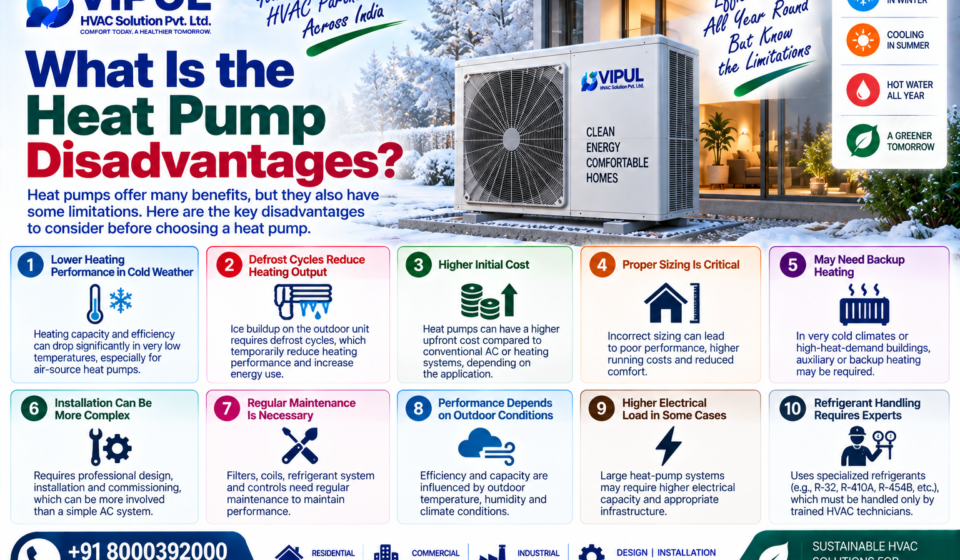
If you are asking “What is the major disadvantage of a heat pump?”, the most important limitation depends on the type of heat pump and the application. For air-source heat pumps, one major consideration is that heating capacity and efficiency can decrease as outdoor temperatures become very low, particularly in cold climates. Defrost cycles can also temporarily reduce heating performance and consume additional energy.
However, modern cold-climate heat pumps have been developed to maintain useful performance at lower temperatures, so this limitation does not mean that heat pumps are unsuitable for all climates. Proper equipment selection, sizing, installation and, where necessary, backup heating can address many of these challenges. ENERGY STAR also emphasizes correct sizing and professional installation for achieving expected performance.
For homeowners and businesses in India and Gujarat, the importance of each limitation will depend on the local climate and whether the heat pump is being used for space heating, cooling, hot water or an industrial process.
Quick Answer: What Is the Biggest Disadvantage of a Heat Pump?
For an air-source heat pump, the major technical disadvantage is:
Its heating performance can decline as outdoor conditions become colder, while defrosting may temporarily reduce heating output and increase energy consumption.
Other important disadvantages include:
- Higher initial investment in some applications
- More complex installation than a simple cooling-only AC
- Performance depends on outdoor conditions
- Correct sizing is critical
- Backup heating may be needed in some cold climates
- Refrigerant and system servicing require qualified technicians
- Large systems may require significant electrical infrastructure
These limitations need to be evaluated against the benefits of heating, cooling and potentially hot-water production from one system.
1. Lower Heating Capacity in Very Cold Weather
This is one of the most important limitations of air-source heat pumps.
An air-source heat pump extracts heat from outdoor air during heating operation. As the outdoor temperature falls, there is generally less usable heat available and the heat pump may need to work harder to maintain the required indoor temperature.
The U.S. Department of Energy notes that conventional air-source heat pumps can experience reduced heating capacity and efficiency at low outdoor temperatures.
This creates an important engineering consideration:
Lower outdoor temperature → higher heating demand + potentially lower heat-pump capacity
That does not mean modern heat pumps stop working in cold weather. Cold-climate models are specifically engineered to improve low-temperature performance.
2. Defrost Cycles Can Reduce Efficiency
During heating operation, the outdoor coil can become cold enough for moisture to freeze on its surface.
Ice accumulation can:
- Restrict airflow
- Reduce heat transfer
- Reduce heating performance
- Increase fan/compressor energy consumption
The system therefore periodically enters a defrost cycle to remove accumulated frost.
During defrost, a heat pump may temporarily operate in a cooling-like refrigeration mode to transfer heat to the outdoor coil and melt the frost. DOE/NREL field research documents the energy impact of defrost operation in air-source heat pumps.
Therefore:
Frost → Defrost → Temporary performance reduction → Additional energy use
The severity depends heavily on outdoor temperature and humidity.
3. Higher Initial Cost in Some Applications
Another disadvantage can be the initial investment.
A complete heat-pump project may require:
- Heat-pump equipment
- Indoor units
- Outdoor units
- Refrigerant piping
- Electrical work
- Controls
- Ductwork
- Water piping
- Storage tanks
- Pumps
- Installation
- Testing
- Commissioning
The exact cost varies significantly by application.
A simple residential heat pump can be very different from a commercial air-to-water system or an industrial high-temperature heat pump.
Therefore, comparing only the equipment purchase price can be misleading.
A better comparison is:
Initial Cost + Installation Cost + Energy Cost + Maintenance + Expected Operating Life
4. Correct Sizing Is Extremely Important
A heat pump should not be selected simply according to floor area.
For example, two homes of the same size can have very different heating and cooling loads because of:
- Insulation
- Window area
- Solar exposure
- Ceiling height
- Occupancy
- Building orientation
- Ventilation
- Infiltration
- Internal heat gains
- Local climate
ENERGY STAR recommends proper sizing because oversized or undersized equipment can affect comfort and performance. DOE’s Building Science Education resources similarly recommend determining heating and cooling loads before sizing HVAC equipment.
Oversized heat pump
An oversized system can:
- Cycle too frequently
- Reduce efficiency
- Affect comfort
- Increase equipment wear
Undersized heat pump
An undersized system may:
- Run for long periods
- Struggle to meet peak loads
- Require auxiliary heating
- Reduce comfort
The solution is load-based equipment selection, not simply buying a larger unit.
5. Backup Heating May Be Required in Some Applications
In very cold climates or buildings with critical heating requirements, a backup or auxiliary heating source may be appropriate.
Possible backup systems include:
- Electric resistance heater
- Existing boiler
- Gas heating system
- Other auxiliary heating equipment
DOE specifically identifies the need for backup heat as a consideration for some cold-climate air-source heat-pump applications.
However, backup heating is not automatically required for every heat pump.
Modern cold-climate systems can operate effectively at low temperatures, and the requirement depends on:
- Outdoor design temperature
- Building heat load
- Heat-pump capacity
- Equipment operating range
- Required indoor temperature
- Criticality of the application
6. Outdoor Conditions Affect Performance
Air-source heat pumps exchange heat with outdoor air.
That means outdoor conditions can affect performance.
Important variables include:
- Outdoor temperature
- Relative humidity
- Wind
- Frost formation
- Outdoor coil condition
- Airflow
- Heat-source temperature
For this reason, the heat pump should be selected according to the actual design conditions of the project.
This is particularly important for commercial and industrial systems.
7. Installation Can Be More Complex
A heat pump is not simply an outdoor AC unit with a different label.
Depending on the system, installation may involve:
Air-to-air system
- Outdoor unit
- Indoor unit
- Refrigerant piping
- Drainage
- Electrical wiring
- Controls
Air-to-water system
Additional components may include:
- Water circulation piping
- Pumps
- Storage tank
- Buffer tank
- Heat exchanger
- Valves
- Sensors
- Controls
Industrial system
The project may additionally require:
- Process piping
- Pumps
- Storage
- Heat recovery
- Automation
- BMS
- Safety controls
Therefore, installation quality is important.
ENERGY STAR notes that improper installation can reduce heat-pump efficiency and recommends professional site evaluation and installation.
8. Maintenance Is Still Necessary
A heat pump is not maintenance-free.
Regular maintenance can include:
- Filter cleaning
- Coil cleaning
- Fan inspection
- Electrical inspection
- Refrigerant-system checks
- Drain inspection
- Sensor checks
- Control-system checks
- Water-flow checks for hydronic systems
- Pump inspection
- Heat-exchanger cleaning
DOE also recommends regular maintenance such as filter replacement/cleaning and refrigerant-related servicing to maintain heat-pump performance.
For commercial and industrial systems, preventive maintenance becomes even more important because downtime can affect business operations.
9. Refrigerant Handling Requires Professional Service
Heat pumps use refrigerants such as:
- R-32
- R-410A
- R-454B
- R-290
- R-134a
- CO₂
- Other application-specific refrigerants
The exact refrigerant depends on the equipment.
A technician should never assume that one refrigerant can simply replace another.
Improper refrigerant charging or servicing can cause:
- Poor heating/cooling
- High operating pressure
- Compressor problems
- Reduced efficiency
- Equipment damage
DOE specifically identifies improper charging as an installation issue that can reduce efficiency and shorten equipment life.
10. Heat Pumps Need Appropriate Electrical Capacity
Heat pumps use electricity to operate:
- Compressor
- Fans
- Pumps
- Controls
- Auxiliary heating, if installed
A large commercial or industrial heat pump may therefore require significant electrical infrastructure.
Before installation, engineers should verify:
- Voltage
- Phase
- Connected load
- Starting/current characteristics
- Breaker requirements
- Cable sizing
- Earthing
- Control wiring
For large projects, electrical integration should be included in the overall HVAC design.
11. Heat Pumps Can Be More Sensitive to Poor Installation
The performance of a heat pump depends not only on the equipment but also on installation quality.
Problems can include:
- Incorrect refrigerant charge
- Poor airflow
- Undersized ducts
- Leaking ducts
- Incorrect piping
- Poor insulation
- Incorrect controls
- Improper drainage
- Poor outdoor-unit placement
ENERGY STAR specifically emphasizes professional installation and notes that installation quality has a significant impact on efficiency and performance.
12. Outdoor Unit Requires Proper Space
The outdoor unit needs adequate:
- Airflow
- Clearance
- Service access
- Structural support
- Drainage
- Electrical connection
It should not be installed in a location where airflow is severely restricted.
For commercial projects, multiple outdoor units may require careful equipment layout.
13. Heat Pump Economics Depend on the Application
A heat pump can be highly efficient, but that does not mean it will always have the lowest total cost for every building.
The economics depend on:
- Electricity tariff
- Alternative fuel price
- Operating hours
- Climate
- Heat-source temperature
- Required heating temperature
- Equipment efficiency
- Installation cost
- Maintenance
- System life
For example, a heat pump replacing inefficient electric resistance heating can have a different economic outcome from one replacing a relatively efficient heating system.
Therefore, a proper life-cycle cost analysis is better than simply comparing purchase prices.
14. High-Temperature Applications Need Special Design
Heat pumps are not all designed for the same water or air temperature.
For example, a system designed for moderate-temperature space heating may not be appropriate for a process requiring very high-temperature hot water.
For industrial applications, engineers should evaluate:
- Heat-source temperature
- Required outlet temperature
- Temperature lift
- Flow rate
- Process load
- Operating hours
- COP at required conditions
VIPUL HVAC states that its heat-pump systems can provide water outlet temperatures of up to 60–80°C depending on the application.
The important point is that the required temperature must be matched to the equipment’s actual performance data.
Are Heat Pumps Bad Because They Have Disadvantages?
No.
Every HVAC technology has limitations.
For example:
Conventional AC
Its primary limitation is that a cooling-only system does not normally provide heating.
Boiler
A boiler may require fuel and combustion equipment.
Electric resistance heating
It directly converts electricity into heat and can have higher operating energy use than a heat pump in suitable conditions.
Heat pump
Its performance depends on heat-source conditions, system design and proper installation.
The right question is therefore not:
“Does a heat pump have disadvantages?”
It is:
“Are the heat pump’s limitations acceptable for my specific application?”
Heat Pump Advantages vs Disadvantages
| Factor | Heat Pump Consideration |
|---|---|
| Heating | Provides heating in suitable configurations |
| Cooling | Reversible systems can provide cooling |
| Efficiency | Can be highly efficient under suitable conditions |
| Cold weather | Performance may decline depending on model and climate |
| Initial cost | Can be higher depending on application |
| Installation | Requires proper engineering |
| Maintenance | Regular maintenance required |
| Backup | May be useful in some cold/critical applications |
| Hot water | Available with suitable systems |
| Controls | Can integrate with digital controls/BMS |
| Refrigerant | Must match manufacturer specification |
Are Heat Pumps Suitable for India?
For many Indian applications, heat pumps can be considered for:
- Hot-water production
- Hotels
- Hospitals
- Residential buildings
- Offices
- Restaurants
- Industrial facilities
- Process hot water
- Swimming pools
The major disadvantage associated with very cold outdoor air may be less important in regions with relatively mild winters than in cold-climate regions.
However, that does not eliminate the need for proper engineering.
For Indian projects, selection should consider the actual:
Climate + Load + Heat Source + Required Temperature + Operating Hours + Electricity Cost
What About Heat Pumps in Gujarat?
For Gujarat projects, the application needs to be evaluated according to the actual requirement.
Many buildings have significant cooling loads, while applications such as hotels, hospitals, restaurants and industrial facilities may have substantial hot-water requirements.
A heat pump can therefore be evaluated for:
Residential
- Space heating/cooling
- Hot water
Hotels
- Domestic hot water
- Heating
- Swimming-pool applications
Hospitals
- Hot water
- Heating
- Specialized HVAC applications
Industries
- Process hot water
- Preheating
- Heat recovery
VIPUL HVAC’s current heat-pump offering includes air-source and water-source systems, hot-water load calculation, capacity planning, piping/storage design, installation, commissioning and AMC support.
How Can You Reduce Heat Pump Disadvantages?
Many heat-pump limitations can be reduced through proper engineering.
1. Perform a Load Calculation
Do not size the system based only on floor area.
2. Select the Right Heat-Pump Type
Consider:
- Air-source
- Water-source
- Ground-source
- Air-to-water
- High-temperature heat pump
3. Check Low-Temperature Performance
For air-source systems, review manufacturer performance at the actual design outdoor temperature.
4. Consider Backup Heating
For critical or cold-climate applications, evaluate auxiliary heating.
5. Improve Building Insulation
Reducing heat loss can reduce the required heating capacity.
6. Use Efficient Controls
Variable-speed compressors and appropriate controls can improve part-load operation. DOE notes that staged and variable-speed technologies can help heat pumps operate closer to the required load.
7. Maintain the System
Clean filters, coils and appropriate airflow are essential.
8. Use Professional Installation
Correct refrigerant charging, airflow, piping and controls are important for performance.
VIPUL HVAC Solution: Heat Pump Engineering and Installation
VIPUL HVAC SOLUTION PVT. LTD. provides engineered HVAC solutions for residential, commercial and industrial applications.
Its current heat-pump services include:
- Heat-pump selection
- Hot-water load calculation
- Capacity planning
- Storage-tank design
- Piping design
- Electrical integration
- Control integration
- Installation
- Testing
- Commissioning
- Performance optimization
- AMC support
VIPUL currently offers air-source and water-source heat-pump solutions and states that its systems can be designed according to application-specific hot-water demand.
The company also provides broader HVAC solutions including:
For a heat-pump project, the objective should be to select a system that matches the actual building or process requirement, rather than simply selecting the largest available unit.
📞 +91 8000392000
📧 info@vipulhvacsolution.in
🌐 VIPUL HVAC Solution Pvt. Ltd.
Frequently Asked Questions
What is the major disadvantage of a heat pump?
For air-source heat pumps, a major limitation is that heating capacity and efficiency can decline at very low outdoor temperatures. Defrost cycles can also temporarily reduce heating output and consume additional energy.
Do heat pumps work in cold weather?
Yes. Modern heat pumps can operate in cold weather, and cold-climate models are specifically designed for improved low-temperature performance. The appropriate model should be selected according to the project’s design conditions.
Do heat pumps need backup heating?
Not always. Backup heating may be considered where outdoor temperatures are very low, peak heating loads are high or uninterrupted heating is critical.
Are heat pumps expensive?
The initial cost can be higher than a simple cooling-only system or some conventional heating options, depending on the application. However, total ownership cost also depends on energy consumption, operating hours, maintenance and system life.
Do heat pumps require maintenance?
Yes. Filters, coils, airflow, electrical components, controls and the refrigerant circuit should be inspected and maintained as appropriate.
Can a heat pump provide both heating and cooling?
Yes. Reversible heat pumps can provide both heating and cooling.
Can a heat pump provide hot water?
Yes. Air-to-water and other suitable heat-pump systems can be designed for hot-water applications.
What is the biggest problem with air-source heat pumps?
The principal technical consideration is their dependence on outdoor conditions. At very low temperatures, heating capacity and efficiency can decline, and frost may require defrost operation.
Are heat pumps suitable for Gujarat?
They can be suitable for specific residential, commercial and industrial applications. The system should be selected according to the project’s actual cooling, heating or hot-water requirement.
Can a heat pump replace a boiler?
In some applications, yes. However, the required temperature, capacity, heat source, distribution system and backup requirements must be evaluated before replacing a boiler.
Conclusion
So, what is the major disadvantage of a heat pump?
For an air-source heat pump, the key limitation is performance at low outdoor temperatures. Heating capacity and efficiency can decrease in colder conditions, and frost can lead to defrost cycles that temporarily reduce heating performance.
But this limitation should be considered in context. Modern cold-climate heat pumps, correct sizing, good installation, appropriate controls and backup strategies can address many low-temperature challenges.
For most projects, the right approach is:
Load Calculation → Climate Assessment → Heat-Source Evaluation → Heat-Pump Selection → System Design → Professional Installation → Commissioning → Maintenance
That approach helps determine whether a heat pump is technically and economically appropriate for the specific project.
Important Links: