
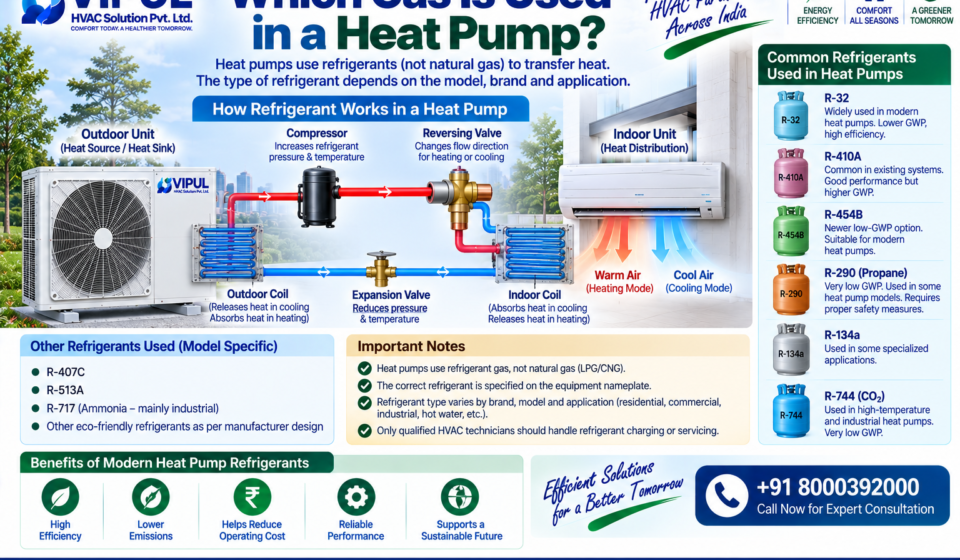

Which Gas Is Used in a Heat Pump? Complete Refrigerant Guide
If you are asking “Which gas is used in a heat pump?”, the answer depends on the heat-pump type, application, capacity, manufacturer and model. There is no single refrigerant used in every heat pump.
Common refrigerants used in heat-pump systems include R-32, R-410A, R-454B, R-290 (propane), R-134a, R-407C, R-513A and CO₂ (R-744), depending on the equipment and application. The U.S. EPA and European Commission both list multiple refrigerant options for different heat-pump applications, with different efficiency, GWP and safety characteristics.
For residential and light-commercial heat pumps, R-32, R-410A and newer lower-GWP alternatives such as R-454B are among the refrigerants encountered in the market. However, you should never select or add refrigerant based only on the type of heat pump. The correct refrigerant is the one specified on the equipment nameplate and by the manufacturer.
For commercial and industrial heat-pump projects, refrigerant selection becomes even more application-specific.
Quick Answer: Which Gas Is Used in a Heat Pump?
| Refrigerant | Typical Application/Context | Key Point |
|---|---|---|
| R-32 | Residential/light-commercial HVAC and heat pumps | Lower GWP than R-410A; A2L mildly flammable |
| R-410A | Existing/legacy residential & commercial AC/heat-pump equipment | Zero ODP but relatively high GWP |
| R-454B | Newer HVAC/heat-pump equipment in some markets | Lower-GWP A2L alternative to R-410A |
| R-290 | Certain heat-pump and self-contained applications | Very low GWP but highly flammable (A3) |
| R-134a | Some older/specialized heat-pump applications | Higher GWP; declining in many applications |
| R-407C | Some commercial HVAC applications | Blend used in various refrigeration/HVAC systems |
| R-513A | Certain commercial refrigeration/HVAC applications | Lower-GWP alternative to R-134a in some applications |
| R-744 (CO₂) | Heat-pump water heating and specialized systems | Very low GWP; high-pressure system |
| R-717 (Ammonia) | Industrial heat pumps | Very low GWP; specialized industrial application |
The EPA’s current residential/light-commercial heat-pump listings include R-32, R-410A, R-454B and R-290 among acceptable refrigerant options under specified use conditions.
What Is the Gas in a Heat Pump Called?
The “gas” is technically called a refrigerant.
A refrigerant is a working fluid that circulates through the heat pump’s refrigeration circuit.
It changes pressure and temperature as it passes through components such as:
- Compressor
- Condenser
- Expansion valve
- Evaporator
The refrigerant enables the heat pump to absorb heat from one location and reject or deliver that heat somewhere else.
So when someone asks:
“What gas is used in a heat pump?”
the technically correct answer is:
A heat pump uses a refrigerant, and the specific refrigerant depends on the equipment and application.
How Does Refrigerant Work in a Heat Pump?
A simplified refrigeration cycle looks like this:
Evaporator → Compressor → Condenser → Expansion Valve → Evaporator
Step 1: Evaporation
The refrigerant absorbs heat at the evaporator.
Step 2: Compression
The compressor raises the refrigerant pressure and temperature.
Step 3: Condensation
The high-temperature refrigerant releases heat through the condenser.
Step 4: Expansion
The expansion valve reduces the refrigerant pressure and temperature.
Step 5: Cycle Repeats
The refrigerant returns to the evaporator and the cycle continues.
In a reversible heat pump, the direction of heat transfer can be changed to provide heating or cooling.
What Refrigerant Does VIPUL HVAC Use in Heat Pumps?
VIPUL HVAC’s current heat-pump page specifies “eco-friendly refrigerants”, but does not publish one universal refrigerant designation such as R-32 or R-410A for its entire heat-pump range. The company lists both air-source and water-source heat pumps, with systems designed according to the application and hot-water demand.
Therefore, for a VIPUL heat-pump project, the correct approach is to select the refrigerant according to the specific equipment model and manufacturer specification, rather than assuming that every VIPUL heat pump uses the same refrigerant.
This is important because different heat-pump applications can require different refrigerants.
Is R-32 Used in Heat Pumps?
Yes.
R-32 is used in some air-conditioning and heat-pump equipment.
The U.S. EPA lists HFC-32 as an acceptable refrigerant for certain residential and light-commercial AC and heat-pump applications, subject to use conditions. Its listed GWP is 675 and its ASHRAE safety classification is A2L, meaning lower flammability than A3 refrigerants but still requiring appropriate safety practices.
The European Commission also identifies R-32 as a refrigerant used in domestic heat-pump applications.
Advantages of R-32
- Lower GWP than R-410A
- Good thermodynamic performance
- Widely used in modern HVAC equipment
- Suitable for certain heat-pump designs
Important consideration
R-32 is classified A2L, so equipment design, installation, charging and servicing must follow the applicable safety requirements.
Is R-410A Used in Heat Pumps?
Yes.
R-410A has been widely used in residential and light-commercial air-conditioning and heat-pump equipment.
The EPA lists R-410A as an acceptable refrigerant for specified residential and light-commercial AC and heat-pump applications.
R-410A has:
- Zero ozone-depletion potential
- A relatively high GWP
- A1 safety classification in the cited EPA listing
The EPA explains that R-410A became an important replacement for older R-22 systems, but also notes that R-410A has climate impacts because of its GWP.
This is one reason the HVAC industry has been moving toward lower-GWP refrigerants in many newer applications.
Is R-454B Used in Heat Pumps?
Yes, in certain newer HVAC and heat-pump applications.
R-454B is an HFC/HFO blend with significantly lower GWP than R-410A.
The EPA lists R-454B as acceptable for certain residential and light-commercial AC and heat-pump applications, subject to use conditions. It is classified as A2L.
The European Commission also identifies R-454B as a lower-GWP alternative to R-410A in certain heat-pump applications.
However:
R-454B is not a universal drop-in replacement for R-410A.
The equipment must be designed and approved for the refrigerant.
Is R-290 Used in Heat Pumps?
Yes, in certain applications.
R-290 is propane used as a refrigerant.
It has an extremely low GWP compared with many HFC refrigerants.
The European Commission lists R-290 as a climate-friendly refrigerant option for certain domestic and industrial heat-pump applications.
However, R-290 is classified A3, meaning it is highly flammable.
Therefore, equipment using R-290 requires appropriate:
- System design
- Refrigerant charge limits
- Installation procedures
- Ventilation considerations
- Safety controls
- Technician training
The EPA also lists R-290 as acceptable for specified self-contained room AC applications subject to use conditions.
Is CO₂ Used in Heat Pumps?
Yes.
CO₂ is designated R-744 and is increasingly relevant in certain heat-pump applications, particularly heat-pump water heating.
The European Commission identifies R-744 as a refrigerant for domestic and industrial heat-pump applications and lists a GWP of approximately 1 under its stated methodology.
CO₂ systems operate at relatively high pressures, so they require equipment specifically designed for CO₂ operation.
A CO₂ heat pump should therefore never be treated as simply another refrigerant conversion.
Is Ammonia Used in Heat Pumps?
Yes.
Ammonia is designated R-717.
It is primarily associated with industrial refrigeration and industrial heat-pump applications, rather than ordinary residential split heat pumps.
The European Commission identifies R-717 for industrial heat-pump applications and lists it as having zero GWP in the referenced table.
Ammonia systems require specialized engineering because ammonia has specific toxicity and safety considerations.
What About R-134a?
R-134a has been used in various refrigeration, air-conditioning and heat-pump applications.
The EPA lists HFC-134a as an acceptable refrigerant in specified residential/light-commercial AC and heat-pump applications, with a GWP of 1,430 in its current listing.
However, newer lower-GWP refrigerant options are increasingly important in many markets.
R-32 vs R-410A for Heat Pumps
One common question is:
“Which is better, R-32 or R-410A?”
There isn’t a universal answer independent of the equipment.
| Factor | R-32 | R-410A |
|---|---|---|
| Refrigerant type | HFC | HFC blend |
| GWP in EPA listing | 675 | 2,090 |
| ODP | 0 | 0 |
| Safety classification | A2L | A1 |
| Used in HVAC | Yes | Yes |
| Used in heat pumps | Yes | Yes |
| Equipment compatibility | Model-specific | Model-specific |
The EPA’s current data show R-32 has a substantially lower GWP than R-410A.
However, lower GWP does not mean you can replace one refrigerant with the other in an existing heat pump.
R-410A vs R-454B
R-454B is one of the newer lower-GWP alternatives associated with R-410A replacement in certain equipment.
The EPA lists:
- R-410A: GWP 2,090
- R-454B: GWP 470
in its current residential/light-commercial heat-pump listing.
However, the two refrigerants have different properties and safety classifications.
Therefore:
R-454B equipment must be designed and approved for R-454B.
Do not retrofit an existing R-410A system with R-454B simply because its GWP is lower.
Heat Pump Refrigerant GWP Comparison
The following values are useful for understanding why refrigerant selection is changing:
| Refrigerant | Approx. GWP* | Safety Classification |
|---|---|---|
| R-290 | 3 | A3 |
| R-744 (CO₂) | 1 | A1 |
| R-32 | 675 | A2L |
| R-454B | 470 | A2L |
| R-410A | 2,090 | A1 |
| R-134a | 1,430 | A1 |
| R-407C | 1,770 | A1 |
| R-513A | 630 | A1 |
*Values vary slightly depending on the assessment methodology and regulatory source. The table above follows the EPA/European sources cited in this article.
Why Are Heat Pump Refrigerants Changing?
The HVAC industry is increasingly looking at refrigerants with lower environmental impact.
Historically, HVAC equipment used refrigerants such as:
- R-22
- R-134a
- R-410A
Newer alternatives can include:
- R-32
- R-454B
- R-454C
- R-290
- R-744
- R-717
The appropriate refrigerant depends on:
- Equipment type
- Capacity
- Application
- Safety requirements
- Operating temperature
- System pressure
- Environmental regulations
- Manufacturer design
The EPA’s current technology-transition rules illustrate that refrigerant requirements are becoming increasingly application-specific and that certain high-GWP refrigerants are subject to restrictions in particular sectors.
Can You Change the Refrigerant in a Heat Pump?
Not automatically.
This is a very important HVAC maintenance point.
You should not assume:
R-410A heat pump → remove R-410A → add R-32
or:
R-410A heat pump → add R-454B
These refrigerants are not universal drop-in replacements.
A refrigerant change can affect:
- Pressure
- Compressor operation
- Oil compatibility
- Expansion device
- Heat-exchanger performance
- Refrigerant charge
- Controls
- Safety requirements
- System efficiency
The equipment manufacturer’s instructions should determine the approved refrigerant.
Can You Mix Two Refrigerants?
No—do not mix refrigerants unless the equipment manufacturer specifically designs and approves a particular blend.
R-32, R-410A, R-454B, R-290 and other refrigerants have different properties.
An HVAC technician should identify the existing refrigerant before servicing the system.
How Do You Know Which Refrigerant Your Heat Pump Uses?
The easiest method is to check the equipment nameplate.
Look for information such as:
Refrigerant: R-32
or
Refrigerant: R-410A
The nameplate may also specify:
- Refrigerant charge
- Model number
- Serial number
- Operating pressure
- Electrical rating
- Manufacturer
- Capacity
You can also check:
- Installation manual
- Product datasheet
- Manufacturer website
- Service documentation
- Original purchase invoice
If the label is missing or unclear, have a qualified HVAC technician identify the refrigerant.
What Refrigerant Is Used in Heat Pump Water Heaters?
Heat-pump water heaters can use different refrigerants depending on the manufacturer and model.
Potential refrigerants include:
- R-134a
- R-410A
- R-32
- R-290
- CO₂/R-744
- Other manufacturer-specific refrigerants
For water-heating applications, refrigerant selection is closely connected with:
- Required water temperature
- Ambient temperature
- Compressor design
- Heating capacity
- COP
- High-side pressure
- Storage requirements
VIPUL HVAC’s current heat-pump offering is designed for hot-water applications and lists water outlet temperatures of up to 60–80°C depending on the application, along with air-source and water-source configurations.
What Refrigerant Is Best for an Industrial Heat Pump?
There is no single “best” refrigerant for every industrial heat pump.
Industrial refrigerant selection depends on:
- Required heating temperature
- Heat-source temperature
- Capacity
- Pressure range
- Process requirements
- Safety
- Refrigerant availability
- Environmental requirements
- Equipment architecture
Possible industrial refrigerants include:
- R-134a
- R-513A
- R-454B
- R-290
- R-744
- R-717
- Specialized high-temperature refrigerants
For example, the European Commission lists R-717 ammonia and R-744 CO₂ among options for industrial heat-pump applications, while also listing several HFC/HFO alternatives.
Heat Pump Refrigerant and Safety
Refrigerant safety classification is important.
For example:
A1
Generally lower toxicity and no flame propagation under the classification conditions.
Example:
R-410A
A2L
Lower toxicity with lower flammability.
Examples:
R-32, R-454B
A3
Higher flammability.
Examples:
R-290
These classifications affect:
- Equipment design
- Refrigerant charge
- Installation
- Ventilation
- Leak detection
- Service procedures
- Applicable codes and standards
The EPA explicitly attaches use conditions to several refrigerants used in AC and heat-pump applications.
Why Refrigerant Charge Matters
The quantity of refrigerant inside a heat pump affects system operation.
Too little refrigerant can cause:
- Reduced capacity
- Poor heating/cooling
- Low suction pressure
- Compressor problems
- Higher operating stress
Too much refrigerant can also cause:
- Abnormally high pressures
- Reduced efficiency
- Compressor problems
- Poor system performance
Therefore, refrigerant should be charged according to the manufacturer’s specified procedure and quantity, not simply by adding gas until the system “feels cold.”
Heat Pump Refrigerant Leak: What Should You Do?
If a heat pump has a refrigerant leak, don’t simply keep adding refrigerant.
A professional technician should:
- Inspect the system.
- Identify the leak.
- Repair the leak.
- Perform the required pressure/leak testing.
- Evacuate the system according to the manufacturer’s procedure.
- Charge the specified refrigerant.
- Test system performance.
Repeated refrigerant top-ups without repairing the leak can result in poor performance and unnecessary refrigerant emissions.
The EPA emphasizes responsible handling of refrigerants because releases can have environmental consequences.
Does Refrigerant Affect Heat Pump Efficiency?
Yes.
System efficiency depends on many factors, but refrigerant properties influence:
- Pressure ratio
- Compressor work
- Heat-transfer characteristics
- Operating temperatures
- Expansion process
- Heat-exchanger design
However, you should not judge a heat pump’s efficiency from the refrigerant alone.
Two systems using the same refrigerant can have different efficiency because of differences in:
- Compressor
- Heat exchangers
- Controls
- Fans
- Pumps
- Refrigerant circuit
- Part-load performance
- System design
Does R-32 Mean a Heat Pump Is More Efficient?
Not necessarily.
R-32 has favorable characteristics and a lower GWP than R-410A, but overall heat-pump efficiency depends on the complete system design.
When comparing heat pumps, evaluate manufacturer-rated:
- COP
- Heating capacity
- Cooling capacity
- Seasonal efficiency
- Operating range
- Part-load performance
rather than choosing solely from the refrigerant designation.
Why Choose VIPUL HVAC for Heat Pump Solutions?
VIPUL HVAC SOLUTION PVT. LTD. provides engineered HVAC solutions for residential, commercial and industrial applications.
Its current heat-pump offering includes:
- Air-source heat pumps
- Water-source heat pumps
- Hot-water systems
- Hot-water load calculation
- Capacity planning
- Storage-tank design
- Piping design
- Electrical integration
- Control integration
- Installation
- Testing
- Commissioning
- Performance optimization
- AMC support
VIPUL’s published heat-pump specifications state that the systems use eco-friendly refrigerants, with refrigerant selection dependent on the equipment/application rather than identifying one refrigerant for the entire portfolio.
For a specific project, the correct refrigerant should always be confirmed from the selected equipment’s manufacturer datasheet and nameplate.
📞 +91 8000392000
📧 info@vipulhvacsolution.in
🌐 vipulhvacsolution.in
Frequently Asked Questions
Which gas is used in a heat pump?
Heat pumps use refrigerants rather than a single universal “gas.” Common refrigerants include R-32, R-410A, R-454B, R-290, R-134a, R-407C, R-513A and CO₂, depending on the system.
Is R-32 used in heat pumps?
Yes. R-32 is used in certain residential and light-commercial heat-pump systems and is classified A2L.
Is R-410A used in heat pumps?
Yes. R-410A has been widely used in residential and light-commercial AC and heat-pump equipment.
Is R-454B used in heat pumps?
Yes. R-454B is a lower-GWP alternative used in certain newer AC and heat-pump equipment, subject to applicable requirements.
Is R-290 used in heat pumps?
Yes, in certain self-contained and other appropriately designed heat-pump applications. R-290 is highly flammable and requires equipment and installation designed specifically for it.
Can I replace R-410A with R-32?
Not as a general DIY or service substitution. The heat pump must be specifically designed and approved for the refrigerant being used.
Can different refrigerants be mixed?
No. Do not mix refrigerants unless the equipment manufacturer specifically specifies a particular blend.
How do I know which refrigerant my heat pump uses?
Check the outdoor-unit nameplate, product manual or manufacturer’s technical documentation.
Which refrigerant is best for a heat pump?
There is no universal best refrigerant. The appropriate choice depends on the heat-pump design, application, temperature range, capacity, safety requirements and regulations.
Does VIPUL HVAC provide heat-pump installation?
Yes. VIPUL states that it provides heat-pump system selection, capacity planning, installation, testing, commissioning, optimization and AMC support.
Conclusion
The answer to “Which gas is used in a heat pump?” is not simply one refrigerant name.
Modern heat pumps can use different refrigerants, including R-32, R-410A, R-454B, R-290, R-134a, R-407C, R-513A, CO₂ and ammonia, depending on the application and equipment design.
The most important rule is:
Always use the refrigerant specified by the heat-pump manufacturer.
Do not choose a refrigerant based only on its name, GWP or availability, and do not mix or substitute refrigerants without manufacturer approval.
For residential, commercial or industrial heat-pump projects, proper capacity calculation, refrigerant selection, system design, installation and commissioning are essential for safe and efficient operation.
Suggested Internal Links
- What Is a Heat Pump System?
- Heat Pump for 2,000 Sq Ft Home
- Which Is Better, AC or Heat Pump?
- Heat Pump System Diagram
- Chiller Systems
- VRF / VRV Systems
- AHU Supplier in India
- BMS & HVAC Automation
- HVAC Maintenance & AMC