
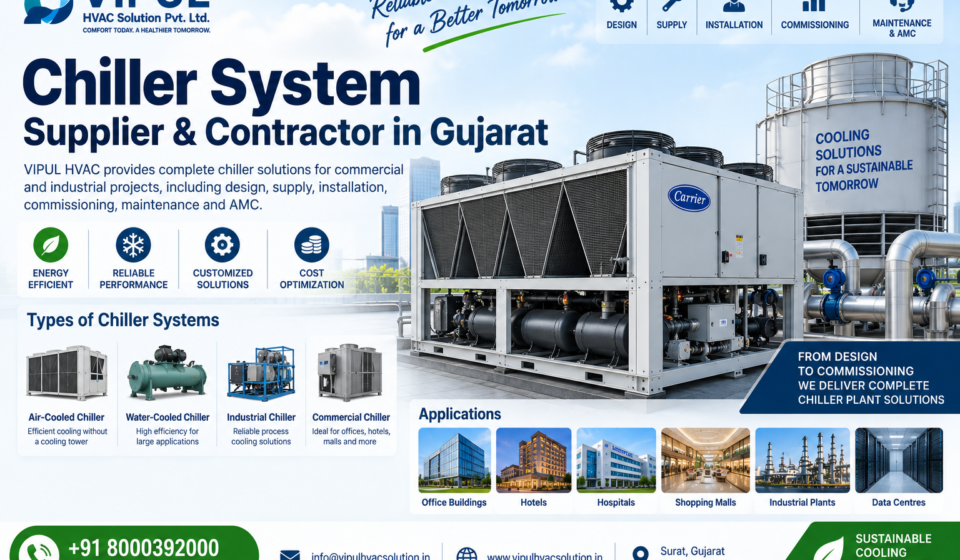

Chiller System Supplier & Contractor in Gujarat
VIPUL HVAC Solution Pvt. Ltd. provides complete chiller system solutions for commercial and industrial projects across Gujarat, including chiller plant design, equipment selection, supply, installation, testing, commissioning, maintenance and AMC support.
A professionally designed chiller system can provide centralized cooling for large buildings and industrial facilities where reliable cooling capacity, temperature control and long-term operating performance are important. VIPUL HVAC currently lists air-cooled and water-cooled chiller systems, with project solutions covering chiller selection, pumps, cooling towers, chilled-water and condenser-water piping, controls, commissioning and performance optimization.
Looking for a chiller system supplier or chiller contractor in Gujarat? Contact VIPUL HVAC at +91 8000392000 for project consultation.
What Is a Chiller System?
A chiller system is a centralized HVAC system that removes heat from a liquid, normally producing chilled water that is circulated through the building’s cooling system.
The chilled water can be supplied to equipment such as:
- Air Handling Units (AHUs)
- Fan Coil Units (FCUs)
- Chilled-water coils
- Process-cooling equipment
- Other application-specific heat exchangers
In a typical commercial HVAC application, the basic cooling cycle can be understood as:
Chiller → Chilled-Water Pump → AHU/FCU → Conditioned Space → Return Water → Chiller
For a larger water-cooled plant, the condenser side may also include:
Chiller → Condenser-Water Pump → Cooling Tower → Chiller
The exact configuration depends on the selected equipment, building load, climate, operating conditions and project requirements.
VIPUL HVAC describes its chiller solutions as centralized systems for large-scale commercial and industrial cooling, with chilled-water distribution to AHUs or FCUs.
Chiller Plant Design & Solutions
What Is a Chiller Plant?
A chiller plant is more than just the chiller machine.
A complete chilled-water plant can include:
- Chiller
- Chilled-water pumps
- Condenser-water pumps
- Cooling towers, where applicable
- Chilled-water piping
- Condenser-water piping
- Valves
- AHUs and/or FCUs
- Electrical panels
- Controls and automation
- BMS integration
- Insulation
- Instrumentation
- Testing and commissioning systems
The plant should be designed as an integrated system rather than selecting individual components independently.
ASHRAE technical guidance and HVAC design practice consider factors such as condenser type, chiller efficiency, number of chillers and chilled-water design temperatures when evaluating chilled-water plants.
VIPUL HVAC Chiller Plant Solutions
VIPUL HVAC provides chiller-related engineering that can include:
- Cooling-load analysis
- Chiller plant design
- Chiller selection
- Pump selection
- Cooling tower selection where applicable
- Chilled-water piping
- Condenser-water piping
- Electrical coordination
- Controls and automation
- BMS integration
- Testing
- Commissioning
- Optimization
- AMC and performance monitoring
These capabilities are also reflected on VIPUL HVAC’s current chiller systems page.
Types of Chiller Systems
The best chiller system depends on the project’s cooling load, climate, available space, water availability, efficiency requirements, operating profile and lifecycle cost.
Air-Cooled Chiller
An air-cooled chiller rejects heat directly to the surrounding air through condenser coils and fans.
Key characteristics
- Does not require a cooling tower
- Generally simpler water-side infrastructure
- Suitable where water availability is limited
- Can be suitable for commercial and industrial applications
- Useful for projects where plant simplicity is important
VIPUL HVAC lists air-cooled chillers among its chiller configurations and notes their suitability for applications where cooling-tower infrastructure is not preferred.
Air-Cooled Chiller Applications
Common applications can include:
- Commercial buildings
- Offices
- Hotels
- Retail buildings
- Institutional buildings
- Industrial facilities
- Process cooling
Water-Cooled Chiller
A water-cooled chiller rejects heat through a condenser-water loop, normally using a cooling tower as part of the heat-rejection system.
Key characteristics
- Suitable for large centralized cooling plants
- Can provide strong efficiency under appropriate operating conditions
- Requires condenser-water infrastructure
- Requires cooling tower where applicable
- Requires water-management and maintenance considerations
Water-cooled systems can be attractive for larger projects where plant efficiency and operating conditions justify the additional infrastructure.
VIPUL HVAC identifies water-cooled chillers as part of its chiller portfolio and describes them as suitable for large-scale cooling applications.
Air-Cooled vs Water-Cooled Chiller
| Factor | Air-Cooled Chiller | Water-Cooled Chiller |
|---|---|---|
| Heat rejection | Outdoor air | Condenser water |
| Cooling tower | Generally not required | Normally required |
| Water consumption | Lower plant water requirement | Requires condenser-water system |
| Plant complexity | Generally simpler | More complex |
| Large cooling plants | Suitable depending on project | Often considered for large plants |
| Maintenance | Air-side maintenance | Chiller + cooling tower + water system |
| Space requirements | Outdoor installation area | Chiller plant + cooling tower |
| Selection | Project dependent | Project dependent |
There is no universally better chiller type.
The correct selection should come from engineering analysis rather than choosing purely on equipment price.
Industrial Chiller Systems
Industrial Chiller
Industrial facilities can have cooling requirements that are different from conventional comfort air conditioning.
An industrial chiller may be used for:
- Process cooling
- Manufacturing
- Pharmaceutical production
- Food processing
- Chemical industries
- Textile industries
- Machinery cooling
- Production equipment
- Temperature-controlled processes
Industrial chiller selection should consider both the HVAC load and process requirements.
Important parameters can include:
- Required leaving-water temperature
- Return-water temperature
- Process flow rate
- Operating hours
- Load profile
- Redundancy
- Ambient conditions
- Water quality
- Control requirements
- Future expansion
Commercial Chiller Systems
Commercial Chiller
Commercial buildings often require centralized cooling across multiple floors and zones.
Chiller systems can be considered for:
- Corporate offices
- Hotels
- Hospitals
- Shopping malls
- IT parks
- Educational institutions
- Large retail facilities
- Convention facilities
- Commercial complexes
VIPUL HVAC identifies commercial buildings, hospitals, hotels and other large facilities among applications where chiller systems can provide centralized cooling.
HVAC Chiller
An HVAC chiller is generally used to produce chilled water for space-conditioning applications.
A typical HVAC chilled-water system may consist of:
Chiller
↓
Chilled-Water Pump
↓
AHU / FCU
↓
Cooling Coil
↓
Conditioned Space
↓
Return Chilled Water
↓
Chiller
For larger plants, the condenser loop may include:
Chiller → Condenser Pump → Cooling Tower → Chiller
The actual arrangement depends on the project design.
Chiller Installation Services in Gujarat
A successful chiller installation begins before the equipment reaches the site.
VIPUL HVAC can structure a chiller project around the following process.
Step 1 — Site Survey
The project team evaluates:
- Building layout
- Available plant space
- Equipment location
- Existing HVAC infrastructure
- Electrical availability
- Piping routes
- Cooling tower location where applicable
- Maintenance access
- Future expansion requirements
Step 2 — Cooling Load Calculation
The required cooling capacity should be established from the actual building or process requirements.
The assessment can consider:
- Building area
- Occupancy
- Solar heat gain
- Lighting
- Equipment loads
- Fresh-air requirements
- Process loads
- Operating hours
- Climate
- Future capacity requirements
A correctly calculated load helps avoid unnecessary oversizing or inadequate capacity.
Step 3 — Chiller Selection
The appropriate chiller can then be evaluated based on:
- Required cooling capacity
- Air-cooled or water-cooled configuration
- Efficiency
- Part-load performance
- Refrigerant
- Operating conditions
- Redundancy
- Available space
- Lifecycle cost
- Maintenance requirements
VIPUL HVAC’s current chiller page specifically states that its selection approach considers load profile, redundancy requirements and lifecycle cost, rather than only initial investment.
Step 4 — Equipment Supply
After approval of the technical and commercial proposal, the required HVAC equipment and associated components can be coordinated for the project.
Step 5 — Chilled-Water Piping
The chilled-water distribution system connects the chiller plant to AHUs, FCUs or other cooling equipment.
The design should consider:
- Pipe sizing
- Flow rate
- Pressure drop
- Insulation
- Valves
- Pumps
- Expansion arrangements
- Drainage
- Balancing
- Maintenance access
Step 6 — Electrical & Control Integration
A modern chiller plant may require coordination of:
- Electrical panels
- Starters/VFDs where applicable
- Pumps
- Chiller controls
- Cooling towers
- Sensors
- Temperature monitoring
- Pressure monitoring
- PLC
- BMS
VIPUL HVAC lists electrical, control and automation integration among its chiller capabilities.
Step 7 — Testing
Before commissioning, the system should be checked for proper operation.
Testing can include:
- Piping pressure testing
- Leak inspection
- Electrical testing
- Pump testing
- Control testing
- Flow verification
- Sensor verification
- Chiller operation
- Cooling-tower operation where applicable
Step 8 — Commissioning
Commissioning confirms that the complete system operates according to the approved design and manufacturer’s requirements.
This may include:
- Start-up
- Flow verification
- Temperature verification
- Control sequence testing
- Equipment performance checks
- Alarm testing
- BMS communication
- System optimization
VIPUL HVAC lists testing, commissioning and optimization as part of its chiller project capabilities.
Chiller Maintenance & AMC Services
A chiller is a major HVAC asset, and preventive maintenance can help protect cooling performance and system reliability.
Chiller maintenance can include:
- Routine inspection
- Chiller cleaning
- Condenser inspection
- Evaporator inspection
- Pump inspection
- Electrical inspection
- Control-system inspection
- Temperature monitoring
- Pressure monitoring
- Refrigerant-system checks where applicable
- Water-flow verification
- Cooling-tower maintenance where applicable
- Performance monitoring
- Breakdown support
VIPUL HVAC offers AMC and performance monitoring as part of its chiller solution offering.
Chiller Repair & Service
Common Chiller Problems
A chiller may experience performance problems for different reasons.
Common symptoms include:
Chiller Not Cooling
Possible causes can include:
- Insufficient water flow
- Fouled heat-transfer surfaces
- Control problems
- Refrigeration-system issues
- Incorrect operating conditions
- Sensor problems
A proper diagnostic process is required before identifying the root cause.
High Discharge Pressure
Possible contributing factors can include:
- Condenser-side problems
- Poor heat rejection
- High ambient conditions
- Fouled condenser
- Cooling-tower problems
- Insufficient condenser-water flow
Low Suction Pressure
Possible causes can include:
- Low chilled-water flow
- Refrigeration-system issues
- Expansion/control problems
- Low load
- Heat-transfer problems
Compressor Problems
Compressor issues may involve:
- Electrical faults
- Overheating
- Lubrication problems
- Control faults
- Operating-condition issues
Pump Problems
Chilled-water or condenser-water pumps can experience:
- Low flow
- Mechanical problems
- Electrical faults
- Seal issues
- Cavitation-related symptoms
- Incorrect balancing
Professional troubleshooting should identify the actual cause instead of replacing components unnecessarily.
Chiller Services Near Me
If you are searching online for:
- Chiller repair near me
- Chiller service near me
- Chiller contractor near me
- Chiller maintenance near me
- Chiller installation near me
- Chiller supplier near me
local service availability, technical capability and response time should all be considered.
Rather than creating a separate page simply called “chiller repair near me,” VIPUL HVAC can strengthen local relevance through its main chiller page, branch/location pages, service-area information, Google Business Profile and genuine project/service signals.
VIPUL HVAC’s current branch listing includes Surat, Ankleshwar, Bharuch, Baroda, Ahmedabad, Talala, Junagadh and Vapi.
Commercial Chiller Applications
Office Buildings
Chillers can provide centralized cooling for:
- Corporate offices
- IT offices
- Business centres
- Large commercial buildings
The system can be connected to AHUs and FCUs to distribute conditioned air throughout the building.
Hotels
Hotel HVAC systems may require cooling for:
- Guest rooms
- Lobby
- Restaurants
- Banquet halls
- Kitchens
- Meeting rooms
- Back-of-house areas
The overall HVAC design should also address ventilation and fresh-air requirements.
Hospitals
Hospital HVAC systems require application-specific engineering.
Depending on the area, design may need to consider:
- Temperature
- Humidity
- Filtration
- Outdoor air
- Pressure relationships
- Airflow
- Infection-control requirements
A chiller may form part of the central cooling plant serving AHUs and other air-distribution equipment.
Shopping Malls
Large retail complexes can have significant cooling requirements due to:
- Large floor areas
- High occupancy
- Lighting
- Retail equipment
- Entrances
- Extended operating hours
Central chilled-water systems can be considered where appropriate.
Data Centers
Data centers have highly specific cooling and reliability requirements.
Chiller selection should be coordinated with the complete cooling architecture, redundancy strategy, environmental requirements and controls.
For high-density facilities, the cooling design may also need to integrate with specialized precision or liquid-cooling systems.
Industrial Chiller Applications
Industrial chiller systems can support:
Manufacturing Plants
For process and environmental cooling.
Pharmaceutical Facilities
For controlled manufacturing environments and process requirements.
Chemical Industries
For process-temperature control and equipment cooling.
Food Processing
For production and process-cooling applications.
Textile Industries
For process-related cooling requirements.
Warehouses and Industrial Buildings
For selected temperature-control applications.
The final system should always be designed according to the actual process and facility requirements.
Chiller Plant Components
A complete chiller plant can contain several interconnected systems.
1. Chiller
The primary refrigeration equipment responsible for removing heat from the chilled-water loop.
2. Chilled-Water Pumps
Move chilled water between the chiller plant and cooling coils.
3. Cooling Tower
Used in many water-cooled systems to reject heat to the atmosphere.
4. Condenser-Water Pumps
Circulate condenser water between the chiller and cooling tower.
5. AHUs
Distribute conditioned air through building spaces.
6. FCUs
Provide localized cooling for individual zones.
7. Piping
Connects the plant with the building’s cooling equipment.
8. Valves
Control and isolate water flow.
9. Controls
Monitor and regulate system operation.
10. BMS
Can provide centralized monitoring and control where the system architecture supports it.
How to Choose the Right Chiller System
Before purchasing a chiller, consider these factors:
1. What is the cooling load?
Start with a professional load calculation.
2. Air-cooled or water-cooled?
Evaluate climate, water availability, plant space, efficiency and lifecycle cost.
3. What is the operating profile?
A building operating 24/7 has different requirements from a building operating eight hours a day.
4. Is redundancy required?
Critical facilities may need standby or redundant capacity.
5. What is the available plant space?
Equipment placement, maintenance access and cooling-tower requirements should be considered.
6. What is the required chilled-water temperature?
The temperature requirement depends on the application and cooling coils/process.
7. Is BMS integration required?
For large commercial buildings, centralized monitoring may be beneficial.
8. What is the lifecycle cost?
Do not evaluate the chiller only by purchase price.
Consider:
Capital Cost + Installation Cost + Energy Cost + Maintenance Cost + Replacement Cost
Why Choose VIPUL HVAC for Chiller Systems?
HVAC Engineering Approach
VIPUL HVAC’s current chiller offering goes beyond basic equipment supply and includes engineering elements such as plant design, equipment selection, piping, controls and commissioning.
Key capabilities include:
- Site survey
- Cooling-load analysis
- Chiller selection
- Chiller plant design
- Pump selection
- Cooling tower selection
- Chilled-water piping
- Condenser-water piping
- AHU/FCU integration
- Electrical coordination
- Control and automation
- BMS integration
- Testing
- Commissioning
- Optimization
- Preventive maintenance
- AMC
VIPUL HVAC’s official site currently positions the company around commercial, industrial and institutional HVAC solutions, with chiller systems among its major HVAC product categories.
Our Chiller Project Process
From Concept to Commissioning
1. Site Survey
Understand the building, process and existing HVAC infrastructure.
↓
2. Cooling Load Calculation
Determine required cooling capacity.
↓
3. System Design
Develop the chilled-water plant concept and distribution strategy.
↓
4. Chiller Selection
Select suitable air-cooled or water-cooled equipment.
↓
5. BOQ & Proposal
Prepare technical and commercial requirements.
↓
6. Equipment Supply
Coordinate the approved HVAC equipment.
↓
7. Installation
Install chillers, pumps, piping, controls and associated systems.
↓
8. Testing
Check piping, electrical, controls and equipment.
↓
9. Commissioning
Start and optimize the complete system.
↓
10. AMC & Maintenance
Support long-term operation through maintenance and service.
Chiller System Capacity
VIPUL HVAC’s current chiller page lists a 20 TR to 1000+ TR capacity range. However, this should be treated as a project portfolio/range indication rather than a recommendation for every project. Actual chiller capacity should be determined through cooling-load calculations and equipment selection.
For example:
Small commercial requirement → Smaller chiller configuration
Large commercial building → Multiple-chiller plant
Industrial process → Application-specific chiller
Critical facility → Chiller + redundancy strategy
Chiller System Cost in Gujarat
There is no single fixed price for a chiller system.
The total project cost depends on:
- Chiller capacity
- Air-cooled or water-cooled configuration
- Number of chillers
- Chiller efficiency
- Pumps
- Cooling towers
- Piping
- AHUs/FCUs
- Electrical work
- Controls
- BMS
- Insulation
- Installation
- Testing and commissioning
- Plant-room requirements
- Project complexity
Therefore, the correct way to estimate the investment is through a site survey + cooling-load calculation + technical BOQ.
Need a chiller quotation?
Call VIPUL HVAC Solution Pvt. Ltd. at +91 8000392000.
Chiller Services Across Gujarat
VIPUL HVAC can support commercial and industrial HVAC requirements across Gujarat.
Key service locations include:
- Surat
- Ahmedabad
- Vadodara
- Bharuch
- Ankleshwar
- Vapi
- Junagadh
- Talala
VIPUL’s official branch page currently lists these locations.
For local SEO, each genuine location page should provide useful information about the company’s actual service availability rather than creating duplicate city pages with the same content.
Frequently Asked Questions About Chiller Systems
What is a chiller system?
A chiller system removes heat from a liquid, typically producing chilled water that is circulated to AHUs, FCUs or process equipment for cooling.
What is a chiller plant?
A chiller plant is the complete centralized cooling installation, which may include chillers, pumps, cooling towers, piping, valves, controls, AHUs/FCUs and BMS.
What is the difference between an air-cooled and water-cooled chiller?
An air-cooled chiller rejects heat directly to outdoor air, while a water-cooled chiller uses a condenser-water system and typically a cooling tower for heat rejection.
Which is better: air-cooled or water-cooled chiller?
Neither is universally better. The correct choice depends on cooling load, climate, water availability, plant space, efficiency, operating conditions and lifecycle cost.
What size chiller do I need?
Chiller capacity should be determined through a professional cooling-load calculation. It should not be selected simply from building area.
How much does a chiller system cost?
The cost varies according to capacity, chiller type, pumps, cooling towers, piping, AHUs, controls, electrical work, installation and commissioning. A project-specific quotation is required.
How often should a chiller be serviced?
Maintenance frequency should follow the equipment manufacturer’s recommendations, operating conditions and the site’s maintenance program. Critical facilities may require more frequent inspection and monitoring.
Do you provide chiller AMC services?
Yes. VIPUL HVAC lists AMC and performance monitoring as part of its chiller solutions.
Do you provide chiller installation in Gujarat?
VIPUL HVAC provides chiller-related design, supply, installation, testing and commissioning support for commercial and industrial HVAC applications.
Can VIPUL HVAC design a complete chiller plant?
Yes. VIPUL’s listed chiller capabilities include cooling-load analysis, plant design, chiller/pump/cooling-tower selection, piping, controls, commissioning and optimization.
Do chillers work with AHUs?
Yes. Chilled water from the chiller plant can be circulated to cooling coils in AHUs, which then condition and distribute air to building spaces.
Can chillers be used for industrial process cooling?
Yes, subject to the process requirements. Industrial applications should be designed around the required flow rate, temperatures, operating conditions and process load.
Why Professional Chiller Design Matters
A chiller plant is a complete engineered system.
Simply purchasing a high-capacity chiller does not guarantee efficient operation.
The actual result depends on:
- Correct Load Calculation
- Correct Chiller Selection
- Correct Pump Selection
- Correct Piping
- Correct Air Distribution
- Correct Controls
- Professional Installation
- Testing & Commissioning
- Preventive Maintenance
This is why selecting an experienced HVAC project partner is important for large chiller installations.
Get a Chiller Project Consultation from VIPUL HVAC
Whether you are planning a new chiller plant, replacing an existing chiller, expanding cooling capacity or looking for chiller maintenance, VIPUL HVAC can help evaluate the HVAC requirement and develop an appropriate solution.
VIPUL HVAC Solution Pvt. Ltd.
Chiller Systems | HVAC Design | Installation | Commissioning | Maintenance | AMC
📞 Call: +91 8000392000
📧 Email: info@vipulhvacsolution.in
🌐 Website: VIPUL HVAC Solution Pvt. Ltd.
Planning a chiller project in Gujarat? Contact VIPUL HVAC for a site survey, cooling-load assessment and project-specific chiller solution.

[…] Which is better: air cooled or water cooled chiller? […]
[…] There is no single chiller configuration suitable for every industrial application. […]
[…] Chillers […]