

Table of Contents
ToggleWhich Is Better, VRF or VRV? Complete Guide for Commercial HVAC Projects
If you are planning air conditioning for an office, hotel, hospital, showroom, restaurant, commercial building or large residence, you may come across two terms: VRF and VRV.
But here is the most important answer:
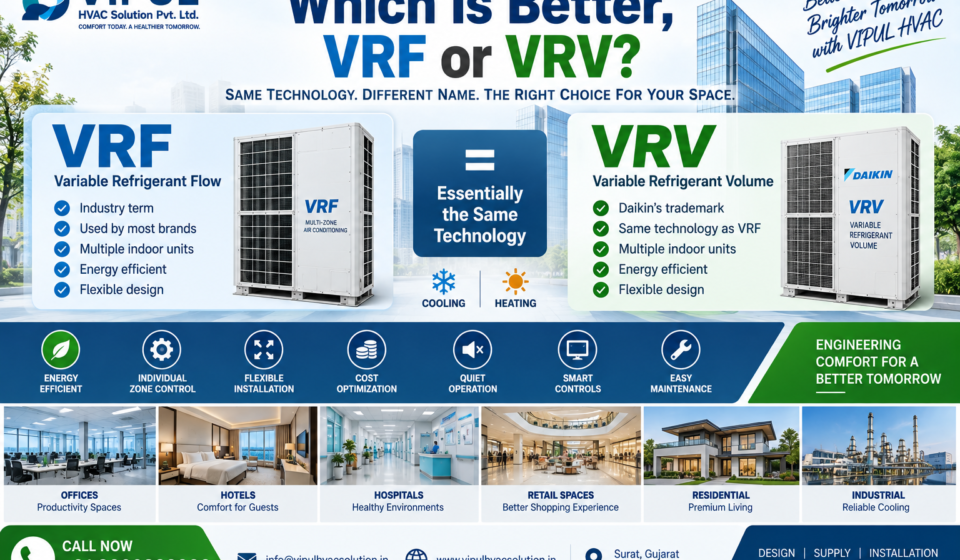
VRF and VRV are essentially the same HVAC technology. VRF means Variable Refrigerant Flow, while VRV means Variable Refrigerant Volume. “VRV” is Daikin’s trademarked name for its technology.
So, the real question is not “Which is better, VRF or VRV?” The better question is:
Which VRF/VRV system, brand, capacity and design is best for your building?
For a successful project, equipment selection, heat-load calculation, refrigerant piping design, zoning, installation, testing and commissioning are all important.
VIPUL HVAC Solution Pvt. Ltd. provides VRF/VRV solutions, including system design, indoor and outdoor unit selection, refrigerant piping design, zoning, commissioning and AMC support.
What Is VRF?
VRF = Variable Refrigerant Flow.
VRF is an advanced air-conditioning technology that varies refrigerant flow according to the cooling or heating demand of different zones.
A typical VRF system consists of:
- Outdoor unit
- Multiple indoor units
- Refrigerant piping
- Branch piping components
- Communication wiring
- Controllers
- Drain piping
- Optional centralized control
- Optional BMS integration
The system can provide different levels of cooling to different indoor zones according to demand.
For example:
Office 1 → 22°C
Office 2 → 24°C
Conference room → 23°C
Reception → 24°C
The exact design depends on the project.
What Is VRV?
VRV = Variable Refrigerant Volume.
VRV is essentially the same underlying technology as VRF.
Daikin developed its VRV technology in 1982 and uses VRV as a trademark. Other manufacturers generally use the term VRF for similar variable-refrigerant systems.
Therefore:
VRF = Generic industry term
VRV = Daikin’s trademarked term
This distinction is important when comparing equipment brands.
VRF vs VRV: What Is the Difference?
| Feature | VRF | VRV |
|---|---|---|
| Full form | Variable Refrigerant Flow | Variable Refrigerant Volume |
| Technology | Variable refrigerant system | Variable refrigerant system |
| Basic principle | Modulates refrigerant according to demand | Modulates refrigerant according to demand |
| Multiple indoor units | Yes | Yes |
| Individual zone control | Yes | Yes |
| Inverter technology | Common | Common |
| Commercial applications | Yes | Yes |
| Brand terminology | Used by most manufacturers | Daikin trademark |
| Technology difference | No fundamental difference | No fundamental difference |
Simple answer:
There is no fundamental technology advantage simply because a system is called VRF or VRV.
The difference is primarily terminology and branding.
Why Do Some Companies Call It VRF and Daikin Calls It VRV?
Daikin introduced its VRV system in 1982 and trademarked the term VRV. Because the term is trademarked, other manufacturers generally use VRF — Variable Refrigerant Flow.
That’s why you may see:
- Daikin → VRV
- Mitsubishi Electric → VRF
- Toshiba → VRF
- Carrier → VRF
- LG → VRF
- Hitachi → VRF
- Blue Star → VRF
The exact product name and specifications vary by manufacturer.
How Does a VRF/VRV System Work?
A VRF/VRV system uses refrigerant to transfer heat between the outdoor unit and multiple indoor units.
Basic operating sequence:
Outdoor Unit
↓
Refrigerant Piping
↓
Branch Components
↓
Multiple Indoor Units
↓
Individual Zones
The system continuously adjusts refrigerant delivery according to the requirements of connected zones.
Daikin describes its VRV system as providing individual zone control and adapting refrigerant operation to building requirements.
Is VRF Better Than VRV?
No — VRF is not inherently better than VRV.
And:
VRV is not inherently better simply because it is called VRV.
If you are comparing:
VRF vs VRV
You are generally comparing the same basic type of HVAC technology.
If you want to compare actual systems, you should compare:
Daikin VRV vs Mitsubishi Electric VRF
or
Daikin VRV vs Carrier VRF
or
Daikin VRV vs LG VRF
Rather than simply:
VRF vs VRV.
What Makes One VRF/VRV System Better Than Another?
The actual performance of a project depends on several factors.
1. Heat-Load Calculation
The first step should be determining the actual cooling load.
Factors can include:
- Building area
- Occupancy
- Solar heat gain
- Glass area
- Lighting load
- Equipment load
- Fresh-air load
- Building orientation
- Operating hours
- Local climate
Incorrect load calculation can lead to oversized or undersized equipment.
2. Correct Outdoor Unit Selection
The outdoor unit should be selected based on:
- Required capacity
- Connected indoor units
- Diversity
- Operating conditions
- Piping limitations
- Manufacturer specifications
- Future requirements
A larger outdoor unit does not automatically mean better performance.
3. Indoor Unit Selection
VRF/VRV systems offer multiple indoor-unit configurations.
Depending on the manufacturer and model, options may include:
- Ceiling cassette
- Concealed ducted
- Wall-mounted
- Ceiling-suspended
- Floor-standing
- Other specialized configurations
The indoor unit should match the room architecture and cooling requirement.
4. Refrigerant Piping Design
This is one of the most important parts of a VRF project.
The design should consider:
- Pipe diameter
- Total pipe length
- Equivalent pipe length
- Vertical separation
- Branching arrangement
- Manufacturer limitations
- Insulation
- Refrigerant requirements
Poor piping design can negatively affect system performance.
5. Zoning
One of the biggest advantages of VRF/VRV is zoning.
For example, an office building may have:
Zone 1 → Reception
Zone 2 → Management cabins
Zone 3 → Open office
Zone 4 → Conference room
Zone 5 → Server/IT area
Each area can have different operational requirements.
6. Controls and BMS Integration
Modern commercial HVAC projects may require centralized controls.
Depending on the equipment and project architecture, VRF/VRV systems can support:
- Centralized controllers
- Remote monitoring
- Energy monitoring
- Scheduling
- Fault alarms
- Zone control
- BMS integration
VIPUL HVAC also provides BMS and HVAC automation solutions as part of its HVAC project capabilities.
7. Installation Quality
Even an excellent VRF/VRV product can perform poorly if installation is not done correctly.
Important installation activities include:
- Correct refrigerant piping
- Proper pipe insulation
- Pressure testing
- Leak testing
- Vacuuming
- Electrical connections
- Communication wiring
- Drain installation
- Controller setup
- Outdoor-unit installation
- Indoor-unit installation
8. Testing & Commissioning
Commissioning is an essential stage of the project.
It can include:
- Refrigerant system checks
- Leak testing
- Electrical checks
- Communication checks
- Indoor-unit operation
- Outdoor-unit operation
- Drain testing
- Controller testing
- Temperature verification
- Performance checks
VIPUL HVAC lists commissioning and performance optimization among its VRF/VRV project services.
Advantages of VRF/VRV Systems
Energy-Efficient Operation
Variable refrigerant systems can adjust capacity according to demand instead of continuously operating at full capacity.
Daikin highlights inverter technology and individual zone control as key aspects of its VRV technology.
Individual Zone Control
Different rooms can have different cooling requirements.
This makes VRF/VRV attractive for buildings with multiple independent spaces.
Flexible Installation
VRF systems can accommodate multiple indoor units and different building layouts, subject to the manufacturer’s design limitations.
Multiple Indoor Unit Options
Different indoor-unit styles allow the system to be adapted to different architectural requirements.
Space Saving
Compared with installing separate conventional systems for every zone, a properly designed VRF/VRV system can reduce the number of outdoor units.
Smart Controls
Advanced systems can support centralized controls and building automation integration.
VRF/VRV vs Chiller System
The right comparison for a large project is often not simply VRF vs VRV.
It may actually be:
VRF/VRV vs Chiller
| Factor | VRF/VRV | Chiller |
|---|---|---|
| Zoning | Excellent | Depends on design |
| Refrigerant piping | Yes | Usually chilled-water piping |
| Water pumps | Generally not required | Required |
| Multiple small zones | Excellent | Possible |
| Large central plants | Possible but application-dependent | Strong option |
| Individual control | Excellent | Depends on terminal system |
| Maintenance | Specialized | Specialized |
| Best application | Many zoned commercial spaces | Large centralized cooling plants |
The correct selection depends on building size, cooling load, operating profile, available plant space and project economics.
Is VRF Suitable for Offices?
Yes.
VRF/VRV can be a strong solution for offices where different areas require independent temperature control.
Typical applications include:
- Corporate offices
- IT offices
- Co-working spaces
- Business centers
- Commercial buildings
- Showrooms
Is VRF Suitable for Hotels?
Yes.
Hotels often require individual room control.
A properly designed VRF system can provide independent temperature control for:
- Guest rooms
- Reception
- Restaurants
- Meeting rooms
- Offices
- Common areas
However, ventilation and fresh-air requirements must be addressed separately as part of the overall HVAC design.
Is VRF Suitable for Hospitals?
VRF can be suitable for selected hospital areas, but it should not automatically be considered the solution for every clinical space.
Hospital HVAC design may require specialized consideration of:
- Outdoor air
- Filtration
- Pressure relationships
- Temperature
- Humidity
- Airflow direction
- Infection-control requirements
The HVAC system should therefore be selected according to the function and risk level of each area.
Is VRF Suitable for Restaurants?
Yes, but VRF should be coordinated with the restaurant’s ventilation strategy.
A restaurant may require:
VRF + Fresh Air + Kitchen Exhaust + Make-Up Air
The kitchen exhaust system and space-conditioning system need to be designed together to avoid unwanted pressure and comfort problems.
VRF/VRV Does Not Replace Fresh-Air Ventilation
This is an important point for building owners.
A VRF/VRV system primarily handles space cooling/heating.
It does not automatically mean that the building receives the required outdoor air.
Depending on the building, separate systems may be required for:
- Fresh air
- Exhaust
- Toilet ventilation
- Kitchen exhaust
- Smoke management
- Air filtration
- Heat recovery
- Pressurization
Therefore, a complete HVAC solution may include:
VRF/VRV + Fresh Air + Exhaust + Controls + BMS
Why Choose VIPUL HVAC for VRF/VRV Projects?
VIPUL HVAC Solution Pvt. Ltd. provides VRF/VRV HVAC solutions for commercial and institutional applications.
Its official VRF/VRV service offering includes:
- Complete VRF system design
- Indoor-unit selection
- Outdoor-unit selection
- Refrigerant piping design
- Control logic
- Zoning
- Commissioning
- Performance optimization
- AMC services
VIPUL HVAC also provides HVAC solutions for offices, hospitals, factories, malls and cleanroom environments.
VIPUL HVAC Project Approach
Site Survey
↓
Heat-Load Calculation
↓
HVAC Design
↓
VRF/VRV Selection
↓
BOQ & Technical Proposal
↓
Equipment Supply
↓
Installation
↓
Testing
↓
Commissioning
↓
AMC & Maintenance
This end-to-end approach helps coordinate equipment selection, piping, controls and installation.
VRF or VRV: Final Verdict
Which is better, VRF or VRV?
Neither is inherently better.
VRF and VRV describe essentially the same variable-refrigerant HVAC technology. VRV is Daikin’s trademarked terminology, while VRF is the commonly used generic industry term.
The more important decision is:
Which manufacturer, model, capacity and system design is best for your building?
A successful VRF/VRV project requires more than selecting a famous brand.
It requires:
Correct Heat Load + Correct Equipment + Correct Piping + Correct Zoning + Professional Installation + Testing + Commissioning
For commercial and industrial HVAC projects in Gujarat, VIPUL HVAC Solution Pvt. Ltd. can support the project from design and selection through installation, commissioning and maintenance.
Planning a VRF/VRV project?
Call VIPUL HVAC Solution Pvt. Ltd.
Phone: +91 8000392000
Email: info@vipulhvacsolution.in
Website: VIPUL HVAC Solution Pvt. Ltd.
Frequently Asked Questions
1. Is VRF and VRV the same?
Yes. VRF and VRV refer to essentially the same variable-refrigerant HVAC technology. VRV is Daikin’s trademarked name.
2. Which is better, VRF or VRV?
Neither is automatically better. The selection should be based on manufacturer, model, cooling load, efficiency, zoning, piping requirements, controls, installation quality and after-sales support.
3. Is VRV only made by Daikin?
VRV is Daikin’s trademark. Other manufacturers generally market comparable technology under the term VRF.
4. Is VRF good for offices?
Yes. VRF is particularly suitable for buildings requiring multiple independently controlled zones.
5. Is VRF energy efficient?
VRF systems can provide efficient part-load operation because the system can modulate capacity according to demand. Actual efficiency depends on the selected equipment, design, operating conditions and installation.
6. Can VRF provide fresh air?
VRF itself should not be assumed to provide the building’s required outdoor-air ventilation. A separate fresh-air/ventilation strategy may be required.
7. Can VRF be connected to BMS?
Many modern systems support centralized controls and BMS integration, subject to the selected manufacturer and system architecture.
8. Does VIPUL HVAC provide VRF installation?
Yes. VIPUL HVAC lists VRF/VRV system design, indoor/outdoor unit selection, refrigerant piping design, commissioning, performance optimization and AMC services.
Important Links:
- VRF vs VRV
- Difference between VRF and VRV
- VRF or VRV which is better
- VRF system
- VRV system
- Best VRF system
- Best VRV system
- VRF HVAC system
- VRF VRV system Gujarat
- VRF installation Gujarat
- VRF contractor Gujarat
- VRF consultant Surat
- VIPUL HVAC VRF
- VIPUL HVAC VRV
Which Is Better, VRF or VRV? Complete VRF vs VRV Guide
Need help choosing VRF or VRV for your building? Contact VIPUL HVAC Solution Pvt. Ltd. at +91 8000392000 for HVAC design, system selection, installation, testing and commissioning.

Vipul HVAC House
At Vipul hvac solution pvt.ltd., we take great pride in delivering high-quality HVAC solutions that ensure comfort and efficiency in both residential and commercial spaces. As a trusted HVAC of reliable, energy-efficient systems, and we are dedicated to providing you with the best products and services to meet your needs
[…] Daikin uses the term VRV (Variable Refrigerant Volume) for its proprietary variable-refrigerant technology. VRF is the generic industry term for similar multi-zone systems. Vipulhvac Solution […]
[…] VIPUL HVAC’s own VRF/VRV guide explains that VRF and VRV are essentially the same underlying technology, with VRV being Daikin’s trademarked terminology. Vipulhvac Solution […]
[…] VIPUL HVAC’s published VRF/VRV information explains that VRF and VRV refer to essentially the same variable-refrigerant technology, with VRV being Daikin’s trademarked terminology. Vipulhvac Solution […]