
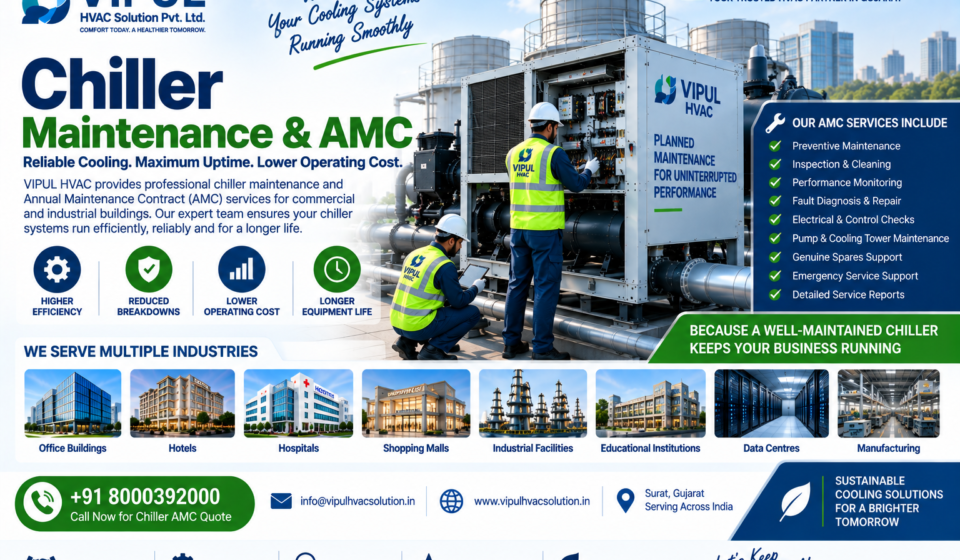

Chiller Maintenance & AMC: Complete Guide to Preventive Maintenance, Repair & Annual Service
A Chiller Maintenance & AMC program is essential for keeping commercial and industrial cooling systems reliable, efficient and ready for operation throughout the year. Regular inspection, cleaning, performance monitoring, water-side maintenance, electrical checks, controls testing and timely repairs can help reduce unexpected breakdowns and maintain the intended performance of a chiller plant.
VIPUL HVAC SOLUTION PVT. LTD. provides HVAC maintenance and Annual Maintenance Contract (AMC) services for commercial and industrial HVAC systems, with preventive inspection, fault diagnosis, servicing and repair support. The company states that its maintenance and AMC services are designed to support optimal performance, energy efficiency and long system life.
For liquid-chilling systems, ASHRAE recommends establishing normal operating conditions, monitoring operating trends, checking leaks, maintaining water quality, inspecting controls and performing periodic cleaning and component maintenance according to the equipment and manufacturer requirements.
What Is Chiller Maintenance?
Chiller maintenance is the planned inspection, cleaning, testing, adjustment and servicing of a chiller system to maintain safe and reliable operation.
A complete maintenance program can cover:
- Chiller inspection
- Compressor inspection
- Refrigerant-system checks
- Condenser cleaning
- Evaporator inspection
- Chilled-water checks
- Condenser-water checks
- Cooling-tower maintenance
- Pump inspection
- Electrical testing
- Control-system inspection
- Sensor verification
- Leak detection
- Vibration monitoring
- Performance analysis
- Safety-control testing
- Preventive repairs
The exact maintenance requirements depend on the chiller type, manufacturer, operating hours, water quality, refrigerant, application and site conditions.
ASHRAE specifically recommends following the manufacturer’s operation and maintenance instructions while establishing a preventive maintenance schedule appropriate to the application.
What Is Chiller AMC?
AMC stands for Annual Maintenance Contract.
A Chiller AMC is a planned service agreement between the HVAC service provider and the customer covering agreed maintenance, inspection and support activities for a specified period, commonly one year.
Depending on the contract, an AMC may include:
- Scheduled preventive maintenance
- Equipment inspection
- Chiller cleaning
- Electrical checks
- Refrigeration-system checks
- Water-flow verification
- Cooling-tower inspection
- Pump inspection
- Control checks
- Performance monitoring
- Breakdown support
- Emergency service
- Replacement recommendations
- Maintenance reports
The exact scope should always be clearly defined in the AMC agreement.
Why Is Chiller Maintenance Important?
A chiller is a major HVAC investment, and its performance depends on many interconnected components.
Without appropriate maintenance, problems can develop in:
- Refrigeration circuit
- Heat-transfer surfaces
- Pumps
- Cooling towers
- Electrical systems
- Controls
- Water circuits
- Sensors
These problems can eventually affect cooling capacity and energy consumption.
ASHRAE states that proper operation and maintenance are essential for reliability, longevity and safety of liquid-chilling systems.
Benefits of Regular Chiller Maintenance
1. Better Cooling Performance
Regular maintenance helps identify issues that can reduce cooling capacity.
Examples include:
- Fouled condenser
- Dirty heat exchanger
- Low water flow
- Incorrect controls
- Refrigerant problems
2. Improved Energy Efficiency
A poorly maintained chiller may consume more energy than necessary.
ASHRAE notes that proper water treatment and regular tube cleaning can help reduce power consumption and operating problems associated with fouling.
3. Reduced Unexpected Breakdowns
Preventive maintenance allows technicians to identify developing problems before they become major failures.
4. Longer Equipment Life
Regular inspection and servicing can help protect:
- Compressors
- Pumps
- Motors
- Heat exchangers
- Electrical components
- Controls
5. Better Reliability
For hospitals, hotels, malls, offices, factories and other facilities, an unexpected cooling failure can disrupt operations.
A structured maintenance program helps improve operational readiness.
6. Better Operating Data
Recording operating parameters creates a historical performance baseline.
Changes in:
- Temperature
- Pressure
- Flow
- Power
- Vibration
- Operating hours
can help identify developing problems.
ASHRAE recommends maintaining operating records because changes from normal startup conditions can provide an early indication that maintenance is required.
Chiller Maintenance Checklist
A professional maintenance program should be adapted to the specific chiller, but the following checklist provides a useful framework.
Refrigeration System
- Refrigerant pressure
- Refrigerant charge/level where applicable
- Leak inspection
- Compressor operation
- Oil condition
- Oil level
- Filter/drier condition
- Refrigeration temperatures
Water System
- Chilled-water temperature
- Return-water temperature
- Water flow
- Pressure
- Strainers
- Valves
- Pumps
- Water quality
Condenser
- Condenser approach
- Heat-transfer performance
- Tube condition
- Fouling
- Water flow
- Condenser pressure
Electrical
- Voltage
- Current
- Electrical connections
- Starter/contactor condition
- Motor condition
- Control panel
- VFD operation where applicable
Controls
- Sensors
- Setpoints
- Safety controls
- Interlocks
- Alarms
- Control sequence
Mechanical
- Vibration
- Noise
- Bearings
- Couplings
- Seals
- Mounting
- Alignment
Chiller Preventive Maintenance
Preventive maintenance means servicing the equipment before a failure occurs.
A typical preventive-maintenance program can include:
Daily / Routine Monitoring
Depending on the facility and control system, operators can monitor:
- Supply chilled-water temperature
- Return temperature
- Condenser-water temperature
- Pressure
- Flow
- Compressor status
- Alarms
- Power consumption
Not every parameter needs to be manually checked every day; the monitoring frequency should follow the equipment and project requirements.
Monthly Chiller Maintenance
Depending on the manufacturer’s instructions and site conditions, monthly activities may include:
- General equipment inspection
- Electrical-panel inspection
- Leak inspection
- Pump inspection
- Vibration observation
- Temperature review
- Pressure review
- Alarm-history review
- Water-system inspection
- Cooling-tower inspection
Quarterly Chiller Maintenance
Quarterly service may include:
- Detailed electrical inspection
- Control-system inspection
- Sensor verification
- Pump inspection
- Refrigeration-system inspection
- Water-flow verification
- Cooling-tower checks
- Performance comparison with baseline
The exact frequency should be determined from the manufacturer’s maintenance schedule and operating conditions.
Annual Chiller Maintenance
Annual maintenance is generally more comprehensive.
It can include:
- Detailed chiller inspection
- Heat-exchanger inspection
- Condenser cleaning where required
- Electrical tightening/checks
- Control and safety testing
- Refrigerant leak inspection
- Oil-system checks
- Pump inspection
- Cooling-tower service
- Water-quality assessment
- Vibration assessment
- Performance testing
- Maintenance report
- Recommendations for corrective work
ASHRAE’s maintenance guidance includes periodic leak checks, water-flow checks, pressure and temperature checks, cleaning of condenser/lubricant coolers, control calibration, electrical inspection, safety-interlock checks and vibration monitoring.
Air Cooled Chiller Maintenance
Air-cooled chillers use outdoor air for heat rejection, so condenser coils and fans are important maintenance points.
Air-Cooled Chiller Checklist
Condenser Coil
Inspect for:
- Dust
- Dirt
- Debris
- Blockage
- Corrosion
- Bent fins
Dirty condenser coils can restrict heat rejection.
Condenser Fans
Check:
- Fan motor
- Bearings
- Blade condition
- Rotation
- Vibration
- Electrical connections
Refrigeration Circuit
Check:
- Refrigerant condition
- Operating pressures
- Temperature
- Leaks
- Compressor performance
Electrical System
Check:
- Current
- Voltage
- Connections
- Contactors
- Protection devices
- Control panel
Water Cooled Chiller Maintenance
Water-cooled chillers require additional maintenance because the system includes condenser water and usually a cooling tower.
Important Maintenance Areas
Condenser Tubes
Fouling can reduce heat-transfer performance.
ASHRAE recommends proper water treatment and regular tube cleaning for liquid chillers to help control fouling and operating problems.
Cooling Tower
Inspect:
- Fill
- Nozzles
- Basin
- Fans
- Motors
- Drift eliminators
- Water distribution
- Water quality
Condenser-Water Pumps
Check:
- Flow
- Pressure
- Bearings
- Seals
- Alignment
- Vibration
- Motor
Water Treatment
Appropriate water treatment helps manage:
- Scale
- Corrosion
- Fouling
- Biological growth
Chiller Compressor Maintenance
The compressor is one of the most important components of a chiller.
Maintenance may include checking:
- Operating pressures
- Oil level
- Oil condition
- Compressor temperature
- Vibration
- Electrical current
- Motor condition
- Unusual noise
The exact procedure depends on whether the chiller uses:
- Scroll compressor
- Screw compressor
- Centrifugal compressor
- Reciprocating compressor
VIPUL’s current chiller offering includes scroll, screw and centrifugal compressor options, depending on project requirements.
Chiller Condenser Maintenance
The condenser must reject heat effectively.
If heat transfer deteriorates, the chiller may experience:
- Higher condensing pressure
- Increased compressor power
- Reduced cooling capacity
- Higher operating cost
For water-cooled chillers, condenser tubes may require periodic cleaning depending on water quality and fouling conditions.
ASHRAE notes that with proper water treatment, condenser tubes may require cleaning at relatively long intervals, while site conditions can require more frequent attention.
Chiller Evaporator Maintenance
The evaporator transfers heat from the chilled fluid to the refrigerant.
Maintenance may include:
- Water-flow verification
- Temperature-difference monitoring
- Fouling inspection
- Pressure-drop monitoring
- Leak inspection
- Fluid-quality checks
In open or contaminated water circuits, cleaning requirements may be greater.
Chiller Pump Maintenance
Pumps are critical to maintaining water flow.
Inspect:
- Pump flow
- Discharge pressure
- Suction pressure
- Motor current
- Bearings
- Mechanical seals
- Alignment
- Vibration
- Coupling
A chiller can have adequate refrigeration capacity but still fail to deliver required cooling if water flow is insufficient.
Cooling Tower Maintenance
For water-cooled chiller plants, cooling-tower maintenance is an essential part of the overall AMC.
Check:
- Fan operation
- Fan motor
- Fill condition
- Nozzles
- Basin
- Water distribution
- Drift eliminators
- Blowdown
- Water treatment
- Vibration
- Make-up water
Poor cooling-tower performance can increase condenser-water temperature and affect chiller performance.
Electrical Maintenance for Chillers
Electrical inspection can include:
- Voltage
- Current
- Phase balance
- Cable connections
- Terminals
- Starters
- Contactors
- Overload protection
- MCC
- VFD
- Control panel
Loose or deteriorated electrical connections can create reliability and safety concerns.
Chiller Controls & BMS Maintenance
Modern chiller plants can use automation and BMS to monitor and control equipment.
Maintenance should verify:
- Temperature sensors
- Pressure sensors
- Flow sensors
- Setpoints
- Control sequences
- Alarms
- Interlocks
- Communication
- BMS data
VIPUL’s chiller offering supports PLC/BMS-compatible controls, while its broader HVAC services include BMS and HVAC automation.
Chiller Performance Monitoring
One of the most valuable parts of an AMC is performance trending.
Important parameters can include:
| Parameter | Why It Matters |
|---|---|
| Chilled-water supply temperature | Indicates cooling delivery |
| Chilled-water return temperature | Indicates building/process load |
| Water flow | Confirms hydraulic performance |
| Condenser-water temperature | Important for water-cooled chillers |
| Refrigerant pressure | Indicates refrigeration operation |
| Compressor current | Indicates electrical/load condition |
| Vibration | Can indicate mechanical problems |
| Power consumption | Helps evaluate efficiency |
| Alarm history | Helps identify recurring problems |
Trend data can help technicians distinguish between a sudden fault and gradual performance deterioration.
What Is Chiller Breakdown Maintenance?
Breakdown maintenance is performed when a chiller or associated component has already developed a fault.
Common problems include:
- Chiller not starting
- Chiller tripping
- High-pressure trip
- Low-pressure trip
- Compressor fault
- Pump failure
- Cooling-tower problem
- Refrigerant leakage
- Sensor failure
- Electrical fault
- BMS communication failure
- Poor cooling
A professional service team should first diagnose the root cause rather than simply resetting the equipment.
Common Chiller Problems & Solutions
Problem 1: Chiller Not Cooling
Possible causes:
- Low water flow
- Fouled heat exchanger
- Refrigerant problem
- Incorrect setpoint
- Compressor issue
- High building/process load
Recommended action: Check operating data and perform systematic diagnosis.
Problem 2: High Energy Consumption
Possible causes:
- Dirty condenser
- Poor water flow
- Incorrect setpoints
- Inefficient pumping
- Poor cooling-tower performance
- Equipment degradation
- Poor control strategy
Problem 3: High Condenser Pressure
For a water-cooled chiller, possible causes include:
- High condenser-water temperature
- Cooling-tower problem
- Low condenser-water flow
- Fouled condenser
For an air-cooled chiller:
- Dirty condenser coils
- Fan failure
- High ambient temperature
- Restricted airflow
Problem 4: Low Chilled-Water Flow
Potential causes:
- Pump problem
- Blocked strainer
- Closed valve
- Air in the system
- Piping restriction
Problem 5: Frequent Chiller Trips
Possible causes include:
- High pressure
- Low pressure
- Electrical protection
- Flow protection
- Sensor failure
- Compressor protection
- Control fault
Frequent trips should be investigated rather than repeatedly reset.
Chiller AMC: What Should Be Included?
Before signing an AMC, clearly define the scope.
A good AMC document should specify:
Equipment Covered
For example:
Service Frequency
Specify:
- Monthly
- Quarterly
- Half-yearly
- Annual
- Emergency/breakdown support
Preventive Maintenance
Clearly identify included activities.
Breakdown Support
Specify:
- Response procedure
- Working hours
- Emergency support
- Labour coverage
Spare Parts
Clarify whether spare parts are:
- Included
- Excluded
- Charged separately
Consumables
Clearly define consumables such as:
- Filters
- Lubricants
- Chemicals
- Cleaning materials
Reports
Maintenance reports can include:
- Equipment condition
- Operating readings
- Faults found
- Corrective actions
- Recommendations
Comprehensive AMC vs Preventive AMC
Different AMC structures are possible.
Preventive AMC
Usually focuses on scheduled maintenance and inspections.
Suitable when the customer wants predictable routine servicing.
Comprehensive AMC
May include a broader range of service and repair support, depending on the contract.
The customer should carefully review exclusions, spare-parts coverage, consumables, refrigerant and emergency-service terms before signing.
Benefits of Chiller AMC
1. Planned Maintenance
Maintenance is scheduled rather than performed only after failure.
2. Better Equipment Reliability
Regular inspections can identify problems early.
3. Reduced Downtime Risk
Potential failures can sometimes be addressed before they interrupt operations.
4. Better Performance Monitoring
Operating trends can be recorded and compared.
5. Predictable Maintenance Planning
The facility can plan service activities and budgets.
6. Technical Support
A dedicated HVAC service provider can maintain knowledge of the equipment and its operating history.
Chiller Maintenance for Different Industries
Commercial Buildings
Maintenance supports cooling for:
- Offices
- Commercial complexes
- Shopping malls
- Retail buildings
Hotels
Chiller maintenance helps support:
- Guest rooms
- Restaurants
- Banquet halls
- Common areas
Hospitals
Central cooling may serve:
- Patient areas
- Operating areas
- Diagnostic spaces
- Administrative areas
Pharmaceutical Facilities
Chillers can support AHUs and controlled HVAC environments.
Manufacturing Plants
Maintenance is important for:
- Process cooling
- Machinery cooling
- Factory HVAC
Data Centers
Critical cooling infrastructure may require carefully planned preventive maintenance and redundancy strategies.
Chiller Maintenance vs Chiller AMC
| Chiller Maintenance | Chiller AMC |
|---|---|
| Individual service activity | Contracted maintenance program |
| Can be one-time | Usually covers a defined period |
| May address a specific issue | Includes planned maintenance |
| Limited scope | Agreed scope of services |
| May be reactive | Primarily preventive |
| No ongoing commitment necessarily | Ongoing service relationship |
An AMC is therefore a structured maintenance arrangement, while chiller maintenance can refer to any individual maintenance activity.
How Much Does Chiller AMC Cost?
There is no standard AMC price for every chiller.
The cost depends on:
- Chiller capacity
- Number of chillers
- Chiller type
- Compressor type
- Air-cooled/water-cooled configuration
- Number of pumps
- Cooling towers
- Operating hours
- Site location
- Maintenance frequency
- Scope of AMC
- Spare-parts coverage
- Consumables
- Emergency support
- Equipment condition
Therefore, a professional AMC quotation should be based on an equipment inventory and site inspection.
How to Choose a Chiller Maintenance Company
Before selecting a service provider, evaluate:
1. HVAC Experience
Does the company understand central chiller systems?
2. Technical Capability
Can the team work with:
- Chillers
- Pumps
- Cooling towers
- AHUs
- Controls
- BMS?
3. Preventive Maintenance
Does the company provide a documented maintenance schedule?
4. Breakdown Support
Is technical support available when unexpected faults occur?
5. Performance Monitoring
Does the provider record operating parameters?
6. Reporting
Will you receive maintenance reports after service?
7. Spare Parts Support
Can required components be sourced when necessary?
8. AMC Flexibility
Can the agreement be customized according to the facility’s needs?
VIPUL HVAC Chiller Maintenance & AMC Services
VIPUL HVAC SOLUTION PVT. LTD. provides HVAC maintenance and AMC support for commercial and industrial applications.
Its maintenance offering includes routine inspections, fault diagnosis, preventive servicing and repairs, with the objective of maintaining efficient and reliable HVAC operation.
For chiller systems, VIPUL’s current capabilities include:
- Chiller maintenance
- AMC
- Performance monitoring
- Chiller optimization
- Chiller repair
- Cooling-system inspection
- Chiller plant support
- Testing and commissioning
- HVAC maintenance
VIPUL’s chiller systems page also lists AMC and performance monitoring among its chiller capabilities.
VIPUL HVAC Chiller AMC Process
Step 1 — Equipment Survey
Inspect the existing chiller plant and associated equipment.
↓
Step 2 — Condition Assessment
Record equipment condition and identify existing problems.
↓
Step 3 — Performance Baseline
Record important operating parameters.
↓
Step 4 — AMC Scope
Define:
- Equipment covered
- Service frequency
- Preventive activities
- Breakdown support
- Spare-parts terms
↓
Step 5 — Preventive Maintenance
Perform scheduled inspections and servicing.
↓
Step 6 — Performance Monitoring
Track operating parameters and identify changes.
↓
Step 7 — Corrective Maintenance
Address identified problems.
↓
Step 8 — Reporting
Provide maintenance findings and recommendations.
↓
Step 9 — Annual Review
Evaluate equipment condition and recommend future improvements.
Why Choose VIPUL HVAC for Chiller Maintenance & AMC?
Choosing the right maintenance partner is as important as selecting the chiller itself.
VIPUL HVAC provides a broader HVAC service capability covering commercial, industrial and institutional applications. The company states that it provides end-to-end HVAC engineering and maintenance support focused on lifecycle performance.
VIPUL HVAC Can Support:
- Chiller Maintenance
- Chiller AMC
- Chiller Repair
- Preventive Maintenance
- Performance Monitoring
- Cooling Tower Maintenance
- Pump Inspection
- Electrical Checks
- Controls & BMS Support
- Testing & Commissioning
- HVAC Optimization
- Breakdown Support
Chiller Maintenance Services in Gujarat
VIPUL HVAC supports HVAC projects across Gujarat and nearby regions.
Chiller maintenance and AMC services can be considered for facilities in:
- Surat
- Ahmedabad
- Vadodara
- Bharuch
- Ankleshwar
- Vapi
- Rajkot
- Junagadh
- Talala
- Other Gujarat locations
The company’s official website states that it provides HVAC services across Surat, Gujarat and nearby regions and serves commercial buildings, hospitals, factories, offices, malls and specialized HVAC environments.
Frequently Asked Questions
What is chiller maintenance?
Chiller maintenance is the inspection, cleaning, testing, adjustment and servicing of a chiller and its associated systems to maintain reliable and efficient operation.
What does AMC mean in HVAC?
AMC means Annual Maintenance Contract. It is a defined service agreement covering agreed preventive maintenance and, depending on the contract, breakdown support and other services.
How often should a chiller be serviced?
There is no single frequency suitable for every chiller. Maintenance should follow the manufacturer’s recommendations and be adjusted for operating hours, water quality, application and site conditions. ASHRAE recommends establishing preventive maintenance schedules appropriate to the application.
Is chiller AMC necessary?
For commercial and industrial facilities where cooling reliability is important, a structured AMC can provide planned maintenance, performance monitoring and technical support.
What is included in chiller preventive maintenance?
It can include refrigeration checks, water-flow checks, electrical inspection, control testing, leak inspection, heat-exchanger cleaning, pump checks and cooling-tower maintenance where applicable.
Does water-cooled chiller maintenance include cooling-tower maintenance?
It can, but this should be specifically included in the AMC scope. Cooling-tower inspection and water treatment are important parts of maintaining a water-cooled chiller plant.
How can chiller maintenance reduce energy consumption?
Maintaining heat-transfer surfaces, water flow, controls and equipment condition can help prevent avoidable efficiency losses. ASHRAE specifically identifies water treatment and tube cleaning as measures that can reduce power consumption and operating problems associated with fouling.
Does VIPUL HVAC provide chiller AMC?
Yes. VIPUL HVAC lists AMC and performance monitoring among its chiller capabilities and provides broader HVAC maintenance and AMC services.
Can VIPUL HVAC maintain both air-cooled and water-cooled chillers?
VIPUL’s current chiller portfolio includes both air-cooled and water-cooled chillers, and its maintenance offering supports commercial and industrial HVAC systems. The exact AMC scope should be confirmed based on the equipment and site.
Conclusion
Chiller Maintenance & AMC should be treated as an important part of the entire HVAC lifecycle rather than as a service performed only after a breakdown.
A well-planned maintenance program should cover the complete system:
Chiller → Pumps → Piping → Cooling Tower → Heat Exchangers → Electrical → Controls → BMS
Regular inspections, water-quality management, heat-exchanger cleaning, electrical checks, leak detection, performance monitoring and preventive servicing can help maintain reliability, efficiency and equipment life.
ASHRAE’s liquid-chilling guidance reinforces the importance of preventive maintenance, operating-condition monitoring, water treatment, cleaning, leak checks, control checks and manufacturer-specific maintenance procedures.
VIPUL HVAC SOLUTION PVT. LTD. provides Chiller Maintenance & AMC along with chiller repair, performance monitoring, optimization, testing and commissioning support for commercial and industrial HVAC applications.
Need Chiller Maintenance or AMC?
Contact VIPUL HVAC SOLUTION PVT. LTD.
📞 +91 8000392000
📧 info@vipulhvacsolution.in

[…] Chiller Maintenance & AMC […]
[…] Chiller Maintenance & AMC […]
[…] VIPUL also provides HVAC maintenance and AMC services for commercial and industrial HVAC systems. Vipulhvac Solution […]