

How Much Area Does a 1-Ton Cassette AC Cover? Complete Guide
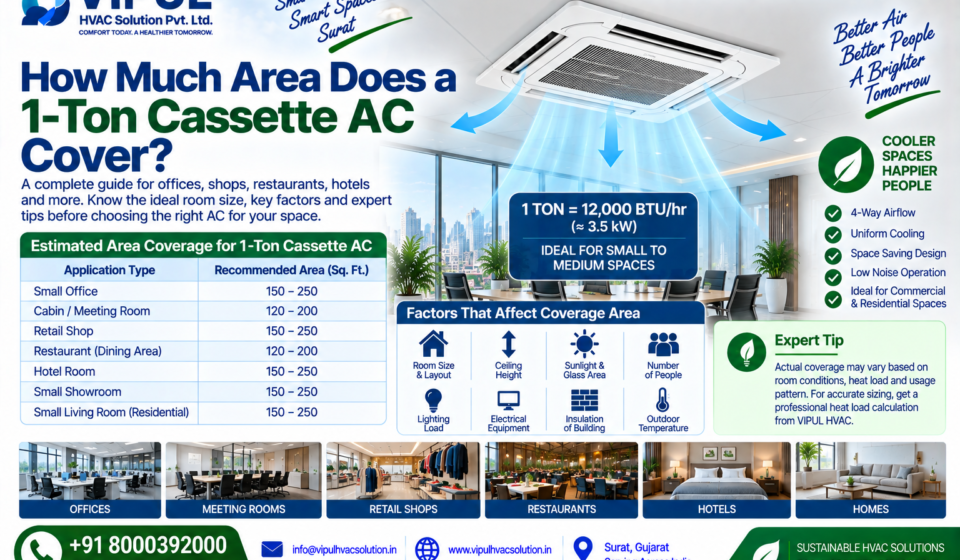
If you are searching for “how much area does a 1-ton cassette AC cover?”, a practical starting range is around 150–250 sq. ft. for many light-load spaces, but there is no universal square-foot coverage figure.
The actual area depends on the building’s heat load, ceiling height, insulation, glass/windows, sunlight, occupancy, lighting, equipment and ventilation requirements.
A 1-ton AC provides approximately 12,000 BTU/hr (about 3.5 kW) of nominal cooling capacity. Manufacturer specifications can vary by model; for example, LG’s cassette range includes units around 3.6 kW/12,300 BTU/hr.
Important: Floor area should be used only for preliminary estimation. For commercial HVAC projects, the final AC capacity should be selected after a proper cooling-load calculation.
Quick Answer: How Much Area Does a 1-Ton Cassette AC Cover?
As a preliminary planning guide:
| Application | Approx. Area |
|---|---|
| Small office | 150–250 sq. ft. |
| Cabin / meeting room | 120–200 sq. ft. |
| Retail shop | 150–250 sq. ft. |
| Restaurant dining area | 120–200 sq. ft. |
| Hotel room | 150–250 sq. ft. |
| Small showroom | 150–250 sq. ft. |
| Small residential room | 150–250 sq. ft. |
These are general planning ranges, not guaranteed coverage figures.
For example, a 200-sq.-ft. room with low heat gain may work well with 1 ton, while a 200-sq.-ft. room with large glass windows, direct sunlight and high occupancy may require more capacity.
What Is a 1-Ton Cassette AC?
A 1-ton cassette AC is a ceiling-mounted air-conditioning system with approximately:
12,000 BTU/hr cooling capacity
or approximately:
3.5 kW cooling capacity
The term “ton” refers to cooling capacity, not the physical weight of the AC.
For comparison:
| AC Capacity | Approx. Cooling Capacity |
|---|---|
| 1 Ton | 12,000 BTU/hr |
| 1.5 Ton | 18,000 BTU/hr |
| 2 Ton | 24,000 BTU/hr |
| 2.5 Ton | 30,000 BTU/hr |
| 3 Ton | 36,000 BTU/hr |
Manufacturer specifications can differ slightly from these nominal conversions. For example, LG’s cassette specifications list a 3.6 kW unit at approximately 12,300 BTU/hr.
Why Does 1 Ton Not Always Cover the Same Area?
The biggest mistake people make is assuming:
1 Ton = X square feet in every building.
That isn’t technically reliable.
Consider two rooms of exactly 200 sq. ft.
Room A — Office
- 3 people
- Few computers
- Limited glass
- Good insulation
- Moderate lighting
A 1-ton cassette may be suitable.
Room B — Showroom
- 10 people
- Large glass frontage
- Direct sunlight
- Display lighting
- Frequent door opening
The same 1-ton cassette may not provide sufficient cooling.
Therefore:
Cooling capacity should be based on heat load, not floor area alone.
VIPUL HVAC’s published AC information also states that capacity selection should consider heat load, occupancy and operating hours.
1-Ton Cassette AC Coverage by Application
1. Small Office
A 1-ton cassette can be considered for approximately:
150–250 sq. ft.
For example, a 180-sq.-ft. office with moderate occupancy and good insulation may be a suitable candidate.
However, the actual requirement depends on:
- Number of employees
- Computers
- Lighting
- Windows
- Solar exposure
- Ceiling height
- Fresh-air requirement
2. Cabin
A manager’s cabin or small executive office may require:
120–200 sq. ft.
A 1-ton cassette can provide comfortable cooling when the room’s heat load is appropriate.
For a small cabin, however, the final selection should also consider whether a wall-mounted split AC would be more practical.
3. Meeting Room
Meeting rooms can have higher cooling requirements because of occupancy.
For example:
10 people + lighting + projector + computers
can generate considerably more heat than an empty room.
A 1-ton cassette might serve approximately:
120–180 sq. ft.
depending on the building conditions.
4. Retail Shop
A small retail shop may require approximately:
150–250 sq. ft.
But shops with:
- Glass frontage
- Direct sunlight
- Frequent door opening
- Display lighting
- High customer traffic
may require a higher cooling capacity.
5. Restaurant Dining Area
A 1-ton cassette can potentially serve:
120–200 sq. ft.
of a light-to-moderate-load dining area.
However, restaurant HVAC requires special consideration because of:
- Occupancy
- Fresh air
- Kitchen heat
- Exhaust
- Make-up air
- Door opening
A cassette AC should not be considered a substitute for a properly designed kitchen exhaust system.
6. Hotel Room
For a smaller hotel room, a 1-ton cassette may be considered for approximately:
150–250 sq. ft.
The actual requirement depends on:
- Room orientation
- Windows
- Solar gain
- Occupancy
- Insulation
- Operating schedule
7. Small Showroom
A small showroom may be suitable for approximately:
150–250 sq. ft.
But glass frontage can significantly increase cooling load.
A west-facing showroom with large glass windows can require substantially more capacity than an internal room of the same size.
8. Small Residential Room
A 1-ton cassette could potentially serve approximately:
150–250 sq. ft.
depending on:
- Ceiling height
- Number of occupants
- Windows
- Sunlight
- Insulation
- Location
- Outdoor temperature
For a typical residential bedroom, however, a wall-mounted split AC may be more economical and practical than a cassette system.
1-Ton Cassette AC Coverage Example
Suppose you have an office:
15 ft × 15 ft
Area:
15 × 15 = 225 sq. ft.
If the room has:
- Normal ceiling height
- Good insulation
- Moderate occupancy
- Limited glass
- Normal lighting
- Low equipment heat
then a 1-ton cassette could potentially be considered.
But if the same 225-sq.-ft. office has extensive glass and strong afternoon sunlight, the required capacity could be higher.
Can a 1-Ton Cassette AC Cool 300 Sq. Ft.?
It may be possible under low-load conditions, but 300 sq. ft. should not automatically be treated as the coverage limit or recommendation.
For example, a well-insulated internal office may have a much lower heat load than a heavily glazed retail space.
Therefore:
Do not select a 1-ton cassette solely because the room is 300 sq. ft.
Calculate the actual cooling requirement first.
Can a 1-Ton Cassette AC Cover 100 Sq. Ft.?
Yes, from a cooling-capacity perspective, a 1-ton unit can potentially serve a 100-sq.-ft. room.
But that does not mean a 1-ton cassette is necessarily the most appropriate choice.
If the actual cooling load is significantly lower, a smaller system may be more suitable.
Oversizing can affect:
- Initial equipment cost
- Cycling behaviour
- Energy consumption
- Humidity control
- Comfort
Equipment should therefore be selected according to the actual application.
Factors That Affect 1-Ton Cassette AC Coverage
1. Room Size
Floor area is an important input, but it is only one part of the calculation.
2. Ceiling Height
A room with an 8-ft ceiling and one with a 14-ft ceiling can have significantly different volumes and air-distribution requirements.
3. Number of People
More occupants generally mean more internal heat.
A conference room with 15 people can have a much higher cooling requirement than a private office with two people.
4. Glass Area
Large windows increase solar heat gain.
Particularly important are:
- West-facing windows
- South-facing windows
- Floor-to-ceiling glass
- Unshaded windows
5. Lighting
Lighting contributes to the internal heat load.
Retail stores and showrooms with extensive display lighting may therefore require additional cooling capacity.
6. Electrical Equipment
Computers, monitors, printers, displays and other equipment generate heat.
A technology-heavy office can require more cooling than a low-equipment workspace of the same size.
7. Outdoor Temperature
Higher outdoor temperatures can increase the cooling requirement.
8. Building Insulation
Better insulation can reduce heat transfer through the building envelope.
Poor insulation can increase cooling demand.
9. Door Opening
Retail stores and restaurants can experience additional heat gain and air infiltration because doors are frequently opened.
10. Fresh-Air Requirement
Outdoor air entering the building may need to be cooled and dehumidified.
This can add to the HVAC load.
1-Ton Cassette AC Airflow
Cooling capacity alone does not determine comfort.
Air distribution is also important.
A cassette AC is ceiling-mounted and commonly uses multi-directional airflow to distribute conditioned air across a room.
When selecting a cassette AC, evaluate:
- Cooling capacity
- Airflow
- Air throw
- Ceiling height
- Air-distribution pattern
- Indoor-unit position
- Noise
- Controls
LG’s cassette documentation shows different airflow and capacity configurations across its cassette range.
Benefits of a 1-Ton Cassette AC
1. Ceiling-Mounted Design
It frees up wall space.
2. Multi-Directional Airflow
Many cassette designs distribute air in multiple directions.
3. Uniform Cooling
Proper positioning can help distribute cooling throughout the occupied zone.
4. Better Interior Appearance
The indoor unit can integrate with a false-ceiling design.
5. Suitable for Commercial Spaces
Cassette systems can be useful for:
- Offices
- Shops
- Clinics
- Restaurants
- Small showrooms
- Meeting rooms
VIPUL HVAC describes cassette systems as suitable for commercial and residential spaces and emphasizes flexible installation and uniform cooling.
1-Ton Cassette AC vs 1-Ton Split AC
| Feature | 1-Ton Cassette | 1-Ton Wall Split |
|---|---|---|
| Installation | Ceiling | Wall |
| Air distribution | Multi-directional on many models | Primarily front-facing |
| Wall space | Minimal | Required |
| False ceiling | Usually required | Not required |
| Commercial appearance | Excellent | Standard |
| Small office | Suitable | Suitable |
| Retail | Suitable | Suitable |
| Residential bedroom | Possible | Often simpler |
| Installation complexity | Higher | Lower |
The choice depends on the architecture, budget and intended application.
How Many 1-Ton Cassette ACs Do You Need?
Suppose you have:
600 sq. ft. office
A simple area calculation might suggest:
600 ÷ 200 = 3 units
But this is only a preliminary estimate.
The actual design could require:
- 2 × 1.5-ton units
- 3 × 1-ton units
- 2 × 2-ton units
- Another combination
depending on the cooling load and room layout.
A professional HVAC design should determine the final arrangement.
1-Ton Cassette AC for Commercial Projects
For commercial buildings, HVAC design should consider:
Comfort
Temperature and humidity.
Air Distribution
Correct airflow throughout occupied areas.
Ventilation
Required outdoor-air supply.
Energy Efficiency
Equipment efficiency and operating schedule.
Controls
Individual or centralized control.
Maintenance
Access to filters, coils, fans and other components.
VIPUL HVAC provides HVAC design, equipment selection, installation, testing, commissioning and AMC services for residential, commercial and industrial requirements.
Does VIPUL HVAC Supply 1-Ton Cassette AC?
There is an important distinction here.
VIPUL’s current published cassette AC capacity range is 1.5 TR to 4.0 TR, while its listed wall-mounted split AC range starts at 1.0 TR.
Therefore, if you specifically require a 1-ton cassette AC, confirm current model availability and approved-brand options directly with VIPUL rather than assuming that every 1-ton cassette model is stocked.
VIPUL can support capacity selection, equipment supply, refrigerant piping, drainage, installation, testing, commissioning and AMC as part of its HVAC services.
How to Select the Correct Cassette AC Capacity
Use this process:
Step 1 — Measure the Room
Record:
- Length
- Width
- Height
Step 2 — Identify Occupancy
How many people normally use the room?
Step 3 — Check Windows
Measure:
- Glass area
- Orientation
- Sun exposure
Step 4 — Calculate Equipment Load
Consider:
- Computers
- Displays
- Machinery
- Lighting
Step 5 — Check Ventilation
Determine fresh-air requirements.
Step 6 — Calculate Cooling Load
Use a proper HVAC methodology.
Step 7 — Select Equipment
Choose the appropriate:
- Capacity
- Airflow
- Indoor-unit type
- Efficiency
- Controls
Common Mistakes When Choosing a 1-Ton Cassette AC
1. Choosing by square feet only
Room area does not tell the complete story.
2. Ignoring sunlight
Solar heat gain can be significant.
3. Ignoring occupancy
People add sensible and latent heat.
4. Ignoring ceiling height
Air distribution can be affected.
5. Ignoring fresh air
Ventilation adds cooling load.
6. Buying the cheapest model
Compare efficiency, warranty, installation and service.
7. Not planning maintenance access
The cassette must remain accessible for servicing.
Frequently Asked Questions
How much area does a 1-ton cassette AC cover?
As a preliminary guide, approximately 150–250 sq. ft. can be considered for many light-load spaces. Actual coverage depends on heat load and building conditions.
Can a 1-ton cassette AC cover 200 sq. ft.?
Yes, a 200-sq.-ft. room may be suitable for a 1-ton cassette if its cooling load is appropriate.
Can a 1-ton cassette AC cover 300 sq. ft.?
It can under some low-load conditions, but 300 sq. ft. should not automatically be considered suitable. A heat-load calculation is recommended.
What is the BTU capacity of a 1-ton cassette AC?
Approximately 12,000 BTU/hr, or around 3.5 kW of cooling. Actual manufacturer ratings may vary slightly; LG, for example, lists a cassette model at 3.6 kW / 12,300 BTU/hr.
Is a 1-ton cassette AC suitable for an office?
Yes, it can be suitable for a small office or cabin when the calculated cooling load is within the unit’s capacity.
Is a 1-ton cassette AC suitable for a restaurant?
It may be suitable for a small dining area, but kitchen exhaust, fresh air and cooking heat require separate HVAC consideration.
Is a cassette AC better than a split AC?
Neither is universally better. Cassette ACs can provide ceiling-mounted, multi-directional air distribution, while wall-mounted splits are often simpler for smaller rooms.
Does a 1-ton cassette AC consume less electricity than a 1-ton split AC?
Not necessarily. Electricity consumption depends on the specific model’s efficiency, operating conditions, controls and actual cooling load.
How many 1-ton cassette ACs are required for 1,000 sq. ft.?
There is no fixed answer. The number should be determined through cooling-load calculation and zoning rather than simply dividing 1,000 sq. ft. by an assumed coverage figure.
Does VIPUL HVAC provide cassette AC installation?
Yes. VIPUL’s published cassette AC service includes system design/capacity selection, equipment supply, refrigerant piping and drainage, electrical/control wiring, installation, testing, commissioning and AMC.
Why Choose VIPUL HVAC SOLUTION PVT. LTD.?
VIPUL HVAC SOLUTION PVT. LTD. is a Surat-based HVAC company providing residential, commercial and industrial HVAC solutions.
Its current portfolio includes:
- Split AC
- Cassette AC
- Floor-standing AC
- VRF/VRV
- Chillers
- AHUs
- Ducted & package AC
- Ventilation
- Precision air conditioning
- BMS & HVAC automation
- HVAC maintenance and AMC
VIPUL’s published cassette AC service emphasizes system design and capacity selection, followed by equipment supply, piping, installation, testing and commissioning.
The company currently lists 26+ years of HVAC experience and serves Surat, Gujarat and nearby regions.
VIPUL HVAC Selection Process
Site Survey
↓
Heat-Load Assessment
↓
Capacity Selection
↓
Equipment Selection
↓
Piping & Drainage Design
↓
Installation
↓
Testing & Commissioning
↓
AMC & After-Sales Support
Conclusion
So, how much area does a 1-ton cassette AC cover?
For preliminary planning, approximately 150–250 sq. ft. is a reasonable range for many light-to-moderate-load spaces. However, this should not be treated as a universal rule.
A 1-ton AC provides approximately 12,000 BTU/hr or 3.5 kW of nominal cooling, while actual room coverage depends on:
Room Size + Ceiling Height + Occupancy + Glass Area + Sunlight + Insulation + Equipment + Ventilation + Outdoor Conditions
The correct approach is:
Measure → Calculate Heat Load → Select Capacity → Select Cassette → Install → Commission
For commercial projects, professional HVAC design is especially important because incorrect sizing can affect comfort, energy consumption and equipment performance.
VIPUL HVAC SOLUTION PVT. LTD. provides HVAC design, capacity selection, equipment supply, installation, testing, commissioning and maintenance support. Its current published cassette range is 1.5 TR–4 TR, so customers specifically seeking a 1-ton cassette should confirm current availability directly.
Need Help Selecting the Right AC Capacity?
VIPUL HVAC SOLUTION PVT. LTD.
📞 +91 8000392000
📧 info@vipulhvacsolution.in
📍 Surat, Gujarat
Important Links:
- 1 ton cassette AC coverage area
- 1 ton cassette AC room size
- 1 ton cassette AC coverage in sq ft
- 1 ton cassette AC area
- 1 ton AC coverage area
- 1 ton cassette AC for office
- 1 ton cassette AC for showroom
- 1 ton cassette AC for shop
- 1 ton cassette AC for restaurant
- 1 ton cassette AC for commercial space
- 1 TR cassette AC coverage
- 12000 BTU cassette AC coverage
- 1 ton cassette AC capacity
- cassette AC coverage calculator
- 1 ton AC room size

[…] How Much Area Does a 1-Ton Cassette AC Cover? […]