

Table of Contents
ToggleWhat Is BMS in HVAC System? Complete Guide to Building Management Systems
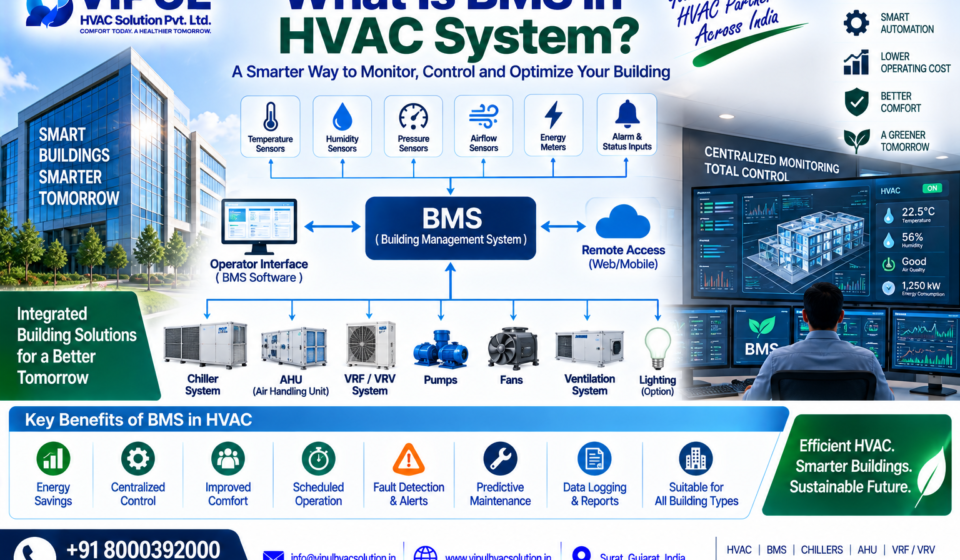
What is BMS in HVAC system? A Building Management System (BMS) is a centralized digital system used to monitor, control, schedule and optimize HVAC equipment such as chillers, AHUs, VRF/VRV systems, pumps, fans and other building services.
In an HVAC application, BMS collects information from temperature, humidity, pressure, airflow, energy and equipment-status sensors, processes that information through controllers, and allows operators to monitor or control equipment from a centralized interface. ASHRAE describes building automation/control systems as systems that can monitor sensors, control equipment, schedule operation, report alarms, monitor energy use and trend operating data.
For modern commercial, industrial, hospital, pharmaceutical, hotel and institutional buildings, BMS can provide a single platform for better HVAC visibility, automation and operational management.
Quick Answer: What Is BMS in HVAC System?
BMS in HVAC is a computerized building management system that monitors and controls HVAC equipment using sensors, controllers, communication networks and software.
A typical HVAC BMS can monitor:
- Temperature
- Humidity
- Pressure
- Airflow
- Chiller status
- AHU status
- Fan operation
- Pump operation
- VRF/VRV systems
- Energy consumption
- Equipment alarms
- Operating schedules
Depending on the project design, the BMS can also automatically adjust equipment operation according to programmed control sequences and building requirements. ASHRAE notes that automatic HVAC controls can regulate variables such as temperature, humidity, pressure and air/water flow and can sequence equipment to meet load requirements.
What Does BMS Stand For?
BMS = Building Management System
It is also commonly discussed alongside terms such as:
- BAS — Building Automation System
- Building Automation and Control System
- HVAC Automation System
- Building Energy Management System
- Facility Management System
The terminology can vary by project and industry. ASHRAE uses BAS for computerized building automation and control, while BMS is widely used for the supervisory management layer that provides monitoring, control and information management.
How Does BMS Work in HVAC?
A BMS generally works through four major levels:
1. Sensors
Sensors measure actual operating conditions.
Examples include:
- Temperature sensors
- Humidity sensors
- CO₂ sensors
- Pressure sensors
- Differential-pressure sensors
- Airflow sensors
- Water-flow sensors
- Energy meters
- Equipment status signals
2. Controllers
Controllers receive information from sensors and execute programmed control logic.
For example:
If room temperature rises above the programmed setpoint, the control system can adjust the HVAC equipment according to the programmed sequence.
Modern digital controls can operate through Direct Digital Control (DDC). ASHRAE explains that DDC controllers receive inputs, execute control algorithms and position output devices accordingly.
3. Communication Network
Controllers and equipment exchange information through communication networks.
Depending on the equipment and project design, protocols such as BACnet may be used. ASHRAE identifies BACnet as ASHRAE Standard 135, a building automation and control networking protocol.
4. BMS Software / Operator Interface
The collected information is displayed through software or a graphical user interface.
Facility operators can see:
- Equipment status
- Temperature
- Alarms
- Energy consumption
- Operating schedules
- Trends
- Fault conditions
- System performance
Simple BMS HVAC Diagram
A simplified BMS architecture looks like this:
Sensors → DDC Controllers → Communication Network → BMS Server/Software → Operator
At the equipment level:
- BMS
- Chiller / VRF / AHU / FCU / Pumps / Fans
- Sensors + Actuators
- Temperature / Pressure / Flow / Humidity / Equipment Status
The BMS uses this information to monitor and, where configured, control HVAC operation.
Main Components of a BMS HVAC System
1. Temperature Sensors
Temperature sensors measure indoor or equipment-related temperatures.
They may be installed in:
- Rooms
- Supply-air ducts
- Return-air ducts
- Chilled-water lines
- Condenser-water systems
- AHUs
- Other HVAC equipment
2. Humidity Sensors
Humidity monitoring can be particularly important in:
- Hospitals
- Pharmaceutical facilities
- Cleanrooms
- Data centers
- Museums
- Laboratories
- Manufacturing facilities
BMS can display humidity conditions and execute programmed control sequences where humidity-control equipment is connected.
3. Pressure Sensors
Pressure sensors can monitor:
- Duct static pressure
- Filter differential pressure
- Room pressure
- Cleanroom pressure
- Chilled-water pressure
- Differential pressure between zones
This is particularly useful where pressure relationships are important.
4. Airflow Sensors
Airflow measurement can help operators understand whether ventilation and air-distribution systems are operating according to the design requirements.
5. DDC Controllers
DDC controllers are an important part of modern HVAC automation.
They receive sensor inputs, process programmed logic and send commands to controlled equipment.
6. Actuators
Actuators can operate devices such as:
- Control valves
- Dampers
- Air-handling components
- Other modulating control devices
7. Energy Meters
Energy meters can provide information about electrical consumption and, depending on the system architecture, energy use associated with HVAC equipment.
VIPUL’s BMS offering specifically includes energy consumption tracking as part of its HVAC automation capabilities.
8. BMS Software
The software provides the operator interface.
A graphical interface may display:
- Floor plans
- HVAC equipment
- Temperatures
- Equipment status
- Alarms
- Trends
- Energy data
- Schedules
What HVAC Equipment Can Be Connected to BMS?
A properly engineered BMS can integrate with many HVAC systems.
1. Chiller Systems
BMS can monitor and, where supported by the equipment and control strategy:
- Chiller operating status
- Supply-water temperature
- Return-water temperature
- Chilled-water pumps
- Condenser-water systems
- Alarms
- Energy information
- Operating schedules
VIPUL’s current BMS solution specifically lists integration with chillers.
2. AHU — Air Handling Unit
BMS can monitor and control selected AHU functions such as:
- Supply-air temperature
- Return-air temperature
- Fan status
- Filter status
- Damper position
- Valve position
- Humidity
- Airflow
- Alarms
VIPUL provides BMS integration with AHUs as part of its HVAC automation capabilities.
3. VRF / VRV Systems
Depending on manufacturer compatibility and communication architecture, VRF/VRV systems can be integrated with centralized building controls.
Potential monitoring includes:
- Indoor-unit status
- Outdoor-unit status
- Temperature
- Setpoints
- Fault alarms
- Operating schedules
- Energy information
VIPUL specifically lists VRF integration under its BMS and HVAC automation offering.
4. Pumps
BMS can monitor and control appropriate HVAC pumps, including:
- Chilled-water pumps
- Condenser-water pumps
- Secondary pumps
Variable-speed operation can also be incorporated where the equipment and control design support it.
5. Fans
Depending on the system:
- Supply fans
- Return fans
- Exhaust fans
- Fresh-air fans
- Pressurization fans
can be connected to the automation system.
What Does BMS Control in HVAC?
A BMS does not simply display temperature.
A properly engineered control system can coordinate multiple HVAC functions.
Typical functions include:
| BMS Function | Example |
|---|---|
| Temperature monitoring | Room/supply-air temperature |
| Humidity monitoring | RH monitoring |
| Equipment control | Start/stop |
| Fan control | Speed or operation |
| Pump control | Start/stop/speed |
| Valve control | Modulation |
| Damper control | Fresh/return-air control |
| Scheduling | Operating hours |
| Alarm management | Fault notification |
| Energy monitoring | Electrical consumption |
| Trend logging | Historical data |
| Remote monitoring | Centralized access |
| Equipment integration | Chiller/AHU/VRF |
The exact functions depend on the equipment, controls architecture, communication protocol, point list and sequence of operation.
BMS vs HVAC Automation
These terms are related but are not always identical.
HVAC Automation
HVAC automation generally refers to the automatic control of HVAC equipment.
For example:
Automatically controlling an AHU fan, chilled-water valve and temperature setpoint.
BMS
BMS provides a higher-level platform for monitoring, supervision, alarms, scheduling, data visualization and coordination of building systems.
A BMS can therefore include HVAC automation as one of its major functions.
ASHRAE describes BAS as a centralized monitoring/control system that can connect information from different control systems and devices.
What Are the Benefits of BMS in HVAC?
1. Centralized HVAC Monitoring
Instead of checking multiple pieces of equipment individually, operators can view connected systems through a centralized interface.
2. Better Operational Visibility
A BMS can show equipment status and operating conditions in real time or near real time, depending on system design.
3. Energy Monitoring
Energy information can help facility teams understand how HVAC systems are operating and identify opportunities for optimization.
ASHRAE identifies energy-use monitoring and control as important functions of building automation systems.
4. Automatic Scheduling
HVAC equipment can be scheduled according to:
- Working hours
- Occupancy
- Building zones
- Weekdays
- Weekends
- Holidays
- Process requirements
This can prevent equipment from operating unnecessarily.
5. Alarm and Fault Detection
BMS can display alarms generated by connected HVAC equipment and control systems.
Examples:
- High temperature
- Low temperature
- Fan failure
- Pump failure
- Filter alarm
- High pressure
- Low pressure
- Communication failure
6. Improved Comfort Control
By monitoring temperature and other environmental variables, automation can help maintain programmed indoor conditions.
7. Preventive Maintenance Support
Historical trends and alarm information can help facility teams identify recurring problems and plan maintenance.
However, BMS should support maintenance—not replace physical inspection and professional servicing.
8. Remote Monitoring
Depending on the system architecture and cybersecurity provisions, BMS platforms can provide remote access to HVAC information.
VIPUL’s current BMS offering includes remote access capability.
Can BMS Reduce HVAC Energy Consumption?
Yes, BMS can help reduce unnecessary HVAC energy consumption, but the actual savings depend on system design, equipment efficiency, operating schedules, control sequences, building use and commissioning.
For example, automation can help:
- Avoid unnecessary operating hours
- Adjust setpoints
- Coordinate equipment
- Control fans and pumps
- Monitor energy use
- Identify abnormal operation
- Apply load-based sequences
- Coordinate multiple HVAC systems
It is important not to treat BMS as a guarantee of a specific percentage of energy savings.
ASHRAE also notes that automatic controls are most effective when applied to properly designed mechanical systems; controls cannot compensate for fundamental mechanical-system problems such as inappropriate system selection or excessive oversizing.
BMS for Chiller Plants
BMS becomes particularly useful in large chilled-water systems.
A typical arrangement may include:
- Chiller
- Primary/Secondary Pumps
- Chilled-Water Network
- AHUs + FCUs
- Building Zones
The BMS can collect information from these systems and provide centralized monitoring.
Depending on the project, control sequences may include:
- Chiller start/stop
- Pump sequencing
- Temperature monitoring
- Differential-pressure monitoring
- Equipment alarms
- Scheduling
- Energy monitoring
- Lead/lag operation
- Setpoint management
Actual sequences should be engineered for the specific chiller plant.
BMS for AHU Systems
For AHUs, BMS integration can provide centralized visibility into:
- Supply-air temperature
- Return-air temperature
- Outdoor-air temperature
- Humidity
- Fan status
- Filter condition
- Damper position
- Cooling-valve position
- Heating-valve position
- Static pressure
- Alarm conditions
This can be particularly valuable in buildings with multiple AHUs.
BMS for VRF Systems
VRF systems can contain many indoor units distributed throughout a building.
BMS integration can provide a centralized view of connected VRF equipment, depending on the manufacturer’s gateway and communication architecture.
This may include:
- Unit status
- Temperature
- Setpoint
- Operating mode
- Fault status
- Scheduling
- Energy information
Integration requirements should be confirmed with the selected VRF manufacturer before project execution.
BMS in Hospitals
Hospitals often require close monitoring of HVAC conditions.
BMS may be used to monitor:
- Temperature
- Humidity
- Room pressure
- AHUs
- Fans
- Chillers
- Filters
- Alarms
- Operating schedules
Critical areas such as operating rooms and isolation areas may have specialized control requirements.
BMS should be designed around the project’s clinical, HVAC, infection-control and regulatory requirements rather than treated as a generic automation package.
BMS in Pharmaceutical Industry
Pharmaceutical facilities can require controlled:
- Temperature
- Relative humidity
- Pressure differentials
- Air changes
- Filtration
- Equipment operation
BMS can provide monitoring, alarms, trend logging and control integration for appropriate HVAC systems.
For GMP-related environments, the BMS architecture, validation requirements, data integrity and documentation should be established during project design.
BMS in Data Centers
Data centers require continuous environmental and equipment monitoring.
BMS can potentially monitor:
- Room temperature
- Humidity
- Precision cooling units
- Chillers
- Pumps
- Fans
- Alarms
- Energy consumption
For critical facilities, BMS should be coordinated with the data-center infrastructure, electrical systems and dedicated monitoring platforms.
BMS in Hotels
Hotels have multiple zones with different occupancy patterns.
BMS can support:
- Guest-room HVAC monitoring
- Common-area HVAC
- AHUs
- Chillers
- Pumps
- Ventilation
- Scheduling
- Energy monitoring
- Alarm management
VIPUL’s hotel ventilation content also identifies BMS applications such as fan start/stop, temperature and humidity monitoring, CO₂ monitoring, filter status, fault alarms and schedule-based operation.
BMS in Commercial Buildings
For offices, malls and commercial buildings, BMS can coordinate:
- Central HVAC
- VRF systems
- AHUs
- Chillers
- Pumps
- Ventilation
- Fans
- Energy meters
- HVAC schedules
The major advantage is centralized visibility across multiple zones and equipment systems.
BMS Communication Protocols
Modern HVAC automation depends heavily on communication between equipment and controllers.
One important open protocol is:
BACnet
BACnet is a building automation and control communication protocol standardized as ASHRAE Standard 135.
Depending on the equipment and project, other communication technologies may also be encountered.
Before selecting a BMS, the project team should verify:
- Equipment compatibility
- Communication protocol
- Gateway requirements
- Required data points
- Control points
- Integration responsibility
- Network architecture
- Cybersecurity requirements
- Future expansion requirements
What Is a BMS Point?
A BMS point is an individual piece of information or control signal handled by the automation system.
Examples:
Digital Input
- Fan ON/OFF status
- Pump running status
- Fault status
Digital Output
- Fan start/stop command
- Pump start/stop command
Analog Input
- Temperature
- Pressure
- Humidity
- Flow
Analog Output
- Valve modulation
- Damper modulation
- Fan-speed control
The total number of points can significantly affect the complexity and cost of a BMS project.
How Much Does a BMS HVAC System Cost?
There is no single BMS price because the project scope varies considerably.
Cost can depend on:
- Number of HVAC systems
- Number of AHUs
- Number of chillers
- Number of VRF units
- Number of sensors
- Number of control points
- DDC controllers
- Communication gateways
- BMS software
- Server requirements
- Operator workstations
- Networking
- Panel fabrication
- Installation
- Programming
- Testing and commissioning
- Integration with existing equipment
- Cybersecurity requirements
- Future expansion
Therefore, a professional BMS quotation should be based on a point list, equipment list, control philosophy and sequence of operation, rather than only the building’s square footage.
BMS Design Process for HVAC Projects
A professional BMS project generally follows a structured process.
Step 1 — Understand the HVAC System
Review:
- Chillers
- AHUs
- FCUs
- VRF
- Pumps
- Fans
- Ventilation
- Controls
Step 2 — Prepare the Point List
Identify every monitoring and control point.
Step 3 — Develop Control Philosophy
Define how the system should operate.
Step 4 — Select Sensors and Controllers
Select appropriate field devices and DDC controllers.
Step 5 — Define Communication Architecture
Determine how equipment and controllers communicate.
Step 6 — Develop Graphics
Create HVAC equipment screens and dashboards.
Step 7 — Program Control Logic
Develop the required sequences.
Step 8 — Installation
Install sensors, panels, wiring and communication infrastructure.
Step 9 — Integration
Connect compatible HVAC equipment.
Step 10 — Testing and Commissioning
Verify:
- Sensors
- Controllers
- Equipment commands
- Alarms
- Communication
- Control sequences
- Trends
- Graphics
Step 11 — Training
Train facility operators on the BMS interface and operating procedures.
Common BMS Mistakes to Avoid
1. Designing BMS After HVAC Design
BMS requirements should be considered during HVAC design rather than added as an afterthought.
2. Incomplete Point List
Missing points can create monitoring and control limitations.
3. Poor Sensor Location
Incorrect sensor placement can result in misleading data and poor control.
4. No Clear Sequence of Operation
The system needs clearly defined control logic.
5. Ignoring Equipment Compatibility
Not every HVAC system exposes the same data or control capabilities.
6. Poor Commissioning
A BMS may be installed physically but still perform poorly if control sequences and sensors are not properly commissioned.
7. No Future Expansion Planning
A commercial building may require additional HVAC equipment later.
8. Treating BMS as a Substitute for HVAC Engineering
BMS cannot correct fundamental problems caused by poor load calculations, incorrect equipment selection, inadequate ductwork or improper hydraulic design.
ASHRAE explicitly notes that automatic controls cannot compensate for poorly designed mechanical systems.
BMS vs Traditional HVAC Control
| Feature | Traditional Local Control | BMS |
|---|---|---|
| Local temperature control | Yes | Yes |
| Centralized monitoring | Limited | Yes |
| Multiple equipment integration | Limited | Yes |
| Alarm monitoring | Basic/limited | Advanced |
| Energy monitoring | Limited | Yes |
| Scheduling | Basic | Advanced |
| Historical trends | Limited | Yes |
| Remote monitoring | Usually limited | Possible |
| Chiller integration | Limited | Yes |
| AHU integration | Possible | Yes |
| VRF integration | Manufacturer-dependent | Possible |
| Central dashboard | No/limited | Yes |
The actual capabilities depend on the selected controls architecture and connected equipment.
Why Choose VIPUL HVAC Solution for BMS & HVAC Automation?
VIPUL HVAC Solution Pvt. Ltd. provides HVAC-focused BMS and automation solutions for commercial, industrial and institutional applications.
According to VIPUL’s current BMS service page, its capabilities include:
- HVAC monitoring and control
- Energy consumption tracking
- Alarm and fault detection
- Remote access capability
- VRF integration
- Chiller integration
- AHU integration
- Control logic development
- Sensor and controller integration
- Testing and training
- System optimization
VIPUL can coordinate BMS with HVAC equipment such as VRF systems, chillers and AHUs, helping create a more centralized approach to HVAC monitoring and control.
For a project-specific solution, the BMS design should be developed from the HVAC equipment schedule, point list, sequence of operation and integration requirements.
Frequently Asked Questions About BMS in HVAC
1. What is BMS in HVAC?
BMS stands for Building Management System. In HVAC, it is used to monitor, control, schedule and manage connected HVAC equipment through sensors, controllers, communication networks and software.
2. What does BMS control?
Depending on the design, BMS can control or monitor chillers, AHUs, VRF systems, pumps, fans, valves, dampers, temperatures, humidity, pressure and energy-related data.
3. What is the difference between BMS and BAS?
BMS and BAS are closely related terms. BAS commonly refers to building automation and control, while BMS is frequently used for the broader management and supervisory platform.
4. Can BMS control a chiller?
Yes. A properly engineered BMS can integrate with compatible chiller systems for monitoring and selected control functions.
5. Can BMS control AHU?
Yes. AHUs are commonly integrated with building automation systems for temperature, fan, damper, valve, alarm and other control functions.
6. Can BMS integrate with VRF?
Yes, where the VRF manufacturer provides compatible communication and integration capabilities.
7. Does BMS save electricity?
BMS can help reduce unnecessary energy use through scheduling, monitoring, equipment coordination and optimized control. Actual savings depend on the HVAC system, building operation and control strategy.
8. Is BMS necessary for every building?
No. The requirement depends on building size, HVAC complexity, operational requirements, energy-management objectives and project specifications.
9. Is BMS useful for a chiller plant?
Yes. Chiller plants often have multiple chillers, pumps, valves and sensors, making centralized monitoring and control useful.
10. What is DDC in BMS?
DDC means Direct Digital Control. DDC controllers digitally process sensor inputs and execute programmed control logic for HVAC equipment.
11. What is BACnet in BMS?
BACnet is a building automation communication protocol standardized under ASHRAE Standard 135.
12. Can BMS provide remote access?
Yes, depending on the system architecture, network and cybersecurity configuration. VIPUL’s current BMS offering includes remote access capability.
Conclusion
BMS in an HVAC system is a centralized automation and monitoring platform that connects sensors, controllers, HVAC equipment and software to provide better visibility and control of building climate systems.
It can be used with chillers, AHUs, VRF/VRV systems, pumps, fans and ventilation equipment, depending on equipment compatibility and project requirements.
For larger commercial, industrial, healthcare, pharmaceutical, hotel and institutional facilities, BMS can support:
Monitoring + Automation + Scheduling + Alarm Management + Energy Tracking + HVAC Coordination
However, effective BMS performance starts with good HVAC engineering. Proper load calculation, equipment selection, ductwork, piping, controls design and commissioning remain essential.
For BMS and HVAC automation solutions, VIPUL HVAC Solution Pvt. Ltd. provides HVAC-focused integration covering monitoring, control, energy tracking, alarms, remote access and integration with VRF systems, chillers and AHUs.
For BMS & HVAC Automation Consultation:
📞 +91 8000392000
📧 info@vipulhvacsolution.in
🌐 vipulhvacsolution.in
Important Links for VIPUL HVAC

Vipul HVAC House
At Vipul hvac solution pvt.ltd., we take great pride in delivering high-quality HVAC solutions that ensure comfort and efficiency in both residential and commercial spaces. As a trusted HVAC of reliable, energy-efficient systems, and we are dedicated to providing you with the best products and services to meet your needs
Other Articles

[…] What Is BMS in HVAC System? […]
[…] What Is BMS in HVAC System? […]