
Chiller Troubleshooting: Complete Guide to Common Problems, Causes & Solutions
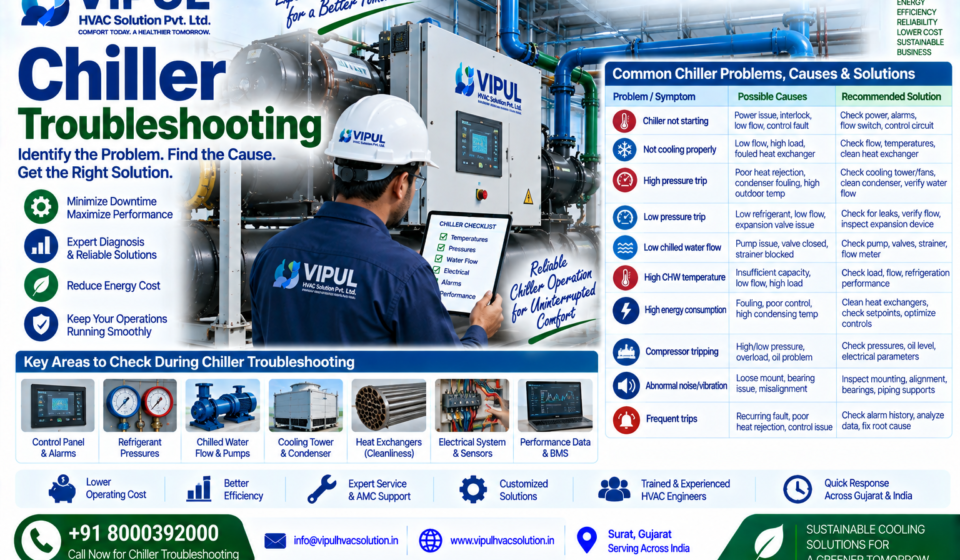
Chiller troubleshooting is the systematic process of identifying why a chiller is not starting, not cooling properly, consuming excessive energy, tripping frequently or showing abnormal pressure, temperature, flow or electrical readings.
A chiller problem should not be diagnosed by simply resetting an alarm. The correct approach is to identify the symptom, operating condition, alarm, pressure, temperature, water flow, electrical parameters and equipment history, then determine the underlying cause.
Manufacturer troubleshooting documentation commonly identifies issues involving heat-exchanger fouling, fluid circuits, electrical components, refrigerant conditions, water flow, condenser performance and control systems.
For commercial and industrial facilities, VIPUL HVAC SOLUTION PVT. LTD. provides chiller maintenance, fault diagnosis, repair, performance monitoring, optimization and AMC support.
What Is Chiller Troubleshooting?
Chiller troubleshooting is the process of finding the root cause of a chiller’s abnormal operation.
Typical symptoms include:
- Chiller not starting
- Chiller not cooling
- High-pressure trip
- Low-pressure trip
- Low chilled-water flow
- High chilled-water temperature
- High energy consumption
- Compressor trip
- Frequent cycling
- High condenser temperature
- Abnormal noise
- Excessive vibration
- Refrigerant leakage
- Pump failure
- Cooling-tower problems
- Sensor or control faults
- BMS communication problems
The important principle is:
Alarm = symptom; root cause = problem that needs to be identified.
A repeated alarm reset without finding the underlying cause can allow the original fault to continue.
How Does Chiller Troubleshooting Work?
A professional troubleshooting sequence can be:
Alarm / Complaint
↓
Check Operating Data
↓
Identify Symptom
↓
Check Water Flow
↓
Check Temperatures
↓
Check Refrigeration Circuit
↓
Check Electrical System
↓
Check Controls & Sensors
↓
Identify Root Cause
↓
Corrective Action
↓
Test Chiller
↓
Monitor Performance
This approach is more reliable than changing components based only on an alarm code.
10 Common Chiller Problems & Troubleshooting
1. Chiller Is Not Starting
One of the first questions during troubleshooting is whether the chiller is receiving the required electrical and control signal.
Possible causes
- Main power unavailable
- Circuit breaker tripped
- Control-power failure
- Emergency stop activated
- Safety interlock open
- Flow switch not satisfied
- High-pressure safety active
- Low-pressure safety active
- Compressor protection active
- Sensor fault
- Controller fault
- BMS start command unavailable
Manufacturer troubleshooting tables commonly list loss of power, control-power problems, safety switches, compressor protection and high-pressure protection among possible reasons for a unit that does not start.
Troubleshooting
Check:
- Main electrical supply
- Control voltage
- Circuit breakers
- Alarm history
- Safety interlocks
- Chilled-water flow
- Pump operation
- Controller status
- BMS command
- Manufacturer-specific fault code
Do not bypass a safety device simply to force the chiller to run.
2. Chiller Is Running but Not Cooling Properly
This is one of the most common chiller complaints.
Possible causes
- Insufficient chilled-water flow
- High entering-water temperature
- Fouled evaporator
- Refrigeration-system problem
- Incorrect setpoint
- Compressor performance problem
- Expansion-device problem
- Sensor error
- Excessive building/process load
- Air in the water circuit
- Poor heat transfer
Carrier troubleshooting documentation identifies insufficient water flow, incorrect operating conditions, exchanger fouling and refrigeration-system issues among potential causes of abnormal chiller performance.
What should be checked?
Measure:
- Chilled-water supply temperature
- Chilled-water return temperature
- ΔT
- Water flow
- Evaporator pressure
- Refrigerant temperatures
- Compressor current
- Operating hours
- Alarm history
3. High-Pressure Chiller Trip
A high-pressure alarm generally means the refrigeration system is experiencing excessive condensing pressure.
The actual cause depends on the chiller type.
Water-Cooled Chiller
Potential causes include:
- High condenser-water temperature
- Low condenser-water flow
- Fouled condenser tubes
- Cooling-tower problem
- Condenser-water pump problem
- Water-treatment issues
- Incorrect control settings
Air-Cooled Chiller
Potential causes can include:
- Dirty condenser coils
- Restricted airflow
- Condenser-fan failure
- Incorrect fan rotation
- High outdoor temperature
- Air recirculation
- Refrigerant overcharge or other refrigeration faults
Manufacturer troubleshooting information lists dirty condensers, inadequate heat rejection, fan problems and refrigerant-related conditions among possible causes of high pressure.
Troubleshooting Sequence
High Pressure Alarm
→ Check condenser temperature
→ Check condenser airflow/water flow
→ Check condenser cleanliness
→ Check fans/pumps
→ Check cooling tower if applicable
→ Check refrigerant circuit
→ Check controls
4. Low-Pressure Chiller Trip
A low-pressure condition can have several possible causes.
Possible causes
- Low refrigerant charge
- Refrigerant leakage
- Insufficient chilled-water flow
- Low load
- Restricted filter/drier
- Expansion-valve problem
- Incorrect operating condition
- Evaporator problem
- Low chilled-water temperature
- Sensor/transducer issue
Carrier documentation lists low chilled-water flow, refrigerant shortage, expansion-device problems and restrictions among possible causes depending on equipment configuration.
Important
Do not assume that every low-pressure alarm means the chiller simply needs refrigerant.
A qualified technician should verify the refrigeration circuit and look for the actual cause before adding refrigerant.
5. Low Chilled-Water Flow
Chilled-water flow is critical to evaporator performance and system protection.
Possible causes
- Pump not operating
- Pump running at incorrect speed
- Closed valve
- Partially closed valve
- Blocked strainer
- Air in the system
- Incorrect balancing
- Pipe restriction
- Flow-switch problem
- Incorrect pump selection
- VFD/control problem
Carrier documentation specifically identifies water-flow faults when flow is stopped or below the required minimum.
Troubleshooting
Check:
- Pump status
- Pump suction pressure
- Pump discharge pressure
- Differential pressure
- Valve position
- Strainer condition
- Flow meter
- Air separator
- Flow switch
- VFD speed
6. High Chilled-Water Supply Temperature
If the chilled-water supply temperature is higher than the required setpoint, investigate both the chiller and the load side.
Possible causes
- Chiller capacity insufficient
- High building/process load
- Low refrigerant performance
- Low chilled-water flow
- Incorrect setpoint
- Evaporator fouling
- Compressor problem
- Control fault
- Incorrect staging of multiple chillers
Example
Suppose the design condition is:
CHW Supply = 7°C
But the plant is operating at:
CHW Supply = 10°C
Do not immediately adjust the setpoint.
First investigate:
Load → Flow → ΔT → Chiller performance → Refrigeration → Controls
This helps prevent masking the actual fault.
7. High Energy Consumption
A chiller can continue cooling while consuming more electricity than expected.
Possible causes
- Dirty condenser
- Poor heat transfer
- High condenser temperature
- Low chilled-water ΔT
- Excessive pumping energy
- Poor cooling-tower performance
- Incorrect control strategy
- Part-load inefficiency
- Equipment degradation
- Sensor errors
- Incorrect setpoints
VIPUL’s maintenance guidance recommends monitoring parameters such as temperature, pressure, flow, power, vibration and operating hours to identify changes from normal operation.
Important Parameters
| Parameter | What to Monitor |
|---|---|
| CHW Supply | Cooling delivery |
| CHW Return | Load condition |
| ΔT | Heat-transfer performance |
| Condenser Temperature | Heat rejection |
| Flow | Hydraulic performance |
| Compressor Current | Electrical loading |
| Power | Energy consumption |
| Vibration | Mechanical condition |
| Alarm History | Recurring problems |
8. Chiller Compressor Tripping
The compressor is one of the most critical components of the refrigeration system.
Possible causes
- High-pressure condition
- Low-pressure condition
- Motor overload
- Low oil pressure
- Electrical imbalance
- High discharge temperature
- Refrigerant problem
- Mechanical problem
- Control fault
- Incorrect operating conditions
Carrier documentation includes compressor overload, oil-related alarms and high discharge-temperature conditions among possible compressor faults.
What to Check?
- Voltage
- Current
- Phase balance
- Oil level/condition where applicable
- Suction pressure
- Discharge pressure
- Discharge temperature
- Compressor vibration
- Alarm history
- Manufacturer-specific diagnostics
Compressor work should be performed by qualified HVAC/refrigeration technicians.
9. Chiller Produces Abnormal Noise or Vibration
Noise and vibration should not automatically be considered normal.
Possible causes
- Loose mounting
- Pump imbalance
- Fan imbalance
- Bearing wear
- Misalignment
- Compressor mechanical issue
- Cavitation
- Poor piping support
- Liquid refrigerant entering compressor
- Damaged coupling
Manufacturer troubleshooting documentation includes loose mounting, bearing problems, liquid slugging and fan-related issues among possible causes of abnormal vibration/noise.
Recommended Checks
- Vibration level
- Bearing condition
- Coupling
- Alignment
- Mounting bolts
- Pump operation
- Compressor operation
- Fan assembly
- Piping supports
10. Frequent Chiller Trips
Frequent trips are an important warning sign.
Common reasons
- High-pressure trips
- Low-pressure trips
- Flow protection
- Electrical protection
- Compressor overload
- Sensor failure
- Incorrect setpoint
- Control-system fault
- Poor condenser performance
- Low chilled-water flow
- Refrigeration fault
Correct approach
Do not repeatedly reset the chiller without diagnosis.
Instead:
Record Alarm
↓
Check Operating Parameters
↓
Identify Pattern
↓
Determine Root Cause
↓
Repair
↓
Reset & Test
↓
Monitor
Trend information can help distinguish an isolated event from a recurring operating problem.
Air-Cooled Chiller Troubleshooting
Air-cooled chillers use outdoor air for heat rejection, making condenser coils and fans important diagnostic areas.
Common Problems
High Head Pressure
Check:
- Condenser coils
- Fan operation
- Fan rotation
- Airflow
- Outdoor temperature
- Air recirculation
- Refrigerant conditions
Poor Cooling
Check:
- Chilled-water flow
- Supply/return temperatures
- Condenser condition
- Refrigeration circuit
- Compressor
- Controls
High Energy Consumption
Check:
- Coil cleanliness
- Condenser airflow
- Fan operation
- Compressor loading
- Setpoints
- Part-load operation
VIPUL’s air-cooled chiller guidance similarly highlights condenser cleanliness, fan operation, water flow, refrigeration conditions, electrical parameters and controls as maintenance/diagnostic areas.
Water-Cooled Chiller Troubleshooting
Water-cooled chillers have additional components that need to be checked.
Main diagnostic areas
- Chiller
- Condenser
- Cooling tower
- Condenser-water pump
- Chilled-water pump
- Condenser-water piping
- Water-treatment system
- Controls
Common Problem: High Condenser Pressure
Check:
Cooling Tower
→ Fan
→ Water Level
→ Water Distribution
→ Condenser-Water Flow
→ Condenser Tubes
→ Water Quality
→ Chiller Controls
Water-cooled chiller performance can be affected by condenser fouling, water flow, cooling-tower performance and water quality.
Chiller Troubleshooting: Pressure vs Temperature
Pressure readings should never be interpreted in isolation.
A technician may need to evaluate:
- Suction pressure
- Discharge pressure
- Suction temperature
- Discharge temperature
- Chilled-water temperature
- Condenser-water temperature
- Ambient temperature
- Refrigerant type
- Load condition
Important: Refrigerant pressure varies with refrigerant type and operating temperature, so generic pressure values should not be applied to every chiller.
Always use the manufacturer’s specified operating envelope and service documentation.
Chiller Troubleshooting Flowchart
A practical diagnostic flow can be:
CHILLER PROBLEM
       ↓
Check Alarm / Fault Code
       ↓
Is Power Available?
   ↓             ↓
 NO             YES
 ↓               ↓
Electrical     Check Water Flow
Check              ↓
             Flow Normal?
             ↓          ↓
            NO         YES
            ↓           ↓
      Check Pump,    Check Temperatures
      Valves, Flow       ↓
      & Strainer     Check ΔT
                         ↓
                  Check Pressures
                         ↓
                Check Refrigeration
                         ↓
                  Check Electrical
                         ↓
                   Check Controls
                         ↓
                  Identify Root Cause
                         ↓
                       Repair
                         ↓
                  Test & Monitor
Chiller Troubleshooting Checklist
Refrigeration System
- Suction pressure
- Discharge pressure
- Refrigerant temperature
- Refrigerant leakage
- Compressor operation
- Oil condition
- Expansion device
- Filter/drier where applicable
Chilled-Water System
- Supply temperature
- Return temperature
- ΔT
- Water flow
- Pump operation
- Valve position
- Strainer
- Air in system
Condenser System
For water-cooled chillers:
- Condenser-water flow
- Condenser temperature
- Cooling-tower operation
- Condenser tubes
- Water quality
- Condenser pump
For air-cooled chillers:
- Coil cleanliness
- Fan operation
- Airflow
- Fan rotation
- Outdoor conditions
Electrical
- Voltage
- Current
- Phase balance
- Breakers
- Contactors
- Overload protection
- VFD
- Control panel
Controls
- Sensors
- Setpoints
- Flow switches
- Pressure transducers
- Safety interlocks
- Alarm history
- BMS communication
Chiller Troubleshooting: Quick Reference Table
| Problem | Possible Causes | Initial Checks |
|---|---|---|
| Chiller won’t start | Power, interlock, flow, control fault | Power, alarm, pump, safety |
| Poor cooling | Flow, load, refrigeration, fouling | CHW temperatures, flow, pressures |
| High pressure | Poor heat rejection | Condenser, tower/fans, flow |
| Low pressure | Low charge, low flow, restriction | Flow, refrigerant circuit |
| Low CHW flow | Pump, valve, strainer, air | Pump & hydraulic circuit |
| High CHW temperature | High load, low capacity, control | Load, flow, ΔT, chiller |
| High energy use | Fouling, controls, flow, part load | kW, temperatures, flow |
| Compressor trip | Electrical/refrigeration/protection | Current, pressures, alarms |
| Vibration | Bearings, alignment, imbalance | Vibration & mechanical inspection |
| Frequent trips | Recurring underlying fault | Alarm trend & operating data |
Why Chiller Troubleshooting Should Start With Data
One of the most effective ways to troubleshoot a chiller is to compare its current operating condition with its normal baseline.
For example:
| Parameter | Normal Baseline | Current Reading |
|---|---|---|
| CHW Supply | 7°C | 9°C |
| CHW Return | 12°C | 13°C |
| ΔT | 5°C | 4°C |
| Condenser Water | Project-specific | Higher than baseline |
| Compressor Current | Baseline | Higher |
| Power | Baseline | Higher |
| Flow | Baseline | Lower |
The numbers above are illustrative only, not universal operating limits.
The actual acceptable values must come from the specific chiller manufacturer’s documentation and project design.
Chiller Troubleshooting vs Chiller Maintenance
These terms are related but different.
Chiller Maintenance
Maintenance is planned work intended to maintain equipment condition.
Examples:
- Cleaning
- Inspection
- Lubrication where applicable
- Electrical checks
- Water-flow checks
- Sensor checks
- Performance monitoring
Chiller Troubleshooting
Troubleshooting begins when a problem or abnormal condition is observed.
Examples:
- High-pressure trip
- Low-pressure alarm
- No cooling
- Compressor trip
- Low flow
- Abnormal vibration
Chiller Repair
Repair is the corrective work performed after the fault has been diagnosed.
The three can work together:
Preventive Maintenance → Early Detection → Troubleshooting → Repair → Performance Verification
How to Prevent Chiller Problems
The best troubleshooting strategy is often prevention.
1. Maintain Heat-Transfer Surfaces
Keep condensers and evaporators in appropriate condition.
2. Monitor Water Flow
Maintain the required flow through the chiller.
3. Maintain Cooling Towers
For water-cooled plants, cooling-tower condition directly affects heat rejection.
4. Monitor Operating Trends
Record:
- Temperature
- Pressure
- Flow
- Power
- Vibration
- Alarm history
5. Check Electrical Systems
Inspect electrical connections and protective devices according to the manufacturer’s maintenance requirements.
6. Verify Sensors
Incorrect sensor readings can lead to incorrect control decisions.
7. Maintain Water Quality
For water-cooled systems, appropriate water treatment helps manage scaling, corrosion, fouling and biological growth.
8. Follow Manufacturer Instructions
Maintenance intervals and troubleshooting procedures vary by:
- Chiller type
- Manufacturer
- Compressor
- Refrigerant
- Application
- Operating conditions
Manufacturer documentation should therefore be the primary reference for equipment-specific procedures.
When Should You Call a Chiller Service Engineer?
Professional service is appropriate when:
- The chiller repeatedly trips
- High pressure occurs repeatedly
- Low pressure occurs repeatedly
- Refrigerant leakage is suspected
- Compressor problems occur
- Electrical protection trips
- Cooling capacity is significantly reduced
- Abnormal vibration occurs
- Refrigeration components need servicing
- The system requires refrigerant recovery/charging
- Major electrical work is required
- BMS/control faults require diagnosis
Refrigerant and electrical work should be performed by appropriately qualified personnel.
VIPUL HVAC Chiller Troubleshooting & Repair Services
VIPUL HVAC SOLUTION PVT. LTD. provides chiller maintenance and AMC support for commercial and industrial HVAC systems.
Its current maintenance offering includes:
- Chiller troubleshooting
- Chiller fault diagnosis
- Chiller repair
- Preventive maintenance
- Chiller AMC
- Performance monitoring
- Chiller optimization
- Cooling-tower inspection
- Pump inspection
- Electrical checks
- Control-system checks
- Testing and commissioning
VIPUL’s published maintenance guidance emphasizes preventive inspection, fault diagnosis, performance monitoring, water-side checks, electrical inspection and control-system verification.
VIPUL HVAC Chiller Troubleshooting Process
Step 1 — Receive Complaint
Understand the actual problem:
No cooling? Trip? Noise? High energy? High pressure?
↓
Step 2 — Review Alarm History
Identify current and previous alarms.
↓
Step 3 — Inspect Equipment
Check the chiller, pumps, cooling tower, electrical system and controls.
↓
Step 4 — Record Operating Data
Measure relevant:
- Temperature
- Pressure
- Flow
- Current
- Power
- Vibration
↓
Step 5 — Diagnose Root Cause
Identify the actual source of the problem.
↓
Step 6 — Corrective Action
Repair, clean, adjust or replace the affected component as appropriate.
↓
Step 7 — Test Operation
Verify the chiller under operating conditions.
↓
Step 8 — Performance Monitoring
Compare readings with the established baseline.
Chiller Troubleshooting for Commercial & Industrial Applications
VIPUL HVAC can support troubleshooting requirements for applications such as:
Commercial Buildings
- Offices
- Shopping malls
- Hotels
- Institutional buildings
Industrial Facilities
- Manufacturing plants
- Process industries
- Factories
- Production facilities
Specialized Facilities
- Hospitals
- Pharmaceutical facilities
- Data centers
- Cleanrooms
- Process-cooling applications
VIPUL’s current chiller portfolio and services cover commercial and industrial applications, including chiller plant design, equipment selection, installation, testing, commissioning, optimization and AMC.
Frequently Asked Questions About Chiller Troubleshooting
1. What is the most common chiller problem?
There is no single universal fault. Common troubleshooting symptoms include poor cooling, abnormal pressure, insufficient water flow, high energy consumption and repeated trips.
2. Why does a chiller trip on high pressure?
Possible causes include inadequate heat rejection, condenser fouling, insufficient condenser-water flow, cooling-tower problems, restricted airflow or other refrigeration-system conditions. The actual cause must be diagnosed from the equipment’s operating data.
3. Why does a chiller trip on low pressure?
Possible causes include low refrigerant charge, refrigerant leakage, low water flow, restrictions, expansion-device problems or abnormal operating conditions.
4. Why is my chiller not cooling?
Possible causes include insufficient water flow, high load, fouled heat exchangers, refrigeration problems, incorrect setpoints or control faults.
5. How do I troubleshoot low chilled-water flow?
Check pump operation, pump speed, valves, strainers, air in the system, differential pressure, flow instrumentation and piping restrictions.
6. Why is my chiller using too much electricity?
Possible causes include fouling, high condensing temperature, poor flow, inefficient controls, part-load operation, equipment degradation or incorrect operating conditions.
7. How do I troubleshoot a water-cooled chiller?
Check the chiller, chilled-water circuit, condenser-water circuit, cooling tower, pumps, heat exchangers, water quality, electrical system and controls.
8. How do I troubleshoot an air-cooled chiller?
Start with condenser-coil cleanliness, condenser-fan operation, airflow, chilled-water flow, operating temperatures, refrigeration pressures and controls.
9. Should I keep resetting a chiller alarm?
No. A repeated alarm should be investigated to determine the underlying cause rather than repeatedly resetting the safety protection.
10. How often should a chiller be serviced?
The correct interval depends on the equipment manufacturer, chiller type, operating hours, water quality, environment and application. Follow the manufacturer’s maintenance requirements and establish an appropriate preventive-maintenance schedule.
Conclusion
Chiller troubleshooting is a systematic diagnostic process—not simply an alarm-reset procedure.
A reliable troubleshooting approach should evaluate the complete system:
Chiller → Refrigeration Circuit → Chilled-Water Flow → Condenser System → Pumps → Cooling Tower → Electrical System → Controls → BMS
The most useful diagnostic information generally comes from temperature, pressure, flow, electrical readings, power consumption, vibration and alarm history.
For commercial and industrial HVAC plants, preventive maintenance and performance monitoring can also help identify changes before they develop into major failures.
VIPUL HVAC SOLUTION PVT. LTD. provides chiller troubleshooting, repair, maintenance, AMC, performance monitoring, testing and commissioning support for commercial and industrial HVAC applications.
Need Chiller Troubleshooting or Service?
VIPUL HVAC SOLUTION PVT. LTD.
📞 +91 8000392000
📧 info@vipulhvacsolution.in
🌐 vipulhvacsolution.in
Recommended Linking for VIPUL HVAC
- Chiller Capacity Calculation
- Industrial Chiller Systems
- Commercial Chiller Systems
- Air Cooled Chiller
- Water Cooled Chiller
- Chiller Installation Services
- Chiller Maintenance & AMC
- AHU Systems
- FCU Systems
- BMS & HVAC Automation
- HVAC Turnkey Services