
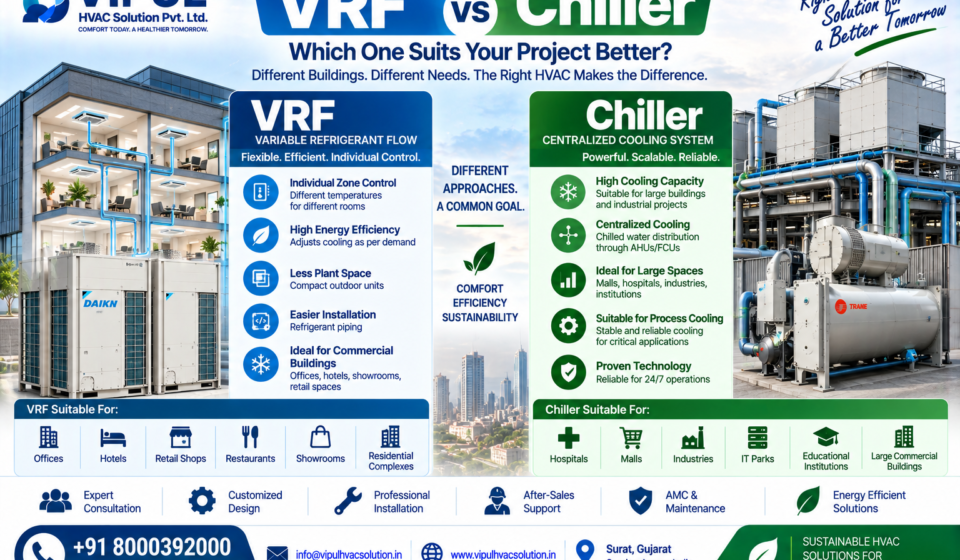

VRF vs Chiller: Which One Suits Your Project Better?
Choosing between a VRF system and a chiller system is an important HVAC design decision for commercial, industrial, institutional and large building projects.
The right choice depends on several factors—not simply the cooling capacity or equipment price.
Quick answer
VRF is generally considered for projects requiring flexible zoning, individual room control and relatively distributed cooling. Chillers are generally considered for centralized cooling plants serving larger buildings or industrial/process applications through chilled-water distribution.
A VRF system circulates refrigerant directly between outdoor and indoor units, while a chiller produces chilled water that is circulated through piping to AHUs, FCUs or other cooling terminals.
Therefore, the correct decision should consider:
- Building size
- Cooling load
- Number of zones
- Operating hours
- Individual temperature control
- Available plant space
- Electrical infrastructure
- Water availability
- Maintenance requirements
- Energy-efficiency objectives
- Future expansion
- Initial and lifecycle cost
VIPUL HVAC Solution Pvt. Ltd. provides both VRF/VRV and chiller solutions, allowing HVAC system selection to be based on the actual project requirements.
What Is a VRF System?
VRF stands for Variable Refrigerant Flow.
A VRF system uses one or more outdoor units connected to multiple indoor units through refrigerant piping. The system can vary refrigerant flow according to the demand of different zones.
This makes VRF particularly useful when different rooms or areas have different cooling requirements.
For example, an office building may have:
- Reception
- Cabins
- Conference rooms
- Workstations
- Server rooms
- Meeting rooms
Each area may have different occupancy and cooling requirements.
VRF technology allows individual zones to be controlled independently. Daikin describes VRV as a commercial multi-split technology providing individual climate control for different zones.
Typical VRF system
VRF Outdoor Unit → Refrigerant Piping → Multiple Indoor Units → Individual Zones
A complete installation may also include:
- Indoor units
- Outdoor units
- Refrigerant piping
- Branch components
- Drain piping
- Controllers
- Communication wiring
- Centralized controls
- BMS integration
- Fresh-air/ventilation system where required
What Is a Chiller System?
A chiller system is a centralized cooling system that produces chilled water for building or process cooling.
The chilled water is pumped through a network of pipes to cooling coils located inside equipment such as:
- AHUs
- FCUs
- Cooling coils
- Process heat exchangers
A simplified system is:
Chiller → Chilled-Water Pump → AHU/FCU → Conditioned Space → Return Water → Chiller
For larger water-cooled plants, the system may additionally include:
Cooling Tower + Condenser-Water Pumps + Chiller
Trane describes chilled-water systems as systems in which a chiller cools water that is then transported through pipes to cooling coils for air conditioning or industrial processes.
VIPUL HVAC currently offers air-cooled and water-cooled chiller solutions, with its published chiller range covering 20 TR to 1000+ TR, depending on project requirements.
VRF vs Chiller: Quick Comparison
| Feature | VRF System | Chiller System |
|---|---|---|
| Cooling medium | Refrigerant | Chilled water |
| Distribution | Refrigerant piping | Chilled-water piping |
| Architecture | Distributed | Centralized |
| Zone control | Excellent | Depends on AHU/FCU/control design |
| Individual room control | Strong | Possible with suitable terminal/control design |
| Plant room | Usually less extensive | Usually more infrastructure |
| Pumps | Generally not required for cooling distribution | Required |
| Cooling tower | Not required | Required for water-cooled systems |
| Installation complexity | Moderate | Higher for complete plants |
| Large centralized cooling | Project dependent | Strong application |
| Multiple independent zones | Very suitable | Possible |
| Process cooling | Application dependent | Often suitable |
| AHU integration | Possible | Common |
| BMS integration | Available depending on system | Common |
| Maintenance | Refrigeration + controls | Chiller + pumps + piping + controls |
| Best selection basis | Zoning and distributed cooling | Central plant and large cooling load |
The table should be treated as a design comparison rather than a universal rule. Actual selection depends on project engineering.
VRF vs Chiller: 7 Key Differences
1. Cooling Distribution
The biggest difference is how cooling is distributed.
VRF
VRF distributes refrigerant directly to multiple indoor units.
Outdoor Unit → Refrigerant Network → Indoor Units
Chiller
A chiller produces chilled water and distributes it through pumps and piping.
Chiller → Pump → Chilled-Water Network → AHU/FCU
This fundamental difference affects the entire HVAC design.
2. Zoning and Individual Temperature Control
VRF is particularly useful when a building has many zones with different cooling requirements.
For example:
- Room A requires cooling
- Room B has lower occupancy
- Room C is unoccupied
- Conference room has high occupancy
- Reception operates continuously
VRF can adjust refrigerant flow according to the requirements of individual indoor units.
Daikin’s VRV documentation specifically highlights individual zone control and variable refrigerant flow technology.
A chiller can also provide zone-level control, but this normally depends on the design of:
- AHUs
- FCUs
- Control valves
- Thermostats
- VAV systems
- BMS
- Air distribution
Therefore, VRF generally offers a simpler path to highly distributed zone control.
3. Building Size and Cooling Load
Building size alone should not determine the HVAC system.
The actual cooling load is more important.
A building may be relatively large but have several independent zones, making VRF worth evaluating.
A large facility with a substantial centralized cooling requirement may be better suited to a chiller-based design.
Chiller plants are widely used in large commercial and industrial facilities because chilled water can serve multiple air handlers and cooling terminals.
VRF may be considered for:
- Offices
- Hotels
- Showrooms
- Restaurants
- Commercial buildings
- Retail spaces
- Educational buildings
- Multi-zone projects
Chillers may be considered for:
- Large commercial buildings
- Hospitals
- Shopping malls
- Hotels
- Manufacturing facilities
- Pharmaceutical plants
- Data centers
- Industrial facilities
- Process-cooling applications
4. Installation Infrastructure
VRF generally requires:
- Outdoor units
- Refrigerant piping
- Indoor units
- Drain piping
- Electrical connections
- Controls
A chiller plant can require significantly more infrastructure, particularly for water-cooled configurations.
Depending on the design, this may include:
- Chillers
- Chilled-water pumps
- Condenser-water pumps
- Cooling towers
- AHUs
- FCUs
- Chilled-water piping
- Condenser-water piping
- Valves
- Controls
- BMS
- Expansion tanks
- Water-treatment systems
Trane’s comprehensive chilled-water system description includes chillers, cooling towers, condenser-water pumps, chilled-water pumps, load terminals and control valves.
Therefore, infrastructure requirements should be evaluated before selecting the technology.
5. Energy Efficiency
It is not accurate to say that VRF is always more energy efficient than a chiller or that a chiller is always more efficient.
Actual performance depends on:
- Cooling load
- Part-load operation
- Equipment efficiency
- Outdoor temperature
- Operating hours
- Control strategy
- Pump energy
- Cooling-tower performance
- Fan energy
- Piping design
- Maintenance
- System commissioning
VRF systems can benefit from variable refrigerant control and individual zone operation. Daikin describes its VRV systems as using variable refrigerant flow and individual control to help optimize operation.
Chilled-water systems can also achieve efficient operation when the complete plant is correctly designed and controlled. Trane notes that chilled-water system design, flow rates, equipment selection and controls influence lifecycle performance.
Important:
Compare complete system energy consumption—not just the efficiency rating of one piece of equipment.
6. Maintenance Requirements
VRF maintenance generally involves:
- Indoor-unit cleaning
- Outdoor-unit maintenance
- Refrigerant-system inspection
- Electrical checks
- Drain inspection
- Filter cleaning
- Controls
- Communication systems
- Refrigerant leak checks where applicable
Chiller maintenance can involve a larger plant ecosystem.
Depending on the configuration:
- Compressor
- Condenser
- Evaporator
- Pumps
- Cooling tower
- Water quality
- Chilled-water circuit
- Condenser-water circuit
- AHUs
- FCUs
- Valves
- Controls
- BMS
For a large chiller plant, preventive maintenance and water-side management can therefore be an important part of lifecycle planning.
7. Initial Cost vs Lifecycle Cost
Equipment purchase price should not be the only comparison.
For VRF, the project cost may include:
Outdoor Units + Indoor Units + Refrigerant Piping + Controls + Installation + Electrical + Drainage + Commissioning
For a chiller plant:
Chillers + Pumps + Cooling Towers Where Applicable + AHUs/FCUs + Piping + Controls + Electrical + Water Treatment + Installation + Commissioning
Therefore, comparing only:
“VRF equipment price vs chiller equipment price”
can produce a misleading conclusion.
A better approach is to compare the complete project lifecycle cost.
Lifecycle cost can include:
Initial Investment + Installation + Energy + Maintenance + Replacement + Downtime
VRF vs Chiller for Different Applications
| Application | VRF | Chiller |
|---|---|---|
| Small office | Often suitable | Usually project dependent |
| Multi-zone office | Strong option | Possible |
| Hotel | Suitable | Suitable |
| Large hotel | Possible | Strong option depending on design |
| Shopping mall | Project dependent | Often evaluated |
| Hospital | Selected areas | Common option depending on requirements |
| Pharmaceutical facility | Application dependent | Often evaluated |
| Factory | Selected areas | Strong option for many process applications |
| Data center | Specialized design required | Commonly evaluated |
| Large industrial plant | Project dependent | Often suitable |
| Showroom | Suitable | Project dependent |
| Retail building | Suitable | Project dependent |
Important: Application suitability does not replace engineering design. Hospitals, pharmaceutical facilities, data centers and industrial plants may have specialized temperature, humidity, ventilation, filtration, redundancy or process requirements.
VRF vs Chiller for Office Buildings
For an office building with many independent rooms and zones, VRF can be attractive because of its zoning flexibility.
For example:
Reception → VRF Indoor Unit
Cabins → VRF Indoor Units
Conference Room → VRF Indoor Unit
Work Area → VRF Indoor Units
However, for a large office campus with a substantial centralized cooling plant, a chiller system may also be evaluated.
The final selection should be based on:
- Building area
- Cooling load
- Floor configuration
- Occupancy
- Operating schedule
- Fresh-air requirement
- Plant space
- Energy model
- Future expansion
VRF vs Chiller for Hotels
Hotels have highly variable cooling requirements.
Guest rooms may have individual temperature preferences while restaurants, kitchens, banquet halls, lobbies and common areas have different loads.
VRF can provide individual zone control for guest rooms and other suitable areas.
A chiller plant may be considered when the hotel has:
- Large central cooling demand
- Extensive AHU systems
- Large banquet facilities
- Multiple common areas
- Centralized HVAC infrastructure
A hybrid approach may also be technically possible depending on the project.
VRF vs Chiller for Hospitals
Hospital HVAC requires more careful engineering than ordinary commercial comfort cooling.
Important considerations can include:
- Temperature
- Humidity
- Ventilation
- Filtration
- Pressure relationships
- Airflow direction
- Infection-control requirements
- Operating-room requirements
- Critical-area redundancy
Therefore, the question should not simply be:
“VRF or chiller?”
Instead:
Which HVAC architecture meets the requirements of each hospital area?
Some areas may require centralized AHU/chilled-water systems while other non-critical areas may have different HVAC requirements.
VRF vs Chiller for Industrial Projects
Industrial HVAC projects can involve two different requirements:
Comfort cooling
For:
- Offices
- Control rooms
- Staff areas
- Meeting rooms
VRF can be considered for suitable zones.
Process cooling
For:
- Machinery
- Production processes
- Heat exchangers
- Manufacturing equipment
- Temperature-controlled processes
A chiller or specialized process-cooling system may be more appropriate depending on the process.
Process cooling should be designed based on:
- Required fluid temperature
- Flow rate
- Heat load
- Operating hours
- Process conditions
- Redundancy
- Water quality
- Future expansion
VIPUL HVAC’s industrial chiller offering includes process-cooling integration, pump and cooling-tower selection, piping, controls, commissioning and AMC support.
VRF vs Chiller: Which Has Better Zoning?
For highly distributed room-by-room control, VRF is particularly well suited.
For centralized cooling with AHUs/FCUs and a plant-wide control architecture, chillers can also provide sophisticated zoning, but through the airside and hydronic system design.
So the comparison is better expressed as:
VRF → distributed refrigerant-based zoning
Chiller → centralized chilled-water architecture
Neither approach should automatically be selected without analyzing the building.
VRF vs Chiller: Which Requires More Space?
VRF generally requires outdoor-unit locations and refrigerant piping routes.
A chiller plant can require space for:
- Chillers
- Pumps
- Cooling towers
- Piping
- AHUs
- Electrical/control equipment
- Maintenance access
Therefore, a centralized chiller installation may require more dedicated mechanical infrastructure.
However, actual space requirements depend heavily on whether the chiller is air-cooled or water-cooled and how the project is configured.
Can a Project Use Both VRF and Chiller?
Yes, a building can use different HVAC technologies for different areas when the overall design supports it.
For example:
Chiller
Could serve:
- Large central areas
- AHUs
- Common spaces
- Process cooling
VRF
Could serve:
- Independent offices
- Small meeting rooms
- Guest rooms
- Separate commercial zones
The decision should be based on engineering requirements rather than forcing one technology throughout the entire project.
10 Factors to Check Before Choosing VRF or Chiller
Before selecting the HVAC architecture, evaluate:
1. Cooling Load
Calculate peak and diversified loads.
2. Building Layout
Understand floors, zones and occupancy.
3. Operating Hours
A 24/7 facility has different requirements from a 10-hour office.
4. Zoning
Determine how independently each area needs to operate.
5. Ventilation
Fresh-air requirements must be designed separately as part of the overall HVAC system.
6. Plant Space
Check available roof, basement and mechanical-room space.
7. Water Availability
Important particularly for water-cooled chiller plants.
8. Energy Performance
Evaluate whole-system energy consumption.
9. Maintenance
Consider the skills, service infrastructure and maintenance requirements.
10. Future Expansion
Plan for additional cooling demand where applicable.
How VIPUL HVAC Helps Select VRF or Chiller
VIPUL HVAC Solution Pvt. Ltd. approaches VRF and chiller selection as an engineering decision rather than simply an equipment purchase.
The project process can include:
01 — Requirement Discussion
Understand building usage and project objectives.
↓
02 — Site Survey
Study architecture, plant space and existing infrastructure.
↓
03 — Heat-Load Calculation
Calculate cooling requirements.
↓
04 — HVAC Concept
Evaluate VRF, chiller or other suitable options.
↓
05 — Equipment Selection
Select appropriate capacities and configurations.
↓
06 — HVAC Design
Develop piping, ducting, controls and equipment layouts.
↓
07 — BOQ & Technical Proposal
Prepare equipment and installation requirements.
↓
08 — Equipment Supply
Supply selected HVAC equipment.
↓
09 — Installation
Complete equipment, piping, ductwork and controls installation.
↓
10 — Testing & Commissioning
Verify system operation and performance.
↓
11 — Optimization
Fine-tune system operation.
↓
12 — AMC & Maintenance
Provide ongoing HVAC support.
VIPUL’s current HVAC offering includes VRF/VRV systems, chiller systems, AHUs, ductwork, ventilation, BMS/HVAC automation, customized HVAC design and maintenance services.
Why Choose VIPUL HVAC Solution Pvt. Ltd.?
For a VRF or chiller project, choosing the equipment alone is not enough.
The engineering, installation and commissioning quality can significantly affect the final system.
VIPUL HVAC can support projects with:
- HVAC design
- Heat-load calculations
- VRF/VRV selection
- Chiller selection
- AHU selection
- Duct design
- Refrigerant piping
- Chilled-water piping
- Ventilation
- HVAC controls
- BMS integration
- Installation
- Testing
- Commissioning
- Optimization
- AMC and maintenance
VIPUL’s current project approach covers design, equipment supply, installation, testing and commissioning for HVAC projects.
VRF vs Chiller: Decision Framework
Instead of asking:
“Which is better—VRF or chiller?”
ask these questions:
Does the project need highly independent zones?
Consider VRF as one option.
Does the project require centralized cooling?
Evaluate a chiller system.
Does the project have significant process cooling?
Evaluate chiller/process cooling solutions.
Does the project have many individual rooms?
Evaluate VRF zoning.
Does the project require extensive AHU-based air distribution?
Evaluate a chilled-water system among the options.
Does the project have limited plant infrastructure?
Compare VRF against the complete infrastructure requirements of a chiller plant.
Is the project large and continuously operating?
Perform a whole-system lifecycle and energy analysis before selecting the technology.
Frequently Asked Questions
Is VRF better than a chiller?
There is no universal answer. VRF and chiller systems use different cooling architectures. VRF is particularly suited to distributed, independently controlled zones, while chillers are commonly used for centralized cooling and larger commercial or industrial applications.
Is VRF cheaper than a chiller?
Not necessarily. The comparison should include the complete installed project cost, including equipment, piping, controls, installation, electrical work, AHUs/FCUs where applicable and commissioning.
Which is more energy efficient, VRF or chiller?
Neither technology is automatically more efficient in every project. Whole-system design, load profile, part-load operation, controls, pumps, fans, cooling towers and maintenance all affect energy consumption.
Is VRF suitable for large buildings?
Yes, VRF can be used in large commercial buildings, but suitability depends on the building configuration, cooling load, zoning, refrigerant-piping requirements and project design.
Are chillers suitable for industrial applications?
Yes. Chillers are widely used for both HVAC and process-cooling applications.
Can VRF and chillers be used together?
Yes. Different HVAC systems can be used for different building areas when the overall engineering design supports such an approach.
Does a VRF system require fresh-air ventilation?
VRF provides space conditioning but does not automatically replace a dedicated fresh-air/ventilation strategy. Outdoor-air requirements should be addressed separately as part of the HVAC design.
What is the first step in choosing VRF or chiller?
Start with a site assessment and cooling-load calculation. Then compare system architecture, zoning, energy, infrastructure, lifecycle cost and maintenance requirements.
Conclusion
VRF vs Chiller is not simply a competition between two HVAC technologies.
They represent different approaches to cooling:
VRF → Refrigerant-based, distributed, highly zoned cooling
Chiller → Centralized chilled-water cooling
For offices, hotels, showrooms and buildings with many independent zones, VRF may be worth evaluating.
For large centralized commercial facilities, industrial facilities and projects requiring chilled-water distribution or process cooling, a chiller system may be worth evaluating.
For some complex projects, a combination of technologies may also be technically appropriate.
The best approach is to calculate the actual cooling load, understand the building’s operating profile, evaluate infrastructure and compare complete lifecycle costs before finalizing the HVAC system.
Planning a VRF or chiller project? Contact VIPUL HVAC Solution Pvt. Ltd. for HVAC design, system selection, installation, testing, commissioning and AMC support.
📞 +91 8000392000
🌐 vipulhvacsolution.in
✉️ info@vipulhvacsolution.in
Important Links:
- VRF vs chiller
- VRF or chiller
- VRF vs chiller system
- difference between VRF and chiller
- VRF vs chilled water system
- VRF chiller comparison
- VRF or chiller for commercial building
- VRF vs chiller cost
- VRF vs chiller efficiency
- VRF vs chiller for hotel
- VRF vs chiller for office
- VRF vs chiller for industrial building
- Chiller vs VRF HVAC
- VRF HVAC system
- Commercial chiller system



[…] VRF vs Chiller […]