

VRF Design Consultancy India: Complete Guide to Professional VRF HVAC Design
If you are searching for VRF design consultancy in India, the most important point is that a successful VRF project requires much more than selecting an air-conditioning brand or calculating the number of indoor units.
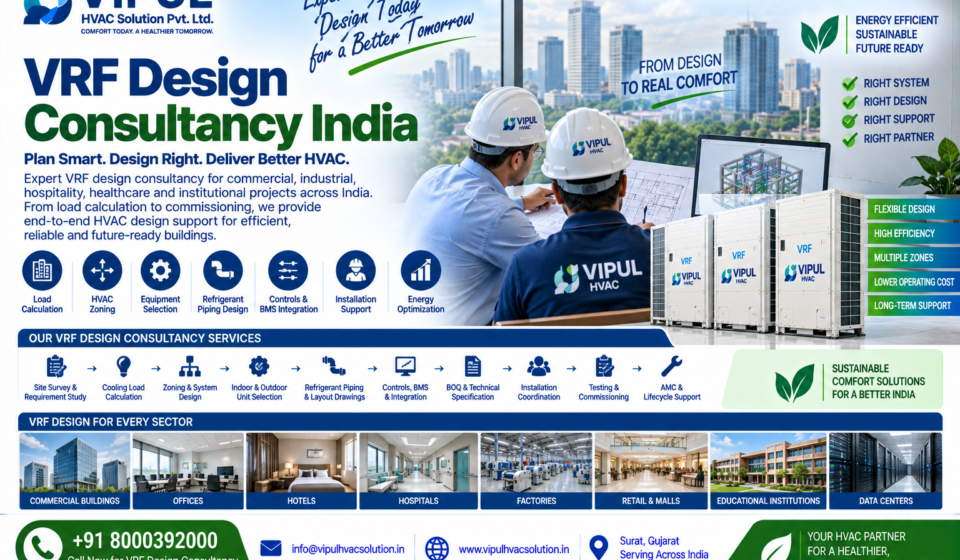
Professional VRF design consultancy involves site analysis, cooling-load calculation, HVAC zoning, indoor and outdoor unit selection, refrigerant piping design, ventilation coordination, controls, BMS integration, energy analysis, BOQ preparation, installation coordination and commissioning.
ASHRAE specifically publishes Guideline 41-2020, Design, Installation and Commissioning of Variable Refrigerant Flow (VRF) Systems, covering VRF design, installation and commissioning considerations.
VIPUL HVAC Solution Pvt. Ltd. provides customized HVAC engineering and VRF/VRV solutions, including system design, equipment selection, refrigerant piping design, zoning, commissioning, performance optimization and AMC support.
What Is VRF Design Consultancy?
VRF design consultancy is the professional engineering service used to determine how a Variable Refrigerant Flow HVAC system should be designed and configured for a specific building.
A VRF consultant evaluates:
- Building architecture
- Room usage
- Cooling and heating loads
- Occupancy
- Equipment heat loads
- Indoor-unit requirements
- Outdoor-unit capacity
- Refrigerant piping
- Pipe lengths
- Vertical differences
- Zoning
- Fresh-air requirements
- Ventilation
- Electrical requirements
- Condensate drainage
- Controls
- BMS integration
- Energy efficiency
- Maintenance access
- Installation requirements
- Testing and commissioning
The objective is to create a technically appropriate, energy-conscious and maintainable HVAC system rather than simply selecting the cheapest equipment.
Why Do You Need VRF Design Consultancy in India?
Modern commercial and industrial buildings can have highly different HVAC requirements.
For example:
Office
Requires:
Comfort + zoning + energy efficiency
Hotel
Requires:
Guest-room control + common-area cooling + scheduling
Hospital
Requires:
Temperature + ventilation + filtration + pressure + specialized HVAC
Factory
Requires:
Cooling + machinery heat management + ventilation + process requirements
Retail Building
Requires:
Flexible zoning + variable occupancy + aesthetics
Data Center
Requires:
Continuous cooling + redundancy + equipment heat management
Therefore, a single standard VRF design cannot be applied to every project.
VIPUL’s customized HVAC design approach considers factors such as building size, orientation, occupancy, equipment heat loads, climate and operational requirements.
VRF Design Consultancy Process in India
A professional VRF design consultancy project can follow the following process.
1. Project Requirement Analysis
The first step is understanding the client’s requirements.
The consultant should identify:
- Building type
- Total area
- Number of floors
- Room usage
- Occupancy
- Operating hours
- Cooling requirements
- Heating requirements where applicable
- Future expansion
- Budget
- Energy objectives
- Architectural constraints
2. Site Survey
For an existing building, a physical site survey is extremely important.
The consultant should inspect:
- Building layout
- Room dimensions
- Ceiling heights
- Windows
- Glass area
- Orientation
- Roof
- External walls
- Existing HVAC
- Electrical infrastructure
- Shaft availability
- Outdoor-unit locations
- Refrigerant pipe routes
- Drainage routes
- Maintenance access
For a new building, the HVAC consultant should coordinate with the architectural and engineering teams at an early stage.
3. Cooling Load Calculation
One of the most important responsibilities of a VRF design consultant is determining the required cooling capacity.
The calculation may consider:
Building Envelope
- Walls
- Roof
- Windows
- Doors
- Glass
- Solar exposure
Occupancy
- Number of people
- Occupancy schedule
- Activity level
Lighting
Lighting contributes to sensible heat gain.
Equipment
Consider:
- Computers
- Printers
- Servers
- Motors
- Electrical equipment
- Production machinery
- Medical equipment
Ventilation
Outdoor air can add sensible and latent loads.
Infiltration
Uncontrolled outdoor air entering through doors, windows and building leakage should also be considered.
4. HVAC Zoning
Correct zoning is one of the major advantages of VRF technology.
A professional consultant can divide the building into zones according to:
- Room function
- Occupancy
- Orientation
- Operating schedule
- Cooling load
- Temperature requirements
- Tenant requirements
- Operating hours
For example:
VRF Outdoor Unit
       │
       ├── Zone 1 → Reception
       │
       ├── Zone 2 → Office Area
       │
       ├── Zone 3 → Conference Room
       │
       ├── Zone 4 → Server/IT Area
       │
       └── Zone 5 → Management Area
VRF systems are designed around multiple indoor units served by outdoor equipment with variable refrigerant flow and zone-level control.
5. VRF Outdoor Unit Selection
The outdoor unit should not be selected simply by adding up the nominal capacities of every indoor unit.
The consultant should evaluate:
- Calculated cooling load
- Diversity
- Simultaneous operation
- Manufacturer combination rules
- Outdoor design conditions
- Operating range
- Piping limitations
- Future requirements
- Redundancy requirements
The final equipment selection should follow the manufacturer’s engineering data.
6. VRF Indoor Unit Selection
Different rooms may require different indoor-unit types.
Common configurations include:
Cassette Units
Suitable for selected open-plan spaces, offices and commercial areas.
Ducted Units
Useful when concealed air distribution is preferred.
Wall-Mounted Units
Suitable for selected small rooms.
Floor/Ceiling Units
Can be considered where ceiling or wall configuration requires an alternative arrangement.
High-Static Ducted Units
Can be considered where longer duct distribution is required, subject to system specifications.
The consultant should consider:
- Airflow
- Room layout
- Static pressure
- Noise
- Ceiling height
- Maintenance access
- Aesthetics
- Cooling load
7. Refrigerant Piping Design
Refrigerant piping is one of the most critical parts of VRF design.
The consultant should determine:
- Pipe diameter
- Main pipe routing
- Branch piping
- Refnet/branch components
- Total pipe length
- Equivalent pipe length
- Vertical height difference
- Insulation
- Refrigerant charge
- Service access
Incorrect piping design can affect system performance.
Therefore, pipe sizing should always follow the selected manufacturer’s engineering guidelines.
8. Fresh Air and Ventilation Coordination
One common misunderstanding is:
VRF = complete ventilation system
This is not necessarily correct.
VRF primarily provides space conditioning. Depending on the building, separate ventilation may be required.
A complete HVAC design can therefore include:
VRF → Space Cooling
FAHU/AHU → Fresh Air
Exhaust → Contaminated/Unwanted Air Removal
BMS → Monitoring & Control
VIPUL provides ventilation solutions including fresh-air handling units, supply/exhaust fans, filtration, dampers, heat recovery and airflow testing/balancing.
9. BMS Integration
Modern commercial buildings increasingly use centralized building management systems.
A VRF consultant can coordinate:
- Centralized controllers
- Temperature monitoring
- Setpoint control
- Scheduling
- Equipment status
- Fault alarms
- Energy monitoring where supported
- BMS communication
VIPUL’s VRF solution offering includes smart controllers and BMS integration.
10. Electrical Coordination
VRF design consultancy should also coordinate with the electrical design team.
Important considerations include:
- Outdoor-unit power requirements
- Indoor-unit power
- Control wiring
- Communication wiring
- Isolators
- Protection
- Cable routing
- Electrical panels
- Emergency power requirements where applicable
The exact electrical requirements depend on the selected equipment.
11. Condensate Drainage Design
Every indoor unit that produces condensate needs a properly designed drainage arrangement.
The consultant should coordinate:
- Drain pipe sizing
- Gravity drainage
- Drain slopes
- Drain pumps where required
- Trap requirements
- Access for cleaning
- Discharge location
Poor condensate design can cause water leakage and indoor-unit problems.
12. Energy-Efficient VRF Design
Energy efficiency should be considered at the design stage.
A consultant should evaluate:
Correct Sizing
Avoid unnecessary oversizing.
Zoning
Cool only the required areas.
Operating Schedule
Match HVAC operation with building occupancy.
Controls
Use appropriate temperature and scheduling controls.
Equipment Efficiency
Compare applicable efficiency data for shortlisted systems.
Ventilation
Coordinate fresh-air requirements with the HVAC load.
Maintenance
Keep filters, coils and other components clean and properly serviced.
ASHRAE’s VRF guidance emphasizes treating VRF as part of an integrated HVAC system rather than viewing the VRF equipment as an isolated product.
VRF Design Consultancy for Different Building Types
VRF Design for Office Buildings
Typical design priorities:
- Individual zone control
- Meeting-room scheduling
- Open-office cooling
- Low noise
- Energy efficiency
- BMS integration
VRF Design for Hotels
The design can include:
- Guest rooms
- Corridors
- Restaurants
- Banquet halls
- Lobby
- Offices
- Back-of-house areas
Guest rooms often benefit from independent temperature control.
VRF Design for Hospitals
Hospital HVAC requires much more specialized engineering.
Depending on the clinical area, the overall HVAC strategy may involve:
- VRF
- AHU
- FAHU
- Fresh air
- Filtration
- Exhaust
- Pressure control
- Humidity control
- Specialized ventilation
VRF should not automatically be assumed to be the complete HVAC system for critical clinical spaces.
VRF Design for Factories
Factory projects may require consideration of:
- Machinery heat
- Production areas
- Factory offices
- Control rooms
- Electrical rooms
- Ventilation
- Exhaust
- Dust
- Fumes
- Process requirements
For large production areas, a chiller/AHU or hybrid HVAC solution may sometimes be more appropriate than VRF alone.
VRF Design for Restaurants
Restaurant HVAC may require coordination between:
- Dining area cooling
- Kitchen exhaust
- Make-up air
- Fresh air
- Odor control
- Kitchen heat
- Exhaust systems
VRF can serve appropriate comfort zones, while kitchen ventilation needs separate engineering.
VRF Design Consultancy Deliverables
A professional VRF consultant may prepare a range of technical documents.
1. HVAC Design Drawings
Showing:
- Indoor units
- Outdoor units
- Piping
- Ductwork where applicable
- Equipment locations
2. Heat-Load Calculation
Room-by-room cooling load.
3. Equipment Schedule
Including:
- Model
- Capacity
- Quantity
- Indoor unit
- Outdoor unit
4. Refrigerant Piping Layout
Showing:
- Main pipes
- Branches
- Pipe sizes
- Routes
5. Control Diagram
Showing the control architecture.
6. BOQ
Bill of quantities for:
- Equipment
- Refrigerant piping
- Insulation
- Controls
- Drainage
- Installation accessories
7. Technical Specification
Defines the required performance and installation standards.
8. Installation Coordination
Reviewing whether the proposed installation matches the design.
9. Testing & Commissioning Documentation
Verification of system operation.
VRF Consultancy vs VRF Supplier
These are not exactly the same.
| VRF Design Consultant | VRF Supplier |
|---|---|
| Studies building | Supplies equipment |
| Calculates load | Provides quotation |
| Designs zoning | Provides selected models |
| Designs piping | Supplies materials |
| Coordinates HVAC | Installs equipment |
| Prepares BOQ | Provides commercial proposal |
| Reviews alternatives | Executes supply |
| Supports commissioning | Provides installation |
For complex projects, having a partner capable of combining design + supply + installation + commissioning can simplify coordination.
VIPUL positions itself as an HVAC project partner rather than only an equipment supplier and lists end-to-end engineering capabilities.
How to Choose a VRF Design Consultancy Company in India
Before appointing a VRF consultant, evaluate:
1. HVAC Engineering Experience
Check whether the company has experience with similar building types.
2. Load Calculation Capability
The consultant should be able to demonstrate a proper load-calculation methodology.
3. VRF Knowledge
Look for experience with:
- Equipment selection
- Refrigerant piping
- Zoning
- Controls
- Commissioning
4. Multi-System Knowledge
A consultant should be able to determine when VRF is appropriate and when alternatives such as chillers, AHUs or package systems should be considered.
5. Ventilation Knowledge
VRF design should be coordinated with fresh-air and exhaust requirements.
6. Installation Experience
Design and installation knowledge together can reduce coordination problems.
7. Commissioning Capability
The project should not end when the equipment starts.
8. Maintenance Support
Long-term maintenance and AMC support should be considered.
Why Choose VIPUL HVAC for VRF Design Consultancy?
VIPUL HVAC Solution Pvt. Ltd. provides HVAC solutions for residential, commercial and industrial environments and currently lists more than 26 years of experience. Its portfolio includes VRF/VRV systems, chillers, AHUs, ventilation and customized HVAC design.
For VRF/VRV projects, VIPUL lists:
- Complete VRF system design
- Indoor-unit selection
- Outdoor-unit selection
- Refrigerant piping design
- Control logic
- Zoning
- Commissioning
- Performance optimization
- AMC support
Its broader HVAC engineering approach can also coordinate VRF with:
Chillers + AHUs + Ventilation + Ductwork + BMS + Precision Cooling
when the project requires multiple HVAC technologies.
VIPUL VRF Design Consultancy Workflow
A practical project workflow can be:
Client Requirement
↓
Site Survey
↓
Architectural Drawing Review
↓
Heat-Load Calculation
↓
HVAC Zoning
↓
VRF System Selection
↓
Indoor & Outdoor Unit Selection
↓
Refrigerant Piping Design
↓
Fresh-Air & Ventilation Coordination
↓
Electrical & Drainage Coordination
↓
BMS & Controls
↓
BOQ & Technical Specification
↓
Commercial Proposal
↓
Installation
↓
Testing
↓
Commissioning
↓
Performance Optimization
↓
AMC
This integrated workflow is consistent with the design-to-commissioning approach described by VIPUL for its VRF solutions.
Common VRF Design Mistakes
Mistake 1: Selecting Capacity From Floor Area Alone
A professional load calculation is required.
Mistake 2: Choosing a Brand Before Designing the System
The design requirements should be established before final equipment selection.
Mistake 3: Ignoring Refrigerant Pipe Length
Piping limitations must be checked against the selected manufacturer’s specifications.
Mistake 4: Ignoring Outdoor Unit Location
Airflow, service access and structural requirements matter.
Mistake 5: Treating VRF as Ventilation
Fresh-air requirements must be separately evaluated.
Mistake 6: Ignoring Maintenance
Indoor and outdoor units need practical access for servicing.
Mistake 7: No Commissioning Plan
A VRF system should be properly tested and commissioned after installation.
Mistake 8: Designing Without Future Requirements
Potential expansion should be considered during the initial design.
VRF Design Consultancy Cost in India
The cost of VRF design consultancy varies according to:
- Building size
- Number of floors
- Number of zones
- Project complexity
- New construction vs existing building
- Required drawings
- Heat-load calculations
- MEP coordination
- Refrigerant piping design
- BMS requirements
- Site visits
- Installation supervision
- Commissioning requirements
Therefore, there is no single standard VRF consultancy price for every project.
A professional quotation should define the exact consultancy scope and deliverables.
VRF Design Consultancy for Gujarat
For projects in Gujarat, professional VRF design may be required for:
- Surat
- Ahmedabad
- Vadodara
- Bharuch
- Ankleshwar
- Vapi
- Rajkot
- Junagadh
- Talala
- Other industrial and commercial locations
VIPUL provides HVAC services across Surat, Gujarat and nearby regions and lists commercial, industrial, hospital, factory and cleanroom applications among the environments it serves.
Frequently Asked Questions
What is VRF design consultancy?
VRF design consultancy is the engineering service of planning and designing a VRF HVAC system according to a building’s cooling load, zoning, piping, ventilation, controls and operational requirements.
Why is VRF design important?
Proper design helps ensure that equipment capacity, refrigerant piping, zoning, controls and ventilation are coordinated before installation.
Does a VRF consultant calculate cooling load?
Yes. Cooling-load calculation is an important part of professional HVAC design.
Can a VRF consultant select the brand?
A consultant can evaluate suitable manufacturers and models according to project requirements, technical specifications, availability, efficiency, service support and budget.
Can VRF work with fresh-air systems?
Yes. VRF can be coordinated with separate FAHU/AHU and ventilation systems where required.
Can VRF be connected to BMS?
Compatible VRF systems can support centralized controls and BMS integration. The exact interface depends on the selected manufacturer and controls architecture.
Is VRF suitable for industrial buildings?
It can be suitable for selected industrial zones, offices and other appropriate areas. High process loads, dust, fumes, ventilation and specialized environmental requirements may require other HVAC technologies or a hybrid solution.
How long does VRF design take?
The timeline depends on project size and complexity, availability of architectural drawings and the scope of engineering deliverables. A small project can require considerably less design work than a multi-floor hospital, hotel or industrial facility.
Does VIPUL provide VRF installation after design?
Yes. VIPUL’s listed VRF capabilities include design, equipment selection, commissioning, performance optimization and AMC support, while its broader HVAC services include installation.
Conclusion
VRF design consultancy in India is an important part of planning a reliable and efficient VRF HVAC project.
A professional design should consider:
Heat Load + Zoning + Equipment Selection + Refrigerant Piping + Ventilation + Controls + BMS + Installation + Commissioning + Maintenance
VRF should be selected based on the actual building requirements rather than simply choosing a popular brand or the lowest quotation.
ASHRAE’s dedicated Guideline 41 provides guidance specifically for VRF design, installation and commissioning, reinforcing the importance of treating VRF as an engineered system rather than simply a collection of air-conditioning units.
For VRF design consultancy, HVAC engineering, VRF/VRV installation and commissioning in India, contact VIPUL HVAC Solution Pvt. Ltd.
📞 +91 8000392000
📧 info@vipulhvacsolution.in
🌐 vipulhvacsolution.in
Important Links:
- VRF design consultant India
- VRF consultant India
- VRF system design India
- VRF HVAC consultant
- VRF design services
- VRF engineering consultant
- VRF design company India
- VRF system consultant
- VRF HVAC design
- VRF consultant Gujarat
- VRF design consultant Gujarat
- VRF consultancy services
- VRF installation consultant
- VRF BOQ preparation
- VRF heat load calculation


[…] VRF consultant India […]