
TFA Full Form in HVAC: 7 Powerful Benefits of Treated Fresh Air
In modern buildings, indoor air quality, ventilation and temperature control are important parts of a properly designed HVAC system. Offices, hospitals, hotels, shopping malls, pharmaceutical facilities and industrial plants may require a reliable supply of filtered and conditioned outdoor air. One HVAC term associated with this requirement is TFA.
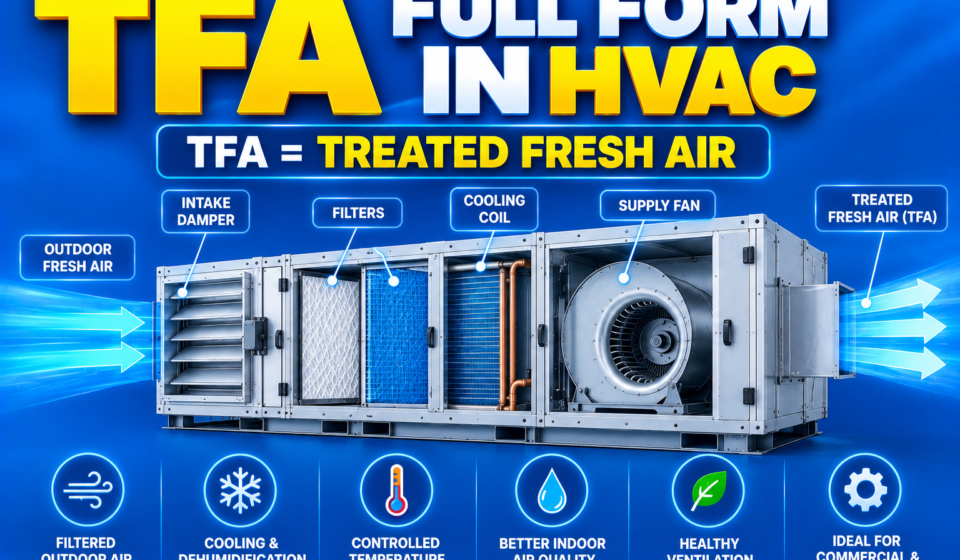
The TFA full form in HVAC is Treated Fresh Air. A TFA unit is an air-handling system designed to treat outdoor air before supplying it to a building, an occupied space or another part of an HVAC system.
Depending on the project, treatment may include air filtration, cooling, dehumidification, heating, humidification and controlled air distribution. Not every TFA unit includes all these features; the final configuration depends on the application and engineering specifications.
In this guide, VIPUL HVAC SOLUTION PVT. LTD. explains the meaning of TFA in HVAC, how a TFA unit works, its major components, applications, benefits and the differences between TFA, AHU and FAHU systems.
What Is the TFA Full Form in HVAC?
The TFA full form in HVAC is Treated Fresh Air.
A Treated Fresh Air Unit is used to bring outdoor air into a building and condition it before distribution. The unit can remove airborne particles through filtration and adjust the air’s temperature and moisture content according to the design requirements.
A typical TFA system may include:
- Fresh air intake and dampers
- Pre-filters and fine filters
- Cooling or heating coils
- Dehumidification provisions
- Supply fan and motor
- Insulated casing
- Drain pan for cooling-coil condensate
- Temperature and humidity sensors
- Motorized dampers and controls
- Variable frequency drive (VFD), where required
- Building Management System (BMS) integration, where specified
The exact arrangement varies by manufacturer and project.
Simple definition: TFA in HVAC means Treated Fresh Air. It refers to outdoor air that is processed to meet the ventilation, temperature, humidity and air-quality requirements of a building or industrial process.
What Is a TFA Unit?
A TFA unit is an HVAC ventilation unit that takes outdoor air, filters it and conditions it before supplying it to the intended area.
In many applications, a dedicated TFA unit is designed to process 100% outdoor air. However, the term should be interpreted according to the approved equipment specification and system design. Some arrangements deliver treated outdoor air directly to occupied spaces, while others supply it to another air-handling or air-conditioning system.
The main purpose is to provide the required ventilation air without relying only on recirculated indoor air.
For example, an office may use a central air-conditioning system for room temperature control and a separate TFA unit to provide the required outdoor ventilation air. The two systems work together to support indoor comfort and air quality.
How Does a TFA Unit Work?
A TFA unit works by drawing outdoor air into the equipment, filtering it, conditioning it as required and supplying it through ductwork.
The basic working sequence is:
Outdoor Air → Filtration → Cooling or Heating → Humidity Treatment, If Required → Supply Fan → Ductwork → Occupied Space
Step 1: Fresh Air Intake
Outdoor air enters the unit through an intake opening. Louvers, dampers and suitable intake arrangements may be used to help manage airflow and reduce the entry of rain or unwanted debris.
The intake location should be selected carefully to avoid nearby exhaust outlets and other contamination sources.
Step 2: Air Filtration
The incoming air passes through filters selected for the required indoor air-quality objectives.
A system may use a pre-filter to capture larger particles, followed by a finer filter for smaller airborne particles. HEPA filtration may be specified for particular applications, such as certain cleanroom or healthcare environments.
Filter selection must be based on the required filtration performance, airflow, pressure drop and maintenance plan.
Step 3: Cooling or Heating
The air may pass over a cooling coil or heating coil to reach the required supply-air condition.
Cooling may use chilled water or direct-expansion (DX) refrigeration, depending on the equipment design. Heating may use an appropriate hot-water, electric or other specified heating arrangement.
Step 4: Humidity Control
In humid climates, outdoor air can introduce a substantial moisture load into a building. When the system is designed for dehumidification, the cooling coil may cool the air sufficiently to remove moisture through condensation.
Additional humidity-control equipment may be required for applications with strict humidity limits.
Step 5: Air Supply
A fan moves the treated air through the duct system to the designated space or connected HVAC equipment.
Fan selection depends on the required airflow, external static pressure, filter resistance and ductwork design.
Step 6: Monitoring and Control
Sensors and controllers can monitor temperature, humidity, pressure and other operating parameters.
Where specified, a BMS can coordinate the TFA unit with other HVAC equipment, ventilation controls and operating schedules.
7 Powerful Benefits of a TFA Unit in HVAC
1. Supports Indoor Air Quality
A TFA unit introduces outdoor air into a building and can filter airborne particles before supplying the air indoors.
This helps support indoor air-quality objectives when the intake location, filter selection, airflow and maintenance programme are properly designed.
Filtration does not remove every pollutant, and outdoor air quality must also be considered.
2. Provides Controlled Fresh Air Ventilation
Buildings need an appropriate amount of outdoor air based on factors such as occupancy, activity, room use and applicable ventilation requirements.
A TFA unit can be designed to deliver the specified outdoor airflow instead of relying on uncontrolled air leakage or occasional window opening.
3. Helps Manage Humidity
Outdoor air can introduce moisture into buildings, particularly in warm and humid climates.
A TFA system designed with suitable dehumidification can remove part of this moisture load before the air reaches occupied areas. This can help the overall HVAC system maintain the intended indoor humidity.
The result depends on coil performance, airflow, control settings and the building’s moisture load.
4. Supports Temperature Control
Cooling or heating components can bring incoming outdoor air closer to the required supply-air condition.
This reduces the difference between untreated outdoor air and the air supplied to the building. It also allows the HVAC design to address ventilation and room cooling as coordinated functions.
5. Can Work with AHUs, FCUs and VRF Systems
A TFA unit can be integrated with different types of air-conditioning systems.
For example, a commercial building may use a TFA unit to provide treated outdoor ventilation air while fan coil units (FCUs) or VRF indoor units handle much of the room’s temperature-control load.
The design must account for the ventilation load and ensure that the combined equipment can meet the space requirements.
6. Helps Support Pressure Control
Some buildings require a defined pressure relationship between indoor areas and the outdoors or between adjacent rooms.
A TFA unit can contribute to that strategy when designed alongside suitable exhaust, relief air, leakage control and airflow-balancing arrangements.
Positive pressure is not automatic. It depends on the relationship between supply air, exhaust air and uncontrolled air leakage.
7. Supports Application-Specific HVAC Design
TFA units can be configured for different airflow rates, filtration levels, cooling requirements and control strategies.
This makes them useful in projects where the quantity and condition of outdoor air must be managed as part of a larger HVAC system.
Energy performance depends on correct sizing, fan efficiency, filtration resistance, control sequences and, where suitable, energy recovery.
Main Components of a TFA Unit
The equipment configuration depends on the project, but common components include the following.
| Component | Function |
|---|---|
| Fresh air intake | Admits outdoor air into the system |
| Intake louver and damper | Helps manage intake and airflow |
| Pre-filter | Captures larger airborne particles |
| Fine filter | Provides additional filtration |
| HEPA filter, if specified | Provides high-efficiency particle filtration for designated applications |
| Cooling coil | Reduces air temperature and may remove moisture |
| Heating coil, if required | Raises air temperature |
| Supply fan | Moves air through the unit and ductwork |
| Drain pan | Collects condensate from cooling and dehumidification |
| Sensors | Measure selected operating conditions |
| Control panel | Coordinates equipment operation |
| VFD, if specified | Adjusts compatible fan motor speed |
| BMS interface, if specified | Enables monitoring or control integration |
Not every TFA unit contains every component. Equipment should be selected according to the project’s ventilation, filtration, temperature, humidity and control requirements.
TFA vs AHU: What Is the Difference?
TFA and AHU are related HVAC terms, but they describe different aspects of an air-handling system.
TFA refers to treated fresh outdoor air. AHU stands for Air Handling Unit, a broader category of equipment used to condition and distribute air.
| Feature | TFA unit | Conventional AHU |
|---|---|---|
| Primary purpose | Treat and supply outdoor ventilation air | Condition and distribute air |
| Air source | Often designed for 100% outdoor air | May use outdoor air, return air or a mixture |
| Filtration | Selected for outdoor-air requirements | Selected for system and space requirements |
| Cooling and heating | Included as required | Included as required |
| Humidity management | Often important for outdoor air | Depends on the system design |
| Recirculation | Depends on the specified arrangement; many dedicated TFA units do not recirculate return air | May recirculate return air |
| Typical use | Dedicated ventilation and outdoor-air treatment | Central air conditioning and air distribution |
A TFA unit can itself be considered a specialised type of air-handling equipment. Therefore, it is more accurate to compare the equipment’s intended function and configuration than to assume every TFA and every AHU are completely different machines.
TFA vs FAHU: Are They the Same?
FAHU stands for Fresh Air Handling Unit.
In HVAC practice, FAHU and TFA are often used for systems that treat outdoor air before supplying it to a building. Their exact meaning can vary across manufacturers, project drawings and equipment schedules.
A project may use either term for a dedicated fresh-air unit, but the acronym alone does not confirm that the unit provides 100% outdoor air or includes a particular filtration or humidity-control arrangement.
Before purchasing equipment, verify the following:
- Outdoor-air percentage
- Design airflow in CFM or cubic metres per hour
- Filter stages and required filtration efficiency
- Cooling and heating capacity
- Supply-air temperature and humidity requirements
- Fan external static pressure
- Electrical supply and motor requirements
- Controls and BMS integration
- Casing construction and insulation
- Access and maintenance provisions
The approved technical specification should define these requirements clearly.
Where Are TFA Units Used?
TFA units are suitable for a range of commercial, institutional and industrial applications where controlled outdoor-air ventilation is required.
1. Hospitals and Healthcare Facilities
Healthcare HVAC systems may require carefully designed ventilation, filtration, humidity control and room pressure relationships.
The TFA configuration must be selected for the intended clinical area and coordinated with the overall ventilation design. A TFA unit alone does not automatically satisfy every healthcare ventilation requirement.
2. Pharmaceutical and Cleanroom Facilities
Pharmaceutical manufacturing and cleanroom environments may require defined airflow rates, filtration efficiency, temperature, humidity and pressure relationships.
The system must be designed to meet the relevant cleanliness classification, process needs and applicable standards.
3. Offices and Commercial Buildings
Offices, business parks and commercial buildings use outdoor-air ventilation to support occupancy-related air-quality requirements.
A dedicated TFA unit may operate alongside the main air-conditioning system to deliver the required outdoor air.
4. Hotels and Shopping Malls
Hotels, malls and other high-occupancy buildings may require ventilation systems that can handle changing occupancy and outdoor conditions.
TFA units can be part of a coordinated HVAC design that manages fresh air, cooling, humidity and exhaust air.
5. Industrial Plants
Manufacturing facilities may need outdoor-air treatment for employee areas, production spaces or specific industrial processes.
The correct configuration depends on the process, contaminants, temperature, humidity, ventilation rate and applicable safety requirements.
6. Educational Institutions
Schools, colleges and training centres may use dedicated outdoor-air equipment to support ventilation in classrooms, laboratories and common areas.
System sizing should account for occupancy and the ventilation requirements of each space.
7. Restaurants and Food Processing Areas
Food preparation and processing facilities may require controlled outdoor air alongside dedicated exhaust and make-up air systems.
The TFA system must be coordinated with kitchen exhaust, process ventilation and the applicable hygiene and safety requirements.
How to Select the Right TFA Unit
Choosing a TFA unit requires more than selecting a model based on building area alone.
Design airflow
Determine the outdoor airflow requirement from the building use, occupancy, applicable ventilation standards and process requirements. Airflow may be expressed in CFM or cubic metres per hour.
Cooling and heating loads
Calculate the outdoor-air sensible and latent loads using the relevant outdoor design conditions and required supply-air conditions.
Filtration requirements
Specify filter efficiency and stages according to outdoor-air quality and the needs of the occupied space or process.
Humidity requirements
Determine whether the application requires dehumidification, humidification or only basic temperature treatment.
Fan selection and static pressure
Select the fan to meet the required airflow at the total system resistance, including filters, coils, dampers and ductwork.
Energy efficiency
Consider efficient fans, suitable controls and energy recovery where appropriate. Energy recovery equipment must be compatible with the exhaust-air conditions and the project’s contamination-control requirements.
Casing and installation conditions
Select the casing, insulation, access panels and corrosion protection according to the environment and installation location.
Controls and BMS integration
Confirm whether the system requires temperature and humidity sensors, motorized dampers, VFDs, alarms or BMS communication.
Maintenance access
Provide access for filter replacement, coil cleaning, drain-pan inspection, fan servicing and sensor checks.
A qualified HVAC designer or consultant should review the final selection against the project specifications.
TFA Unit Maintenance Checklist
Regular maintenance helps the unit continue delivering the intended airflow and air-treatment performance.
- Inspect and replace filters according to pressure drop, condition and manufacturer guidance.
- Clean cooling and heating coils when required.
- Inspect the condensate drain and drain pan.
- Check fan, motor, belts or drive components, where applicable.
- Verify damper operation and airflow settings.
- Check temperature and humidity sensors.
- Review alarms, controls and BMS communication, where provided.
- Inspect casing panels, seals and insulation.
- Measure airflow during commissioning and after significant changes.
- Maintain service records and document corrective work.
Maintenance intervals should be based on the manufacturer’s instructions, operating hours, outdoor-air quality and the application’s requirements.
Common TFA Unit Problems and Their Possible Causes
| Problem | Possible causes | Recommended action |
|---|---|---|
| Low fresh-air airflow | Dirty filters, closed damper, fan fault or duct restriction | Inspect filters, dampers, fan and ductwork |
| Poor cooling | Insufficient coil capacity, incorrect airflow or refrigeration fault | Check operating conditions and equipment performance |
| High indoor humidity | Inadequate dehumidification or incorrect control settings | Review latent load, coil conditions and controls |
| Excessive fan noise | Air turbulence, vibration or mechanical issues | Inspect fan installation and operating conditions |
| Water leakage | Blocked drain, damaged drain pan or incorrect drainage arrangement | Inspect and correct the drainage system |
| High energy consumption | Poor controls, excessive pressure drop or inefficient operation | Review filters, fan settings and system design |
| Incorrect room pressure | Supply/exhaust imbalance or uncontrolled leakage | Measure and balance the complete airflow system |
The same symptom may have several causes. A systematic inspection is more reliable than replacing components without confirming the problem.
TFA and Fresh Air Solutions from VIPUL HVAC SOLUTION PVT. LTD.
VIPUL HVAC SOLUTION PVT. LTD. provides HVAC-related solutions for commercial, industrial and institutional projects, including air-handling equipment, fresh-air systems, HVAC design and consultancy, installation, testing, commissioning and maintenance services.
When planning a TFA installation, our team can discuss the application, airflow requirements, filtration, cooling and humidity-control needs, and integration with the wider HVAC system.
Contact VIPUL HVAC SOLUTION PVT. LTD.
- Phone: +91 8000392000
- Email: info@vipulhvacsolution.in
- Website: https://vipulhvacsolution.in/
- Our branches: https://vipulhvacsolution.in/our-branches/
- Contact page: https://vipulac.in/contact-us/
Our Gujarat Locations
We serve HVAC enquiries through our listed locations in Gujarat:
- Surat: Head Office
- Ankleshwar: HVAC sales and project support
- Bharuch: HVAC sales and project support
- Vadodara (Baroda): HVAC sales and project support
- Ahmedabad: HVAC sales and project support
- Talala: HVAC sales and project support
- Junagadh: Contact the central sales team for assistance
- Vapi: Contact the central sales team for assistance
For location details, visit the official branch directory or contact our central sales team.
Frequently Asked Questions About TFA in HVAC
1. What is the full form of TFA in HVAC?
TFA stands for Treated Fresh Air. It refers to outdoor air that is treated before being supplied to a building or connected HVAC system.
2. What is a TFA unit used for?
A TFA unit is used to filter and condition outdoor air. Depending on its design, it can provide cooling, heating, dehumidification and controlled ventilation.
3. Is TFA the same as FAHU?
TFA and FAHU are often used for similar fresh-air treatment systems. TFA means Treated Fresh Air, while FAHU means Fresh Air Handling Unit. The exact equipment configuration should be verified from the manufacturer’s specification.
4. Is a TFA unit the same as an AHU?
A TFA unit is a specialised air-handling system focused on outdoor-air treatment. An AHU is a broader category of equipment that may handle outdoor air, return air or a mixture of both.
5. Does a TFA unit always use 100% fresh air?
Many dedicated TFA units are designed to handle 100% outdoor air, but the acronym alone does not guarantee this. Confirm the outdoor-air percentage and operating arrangement in the approved technical specification.
6. Does a TFA unit cool the air?
It can. A TFA unit may include a chilled-water or DX cooling coil. The cooling arrangement depends on the project requirements and equipment design.
7. Can a TFA unit control humidity?
A suitably designed TFA unit can dehumidify air using a cooling coil and may include additional humidity-control equipment. Actual performance depends on the coil design, airflow, entering conditions and control sequence.
8. Where are TFA units installed?
TFA units are used in commercial buildings, hospitals, hotels, shopping malls, pharmaceutical facilities, cleanrooms, educational institutions and industrial plants where treated outdoor-air ventilation is required.
9. What is the difference between TFA and an exhaust system?
A TFA unit supplies treated outdoor air. An exhaust system removes air from a space. Both may need to operate together to maintain the intended airflow and pressure balance.
10. How can I select a TFA unit for my project?
Start with the required outdoor airflow, outdoor design conditions, supply-air temperature and humidity, filtration requirements, fan static pressure, controls and installation constraints. A qualified HVAC professional should review the final equipment selection.
11. Does a TFA unit improve indoor air quality?
It can support better indoor air quality by supplying outdoor air and filtering it appropriately. Results depend on outdoor-air quality, filter performance, ventilation rates, maintenance and the building’s other pollutant sources.
12. Where can I get TFA and AHU solutions in Gujarat?
VIPUL HVAC SOLUTION PVT. LTD. supports HVAC project enquiries through its Gujarat locations, including Surat, Ankleshwar, Bharuch, Vadodara, Ahmedabad, Talala, Junagadh and Vapi. Call +91 8000392000 or visit https://vipulhvacsolution.in/ for assistance.
Conclusion
The TFA full form in HVAC is Treated Fresh Air. A TFA unit treats outdoor air through filtration and, where required, cooling, heating and humidity control before supplying it to a building or connected HVAC system.
TFA systems can support ventilation, indoor air-quality objectives and humidity management in commercial, healthcare, pharmaceutical and industrial applications. However, their performance depends on correct airflow calculations, equipment selection, filtration, controls, installation and maintenance.
For TFA, fresh-air handling and other HVAC project requirements, contact VIPUL HVAC SOLUTION PVT. LTD. at +91 8000392000 or visit https://vipulhvacsolution.in/.