
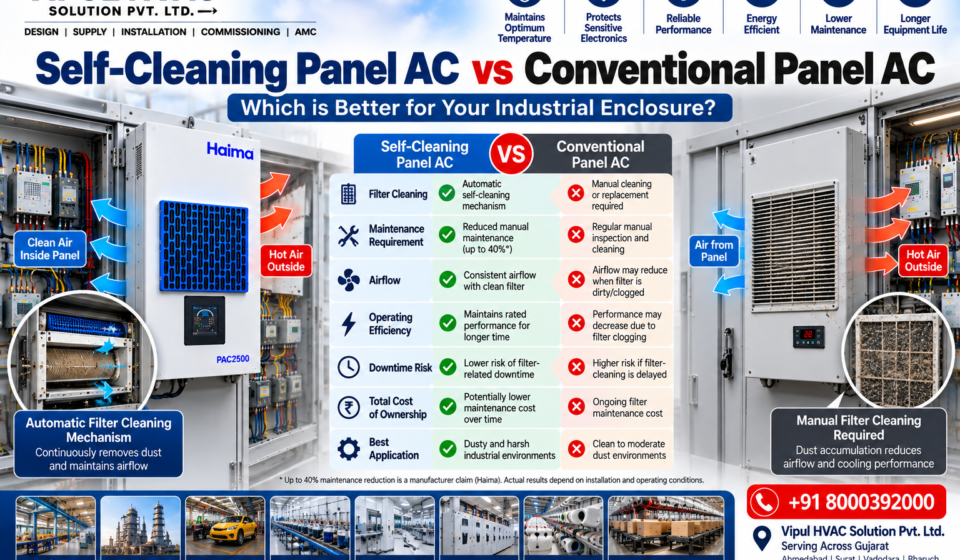

Self-Cleaning Panel AC vs Conventional Panel AC: 7 Key Differences
Industrial electrical panels need reliable cooling to protect sensitive components such as programmable logic controllers (PLCs), variable frequency drives (VFDs), motor control centres (MCCs), servo drives and automation equipment. However, dust accumulation on an air conditioner’s filter can gradually restrict airflow and make it harder for the unit to remove heat from the electrical enclosure.
This creates an important purchasing question for plant managers, electrical panel builders and maintenance engineers: Should you choose a self-cleaning panel AC or a conventional panel AC?
A conventional industrial panel air conditioner typically requires periodic manual inspection and filter cleaning, depending on its design and operating environment. A self-cleaning panel AC uses an automatic mechanism intended to reduce filter clogging and manual cleaning requirements.
For example, Haima’s official product documentation describes an automatic air-filter-cleaning system for its industrial panel AC range. The manufacturer advertises maintenance reductions, but actual savings depend on the installation, operating conditions and maintenance costs at the site.
In this guide, Vipul HVAC Solution Pvt Ltd compares both technologies in terms of filter cleaning, airflow, operating efficiency, maintenance planning and downtime risk.
What Is a Self-Cleaning Panel AC?
A self-cleaning panel AC is an industrial enclosure air conditioner designed with a mechanism that automatically cleans or manages dust accumulation on its air filter.
In Haima’s published product information, the system uses an automatic air-filter-cleaning mechanism intended to maintain airflow and reduce the need for manual filter cleaning.
The primary objective is to reduce one recurring maintenance task: manually removing, cleaning and reinstalling a filter that has accumulated dust.
Key features to evaluate
- Automatic filter-cleaning mechanism
- Consistent airflow under the specified operating conditions
- Cooling capacity suitable for the electrical enclosure’s heat load
- Condenser and evaporator accessibility for servicing
- Temperature monitoring and alarm features, where provided
- Compatibility with the site’s ambient temperature and dust conditions
- Manufacturer-supported maintenance and warranty requirements
Important: Self-cleaning refers to the filter-cleaning function. It does not necessarily mean the compressor, condenser coil, evaporator, fans, drain system, electrical connections and other components never require inspection or servicing.
What Is a Conventional Panel AC?
A conventional panel AC is an enclosure cooling unit that removes heat from an electrical cabinet using a refrigeration system. Depending on the design, it circulates cabinet air through the evaporator while transferring heat to the external side of the cooling system.
Many conventional models use filters that require manual inspection and cleaning or replacement. The required interval varies with the filter design, dust concentration, operating hours and manufacturer instructions.
If the filter becomes clogged, airflow may fall and cooling performance may deteriorate. The maintenance team must identify the problem, safely isolate the equipment when required, clean or replace the filter, and verify that the cooling unit operates correctly afterward.
Conventional panel ACs can be a practical choice where manual maintenance is straightforward, dust loading is manageable and a suitable preventive-maintenance programme is already in place.
Self-Cleaning Panel AC vs Conventional Panel AC: Comparison Table
| Comparison factor | Self-cleaning panel AC | Conventional panel AC |
|---|---|---|
| Filter cleaning | Automatic cleaning mechanism, subject to product design | Usually requires manual filter inspection and cleaning |
| Manual cleaning workload | Intended to reduce routine filter-cleaning work | Depends on dust loading and the maintenance schedule |
| Airflow | Designed to help control filter clogging | Can decline if the filter becomes obstructed |
| Cooling performance | Depends on cooling capacity, ambient conditions and system condition | Depends on cooling capacity, ambient conditions and filter condition |
| Energy efficiency | Depends on rated efficiency and actual operating conditions | Depends on rated efficiency, filter condition and operating conditions |
| Maintenance planning | Filter-cleaning work may be reduced; other servicing remains necessary | Filter maintenance must be planned and completed regularly |
| Downtime exposure | May reduce filter-related intervention, but cannot eliminate every failure | Filter-related service interventions may be more frequent in dusty environments |
| Initial purchase cost | Compare actual quotations and included features | Compare equivalent cooling capacity and specifications |
| Best-fit application | Sites seeking reduced manual filter maintenance | Sites with manageable dust levels and accessible routine maintenance |
The comparison is general. Confirm the actual features of the specific model before purchasing.
1. Filter Cleaning: Automatic vs Manual Maintenance
Filter maintenance is the most direct difference between the two technologies.
Conventional panel AC filter cleaning
Dust can accumulate on a conventional panel AC’s filter as the unit operates. As resistance to airflow increases, the cooling system may no longer perform as intended.
A preventive-maintenance plan should specify:
- How frequently the filter is inspected
- The permitted cleaning method
- When a filter must be replaced
- Who is responsible for the work
- How airflow, temperature and alarms are checked after maintenance
The correct interval should be established using the manufacturer’s instructions and the site’s actual dust conditions. A dusty cement plant may require a different schedule from a relatively clean electrical room.
Self-cleaning panel AC filter cleaning
A self-cleaning unit is designed to automate the filter-cleaning process. This can reduce the need for personnel to perform routine manual filter cleaning.
Haima’s official product information promotes its automatic filter-cleaning technology as a way to reduce manual intervention. Its website also advertises maintenance reductions of up to 40%; this is a manufacturer claim, not a guaranteed saving for every installation.
For an accurate cost comparison, ask the manufacturer or supplier to explain which maintenance activities are included in that percentage and whether it is based on labour, annual maintenance cost or another measurement.
Maintenance takeaway: Automatic filter cleaning can reduce a recurring task, but the complete unit still needs the inspections and servicing specified by its manufacturer.
2. Airflow: Why Filter Clogging Matters
Airflow is essential to effective industrial panel cooling. The refrigeration system can only remove heat as intended when air circulates properly across the relevant heat exchanger surfaces.
What happens when a conventional filter becomes clogged?
A heavily obstructed filter can restrict airflow. Depending on the unit and the degree of obstruction, this can contribute to:
- Reduced heat transfer
- Higher enclosure temperatures
- Longer cooling cycles
- Temperature alarms or protective shutdowns
- Additional maintenance intervention
The exact effect depends on the unit’s fan characteristics, heat-exchanger design, control logic and operating conditions. A specific percentage reduction in airflow should not be assumed without product testing or measured site data.
How does a self-cleaning unit help?
An automatic filter-cleaning mechanism is intended to reduce dust accumulation and help preserve airflow between maintenance visits.
However, a clean filter alone does not guarantee adequate cooling. The unit must still be correctly sized, installed with appropriate clearances and operated within its specified ambient-temperature range.
For reliable performance, measure or monitor enclosure temperature and investigate any recurring alarms rather than relying only on the presence of a self-cleaning function.
3. Operating Efficiency: Does Self-Cleaning Save Electricity?
The answer depends on the equipment and the actual operating conditions.
A clean filter can help a cooling unit maintain the airflow required for heat transfer. If a conventional unit operates with a heavily clogged filter, its cooling performance may deteriorate. A self-cleaning system is designed to reduce that particular risk.
However, it would be misleading to claim that every self-cleaning panel AC consumes less electricity than every conventional model. Power consumption also depends on compressor efficiency, fan power, refrigerant circuit design, cooling load, ambient temperature, control settings and maintenance condition.
Check the Energy Efficiency Ratio (EER)
EER compares cooling capacity with electrical power input under specified test conditions.
Formula:
EER = Cooling capacity in watts ÷ Electrical input power in watts
For example, consider a hypothetical panel AC with:
- Rated cooling capacity: 1,500 W
- Electrical input power: 650 W
Calculation:
EER = 1,500 ÷ 650 = 2.31
This illustrative example gives an EER of approximately 2.31. It is not a specification for a particular product.
When comparing actual models, use the cooling capacity and power-input values measured under comparable manufacturer test conditions. Do not compare one model’s rated EER with another model’s value at different test conditions without accounting for the difference.
Haima’s official product page lists several models and their published EER values. Those figures should be checked against the latest datasheet and applicable test conditions before being used in a procurement decision.
4. Industrial Panel AC Maintenance Requirements
Self-cleaning technology changes the filter-maintenance workload, not the entire maintenance programme.
Conventional panel AC maintenance checklist
The maintenance team should follow the unit’s manual and site safety procedures. Depending on the model, the checklist may include:
- Inspect and clean or replace filters as required.
- Check condenser surfaces for dust and obstruction.
- Inspect evaporator surfaces and the condensate system, where applicable.
- Check fans, unusual noise and vibration.
- Inspect electrical connections and protective devices.
- Check controller settings, temperature readings and alarms.
- Verify enclosure temperature under representative operating load.
Self-cleaning panel AC maintenance checklist
For a self-cleaning model, add the following checks to the manufacturer’s prescribed service plan:
- Verify that the automatic filter-cleaning mechanism operates correctly.
- Inspect the filter and dust collection arrangement as specified by the manufacturer.
- Check for abnormal noise, blockage or a cleaning-system fault.
- Inspect the condenser, evaporator, fans and other serviceable components.
- Verify cooling performance and controller alarms.
- Record any fault, service action or recurring temperature issue.
Do not disable protective functions or open electrical equipment while it is energised. Maintenance must be performed by appropriately trained personnel following the manufacturer’s instructions and the plant’s isolation procedures.
5. Downtime Risks: Can Self-Cleaning Prevent Production Loss?
A panel cooling problem can become an operational problem when sensitive electrical components exceed their permitted temperature limits. The result may be an alarm, a protective shutdown, reduced equipment reliability or an interruption to production.
Conventional panel ACs can face filter-related risk when inspection and cleaning are delayed. Automatic filter cleaning is intended to reduce the likelihood that dust accumulation alone will cause an airflow problem.
But no panel AC should be described as guaranteeing zero downtime. Compressor faults, fan failure, refrigerant-circuit problems, incorrect sizing, extreme ambient temperatures, blocked heat exchangers and electrical faults can affect both technologies.
Assess the real cost of maintenance-related downtime
Use site-specific information rather than assuming a universal financial loss.
Annual manual filter-maintenance cost:
Annual cost = Number of cleaning events per year × Labour hours per event × Labour cost per hour
For example, assume a conventional unit needs 12 filter-cleaning events each year, each taking 0.5 labour hours, at a labour rate of ₹400 per hour.
Calculation:
12 × 0.5 × ₹400 = ₹2,400 per year
This is an illustrative labour-cost calculation only. It excludes travel, consumables, production interruption and other servicing.
If an automatic cleaning system reduces manual filter-cleaning events, the labour savings can be estimated using the same formula and the expected remaining workload. Use actual maintenance logs or a controlled trial to establish the realistic reduction.
Downtime-cost calculation:
Downtime cost = Production loss per hour × Downtime hours
Use the facility’s actual production-loss estimate. Do not assume that every filter-cleaning task requires production shutdown; some installations allow maintenance while the associated process continues operating safely.
6. Which Industries Can Benefit from Self-Cleaning Panel AC?
Automatic filter cleaning may be particularly worth evaluating where dust accumulation makes manual filter maintenance frequent or difficult.
Potential applications include:
- Cement and building-material plants
- Steel and metal-processing facilities
- Textile manufacturing
- Automotive production lines
- Packaging and printing machinery
- Chemical and process industries
- Power and utility installations
- PLC, VFD, MCC and automation control panels
The suitability of a specific model depends on the environment. High dust concentration, conductive particles, corrosive gases, moisture, outdoor exposure and high ambient temperatures require careful evaluation of the unit’s construction, enclosure protection and operating limits.
A self-cleaning filter should not be treated as a substitute for suitable ingress protection or an appropriate closed-loop cooling design.
7. How to Choose Between Self-Cleaning and Conventional Panel AC
Use the following selection process before requesting a quotation.
Step 1: Estimate the electrical cabinet’s heat load
Identify the heat dissipated by the installed components, using manufacturer data wherever available. Do not automatically treat the entire electrical input of every component as heat dissipated inside the enclosure.
Step 2: Confirm the required cooling capacity
Consider the internal heat load, maximum ambient temperature, target cabinet temperature, enclosure construction, solar exposure where relevant and the manufacturer’s capacity data at the actual operating conditions.
Step 3: Assess the dust environment
Record how quickly conventional filters become dirty, how often they need cleaning and whether dust is ordinary, conductive, oily or corrosive.
Step 4: Calculate the maintenance workload
Use maintenance logs to estimate annual cleaning frequency, labour hours, service access and the cost of planned interventions.
Step 5: Compare complete product specifications
Request current documentation for both options, including:
- Rated cooling capacity
- Power input and EER
- Maximum operating ambient temperature
- Filter-cleaning mechanism and maintenance requirements
- Installation clearances and mounting dimensions
- Enclosure protection rating
- Controller, alarm and communication features
- Warranty, spare parts and service support
Step 6: Compare total cost of ownership
Total cost of ownership should include purchase price, energy consumption, filter maintenance, other preventive maintenance, spare parts and any measurable downtime exposure over the selected evaluation period.
A self-cleaning unit may be financially attractive where manual filter maintenance is frequent. A conventional model may remain suitable where dust loading is low and routine maintenance is inexpensive.
The correct choice should be supported by the actual numbers for your site rather than by a general claim that one technology is always superior.
Self-Cleaning Panel AC vs Conventional Panel AC: Frequently Asked Questions
1. What is the main difference between a self-cleaning panel AC and a conventional panel AC?
The main difference is the filter-cleaning arrangement. A self-cleaning panel AC uses an automatic mechanism designed to reduce manual filter cleaning, while a conventional model generally relies on scheduled manual inspection and cleaning or filter replacement.
2. Does a self-cleaning panel AC require no maintenance?
No. It may reduce manual filter-cleaning work, but the compressor, fans, heat exchangers, electrical components, controls and other serviceable parts still require the maintenance specified by the manufacturer.
3. Does self-cleaning technology improve airflow?
It is designed to reduce filter clogging and help maintain airflow. Actual airflow and cooling performance depend on the product design, dust conditions, installation and overall unit condition.
4. Does a self-cleaning panel AC consume less electricity?
Not necessarily in every installation. Compare rated power input, cooling capacity and EER under comparable test conditions. A self-cleaning filter may help avoid performance deterioration caused by clogging, but it does not establish a universal electricity-saving percentage.
5. How often should a conventional industrial panel AC filter be cleaned?
There is no universal interval for all industrial panel ACs. Follow the model’s manual and adjust the inspection schedule according to measured dust accumulation and operating conditions.
6. Is a self-cleaning panel AC suitable for dusty factories?
It may be a good candidate where filter clogging creates a recurring maintenance problem. Confirm that the specific model is suitable for the site’s dust type, ambient temperature, enclosure protection requirements and cooling load.
7. What should I provide when requesting a panel AC quotation?
Provide the enclosure dimensions, internal heat-load estimate, maximum ambient temperature, target internal temperature, installation environment, electrical supply, protection requirements and details of the existing filter-maintenance problem.
Conclusion
Both self-cleaning and conventional industrial panel ACs can be suitable for electrical enclosure cooling. The main advantage of a self-cleaning design is its potential to reduce manual filter-cleaning work and the risks associated with delayed filter maintenance.
A conventional panel AC may remain a cost-effective option where dust accumulation is manageable and preventive maintenance is straightforward.
Before deciding, compare verified cooling capacity, electrical input, EER, maintenance requirements and the expected cost of service interventions. Manufacturer documentation and site-specific maintenance data provide a more reliable basis for selection than unsupported percentage claims.
Industrial Panel AC Enquiry – Vipul HVAC Solution Pvt Ltd
Vipul HVAC Solution Pvt Ltd supports industrial and commercial HVAC enquiries, including industrial panel cooling requirements. If you are evaluating a self-cleaning panel AC or a conventional industrial panel air conditioner, share your cabinet details and application requirements so the appropriate options can be assessed.
For product and project enquiries:
- Company: Vipul HVAC Solution Pvt Ltd
- Phone: +91 8000392000
- Website: https://vipulhvacsolution.in/
Contact the team to discuss cooling capacity, environmental conditions, maintenance priorities and suitable product specifications.
Important links:
- Industrial Panel AC Supplier in Gujarat
- How to Choose the Right Industrial Panel Air Conditioner
- Industrial Panel AC Supplier in Surat
- HVAC Load Calculator
Use these links only where the corresponding pages are published and relevant to the reader.
Technical references:
- Haima official industrial panel AC product range: https://haima.co/product.html
- Haima product and technology overview: https://haima.co/
- Axis Solutions industrial panel AC product information: https://axisindia.in/products-list/cooling-units/
Editorial note: Verify the latest manufacturer datasheets before publishing specific product capacities, EER values, maintenance-reduction percentages or claims about operating limits. Manufacturer-promoted savings are not guaranteed results for every facility.

-
-
-
-
-
Show Comments[…] Self-Cleaning Panel AC vs Conventional Panel AC […]
[…] Self-Cleaning Panel AC vs Conventional Panel AC […]
[…] Self-Cleaning Panel AC vs Conventional Panel AC […]
[…] Self-Cleaning Panel AC vs Conventional Panel AC […]
[…] Self-Cleaning Panel AC vs Conventional Panel AC […]