
How to Prevent Electrical Panel Overheating in Industrial Plants: 9 Proven Solutions
Electrical panel overheating is a common thermal-management challenge in industrial plants. When heat accumulates inside an electrical enclosure, it can affect variable frequency drives (VFDs), programmable logic controllers (PLCs), motor control centres (MCCs), contactors, relays, power supplies and other sensitive electrical components.
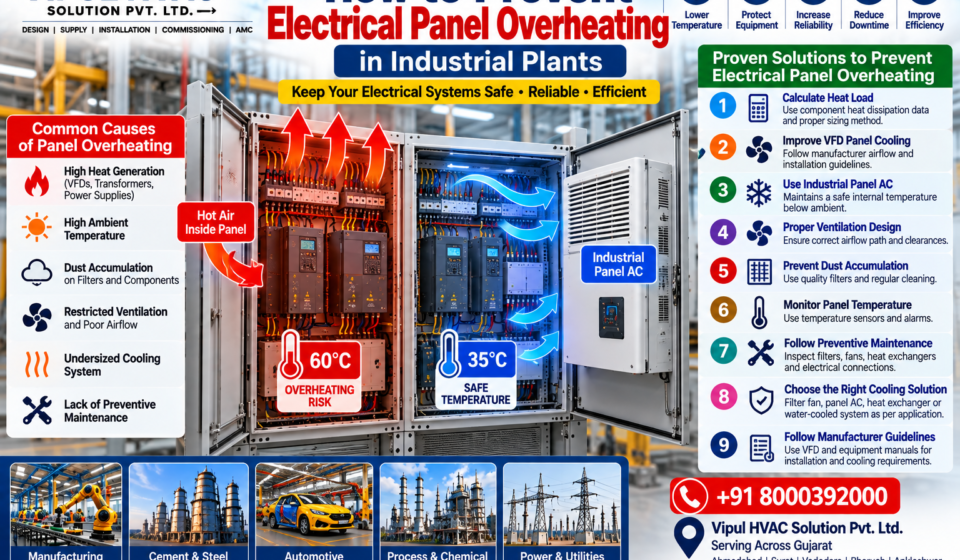
High ambient temperatures, excessive electrical losses, dust accumulation, restricted airflow, undersized cooling systems and poor maintenance can all contribute to rising cabinet temperatures.
If the problem is not corrected, the consequences may include temperature alarms, VFD derating, nuisance trips, unplanned shutdowns and premature component failure. The appropriate electrical panel overheating solution depends on identifying the actual heat source and selecting a cooling method suited to the enclosure and operating environment.
Vipul HVAC Solution Pvt Ltd provides HVAC-related product and project support for industrial cooling requirements. This guide explains nine practical ways to prevent electrical panel overheating, with particular attention to VFD panel cooling, enclosure air conditioning, ventilation and preventive maintenance.
1. Identify the Main Causes of Electrical Panel Overheating
Before installing additional fans or an air conditioner, identify why the panel is becoming hot.
Excessive heat generation
Electrical equipment converts some of its input energy into heat. The amount depends on the component, its loading, efficiency and operating conditions.
Common heat sources include:
- Variable frequency drives and motor drives
- Transformers and power supplies
- Contactors and switching equipment
- Busbars and electrical connections
- PLCs and automation equipment
- Braking resistors installed within or near the enclosure
- High-density electrical assemblies
Do not assume that the full electrical input of every component becomes heat inside the cabinet. Use the manufacturer’s heat-dissipation or power-loss data to estimate the heat actually released into the enclosure.
High ambient temperature
An enclosure installed in a hot factory, near a furnace, under direct sunlight or close to other heat-generating machinery may struggle to dissipate heat naturally.
A cooling system must be selected for the maximum expected ambient temperature, not just the temperature measured during a mild-weather inspection.
Dust accumulation
Dust can block filter fans, obstruct heat-exchanger surfaces and reduce airflow. Conductive or corrosive contamination may also create additional electrical and equipment risks.
Restricted ventilation
Closely packed components, blocked vents, inadequate fan capacity, incorrect fan placement and insufficient clearances around VFDs can create local hot spots.
Incorrect cooling-system selection
A panel air conditioner that is too small, unsuitable for the ambient conditions or poorly installed may fail to maintain the required internal temperature.
First action: Record the enclosure temperature, outside ambient temperature, equipment load, alarm history and cooling-system condition before choosing a solution.
2. Calculate the Electrical Panel Heat Load
Correct cooling selection starts with a realistic heat-load estimate.
The internal heat load should be based on component losses, measured values where appropriate and manufacturer documentation.
Plain-text heat-load formula
Total internal heat load (W) = Heat from component 1 + Heat from component 2 + Heat from component 3 + …
For example, suppose a cabinet has the following illustrative heat losses:
| Component | Heat dissipated |
|---|---|
| VFD | 450 W |
| Transformer | 120 W |
| Power supplies and controls | 80 W |
| Other components | 100 W |
| Total internal heat load | 750 W |
Calculation:
750 W = 450 W + 120 W + 80 W + 100 W
The estimated internal heat load is 750 watts.
These figures are examples, not specifications for a real VFD or electrical panel. Obtain the actual losses from the relevant component datasheets.
Account for additional heat entering the enclosure
The cooling requirement may also be affected by heat transfer through the enclosure walls, solar gain, nearby hot equipment and the installation environment.
For an air conditioner, heat entering through the enclosure walls can increase the required cooling capacity. For a heat exchanger, heat transfer through the cabinet may help remove heat when the outside air is cooler than the internal air.
Use a recognized enclosure-cooling calculation method or a manufacturer’s selection tool to account for these factors. nVent HOFFMAN’s technical guidance explains how internal heat load, enclosure surface area and temperature difference influence cooling selection.
Convert cooling capacity into BTU/h
For unit conversion:
Cooling capacity (BTU/h) = Cooling capacity (W) × 3.412
For example:
750 W × 3.412 = approximately 2,559 BTU/h
This converts 750 W into approximately 2,559 BTU/h. It does not mean that a 2,559 BTU/h air conditioner is automatically sufficient for the example cabinet. The final selection must also account for wall heat gain, ambient temperature, the target enclosure temperature, actual product performance and an appropriate design margin.
3. Improve VFD Panel Cooling
VFDs can generate significant heat while controlling motor speed. Their cooling requirements vary by model, drive rating, load, switching frequency and installation arrangement.
Follow the manufacturer’s installation instructions
For effective VFD panel cooling:
- Maintain the specified mounting orientation.
- Provide the recommended clearance around each drive.
- Keep the manufacturer’s air inlets and outlets unobstructed.
- Check whether the drive’s heat loss is released inside or outside the cabinet.
- Confirm the required ventilation airflow from the exact drive manual.
- Check the permitted ambient-temperature range and any derating requirements.
- Avoid positioning hot exhaust air where it will be drawn back into the equipment’s air inlet.
Schneider Electric’s drive documentation illustrates why the exact model manual matters: ventilation airflow and mounting instructions can vary between drive models and enclosure arrangements.
Avoid creating hot spots
A fan may move air without removing enough heat from the enclosure. If air repeatedly circulates around the same area, the VFD may still experience excessive temperatures.
Arrange the internal airflow so that it supports the manufacturer’s cooling path and distributes air appropriately. Where necessary, use an internal circulation fan, correctly designed ventilation or a suitable enclosure cooling unit.
Do not modify drive covers or remove protective components unless the manufacturer explicitly permits the configuration.
4. Choose the Right Electrical Panel Cooling Solution
There is no single cooling method suitable for every industrial cabinet.
Option A: Filter fan and exhaust fan
A filter fan introduces outside air through a filter while an exhaust fan removes warm air.
Suitable applications may include enclosures where the outside air is sufficiently cool and clean and the required enclosure protection can be maintained.
Advantages:
- Relatively simple installation
- Can provide useful airflow for suitable heat loads
- May have a lower initial cost than a panel AC
Limitations:
- Performance depends on outside-air temperature.
- Filters require inspection and cleaning or replacement.
- Dust and moisture may enter if the system is unsuitable for the environment.
- It cannot normally cool the enclosure below the ambient-air temperature.
Option B: Industrial panel air conditioner
An industrial panel AC uses a refrigeration cycle to remove heat from an electrical enclosure. A suitable closed-loop design cools the internal cabinet air without relying on the outside air entering the enclosure.
Advantages:
- Can maintain an internal temperature below ambient, within its rated operating conditions
- Suitable for dusty environments when the enclosure and cooling system are properly specified
- Helps protect sensitive electrical and automation components
Limitations:
- Requires appropriate cooling-capacity selection
- Consumes electrical power
- Needs installation clearances and preventive maintenance
- Must be suitable for the maximum ambient temperature and environmental conditions
Option C: Air-to-air heat exchanger
A heat exchanger transfers heat between internal and external air streams without mixing them.
It may be suitable when the external air is cooler than the required internal cabinet temperature and the heat exchanger has sufficient capacity.
It is not the right choice when the required internal temperature is below the external ambient temperature.
Option D: Air-to-water heat exchanger
An air-to-water heat exchanger transfers heat from cabinet air to a water circuit. It may suit facilities with an appropriate cooling-water supply and suitable water temperature, flow and quality.
Selection must account for water-side conditions, leak risk, installation requirements and maintenance access.
Quick comparison
| Cooling solution | Best suited for | Main limitation |
|---|---|---|
| Filter fan | Lower heat loads and suitable clean ambient air | Cannot cool below ambient |
| Industrial panel AC | Applications requiring controlled cabinet temperatures | Requires correct sizing and servicing |
| Air-to-air heat exchanger | Applications where outside air is cooler than the required internal temperature | Cannot cool below the external air temperature |
| Air-to-water heat exchanger | Sites with a suitable cooling-water circuit | Requires suitable water supply and system design |
For industrial plants with high ambient temperatures or dust-sensitive electronics, a correctly selected industrial panel AC may be a more suitable solution than relying on outside-air ventilation alone.
5. Prevent Dust Accumulation and Airflow Restrictions
Dust is a frequent contributor to cooling problems in factories, workshops and process plants.
When dust accumulates on a filter, condenser or ventilation grille, it can restrict airflow and reduce heat transfer. The actual impact depends on the equipment design and the amount and type of contamination.
Recommended dust-control measures
- Inspect filters according to the manufacturer’s instructions.
- Clean or replace filters when required.
- Keep air inlets and outlets free of obstructions.
- Inspect condenser surfaces and clean them using the approved procedure.
- Check that exhaust air is not recirculating into an intake.
- Evaluate enclosure protection requirements for dusty or corrosive locations.
- Consider a suitable closed-loop panel AC where outside-air contamination is unacceptable.
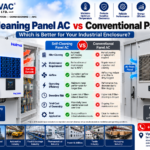
For exceptionally dusty applications, evaluate whether a self-cleaning panel AC filter system is appropriate. Such systems may reduce manual filter-cleaning work, but the complete cooling unit still requires the maintenance specified by its manufacturer.
Do not use compressed air or cleaning chemicals on electrical equipment unless the equipment manufacturer permits the method and the correct safety precautions are followed.
6. Maintain the Correct Enclosure Temperature
The acceptable temperature is determined by the ratings of the installed components and the requirements of the complete assembly.
Do not apply one universal temperature limit to every electrical cabinet.
Monitor the temperature at relevant locations
Use appropriate temperature sensors or monitoring devices to measure conditions near heat-sensitive components, including:
- VFD air inlets and outlets
- PLC and control equipment areas
- Power supply assemblies
- Cabinet air intake and exhaust locations
- Areas identified during thermal inspections
A single sensor may not identify every hot spot. Compare temperature readings with equipment manuals, alarm settings and historical trends.
Use alarms and monitoring where justified
Depending on the installation, a monitoring system may provide:
- High-temperature alarms
- Cooling-unit fault indications
- Fan-failure alarms
- Temperature trend logging
- Remote status monitoring
- Maintenance notifications
Set alarm thresholds according to the installed equipment’s permitted operating conditions. Do not copy generic thresholds without checking the relevant specifications.
Early warning can help maintenance teams investigate a cooling fault before it becomes a production interruption.
7. Follow a Preventive-Maintenance Schedule
Preventive maintenance should cover both the electrical equipment and the cooling system.
Electrical panel maintenance checklist
- Inspect for loose, damaged or discoloured connections using approved procedures.
- Check for unusual odours, noise, vibration or visible damage.
- Review VFD fault codes and temperature alarms.
- Inspect fans, vents and filters.
- Verify that required drive clearances remain unobstructed.
- Check cabinet door seals and cable-entry protection.
- Review temperature readings under representative operating loads.
- Record recurring faults and completed maintenance.
Electrical inspection and servicing must be performed by appropriately trained personnel under the site’s electrical safety and isolation procedures.
Industrial panel AC maintenance checklist
- Inspect and clean filters as instructed by the manufacturer.
- Inspect condenser and evaporator surfaces.
- Check fans for abnormal noise or vibration.
- Check condensate drainage where applicable.
- Verify controller settings and alarm operation.
- Inspect mounting, seals and clearances.
- Check cooling performance at representative operating conditions.
- Record faults, service dates and replaced parts.
The inspection interval should be based on the equipment manual, dust conditions, operating hours and site maintenance history. A dusty industrial environment may require more frequent attention than a clean electrical room.
8. Common Mistakes That Cause Panel Overheating
Installing an undersized panel AC
A cooling unit selected only by cabinet dimensions may be inadequate if the internal heat load is high or the ambient temperature is severe.
Better approach: Calculate the heat load and verify the selected unit’s capacity under the expected operating conditions.
Relying only on ventilation in a hot environment
A fan cannot normally lower cabinet temperature below the air temperature entering the enclosure.
Better approach: Consider refrigeration-based panel cooling when the required internal temperature is below the ambient temperature.
Ignoring the VFD manufacturer’s airflow requirements
A drive may require particular clearances, airflow rates or mounting arrangements.
Better approach: Follow the exact drive manual and account for its documented heat losses.
Ignoring filters and heat exchangers
A fan or air conditioner cannot perform properly if critical airflow paths are obstructed.
Better approach: Include filters, coils, fans and air passages in the preventive-maintenance plan.
Treating the entire cabinet as one uniform temperature zone
The temperature near a drive can differ from the temperature at the bottom of a cabinet.
Better approach: Measure temperatures at relevant locations and correct airflow distribution problems.
Ignoring the outside environment
Dust, corrosive gases, humidity, solar gain and high ambient temperatures can all affect cooling-system suitability.
Better approach: Select the cooling unit and enclosure protection for the actual installation conditions.
9. How to Select an Electrical Panel Cooling System for Your Plant
Before purchasing a new industrial panel AC or upgrading an existing cooling arrangement, prepare the following information.
Panel details
- Height, width and depth
- Enclosure material and mounting location
- Internal component layout
- Required enclosure protection
Thermal information
- Estimated internal heat dissipation in watts
- Maximum outside ambient temperature
- Required internal temperature
- Heat from nearby machinery or solar exposure, where applicable
- Temperature readings and existing alarm history
Operating conditions
- VFD model and rating
- Operating load and duty cycle
- Dust, humidity and corrosive exposure
- Available electrical supply
- Required operating hours and service access
Cooling-system details
- Existing cooling-unit model and rated capacity
- Measured airflow, where available
- Filter condition and cleaning history
- Cooling-unit faults and maintenance records
With this information, the required cooling capacity and suitable cooling method can be evaluated more accurately.
Benefits of Proper Electrical Panel Cooling
A well-designed and maintained cooling system can help a plant:
- Keep components within their permitted operating temperatures
- Reduce overheating-related alarms and interruptions
- Maintain the intended operating conditions for VFDs and automation equipment
- Reduce airflow problems caused by neglected filters
- Support preventive maintenance planning
- Improve the reliability of electrical and control systems
These are potential operational benefits, not guarantees against equipment failure. Component condition, electrical design, loading, installation quality and maintenance practices remain important.
Frequently Asked Questions
1. What is the best solution for electrical panel overheating?
The best solution depends on the root cause. It may involve correcting blocked airflow, cleaning filters, improving VFD clearances, reducing heat sources, upgrading ventilation or installing a correctly sized industrial panel AC.
2. How can I improve VFD panel cooling?
Follow the drive manufacturer’s mounting and airflow requirements, calculate the actual heat losses, keep ventilation paths clear, inspect filters and measure temperatures around the drive. If ventilation cannot maintain the required temperature, assess a suitable enclosure cooling system.
3. Can an exhaust fan prevent electrical panel overheating?
An exhaust fan can help remove heat when outside air is sufficiently cool and the ventilation arrangement is properly designed. It is usually unsuitable as the only solution when the required cabinet temperature is below the ambient temperature.
4. How do I calculate the cooling capacity for an electrical panel?
Estimate the heat dissipated by installed components, account for heat entering through the enclosure and other relevant environmental effects, and verify the cooling unit’s actual capacity at the expected operating conditions. A manufacturer’s enclosure-cooling selection method can help with this calculation.
5. Why does my VFD trip due to high temperature?
Possible causes include insufficient airflow, clogged filters, high ambient temperature, excessive loading, obstructed drive clearances, a failed fan or an unsuitable enclosure cooling arrangement. Check the drive’s fault code and manual before deciding on corrective action.
6. How often should an industrial panel AC be serviced?
Follow the manufacturer’s recommended schedule and adjust inspections according to operating hours, dust accumulation and actual site conditions. Check filters, heat exchangers, fans, drainage, alarms and cooling performance as applicable.
7. Is a panel AC better than a filter fan?
A panel AC is generally more appropriate when the cabinet needs cooling below ambient temperature or when a suitable closed-loop design is required. A filter fan may be adequate for lower heat loads in a suitable environment where outside-air ventilation can maintain the required temperature.
8. Which industries need effective VFD panel cooling?
Industries using motor drives and automation systems—including manufacturing, textiles, cement, steel, packaging, pharmaceuticals, water treatment and process plants—may need carefully designed electrical panel cooling. The exact solution depends on the application and installation environment.
Conclusion
Preventing electrical panel overheating requires more than adding a fan. Industrial plants need to identify heat sources, calculate the internal heat load, maintain suitable airflow, protect against dust accumulation and select an enclosure cooling system that matches the required temperature and environmental conditions.
For VFD panels and other high-heat electrical enclosures, correct cooling selection and preventive maintenance can help reduce overheating-related operating problems. Always confirm cooling capacity, airflow requirements and temperature limits using the relevant equipment documentation.
Electrical Panel Cooling Enquiries – Vipul HVAC Solution Pvt Ltd
Vipul HVAC Solution Pvt Ltd supports industrial HVAC and cooling enquiries, including electrical panel cooling and VFD panel cooling requirements.
For assistance evaluating a panel cooling requirement, share the cabinet dimensions, component heat losses, maximum ambient temperature, target internal temperature and operating environment.
Contact: +91 8000392000
Website: https://vipulhvacsolution.in/
Contact the team to discuss suitable cooling options for your industrial application.
Important links: