
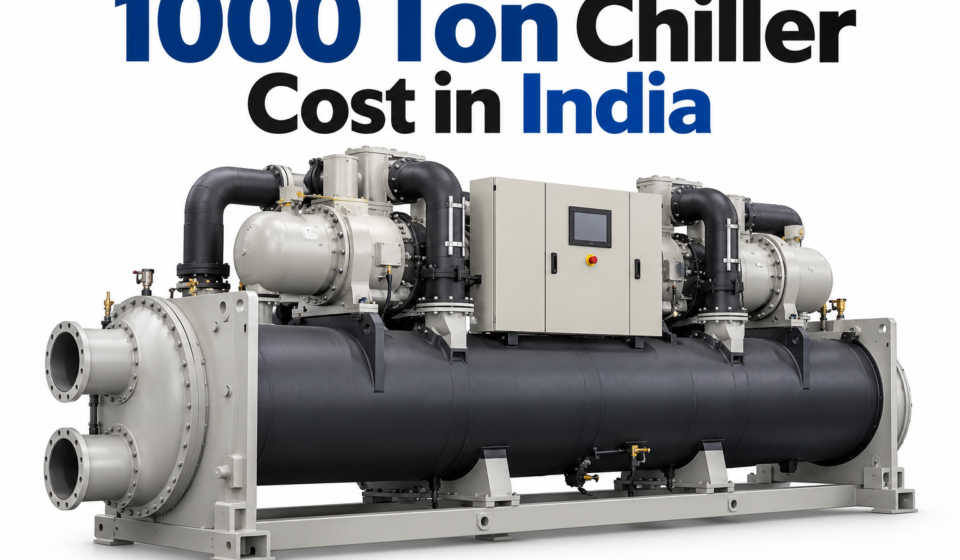

How Much Do Chillers Cost? Complete Industrial and Commercial Chiller Price Guide
How much does a chiller cost in India? The price depends on the cooling capacity, chiller type, compressor technology, energy efficiency, operating temperature, and installation requirements. A small process chiller for manufacturing equipment can cost substantially less than a large central chiller plant designed for a hospital, hotel, factory, shopping mall, or commercial building.
VIPUL HVAC SOLUTION PVT. LTD. provides HVAC solutions for commercial and industrial applications, including chiller systems, air-conditioning equipment, ventilation, and related HVAC requirements.
In this guide, we explain indicative chiller prices, the difference between air-cooled and water-cooled chillers, installation expenses, operating costs, and how to select a suitable chiller for your project.
How Much Does a Chiller Cost in India?
Chiller prices vary widely depending on the application and specifications. The following figures are preliminary budgeting references, not a supplier quotation or guaranteed market price. Actual prices should be confirmed against current manufacturer specifications and project requirements.
| Chiller type or capacity | Indicative equipment price reference |
|---|---|
| Small air-cooled chiller, approximately 1–5 TR | Around ₹50,000–₹2.5 lakh in some market listings |
| Air-cooled process chiller, approximately 5–30 TR | Around ₹25,000–₹45,000 per TR in one published market guide |
| Water-cooled chiller, approximately 30–300 TR | Around ₹15,000–₹30,000 per TR in one published market guide |
| Larger commercial or industrial chiller plant | Project-specific quotation required |
| Low-temperature brine or glycol chiller | Depends heavily on the required fluid temperature and materials |
Important: Do not calculate your final project budget using the price per TR alone. Confirm the required cooling capacity at the actual design conditions, the equipment specification, GST, delivery, installation, commissioning, and any additional plant equipment.
What Is a Chiller and How Does It Work?
An industrial or commercial chiller removes heat from water or another circulating fluid. The cooled fluid is then supplied to equipment, air-handling units, fan-coil units, or process machinery that needs cooling.
A typical chiller system may include:
- Compressor.
- Evaporator.
- Condenser.
- Expansion device.
- Refrigerant circuit.
- Control panel and safety devices.
- Pumps and associated piping, depending on the system configuration.
Chillers are used in applications such as manufacturing, pharmaceutical production, hospitals, hotels, data centres, commercial buildings, and industrial process cooling.
The appropriate chiller depends on whether the project requires comfort air conditioning, process cooling, or a combination of both.
Air-Cooled vs Water-Cooled Chiller: Which Is More Cost-Effective?
1. Air-Cooled Chiller
An air-cooled chiller rejects heat directly to outdoor air through its condenser and fans. It does not require a cooling tower for condenser heat rejection.
Advantages
- Simpler installation in many applications.
- No cooling tower or condenser-water circuit.
- Generally lower initial system complexity.
- Suitable for many commercial and industrial applications.
Cost considerations
The outdoor unit needs adequate ventilation and space. Fan operation, outdoor temperatures, condenser cleanliness, and equipment efficiency affect running costs.
2. Water-Cooled Chiller
A water-cooled chiller rejects heat through a condenser-water circuit, commonly connected to a cooling tower.
Advantages
- Can provide efficient operation in suitable large-scale installations.
- Often worth evaluating for buildings with substantial, continuous cooling demand.
- Suitable for many central chilled-water plant applications.
Cost considerations
The project may require a cooling tower, condenser-water pumps, water treatment, additional piping, and plant-room infrastructure. Water consumption and maintenance also need to be included in the budget.
Which One Should You Choose?
There is no universal winner. An air-cooled chiller may suit a project where simplicity and limited water infrastructure are priorities. A water-cooled chiller may be attractive where cooling demand is high and sustained, and the project can support the additional plant equipment.
Compare the total installed and operating costs for the actual project rather than choosing based only on the initial machine price.
7 Major Factors That Affect Chiller Cost
1. Cooling Capacity in TR
Cooling capacity is one of the most important cost factors. Larger chillers generally cost more overall, but their price per refrigeration ton may differ from that of smaller equipment.
Capacity should be determined through a proper cooling-load calculation, not simply by choosing a large chiller to provide a safety margin.
Oversizing can increase initial costs and may reduce efficiency or cause operational problems at low loads. <Cite refs={[“turn355931search1”]}/>
2. Compressor Type
Chillers may use scroll, screw, or centrifugal compressor technology, depending on capacity and application.
- Scroll compressors: Common in smaller and some medium-capacity systems.
- Screw compressors: Used in many medium- and large-capacity applications.
- Centrifugal compressors: Commonly considered for large central cooling plants.
The appropriate selection depends on capacity, operating conditions, efficiency, redundancy, and manufacturer availability.
3. Required Chilled-Water Temperature
A chiller designed for conventional chilled-water air conditioning may have very different requirements from a process chiller that must cool a fluid to a low temperature.
Lower fluid temperatures can require different compressor selection, heat-exchanger design, materials, and controls.
Brine and glycol systems may also need special fluid compatibility and temperature-control arrangements.
4. Energy Efficiency
A higher-efficiency chiller may cost more upfront but can reduce electricity consumption during operation.
When comparing equipment, review the manufacturer’s performance data at the expected operating conditions. Where available, examine full-load efficiency and part-load performance, including COP, kW/TR, and applicable IPLV or NPLV values.
Do not compare efficiency figures unless the test conditions and rating basis are equivalent.
5. Heat Exchanger and Material Selection
Heat exchangers may use different construction methods and materials depending on the application.
Projects involving corrosive fluids, special process requirements, or unusual water conditions may require additional material specifications and treatment measures, affecting the total price.
6. Controls, Automation and Redundancy
The project may require a basic controller or a more advanced system with PLC integration, building management system connectivity, variable-frequency drives, remote monitoring, or lead-lag control.
Critical facilities may also require standby capacity or multiple chillers so cooling can continue during certain equipment failures or maintenance activities.
These features affect both the equipment budget and the overall system design.
7. Installation and Commissioning Scope
The final project cost depends on what the quotation includes.
Potential additional items include:
- Chilled-water pumps.
- Cooling towers and condenser-water pumps, where required.
- Chilled-water and condenser-water piping.
- Insulation, valves and strainers.
- Electrical cabling and power distribution.
- Foundations, equipment supports, and vibration isolation.
- Controls integration.
- Water treatment.
- Testing, balancing and commissioning.
A low equipment-only price may not represent the lowest installed project cost.
What Is the Total Installed Cost of a Chiller?
The total installed cost is more than the chiller’s purchase price. It includes the equipment, supporting infrastructure, installation work, commissioning, and any project-specific requirements.
A useful budgeting structure is:
Total installed cost = Chiller equipment + Auxiliary equipment + Piping and electrical work + Installation + Controls + Commissioning + Applicable taxes
For a water-cooled plant, the budget should also account for cooling-tower infrastructure and water-treatment arrangements.
For an air-cooled system, the project may avoid cooling-tower costs but still require appropriate foundations, electrical infrastructure, piping, and equipment access.
Ask each supplier to identify included and excluded items clearly. This makes quotations easier to compare.
How Much Does a Chiller Cost to Run?
Electricity is often a major component of a chiller’s lifetime cost, especially in facilities that operate for long hours.
A simple preliminary estimate is:
Annual electricity cost = Average electrical demand (kW) × Annual operating hours × Electricity tariff (₹/kWh)
For example, suppose a chiller plant has an average electrical demand of 50 kW, operates for 4,000 hours per year, and electricity costs ₹8 per kWh.
- Annual electricity consumption: 50 × 4,000 = 200,000 kWh.
- Illustrative annual electricity cost: 200,000 × ₹8 = ₹16,00,000.
This is an example only, not an estimate for a particular chiller. The 50 kW figure represents average electrical demand for the illustrative calculation, not the rated demand of a specific machine.
Actual electricity costs depend on cooling load, operating hours, efficiency, pumps, cooling towers, controls, ambient conditions, and the applicable tariff.
For a reliable comparison, request projected power consumption at the expected operating conditions and part-load profile.
How to Choose the Right Chiller for Your Application
Different industries have different cooling requirements. Consider the following examples when planning a chiller project.
Chiller for a Factory
A factory chiller may cool production machinery, moulding equipment, process fluids, or manufacturing areas.
Selection depends on the process heat load, required fluid temperature, flow rate, operating schedule, and fluid compatibility.
Chiller for a Hospital
Hospitals may require central chilled-water systems for air-handling units and other cooling applications.
The design should consider load diversity, operating schedules, ventilation requirements, redundancy, and the specific requirements of critical areas.
Chiller for a Hotel or Shopping Mall
Hotels and malls often have variable cooling demand throughout the day. Chiller selection should consider occupancy, seasonal load, operating hours, part-load efficiency, and controls.
Chiller for Pharmaceutical or Process Cooling
Pharmaceutical and industrial processes may require tighter temperature control, specific materials, validated monitoring, or special fluid requirements.
The chiller should be selected according to the actual process specification rather than a generic capacity estimate.
Chiller Maintenance and Annual Operating Budget
A chiller’s purchase price is only one part of its lifetime cost. Preventive maintenance helps monitor performance and identify developing faults.
Depending on the system, maintenance may include:
- Checking operating pressures, temperatures, and alarms.
- Inspecting electrical components and safety devices.
- Cleaning condenser and evaporator surfaces as appropriate.
- Checking refrigerant circuits for signs of leakage.
- Inspecting pumps, valves, and piping.
- Monitoring chilled-water flow and temperature.
- Cleaning and maintaining cooling towers where installed.
- Maintaining suitable water quality and treatment.
- Reviewing energy consumption and operating performance.
Maintenance expenses depend on equipment size, operating hours, site conditions, maintenance scope, spare parts, and service-contract terms.
Request an itemized Annual Maintenance Contract (AMC) quotation rather than assuming that every chiller has the same annual service cost.
How to Compare Chiller Quotations
Before purchasing a chiller, request quotations based on the same technical requirements.
Use this checklist:
- Cooling capacity at the specified operating conditions.
- Chilled-fluid inlet and outlet temperatures.
- Fluid type and required flow rate.
- Air-cooled or water-cooled configuration.
- Compressor type and equipment manufacturer.
- Full-load and part-load performance data.
- Electrical supply and connected load.
- Controls, automation and communication requirements.
- Pumps, cooling towers and other auxiliaries.
- Installation, testing and commissioning scope.
- Warranty terms, service support and spare-parts availability.
- GST, delivery charges and payment terms.
A technically comparable quotation helps identify the option that offers the best balance of capital cost, operating cost, and reliability.
Why Contact VIPUL HVAC SOLUTION PVT. LTD.?
VIPUL HVAC SOLUTION PVT. LTD. provides HVAC solutions for commercial and industrial applications, including chiller systems, air-conditioning equipment, VRF/VRV systems, AHUs, ventilation, and related HVAC requirements.
If you are planning a chiller installation, replacement, or upgrade, share the following information to help define the project:
- Application or industry.
- Required cooling capacity, if known.
- Required chilled-water or process-fluid temperature.
- Expected operating hours.
- Air-cooled or water-cooled preference, if established.
- Site location and installation requirements.
- Whether you need equipment supply only or a complete installation.
The correct configuration and quotation should be determined from the project’s actual cooling load, operating conditions, and scope of work.
Contact VIPUL HVAC SOLUTION PVT. LTD.
Central sales: +91 8000392000
Email: info@vipulhvacsolution.in
Website: https://vipulhvacsolution.in/
Branch directory: https://vipulhvacsolution.in/our-branches/
Contact page: https://vipulac.in/contact-us/
Contact the team to discuss your chiller or HVAC project requirements and confirm equipment availability, technical scope, and quotation details.
Frequently Asked Questions About Chiller Cost
1. How much does an industrial chiller cost in India?
The price depends on capacity, operating temperature, compressor type, efficiency, construction, and scope of supply. Small packaged chillers may cost substantially less than large industrial or central cooling plants. A project-specific quotation is needed for an accurate budget.
2. Which is cheaper: an air-cooled or water-cooled chiller?
An air-cooled system can have a simpler installation because it does not require a cooling tower. A water-cooled system needs additional infrastructure but may offer operating-efficiency advantages in suitable applications. Compare the total installed and lifetime costs.
3. How do I calculate the required chiller capacity?
Start with a proper cooling-load calculation based on the process or building requirements. Consider the required fluid temperatures, flow rate, operating conditions, load variation, and equipment losses. Do not select capacity based only on floor area or a generic rule of thumb.
4. What is the difference between chiller equipment cost and installed cost?
Equipment cost covers the chiller itself according to the supplier’s quotation. Installed cost may also include pumps, piping, electrical work, controls, foundations, cooling towers, installation, testing, commissioning, and taxes.
5. Does a higher-efficiency chiller always save money?
Not automatically. Savings depend on the efficiency improvement, operating hours, load profile, electricity tariff, and additional purchase cost. A life-cycle cost analysis helps determine whether the premium is worthwhile.
6. How much electricity does a chiller consume?
Electricity consumption depends on the chiller’s actual power demand and operating hours. Use manufacturer performance data at the expected conditions and include associated pumps and cooling towers where relevant.
7. What information is required for a chiller quotation?
Provide the application, required cooling capacity, fluid temperatures, flow rate, operating hours, site details, and required equipment scope. If some details are unknown, a qualified HVAC professional can help establish the design requirements.
8. Can VIPUL HVAC SOLUTION PVT. LTD. help with chiller requirements?
You can contact the company to discuss chiller systems and related HVAC requirements. Confirm the specific equipment, project scope, availability, and quotation directly with the team.
Conclusion
The answer to “How much do chillers cost?” depends on more than the machine’s capacity. Chiller type, compressor technology, operating temperature, energy efficiency, auxiliary equipment, installation, and maintenance all affect the total investment.
For the best value, determine the actual cooling load, compare technically equivalent quotations, and evaluate electricity consumption alongside the purchase price.
For commercial and industrial chiller enquiries, contact VIPUL HVAC SOLUTION PVT. LTD. at +91 8000392000 or email info@vipulhvacsolution.in to discuss your requirements.
Choose a chiller based on the right capacity, the right operating conditions, and the total cost of ownership—not just the lowest initial price.
Technical references
- ASHRAE Handbook — Liquid-Chilling Systems — chiller selection, capacity, auxiliaries, energy, water, and maintenance costs.
- U.S. Department of Energy — Purchasing Energy-Efficient Electric Chillers — evaluating efficiency and energy savings.
- Industrial Chiller Price in India: 2026 Guide — indicative Indian market pricing and factors affecting quotations.