
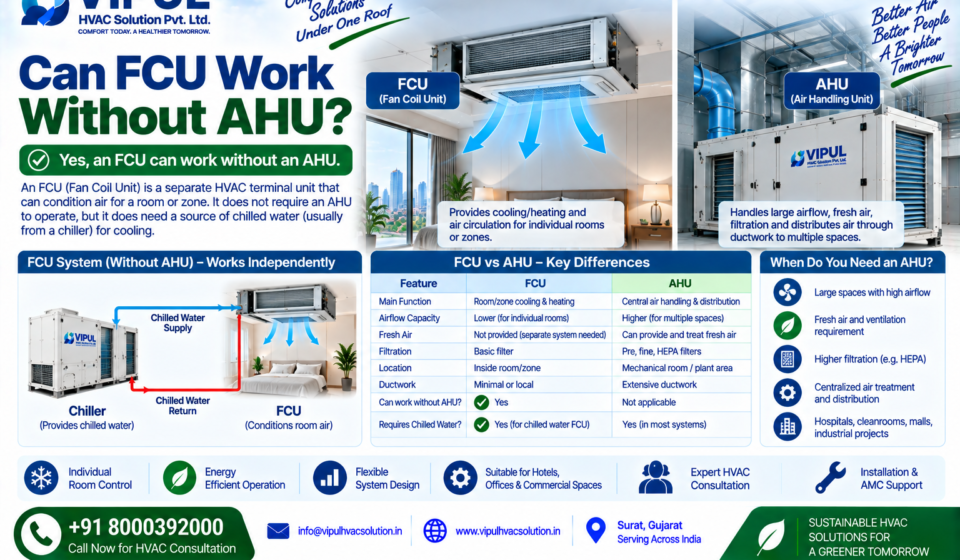

Can FCU Work Without AHU? Complete HVAC Guide
Yes, an FCU (Fan Coil Unit) can work without an AHU (Air Handling Unit). An FCU is a separate HVAC terminal that can condition air for an individual room or zone. It does not inherently require an AHU to operate.
However, there is an important distinction:
An FCU can operate without an AHU, but a chilled-water FCU still needs a source of chilled water—typically a chiller or another suitable cooling-water system.
An FCU primarily handles local temperature control, while an AHU is generally designed for larger airflow volumes, air treatment and distribution. ASHRAE notes that fan-coil units can operate independently of a central air-distribution system.
For many commercial buildings, an FCU + separate fresh-air/ventilation system can be a practical solution. In other projects, an AHU + ductwork may be more appropriate.
What Is an FCU?
FCU stands for Fan Coil Unit.
An FCU is a relatively compact HVAC terminal containing a fan and coil that conditions air for a room or zone.
Depending on the system, an FCU can provide:
- Cooling
- Heating
- Air circulation
- Basic filtration
- Local temperature control
- Air movement within the room
ASHRAE describes fan-coil units as factory-made assemblies that can provide temperature/humidity control, filtration and room air distribution, and notes that they can operate independently of a central air-distribution system.
VIPUL HVAC currently offers FCUs with 0.5 TR to 5 TR capacity, chilled-water cooling, multi-speed airflow, thermostat/BMS-ready controls and condensate management.
What Is an AHU?
AHU stands for Air Handling Unit.
An AHU is generally a larger HVAC air-treatment and distribution unit designed to handle and condition air for one or multiple zones.
Depending on the application, an AHU may include:
- Supply fan
- Cooling coil
- Heating coil
- Pre-filter
- Fine filter
- HEPA filter
- Fresh-air section
- Return-air section
- Dampers
- Humidity control
- BMS controls
- Air distribution through ductwork
VIPUL’s current AHU offering includes customized CFM capacity, single- and double-skin construction, pre/fine/HEPA filtration, cooling/heating coils, backward-curved or EC fans and BMS-ready controls.
Can FCU Work Without AHU?
Yes.
An FCU does not need an AHU simply to cool or heat a room.
For example, a typical chilled-water FCU arrangement can be:
Chiller
↓
Chilled-Water Pump
↓
Chilled-Water Piping
↓
FCU
↓
Conditioned Room
↓
Return Chilled Water
↓
Chiller
In this configuration, there is no AHU.
The FCU receives chilled water, circulates room air across its cooling coil and returns conditioned air to the same space.
VIPUL’s chiller information similarly describes chilled water being distributed to both AHUs and FCUs.
But There Is an Important Catch
The answer becomes different when we talk about ventilation.
An FCU can provide local cooling, but that does not automatically mean it provides all the outdoor ventilation air required by a building.
ASHRAE notes that fan-coil systems may operate independently, but outdoor-air/ventilation requirements need to be properly addressed; in commercial buildings, outdoor air supplied directly through uncontrolled wall openings is not an appropriate substitute for a properly controlled ventilation system.
Therefore:
FCU without AHU
Possible for temperature control.
FCU without any ventilation strategy
May not be appropriate, particularly in occupied commercial spaces where outdoor-air requirements must be met.
This distinction is extremely important.
How Does an FCU Work Without an AHU?
Consider a hotel room.
The system may look like:
Central Chiller
↓
Chilled-Water Pipe
↓
Hotel Room FCU
↓
Room Air
The FCU contains:
1. Fan
The fan pulls room air through the unit.
2. Cooling Coil
Chilled water flows through the coil.
3. Filter
The filter removes some airborne particles from recirculated air.
4. Thermostat
The thermostat controls the room temperature and/or FCU operation.
5. Condensate Drain
Condensation produced during cooling is collected and drained.
The FCU therefore conditions the room air locally.
Does an FCU Need a Chiller?
For a chilled-water FCU, yes, it needs a source of chilled water.
That source is commonly:
- Air-cooled chiller
- Water-cooled chiller
- Suitable chilled-water plant
- Other compatible hydronic cooling source
A simplified system is:
Chiller → Pump → Chilled-Water Piping → FCU → Room
The important point is:
FCU does not require an AHU, but a chilled-water FCU requires chilled water.
VIPUL’s current FCU product page specifies chilled water as the cooling medium.
Can FCU Work With a Chiller but Without AHU?
Yes.
This is one of the most common ways to understand the difference.
For example:
Chiller
↓
Pump
↓
Chilled-Water Distribution
↓
FCUs in Individual Rooms
↓
Room Cooling
There may be no central AHU serving those rooms.
This arrangement can be useful when individual zones need independent temperature control.
ASHRAE identifies fan-coils as suitable for individual-zone applications and notes that they can operate independently of central air-distribution systems.
FCU Without AHU vs FCU With AHU
| Feature | FCU Without AHU | FCU + AHU |
|---|---|---|
| Local cooling | Yes | Yes |
| Individual zone control | Excellent | Excellent |
| AHU required | No | Yes |
| Chilled-water source | Usually required for hydronic FCU | Usually required |
| Fresh-air management | Separate system may be required | AHU can handle it |
| Ductwork | Minimal/local | More extensive |
| Central filtration | Limited | More configurable |
| Large-volume air distribution | Limited | Strong |
| Individual room control | Strong | Strong |
| Hotel rooms | Common application | Possible |
| Offices | Possible | Possible |
| Large open spaces | Project dependent | Often more appropriate |
| Central ventilation | Separate system | Can be integrated |
Why Would You Use an FCU Without an AHU?
There are several reasons.
1. Individual Room Control
Each FCU can serve a specific room or zone.
For example:
- Hotel Room 101
- Hotel Room 102
- Hotel Room 103
- Hotel Room 104
Each room can have its own thermostat/control.
2. Less Air-Duct Infrastructure
A traditional centralized AHU system can require extensive ductwork.
With an FCU, air can be conditioned close to where it is required.
This can reduce the amount of large central air-distribution ductwork, although chilled-water piping and local ductwork may still be needed.
ASHRAE notes that fan-coil systems can require less building interstitial space than all-air systems because water/refrigerant piping can transport energy more compactly than large air-distribution systems.
3. Suitable for Hotels
Hotels are a classic application for room-level FCUs.
A typical hotel can use:
Chiller
↓
Chilled-Water Piping
↓
FCU in Each Room
↓
Individual Thermostat
This allows individual room temperature control.
However, the hotel’s fresh-air and ventilation strategy must still be designed separately or integrated appropriately.
4. Suitable for Offices
FCUs can also be used for:
- Private cabins
- Small offices
- Meeting rooms
- Individual zones
- Commercial spaces
For a large open-plan office, however, the HVAC engineer should compare FCU-based zoning with an AHU/ducted-air solution based on airflow, ventilation, acoustics, ceiling space and control requirements.
5. Retrofit Applications
FCUs can be useful in some retrofit projects where installing large new ductwork is difficult.
For example:
Existing Building
↓
New Chilled-Water Piping
↓
Local FCUs
This can sometimes provide a practical path to adding or modifying cooling zones.
ASHRAE notes that fan-coil systems can be useful for retrofits and for expanding capacity beyond an existing air system.
When Is an AHU Required?
An AHU may be appropriate when the project requires centralized treatment and distribution of larger volumes of air.
Consider an AHU when you need:
- Large airflow
- Centralized ventilation
- Extensive filtration
- Fresh-air treatment
- Humidity control
- Multiple zones through ductwork
- HEPA filtration
- Central BMS control
- Large commercial air distribution
- Specialized cleanroom air handling
For example:
Chiller → AHU → Ductwork → Multiple Rooms
can provide centralized air treatment and distribution.
FCU and AHU Can Work Together
A common misconception is:
“You either use FCU or AHU.”
Not necessarily.
A building can use both.
For example:
Central AHU
Handles:
- Fresh air
- Filtration
- Dehumidification
- Outdoor-air treatment
FCUs
Handle:
- Individual room cooling
- Local temperature control
- Zone-level comfort
A simplified arrangement can be:
Fresh Air System / AHU
↓
Treated Outdoor Air
↓
Rooms
Chiller
↓
Chilled-Water Loop
↓
FCUs
↓
Individual Rooms
This can provide both centralized ventilation and localized temperature control.
FCU + AHU System for a Hotel
A hotel is a good example.
Central ventilation
FAHU/AHU → Fresh Air → Guest Rooms
Cooling
Chiller → Chilled Water → FCUs → Guest Rooms
The FCU provides room-level cooling while the ventilation system manages outdoor air.
This separation can be useful when the project needs both individual comfort control and controlled ventilation.
FCU + AHU System for an Office
A commercial office may use:
AHU
For:
- Fresh air
- Large open workspaces
- Central filtration
- Air distribution
FCUs
For:
- Meeting rooms
- Private cabins
- Small zones
- Areas with different operating schedules
The actual arrangement depends on the building’s load and ventilation design.
FCU Without AHU: What About Fresh Air?
This is one of the most important questions.
An FCU primarily recirculates and conditions air from the space it serves.
If a project requires controlled outdoor air, a separate ventilation system may be necessary.
Possible solutions include:
- Fresh Air Handling Unit (FAHU)
- Dedicated Outdoor Air System (DOAS)
- Mechanical ventilation system
- Treated fresh-air system
- Appropriately designed outdoor-air connection
ASHRAE describes systems where ventilation air can be supplied from a central air handler to fan-coils, with appropriate treatment of outdoor air.
Therefore:
FCU cooling and building ventilation are two related but separate design questions.
Can an FCU Provide Fresh Air?
Some fan-coil configurations can incorporate outdoor air, but the suitability depends on the specific system design.
ASHRAE discusses fan-coil systems that can receive ventilation air from an outside-wall penetration or central air handler, while warning about uncontrolled outdoor-air quantities through building-envelope openings in commercial buildings.
For a commercial project, it is therefore better to have the ventilation strategy professionally designed rather than assuming that a wall opening connected to an FCU solves the outdoor-air requirement.
FCU vs AHU: Key Difference
| Parameter | FCU | AHU |
|---|---|---|
| Full form | Fan Coil Unit | Air Handling Unit |
| Typical role | Local conditioning | Central air handling |
| Size | Smaller | Larger |
| Airflow | Lower | Higher/custom |
| Zone control | Excellent | Central/zone dependent |
| Fresh air | Usually separate strategy | Can be integrated |
| Filtration | Basic/local | More configurable |
| Ductwork | Minimal/local | Common |
| Application | Rooms/zones | Floors/buildings |
| Chilled water | Common | Common |
| BMS | Possible | Common |
| HEPA | Application dependent | More common for specialized systems |
| Humidity control | Limited/application dependent | More configurable |
| Installation | Relatively compact | More infrastructure |
| Maintenance | Local units | Central equipment |
VIPUL’s own AHU information describes AHUs as equipment for larger HVAC systems, while its FCU offering focuses on individual room-level temperature control.
Which Is Better: FCU or AHU?
There is no universal answer.
The correct system depends on:
- Building size
- Cooling load
- Ventilation requirements
- Number of zones
- Ceiling height
- Available plant space
- Ductwork requirements
- Fresh-air requirement
- Filtration
- Humidity requirements
- Operating schedule
- Maintenance strategy
- Energy objectives
FCU may be appropriate when:
- Individual rooms need independent control
- Local cooling is required
- Large duct systems are undesirable
- Chilled-water infrastructure is available
- The project has many individual zones
AHU may be appropriate when:
- Large airflow is required
- Central ventilation is required
- Multiple spaces need centralized air treatment
- Advanced filtration is required
- Humidity control is important
- Extensive duct distribution is appropriate
Can FCU Work Without Chilled Water?
This depends on the type of FCU.
Hydronic FCUs use water through the coil.
Other fan-coil configurations can use DX/refrigerant cooling. ASHRAE recognizes both hydronic and DX fan-coil units.
However, VIPUL’s current FCU offering specifically lists chilled water as its cooling medium.
So when discussing a VIPUL chilled-water FCU project:
FCU does not need an AHU, but it does need an appropriate chilled-water source.
Can FCU Work Without a Chiller?
Again, this depends on the FCU type.
For a chilled-water FCU, there must be a suitable chilled-water source.
A typical commercial system may be:
Chiller → Pump → FCU
Without chilled water reaching the coil, the FCU cannot provide chilled-water cooling.
A DX-type fan-coil configuration is different because the cooling source is refrigerant rather than chilled water.
What Is the Difference Between FCU and Split AC?
An FCU and split AC can both provide local cooling, but their cooling architecture is different.
Split AC
Usually:
Indoor Unit → Refrigerant Piping → Outdoor Condensing Unit
Chilled-Water FCU
Usually:
FCU → Chilled-Water Piping → Central Chiller
An FCU therefore commonly forms part of a centralized chilled-water system.
What Is the Difference Between FCU and VRF?
FCU
Commonly uses:
Chilled Water → Coil → Room Air
VRF
Uses:
Refrigerant → Indoor Unit → Room Air
VRF can provide individual zone control without a central chilled-water plant.
Therefore, when planning a multi-zone HVAC system, engineers may compare:
- FCU + Chiller
- VRF
- AHU + Chiller
- Other HVAC configurations
The correct selection depends on project requirements.
Example: Small Hotel
Suppose a hotel has 100 guest rooms.
One possible design is:
Central Chiller
↓
Chilled-Water Pumps
↓
Chilled-Water Piping
↓
100 FCUs
↓
100 Guest Rooms
A separate fresh-air system can provide ventilation.
There is no requirement for one large AHU to directly cool all 100 rooms.
Example: Large Shopping Mall
A mall may have:
- Large retail areas
- Common areas
- Food court
- Corridors
- Offices
- Service areas
A centralized AHU system may be suitable for some large spaces, while FCUs may be appropriate for smaller zones.
A mixed HVAC architecture can therefore be considered.
Example: Hospital
Hospital HVAC is more specialized.
Different areas may have different requirements:
- Patient rooms
- Offices
- Corridors
- Operating rooms
- Isolation rooms
- Laboratories
- Critical care areas
The decision between AHU, FCU or another system should be based on the specific room’s ventilation, filtration, pressure, temperature and humidity requirements.
It would not be appropriate to assume that one FCU configuration is suitable for every hospital area.
7 Things to Check Before Installing an FCU Without AHU
1. Cooling Load
Calculate the room’s actual cooling requirement.
2. Chilled-Water Availability
Confirm the water temperature, flow and available pressure.
3. Fresh-Air Requirement
Determine whether the room requires mechanical outdoor air.
4. Filtration
Select the required filtration level.
5. Noise
Check the FCU’s sound level for the application.
6. Condensate Drainage
Provide suitable condensate drainage.
7. Controls
Select thermostat, valve and BMS requirements.
VIPUL HVAC FCU Solutions
VIPUL HVAC Solution Pvt. Ltd. currently offers FCU solutions for residential and commercial applications.
Its published FCU specifications include:
- Capacity: 0.5 TR to 5 TR
- Type: Ceiling concealed / exposed
- Cooling medium: Chilled water
- Airflow: Multi-speed
- Noise: Low-noise design
- Controls: Thermostat / BMS ready
- Drainage: Condensate management system
VIPUL also provides AHU solutions for larger centralized HVAC applications, including customized CFM selection, filtration, coils, fans and BMS-ready controls.
This allows the HVAC system to be designed according to the project’s actual requirements rather than automatically choosing one technology.
Why Choose VIPUL HVAC?
VIPUL HVAC can support projects involving:
- FCU selection
- AHU selection
- Chiller selection
- Heat-load calculation
- Chilled-water piping
- Ductwork
- Fresh-air ventilation
- HVAC controls
- BMS integration
- Installation
- Testing
- Commissioning
- AMC and maintenance
A complete chilled-water HVAC project may involve:
Chiller → Pumps → Piping → AHU/FCU → Ductwork/Air Distribution → Controls
VIPUL’s current HVAC portfolio includes FCUs, AHUs, chillers, ductwork, ventilation systems and BMS/HVAC automation.
Frequently Asked Questions
Can FCU work without AHU?
Yes. An FCU can operate independently of an AHU. A chilled-water FCU still requires a suitable chilled-water source, normally a chiller or other hydronic cooling source.
Does FCU need a chiller?
A chilled-water FCU needs chilled water, which is commonly supplied by a chiller. A DX fan-coil configuration can use refrigerant instead.
Can FCU provide fresh air?
An FCU can be part of a system that introduces outdoor air, but the ventilation arrangement must be properly designed. A separate FAHU/DOAS/ventilation system may be required depending on the project.
Can FCU and AHU work together?
Yes. An AHU can handle centralized ventilation and air treatment while FCUs provide individual zone temperature control.
Is FCU better than AHU?
Neither is universally better. FCUs are generally suited to localized/zone conditioning, while AHUs are commonly used for larger centralized air handling and distribution.
Can an FCU cool a room without ductwork?
Yes. Many FCUs can provide air directly to the room, although some configurations can be ducted.
Can an FCU be used in a hotel?
Yes. FCUs are commonly used for individual guest-room temperature control. Ventilation must be addressed separately or through an integrated design.
Can FCU work without a central air system?
Yes. ASHRAE specifically notes that fan-coil units can operate independently of a central air-distribution system.
Final Answer: Can FCU Work Without AHU?
Yes, an FCU can work without an AHU.
A typical chilled-water arrangement is:
Chiller → Chilled-Water Pump → Chilled-Water Piping → FCU → Room
The FCU handles local cooling and temperature control.
However, the absence of an AHU does not mean that ventilation can be ignored.
For commercial buildings, you may need a separate:
FAHU / DOAS / Fresh-Air Ventilation System
to provide controlled outdoor air.
Therefore:
FCU = local temperature control
AHU = centralized air handling and distribution
Chiller = source of chilled water
FAHU/DOAS = dedicated outdoor-air treatment where required
The best configuration should be selected after evaluating the cooling load, ventilation requirement, zoning, building layout, energy objectives and project budget.
Planning an FCU, AHU or chilled-water HVAC system? Contact VIPUL HVAC Solution Pvt. Ltd.
📞 +91 8000392000
📧 info@vipulhvacsolution.in
🌐 vipulhvacsolution.in
Recommended Links:
- Fan Coil Units (FCU)
- Air Handling Units (AHU)
- AHU Supplier in India
- Air Cooled Chiller
- Water Cooled Chiller
- Chiller System Supplier & Contractor in Gujarat
- Fresh Air Ventilation System
- VRF vs Chiller
- BMS & HVAC Automation