
How Much Area Is Covered by a 2 Ton Cassette AC? Complete Guide
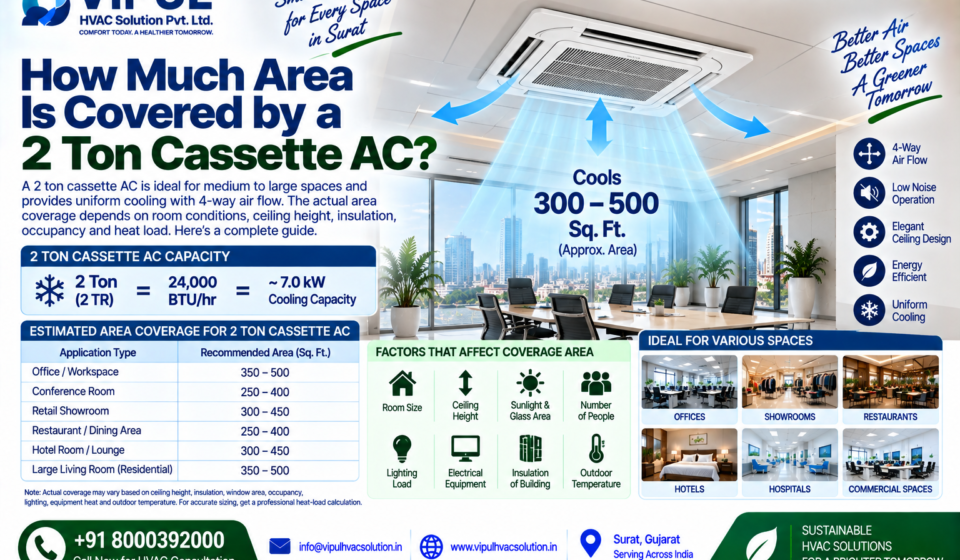
If you are wondering how much area is covered by a 2-ton cassette AC, a practical starting point is around 300–500 sq. ft. for many commercial applications, but there is no single fixed coverage area.
The actual area depends on heat load, ceiling height, glass/windows, insulation, occupancy, lighting, equipment heat, outdoor temperature and the room’s usage. A 2-ton cassette AC has a nominal cooling capacity of approximately 24,000 BTU/hr (about 7 kW), and current 2-ton cassette models from manufacturers such as LG, Godrej and Carrier show cooling capacities in this general range.
VIPUL HVAC SOLUTION PVT. LTD. currently offers cassette AC systems from 1.5 TR to 4.0 TR and states that capacity selection should consider factors such as heat load, occupancy and operating hours.
Quick Answer
How much area can a 2-ton cassette AC cover?
As a general planning range:
| Application | Approx. Area for 2-Ton Cassette AC |
|---|---|
| Well-insulated office | 350–500 sq. ft. |
| Standard office | 300–450 sq. ft. |
| Retail/showroom | 300–450 sq. ft. |
| Restaurant | 250–400 sq. ft. |
| Hotel/common room | 300–450 sq. ft. |
| Large residential room | 350–500 sq. ft. |
| High-heat commercial area | 250–350 sq. ft. |
| Industrial/light commercial area | Project-specific |
These are planning estimates, not guaranteed coverage figures.
For a professional HVAC project, the correct capacity should be determined through a cooling-load calculation, rather than simply dividing floor area by tonnage.
What Is a 2-Ton Cassette AC?
A 2-ton cassette AC is a ceiling-mounted air-conditioning system with approximately 24,000 BTU/hr nominal cooling capacity.
The word “ton” refers to cooling capacity, not the physical weight of the air conditioner.
1 Ton
≈ 12,000 BTU/hr
2 Ton
≈ 24,000 BTU/hr
2 Ton in kW
Approximately:
24,000 BTU/hr ÷ 3,412 = 7.03 kW
For example, Carrier’s listed 2-ton cassette model has a nominal cooling capacity of about 7,033 W / 24,000 BTU/hr, while LG’s 2.0 TR cassette model is also rated at 2.0 TR.
Why Doesn’t a 2-Ton AC Have a Fixed Coverage Area?
This is one of the most important points.
Two rooms can have exactly the same floor area but completely different cooling requirements.
For example:
Room A
400 sq. ft. office
- Low occupancy
- Few computers
- Limited glass
- Good insulation
- Moderate sunlight
A 2-ton AC may potentially be suitable.
Room B
400 sq. ft. showroom
- Large glass frontage
- Direct sunlight
- Many people
- Bright lighting
- Frequent door opening
The same 2-ton AC may not provide the same cooling performance.
Therefore:
AC capacity should be selected based on heat load, not floor area alone.
VIPUL’s current cassette AC information specifically states that system selection should consider heat load, occupancy and operating hours.
2-Ton Cassette AC Coverage Based on Room Type
1. Office
For a reasonably insulated office, a 2-ton cassette AC can often be considered for approximately:
350–500 sq. ft.
The actual requirement depends on:
- Number of employees
- Computers
- Lighting
- Windows
- Sun exposure
- Ceiling height
- Fresh-air requirement
For a standard office with moderate heat gain, 2 tons may be suitable for a larger open-plan zone.
2. Conference Room
A conference room can have a high occupancy load.
For example:
20 people × body heat + lighting + equipment + solar gain
can produce considerably more heat than an empty office.
Therefore, a 2-ton cassette may cover approximately:
250–400 sq. ft.
depending on occupancy and building conditions.
3. Retail Showroom
Showrooms often have:
- Large glass windows
- Display lighting
- Customers
- Frequent door opening
- Electronic equipment
A practical planning range may be:
300–450 sq. ft.
But a heavily glazed showroom exposed to direct sunlight may require more cooling capacity.
4. Restaurant
Restaurants can have significant internal heat loads.
Sources include:
- Customers
- Lighting
- Cooking equipment
- Refrigeration
- Kitchen heat
- Door opening
- Fresh-air requirements
For a dining area, a 2-ton cassette might be considered for approximately:
250–400 sq. ft.
But kitchen areas generally require a dedicated HVAC and exhaust strategy.
A cassette AC should not be used as a substitute for kitchen exhaust.
VIPUL also provides kitchen exhaust and smoke-management systems as part of its HVAC portfolio.
5. Hotel Room or Common Area
For a hotel room or similar comfort zone, a 2-ton cassette can potentially serve:
300–450 sq. ft.
However, hotel applications require consideration of:
- Occupancy
- Windows
- Solar exposure
- Room orientation
- Operating schedule
- Fresh-air requirements
6. Large Living Room
For a residential open-plan living/dining space, a 2-ton cassette may be considered for approximately:
350–500 sq. ft.
A well-insulated room with moderate occupancy can require less capacity than a top-floor room with large west-facing windows.
7. Industrial or Commercial Space
Industrial applications are more difficult to estimate using square footage.
A factory may have:
- Machinery
- Motors
- Compressors
- Production equipment
- High occupancy
- Heat-generating processes
Therefore, a 2-ton cassette might serve only a small office or control room within a factory rather than the entire production area.
For industrial projects, heat-load calculation is essential.
2-Ton Cassette AC: Area Calculation Example
Suppose you have:
Room size = 20 ft × 20 ft
Area:
20 × 20 = 400 sq. ft.
If the room has:
- Normal ceiling height
- Moderate occupancy
- Good insulation
- Limited solar gain
- Standard lighting
then a 2-ton cassette could potentially be considered.
But if the same 400 sq. ft. room has:
- Large glass windows
- Direct afternoon sunlight
- 25 people
- Multiple computers
- High lighting load
the required cooling capacity could be higher.
How to Calculate AC Capacity for a Room
A simplified preliminary method can be used for initial discussion, but it should not replace professional HVAC load calculation.
A common preliminary approach is to estimate cooling capacity from:
Room Area × Approximate Cooling Load per sq. ft.
However, the load factor changes according to the application.
For example:
| Space | Typical Planning Approach |
|---|---|
| Small office | Lower heat-load factor |
| Large office | Moderate factor |
| Retail | Moderate/high factor |
| Restaurant | Higher factor |
| Conference room | High occupancy factor |
| Server room | Specialized calculation |
| Factory | Process-load calculation |
| Hospital | Application-specific HVAC calculation |
This is why professional HVAC engineers use a more detailed calculation.
Factors That Determine 2-Ton AC Coverage
1. Room Size
Larger rooms generally require greater cooling capacity.
But area alone is not enough.
2. Ceiling Height
A room with:
10-ft ceiling
has a different volume from a room with:
16-ft ceiling
even if both have the same floor area.
Higher ceilings can increase the volume that needs conditioning and can affect air distribution.
3. Number of People
People generate sensible and latent heat.
A meeting room with 20 people can have a much higher cooling requirement than a 400-sq.-ft. room occupied by two people.
4. Windows and Glass
Large glass surfaces can increase solar heat gain.
Particularly important:
- West-facing glass
- South-facing glass
- Floor-to-ceiling windows
- Unshaded windows
5. Lighting
Commercial LED lighting generates less heat than older lighting technologies, but lighting still contributes to the cooling load.
6. Electrical Equipment
Computers, printers, displays and other equipment contribute heat.
An office with 20 desktop computers can require more cooling than an office with 5 computers.
7. Outdoor Temperature
Higher outdoor temperatures increase the cooling demand.
The AC must remove heat entering the building while maintaining the desired indoor temperature.
8. Insulation
A well-insulated building generally reduces unwanted heat transfer.
Poor insulation can increase cooling demand.
9. Door Opening
Retail stores, restaurants and commercial spaces with frequently opened doors can experience greater infiltration of warm outdoor air.
10. Fresh-Air Requirement
Fresh outdoor air can add cooling load because outdoor air may need to be cooled and dehumidified.
This is particularly important in:
- Offices
- Restaurants
- Hospitals
- Commercial buildings
- Meeting rooms
2-Ton Cassette AC Airflow
Coverage is not only about cooling capacity.
Air distribution matters too.
Cassette ACs are ceiling-mounted and can distribute air across multiple directions.
For example, a Carrier 2-ton cassette model listed in Surat has a maximum airflow of approximately 730 CFM, while specific models from different manufacturers have different airflow ratings.
LG’s 2-ton cassette model also provides multiple airflow settings and independent vane operation.
Therefore, when comparing cassette ACs, look at:
- Cooling capacity
- Airflow
- Air-throw pattern
- Ceiling height
- Indoor-unit location
- Number of zones
- Noise level
Why Cassette AC Is Different from Wall-Mounted AC
A cassette AC is installed in or near the ceiling and distributes air across the room.
Cassette AC Advantages
- Ceiling-mounted design
- 4-way airflow on many models
- Uniform air distribution
- Saves wall space
- Suitable for commercial interiors
- Good for open-plan areas
- Suitable for offices and showrooms
- Better architectural integration
VIPUL lists cassette ACs for commercial and residential applications and describes them as providing uniform cooling and flexible installation.
2-Ton Cassette AC for Office: Example
Consider a:
400 sq. ft. office
with:
- 8 employees
- 8 computers
- LED lights
- Normal ceiling
- Moderate glass
- Good insulation
A 2-ton cassette could be a reasonable starting point for evaluation.
But an HVAC professional should confirm the actual cooling load before final equipment selection.
2-Ton Cassette AC for Showroom: Example
Consider:
400 sq. ft. showroom
with:
- 10 customers
- Large glass frontage
- Display lighting
- West-facing exposure
- Frequent door opening
The actual cooling requirement could be higher than the office example.
This demonstrates why:
400 sq. ft. ≠ automatically 2 tons
Can a 2-Ton Cassette AC Cool 800–1,000 Sq. Ft.?
You may find online sources claiming that a 2-ton AC can cover 800–1,000 sq. ft.
However, this should not be used as a universal commercial HVAC design rule.
A 2-ton system provides approximately 24,000 BTU/hr of cooling capacity. Whether that is enough for 800–1,000 sq. ft. depends heavily on the building’s cooling load.
For a commercial office, showroom, restaurant or industrial area, designing a 2-ton system for 1,000 sq. ft. solely because of a generic online area estimate can result in insufficient cooling.
A professional load calculation is the safer approach.
Can a 2-Ton Cassette AC Cover 200–300 Sq. Ft.?
Yes.
A 2-ton cassette can certainly serve a 200–300 sq. ft. space, but whether it is appropriately sized depends on the heat load.
If the actual cooling requirement is only 1.2–1.5 tons, installing a 2-ton unit solely because it can cool the area may not be the most appropriate design.
Oversizing should therefore also be considered during system selection.
2-Ton Cassette AC vs 1.5-Ton Cassette AC
| Feature | 1.5 Ton | 2 Ton |
|---|---|---|
| Nominal cooling | ~18,000 BTU/hr | ~24,000 BTU/hr |
| Approx. cooling kW | ~5.3 kW | ~7.0 kW |
| Typical application | Smaller rooms | Larger rooms |
| Office | Small/medium | Medium/large |
| Showroom | Small | Medium |
| Conference room | Smaller | Larger |
| Commercial use | Yes | Yes |
| Final selection | Heat-load based | Heat-load based |
VIPUL’s current cassette range starts at 1.5 TR and extends to 4 TR, allowing capacity to be selected according to application rather than using a single size for every project.
2-Ton Cassette AC Power Consumption
Power consumption varies by manufacturer and model.
For example:
- One current Voltas 2-ton fixed-speed cassette specification lists 1,940 W power consumption.
- A current Godrej 2-ton cassette model lists 1,591 W input power for a specific configuration.
- LG’s current 2-ton cassette model uses inverter technology, so operating power can vary according to load.
Therefore, do not estimate electricity cost from tonnage alone.
How Many 2-Ton Cassette ACs Do You Need?
Suppose your building is:
2,000 sq. ft.
A simple area division might suggest:
2,000 ÷ 400 = 5 units
But this is only a preliminary estimate.
The actual design could require:
- 4 units
- 5 units
- 6 units
- Different capacities
depending on the actual cooling load and zoning.
For example, an office with large glass areas may need a different arrangement from an internal office with limited solar exposure.
Multiple Cassette ACs vs One Large AC
For commercial buildings, multiple cassette units can provide several advantages.
Better zoning
Different rooms can be controlled independently.
Better air distribution
Cooling can be distributed across different zones.
Easier maintenance
Individual units can be serviced separately.
Flexible operation
Unused areas can potentially be operated differently from occupied areas.
However, the final design should consider the building layout and HVAC requirements.
When Should You Use a Larger HVAC System?
A cassette AC may not be the best solution for every large space.
For larger buildings, VIPUL also provides:
Its current product portfolio includes these systems for commercial and industrial applications.
For example:
Small/medium commercial space
Cassette AC
Multi-zone commercial building
VRF/VRV
Large centralized project
Chiller + AHU/FCU
Critical equipment room
Precision AC
The appropriate technology depends on the project.
Why Choose VIPUL HVAC SOLUTION for Cassette AC?
VIPUL HVAC SOLUTION PVT. LTD. is a Surat-based HVAC company providing air-conditioning and complete HVAC solutions.
Its current cassette AC service offering includes:
- System design
- Capacity selection
- Equipment supply
- Refrigerant piping
- Drainage
- Electrical/control wiring
- Installation
- Testing
- Commissioning
- AMC and after-sales support
The company also provides HVAC solutions across Surat, Gujarat and nearby regions.
VIPUL HVAC Selection Process
1. Understand the building
↓
2. Calculate cooling load
↓
3. Select AC capacity
↓
4. Select cassette type
↓
5. Plan indoor-unit location
↓
6. Design piping & drainage
↓
7. Install equipment
↓
8. Test & commission
↓
9. Provide maintenance support
This approach helps avoid selecting an AC purely from floor area.
2-Ton Cassette AC Installation Requirements
Before installation, check:
Ceiling
A suitable false-ceiling/plenum arrangement may be required depending on the model.
Drainage
Condensate drainage needs proper routing and slope or a suitable pump arrangement.
Refrigerant piping
Pipe diameter and maximum lengths must follow the manufacturer’s specifications.
Electrical supply
The required electrical supply depends on the selected model.
Service access
An access arrangement should be provided for maintenance.
Outdoor unit
The outdoor unit requires suitable airflow and service clearance.
For example, LG’s current 2-ton cassette specifications list maximum piping length and elevation limits, illustrating why installation geometry matters when selecting equipment.
Common Mistakes When Selecting a 2-Ton Cassette AC
Mistake 1: Selecting Only by Square Feet
Wrong approach:
“The room is 400 sq. ft., so buy 2 tons.”
The correct approach is:
Area → Heat Load → Required Capacity → Equipment Selection
Mistake 2: Ignoring Glass Area
Large glass surfaces can significantly increase solar heat gain.
Mistake 3: Ignoring Occupancy
Conference rooms and restaurants can have high occupancy loads.
Mistake 4: Ignoring Ceiling Height
High ceilings can change the air-distribution requirement.
Mistake 5: Ignoring Fresh Air
Fresh-air ventilation can add cooling load and may require separate equipment.
Mistake 6: Choosing the Cheapest AC
Compare:
- Cooling capacity
- Efficiency
- Airflow
- Warranty
- Service
- Installation
- Spare parts
- Lifecycle cost
Frequently Asked Questions
How much area does a 2-ton cassette AC cover?
A practical planning range is approximately 300–500 sq. ft. in many commercial applications, but actual coverage can be lower or higher depending on heat load, occupancy, insulation, glass area, ceiling height and outdoor conditions.
Can a 2-ton cassette AC cover 500 sq. ft.?
It can be suitable for some 500-sq.-ft. spaces with moderate heat load and good insulation. A professional cooling-load calculation should confirm the requirement.
Can a 2-ton cassette AC cover 1,000 sq. ft.?
It may be possible under unusually low-load conditions, but 1,000 sq. ft. should not automatically be assumed to be suitable for a 2-ton commercial cassette AC. The cooling load should be calculated.
What is the BTU capacity of a 2-ton cassette AC?
A 2-ton AC is approximately 24,000 BTU/hr, equivalent to roughly 7.0 kW of cooling.
Is a 2-ton cassette AC suitable for an office?
Yes. It can be suitable for appropriately sized office zones, subject to heat-load calculation.
Is a 2-ton cassette AC suitable for a showroom?
Yes, but showroom glass, lighting, occupancy and door opening should be included in the cooling-load calculation.
Is a 2-ton cassette AC suitable for a restaurant?
It can be suitable for dining areas, but kitchen exhaust, fresh air and kitchen heat loads require separate HVAC consideration.
How many square feet can a 2-ton AC cool?
A commonly used planning range is around 300–500 sq. ft. for many commercial applications, but there is no universal square-foot limit.
What is the difference between 2-ton cassette AC and 2-ton split AC?
Both may have approximately the same nominal cooling capacity, but a cassette AC is ceiling-mounted and generally designed for wider, multi-directional air distribution, while a split AC typically uses a wall-mounted indoor unit.
Does VIPUL HVAC supply 2-ton cassette ACs?
VIPUL’s current cassette AC offering covers 1.5 TR to 4.0 TR, including system selection, equipment supply, piping, installation, testing, commissioning and AMC support.
How do I get the correct cassette AC size?
Provide the HVAC professional with the room dimensions, ceiling height, location, glass area, occupancy, equipment loads, lighting and operating hours. The final capacity should be based on a cooling-load calculation.
Conclusion
So, how much area is covered by a 2-ton cassette AC?
For preliminary planning, around 300–500 sq. ft. is a useful range for many commercial spaces, but this is only a starting point. A 2-ton cassette provides approximately 24,000 BTU/hr or 7.0 kW of nominal cooling capacity, and the actual area it can effectively condition depends on the building’s heat load.
For example:
400 sq. ft. well-insulated office → 2-ton may be suitable
400 sq. ft. high-glass showroom → may require more capacity
400 sq. ft. low-load room → may require less
Therefore, the best method is:
Measure → Calculate Heat Load → Select Capacity → Select Cassette → Install & Commission
VIPUL HVAC SOLUTION PVT. LTD. provides cassette AC solutions from 1.5 TR to 4 TR, along with capacity selection, installation, testing, commissioning and AMC support.
Need Help Selecting a Cassette AC?
VIPUL HVAC SOLUTION PVT. LTD.
📞 +91 8000392000
📧 info@vipulhvacsolution.in
📍 Surat, Gujarat
Important Links:
- 2 ton cassette AC coverage area
- 2 ton cassette AC room size
- 2 ton cassette AC coverage in sq ft
- 2 ton cassette AC area
- 2 ton AC coverage area
- 2 ton cassette AC for office
- 2 ton cassette AC for showroom
- 2 ton cassette AC for commercial space
- 2 ton cassette AC room size in India
- 24000 BTU cassette AC coverage
- 2 TR cassette AC coverage
- 2 ton cassette AC capacity
- cassette AC size calculator
- cassette AC for 500 sq ft
- cassette AC for 400 sq ft