
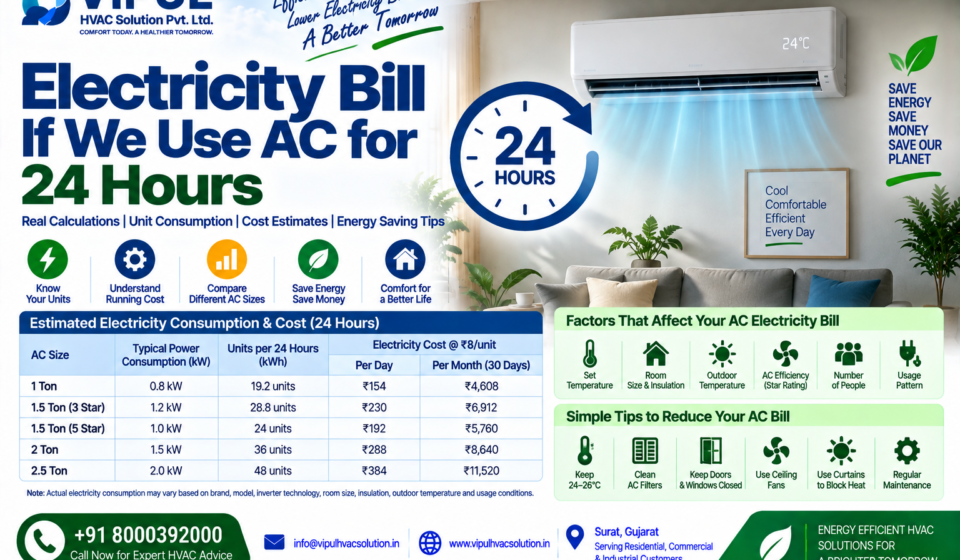

Electricity Bill If We Use AC for 24 Hours: Complete Calculation Guide
If you use an air conditioner for 24 hours continuously, the electricity bill depends mainly on the AC’s power consumption, capacity, efficiency, room temperature, outdoor temperature, thermostat setting, inverter operation and electricity tariff.
There is no single fixed answer such as “24 hours of AC costs ₹X.” For example, a current 1.5-ton LG 5-star inverter model lists rated cooling power consumption of 1,310 W, while another 1.5-ton 3-star model lists 1,750 W. Actual consumption can vary because inverter compressors do not necessarily run at their rated power continuously.
The basic calculation is:
Electricity Units = AC Power in kW × Operating Hours
And:
Electricity Cost = Units Consumed × Electricity Rate per Unit
Quick Answer: How Much Electricity Does an AC Use in 24 Hours?
Suppose an AC has a rated electrical input of 1.5 kW.
If it actually consumed 1.5 kW continuously for 24 hours:
1.5 × 24 = 36 kWh
Therefore, the AC would consume approximately:
36 units per day
If your effective electricity cost were ₹8 per unit:
36 × ₹8 = ₹288 per day
For 30 days:
₹288 × 30 = ₹8,640 per month
But this is a constant-full-power example, not a guaranteed real-world bill.
An inverter AC can consume substantially less than its rated input during periods when the compressor is operating at reduced capacity.
AC Electricity Consumption Calculator
Use this simple formula:
Step 1: Find AC Power
Look at the AC’s specification label or manufacturer’s technical specifications.
For example:
AC power = 1,500 watts
Convert watts to kilowatts:
1,500 ÷ 1,000 = 1.5 kW
Step 2: Multiply by Hours
For 24 hours:
1.5 × 24 = 36 kWh
Step 3: Calculate Cost
If electricity costs ₹8/unit:
36 × ₹8 = ₹288/day
Step 4: Calculate Monthly Cost
For 30 days:
36 × 30 = 1,080 units/month
1,080 × ₹8 = ₹8,640/month
Again, this assumes the AC draws the stated 1.5 kW continuously.
Why Your Actual 24-Hour AC Bill Can Be Lower
An AC’s rated power consumption is not necessarily its average power consumption over 24 hours.
This is especially important for inverter ACs.
An inverter compressor can vary its operating capacity according to the cooling requirement.
For example:
When the room is very hot
The compressor may work harder.
After reaching the target temperature
The compressor can reduce its output.
When the outdoor temperature falls
Cooling demand may decrease.
When the room is well insulated
Less cooling may be required.
Therefore:
Rated Power ≠ Guaranteed 24-Hour Consumption
The Bureau of Energy Efficiency (BEE) explains that AC energy performance is evaluated using efficiency metrics such as ISEER, and its star-labeling program is designed to help consumers compare energy performance.
1.5 Ton AC Electricity Consumption for 24 Hours
A 1.5-ton AC is one of the most common residential AC sizes.
But two 1.5-ton ACs can consume different amounts of electricity.
For example, a current LG 5-star 1.5-ton inverter model lists rated cooling power consumption of 1,310 W.
Using that rated value only as a mathematical example:
1.31 kW × 24 hours = 31.44 units/day
At ₹8/unit:
31.44 × ₹8 = ₹251.52/day
For 30 days:
31.44 × 30 × ₹8 = ₹7,560.96/month
Important
This does not mean that the actual AC will necessarily consume 31.44 units every day.
It is the result if the AC continuously operated at its stated 1.31 kW rated input.
1.5 Ton 3-Star AC for 24 Hours
A current LG 1.5-ton 3-star inverter model lists rated cooling power consumption of 1,750 W, with a minimum listed input of 291 W.
At the rated 1.75 kW:
1.75 × 24 = 42 units/day
At ₹8/unit:
42 × ₹8 = ₹336/day
For 30 days:
42 × 30 = 1,260 units
1,260 × ₹8 = ₹10,080/month
Again, this is a full-rated-power calculation, not a prediction of the actual monthly electricity bill.
1 Ton AC Electricity Consumption for 24 Hours
Suppose a 1-ton AC has an electrical input of approximately:
1.0 kW
Then:
1.0 × 24 = 24 units/day
At ₹8/unit:
24 × ₹8 = ₹192/day
Monthly:
24 × 30 × ₹8 = ₹5,760
Actual consumption depends on the specific model and operating conditions.
2 Ton AC Electricity Consumption for 24 Hours
Suppose a 2-ton AC has a rated electrical input of:
2.0 kW
Then:
2.0 × 24 = 48 units/day
At ₹8/unit:
48 × ₹8 = ₹384/day
Monthly:
48 × 30 × ₹8 = ₹11,520
Again, this is a simple constant-load example.
AC Electricity Bill Table for 24 Hours
The following table shows illustrative calculations, assuming the AC continuously consumes the stated electrical input.
| AC Electrical Input | Units in 24 Hours | Cost @ ₹6/unit | Cost @ ₹8/unit | Cost @ ₹10/unit |
|---|---|---|---|---|
| 0.8 kW | 19.2 | ₹115 | ₹154 | ₹192 |
| 1.0 kW | 24 | ₹144 | ₹192 | ₹240 |
| 1.2 kW | 28.8 | ₹173 | ₹230 | ₹288 |
| 1.5 kW | 36 | ₹216 | ₹288 | ₹360 |
| 1.8 kW | 43.2 | ₹259 | ₹346 | ₹432 |
| 2.0 kW | 48 | ₹288 | ₹384 | ₹480 |
| 2.5 kW | 60 | ₹360 | ₹480 | ₹600 |
| 3.0 kW | 72 | ₹432 | ₹576 | ₹720 |
Formula:
Daily units = kW × 24
How Much Does It Cost to Run AC for 24 Hours a Day?
Let’s take a few examples.
Example 1: 1 kW AC
1 × 24 = 24 units/day
At ₹8/unit:
₹192/day
30 days:
₹5,760/month
Example 2: 1.5 kW AC
1.5 × 24 = 36 units/day
At ₹8/unit:
₹288/day
30 days:
₹8,640/month
Example 3: 2 kW AC
2 × 24 = 48 units/day
At ₹8/unit:
₹384/day
30 days:
₹11,520/month
Example 4: 2.5 kW AC
2.5 × 24 = 60 units/day
At ₹8/unit:
₹480/day
30 days:
₹14,400/month
What Happens If the AC Runs Only 8 Hours?
Compare the difference.
For a 1.5 kW AC:
8 hours
1.5 × 8 = 12 units/day
At ₹8:
₹96/day
Monthly:
₹2,880
24 hours
1.5 × 24 = 36 units/day
At ₹8:
₹288/day
Monthly:
₹8,640
Therefore, operating hours have a major influence on electricity consumption.
Does Temperature Setting Affect Electricity Consumption?
Yes.
The cooling load generally increases when the desired indoor temperature is substantially lower than the outdoor temperature.
For example, running an AC at:
18°C
can create a different cooling demand from operating it at:
24°C or 25°C
depending on outdoor conditions and the building.
The actual consumption also depends on:
- Outdoor temperature
- Room size
- Insulation
- Windows
- Solar heat gain
- Number of people
- Appliances
- AC efficiency
- Air leakage
- Humidity
- Set temperature
BEE’s building-energy guidance recognizes that operating characteristics and conditioned-space conditions affect energy performance.
Does an Inverter AC Consume Electricity for 24 Hours?
Yes, if it remains switched on for 24 hours.
However, being switched on for 24 hours does not mean the compressor continuously operates at maximum power.
An inverter AC can modulate compressor output according to cooling demand.
For example:
High cooling demand
→ Higher compressor output
↓
Room approaches set temperature
→ Compressor output decreases
↓
Temperature maintained
→ Lower operating power may be required
This is one reason why you should not estimate an inverter AC’s actual electricity bill simply by multiplying its maximum or rated input by 24 hours.
Inverter AC vs Non-Inverter AC: Electricity Consumption
| Feature | Inverter AC | Fixed-Speed AC |
|---|---|---|
| Compressor operation | Variable | Mainly ON/OFF |
| Speed control | Yes | No/limited |
| Part-load operation | Better suited | Less flexible |
| Temperature control | More continuous | Cycling |
| Potential energy efficiency | Higher depending on model/use | Generally lower |
| Initial price | Often higher | Often lower |
| Best for long operating periods | Often advantageous | Depends on application |
BEE’s current standards-and-labeling framework includes variable-speed room air conditioners and uses energy-performance parameters for ACs.
How Much Electricity Does a 1.5 Ton AC Consume in 24 Hours?
There is no universal number.
A current 1.5-ton LG 5-star model lists 1,310 W rated cooling power consumption, while a current 1.5-ton 3-star model lists 1,750 W rated cooling power consumption.
Using the rated values for illustration:
5-Star example
1.31 × 24 = 31.44 units/day
3-Star example
1.75 × 24 = 42 units/day
At ₹8/unit:
| Example | Units/day | Illustrative cost/day |
|---|---|---|
| 1.5-ton 5-star example | 31.44 | ₹251.52 |
| 1.5-ton 3-star example | 42.00 | ₹336 |
These figures demonstrate why model-specific efficiency matters, but they should not be interpreted as actual 24-hour consumption for every household.
How Many Units Does an AC Consume Per Day?
The simplest calculation is:
Units = Power (kW) × Hours
For example:
1.2 kW AC × 24 hours
1.2 × 24 = 28.8 units
1.5 kW AC × 24 hours
1.5 × 24 = 36 units
2 kW AC × 24 hours
2 × 24 = 48 units
But real consumption should ideally be measured using an energy meter because compressor cycling and variable-speed operation can significantly change actual usage.
What Other Appliances Add to the Electricity Bill?
The AC is not the only appliance consuming electricity.
Your monthly bill may also include:
- Refrigerator
- Ceiling fans
- Water pump
- Television
- Computers
- Washing machine
- Microwave
- Geyser
- Lights
- Kitchen appliances
- Chargers
- Other equipment
Therefore:
Total electricity bill ≠ AC electricity bill
A simple household calculation is:
AC consumption + refrigerator + fans + lights + other appliances = total household consumption
BEE’s energy-efficiency framework covers multiple household appliances and emphasizes comparing energy consumption when evaluating appliance efficiency.
How to Reduce Your AC Electricity Bill
1. Don’t Set the Temperature Extremely Low
A moderate comfort setting can reduce cooling demand compared with very low setpoints.
2. Keep Doors and Windows Closed
Air leakage increases the cooling load.
3. Clean AC Filters
Dirty filters can restrict airflow and reduce system performance.
4. Maintain the Outdoor Unit
Keep the outdoor unit free from unnecessary obstruction and maintain adequate airflow.
5. Service the AC Regularly
Maintenance can identify:
- Dirty coils
- Refrigerant-related issues
- Electrical problems
- Drainage problems
- Fan issues
- Sensor problems
6. Use an Energy-Efficient AC
BEE’s star-labeling program helps consumers compare energy performance among applicable AC products.
7. Improve Room Insulation
Better insulation can reduce heat entering the room.
8. Reduce Direct Solar Heat
Curtains, blinds and suitable glazing strategies can reduce solar heat gain.
9. Use Timer/Schedule Functions
If cooling isn’t required continuously, scheduling the AC can reduce unnecessary operation.
10. Choose the Correct AC Capacity
An undersized AC may struggle to achieve the desired conditions, while an unnecessarily oversized system can increase initial cost and may not provide the intended efficiency benefits.
Proper sizing should consider the actual cooling load.
Does a 5-Star AC Always Give a Lower Electricity Bill?
Not necessarily in every real-world situation.
A higher efficiency rating indicates better energy performance under the relevant rating methodology, but your actual electricity consumption depends on:
- Operating hours
- Set temperature
- Outdoor temperature
- Room size
- Insulation
- Occupancy
- Equipment load
- AC maintenance
- Usage pattern
BEE states that star ratings communicate appliance energy performance and that AC ratings use ISEER as the relevant performance parameter.
AC Electricity Bill Formula
For a quick calculation:
Daily Consumption
AC Power (W) ÷ 1,000 × Hours Used
Daily Electricity Cost
Daily Units × Electricity Rate
Monthly Electricity Cost
Daily Units × Number of Days × Electricity Rate
Example
1,500 W
Usage:
24 hours/day
Electricity rate:
₹8/unit
Calculation:
1,500 ÷ 1,000 = 1.5 kW
1.5 × 24 = 36 units/day
36 × ₹8 = ₹288/day
36 × 30 × ₹8 = ₹8,640/month
How to Calculate Your Exact AC Electricity Cost
If you want a more realistic estimate, collect these five values:
- AC capacity — e.g. 1 ton / 1.5 ton / 2 ton
- Rated power input — from the specification sheet
- Daily operating hours
- Average electricity tariff
- Estimated average load factor for an inverter system, if you have a reliable measurement
The most accurate method is to measure actual electricity consumption over several days using a suitable energy meter.
Why AC Electricity Consumption Matters for Commercial Buildings
For offices, hotels, hospitals, retail buildings, factories and other commercial facilities, air conditioning can represent a significant part of electricity consumption.
The solution is not simply to switch the AC off.
Instead, HVAC design should consider:
- Cooling-load calculation
- Equipment efficiency
- Zoning
- Variable-speed operation
- Ventilation
- Building envelope
- Controls
- BMS
- Preventive maintenance
- Operating schedules
BEE’s ECBC framework addresses energy efficiency in building envelopes and mechanical systems, including HVAC, for applicable large commercial buildings.
Can VRF Systems Reduce HVAC Electricity Consumption?
VRF systems can provide variable refrigerant flow and zone-wise control, which can be useful for commercial buildings with changing cooling loads.
However, no HVAC system should be described as automatically reducing the electricity bill by a fixed percentage.
Actual energy performance depends on:
- System design
- Equipment efficiency
- Building load
- Diversity
- Operating schedule
- Controls
- Installation
- Maintenance
- Outdoor conditions
For larger commercial projects, VIPUL HVAC SOLUTION PVT. LTD. provides VRF/VRV systems, chillers, AHUs, ventilation, BMS and customized HVAC design.
Why Choose VIPUL HVAC SOLUTION PVT. LTD.?
VIPUL HVAC SOLUTION PVT. LTD. provides HVAC solutions for residential, commercial and industrial applications.
Its current HVAC portfolio includes:
- VRF / VRV systems
- Chiller systems
- Air Handling Units
- Ducted & package AC
- Precision air conditioning
- Ventilation systems
- BMS & HVAC automation
- Indoor air-quality solutions
- HVAC maintenance
- Customized HVAC design
For commercial projects, the company can approach energy consumption as part of the overall HVAC design rather than looking only at the AC equipment.
A typical HVAC optimization process can include:
Site Survey
↓
Cooling-Load Calculation
↓
Equipment Selection
↓
HVAC Design
↓
Zoning & Controls
↓
Installation
↓
Testing & Commissioning
↓
Maintenance & Performance Monitoring
Frequently Asked Questions
How much electricity does an AC use in 24 hours?
It depends on the AC’s electrical input and actual operating load. For example, an AC drawing 1.5 kW continuously would consume 36 units in 24 hours.
How much does a 1.5-ton AC cost to run for 24 hours?
There is no universal cost. If a particular 1.5-ton AC consumes 1.5 kW continuously and electricity costs ₹8/unit, the calculation would be 36 units × ₹8 = ₹288/day.
Does an inverter AC consume less electricity?
An inverter AC can vary compressor speed according to cooling demand and may consume less energy than a comparable fixed-speed system under suitable operating conditions. Actual savings depend on the model and usage.
How many units does a 1.5-ton AC consume in 24 hours?
It depends on the model. For example, a current LG 5-star 1.5-ton model lists 1.31 kW rated cooling input, which mathematically equals 31.44 kWh over 24 hours if operated continuously at that rated input.
How much does a 2-ton AC consume in 24 hours?
It depends on its actual electrical input. A hypothetical 2 kW AC operating continuously for 24 hours would consume 48 units.
Does running AC at 16°C consume more electricity?
It can increase cooling demand compared with a higher temperature setting because the system has to maintain a larger temperature difference, although actual consumption depends on outdoor conditions, building heat gain and the AC’s control system.
Is it cheaper to leave an inverter AC on all day?
Not necessarily. Inverter ACs can operate efficiently at part load, but keeping any AC running when cooling is unnecessary still consumes electricity. Scheduling operation according to occupancy can reduce unnecessary consumption.
Does room size affect AC electricity consumption?
Yes. Room size, insulation, windows, solar exposure, occupancy and equipment loads all affect cooling demand.
Can solar power reduce the cost of running AC?
Yes. Solar electricity can offset some of the electricity drawn from the grid, depending on the solar system, generation profile, net-metering arrangements and building load.
Conclusion
The electricity bill if you use an AC for 24 hours depends primarily on the AC’s actual electrical consumption and the electricity tariff.
The simplest formula is:
AC Electricity Cost = Power (kW) × Hours × Electricity Rate
For example, a 1.5 kW AC running continuously for 24 hours would mathematically consume 36 units/day. At an illustrative ₹8/unit, that would be ₹288/day or ₹8,640 for 30 days.
However, this is a constant-power calculation. Real-world inverter AC consumption can be different because compressor output varies with cooling demand. BEE’s AC efficiency framework uses ISEER and star labeling to help consumers compare energy performance, while actual usage depends on the building and operating conditions.
For larger buildings, reducing electricity consumption requires looking beyond the AC itself and considering load calculation, equipment efficiency, zoning, ventilation, controls, BMS and preventive maintenance.
Need Professional HVAC Energy Optimization?
VIPUL HVAC SOLUTION PVT. LTD.
📞 +91 8000392000
📧 info@vipulhvacsolution.in
🌐 vipulhvacsolution.in
Important Links:
- AC electricity consumption for 24 hours
- AC electricity bill for 24 hours
- 1.5 ton AC electricity consumption
- 1.5 ton AC electricity bill
- 2 ton AC electricity consumption
- AC units per day
- AC power consumption calculator
- AC electricity cost calculator
- AC running cost per day
- AC electricity consumption per month
- inverter AC electricity consumption
- 24 hours AC electricity cost
- how many units does AC consume
- AC electricity bill calculator
- electricity cost of running AC

[…] AC Electricity Bill Calculator […]
[…] AC Electricity Bill Calculator […]