

How to Choose Industrial Panel AC: Complete Sizing Guide
Choosing the right industrial panel air conditioner is essential for protecting electrical components and maintaining reliable industrial operations. An incorrectly sized cooling unit may fail to control cabinet temperatures, consume unnecessary energy or create avoidable maintenance problems.
Electrical control panels contain components such as programmable logic controllers (PLCs), variable frequency drives (VFDs), power supplies, contactors, transformers and communication devices. These components generate heat during operation. When the heat accumulates inside a closed enclosure, the internal temperature can rise beyond the equipment manufacturer’s recommended operating limits.
An industrial panel AC is designed to remove this heat from an electrical enclosure and maintain suitable internal conditions. However, selecting the correct unit requires more than measuring the cabinet or choosing the largest available model.
You must evaluate the internal heat load, maximum ambient temperature, enclosure dimensions, mounting arrangement, environmental conditions and required cooling capacity.
Vipul HVAC Solution Pvt Ltd supports industrial HVAC product and project enquiries. This guide explains how to calculate enclosure cooling requirements and select an appropriate industrial panel air conditioner for your application.
What Is an Industrial Panel Air Conditioner?
An industrial panel air conditioner is a specialised refrigeration-based cooling unit designed for electrical enclosures and control cabinets.
Unlike a conventional room AC, an enclosure air conditioner is engineered to manage heat generated inside a cabinet. Many models use separate internal and external air circuits to cool the enclosure while releasing the extracted heat into the surrounding environment.
Industrial panel AC systems are commonly used for:
- PLC and automation control panels
- VFD and motor drive cabinets
- Motor control centres (MCCs)
- CNC machine control panels
- Industrial electrical distribution cabinets
- SCADA and communication enclosures
- Suitable outdoor electrical cabinets
- Manufacturing and process-control equipment
The correct unit depends on the cabinet’s thermal load and operating environment, not simply on the type of equipment installed.
Why Is Correct Industrial Panel AC Sizing Important?
Correct sizing helps maintain the required internal cabinet temperature and supports the reliable operation of sensitive electronics.
1. Prevents Excessive Cabinet Temperature
Electrical components produce heat during normal operation. If the enclosure cannot remove that heat effectively, its temperature may exceed the specified operating range.
2. Supports Equipment Reliability
Excessive temperatures can contribute to thermal alarms, reduced performance and component degradation. Proper cooling helps maintain suitable operating conditions.
3. Helps Avoid Undersizing
A panel AC with insufficient cooling capacity may run continuously without maintaining the required temperature, particularly during hot weather or high-load operation.
4. Avoids Unnecessary Oversizing
Selecting a much larger unit than required can increase purchase costs and may cause inefficient operation under certain conditions. The objective is to meet the calculated cooling requirement with suitable operating margin.
5. Supports Better Maintenance Planning
A correctly selected and installed unit, combined with routine maintenance, helps keep the cabinet’s thermal conditions more consistent.
7 Factors to Consider When Choosing an Industrial Panel Air Conditioner
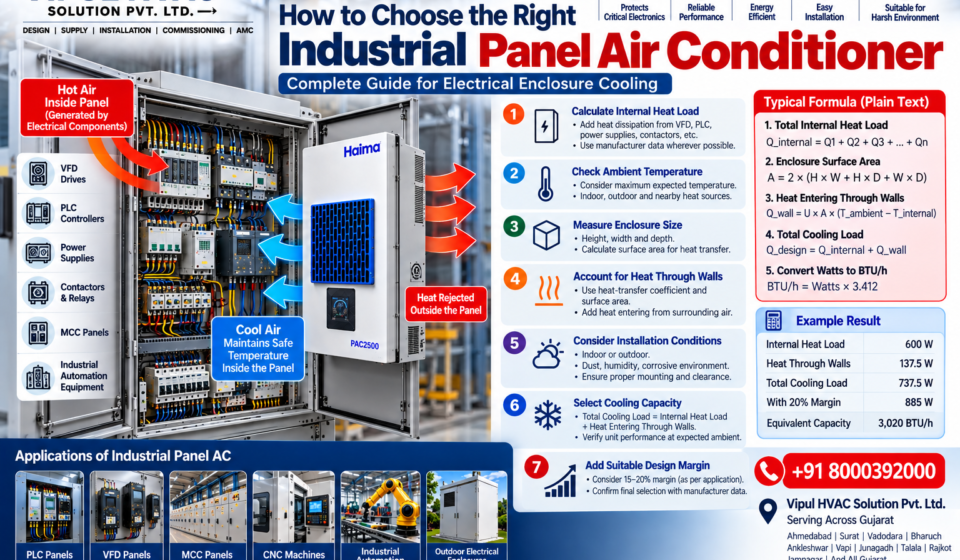
1. Calculate the Internal Heat Load
The internal heat load is the heat released by components inside the enclosure. It is one of the most important inputs in industrial panel AC sizing.
Common heat sources include:
- Variable frequency drives
- Servo drives and motor controllers
- Power supplies
- Transformers
- PLCs and input/output modules
- Contactors, relays and starters
- Braking resistors and other power electronics
- Industrial networking equipment
Use the heat-dissipation figures in the component manufacturer’s technical documentation wherever possible.
Do not automatically treat the total electrical power passing through a panel as heat released inside the cabinet. A motor drive, for example, converts most of its input energy into useful output power and loses only part of that energy as heat.
If manufacturer data is unavailable, use a suitable engineering estimate based on the component type and actual operating conditions, then verify it during detailed design.
Heat-load calculation formula
Total Internal Heat Load = Heat from Component 1 + Heat from Component 2 + Heat from Component 3 + …
Formula:
Q_internal = Q1 + Q2 + Q3 + ... + Qn
Where:
-
Q_internal = Total heat generated inside the electrical enclosure (watts).
-
Q1, Q2, Q3 … Qn = Heat dissipated by each individual component (watts).
-
n = Total number of components considered.
Example
Suppose an electrical panel contains:
| Component | Heat Dissipation |
|---|---|
| VFD | 400 W |
| Power supply | 100 W |
| PLC and modules | 50 W |
| Contactors and relays | 50 W |
| Total internal heat load | 600 W |
Therefore:
Total Internal Heat Load = 400 + 100 + 50 + 50 = 600 W
The electrical enclosure generates an estimated 600 watts of internal heat.
Important: This is only the internal component heat load. For correct industrial panel AC sizing, also consider heat entering through the enclosure walls, solar gain where applicable, and the cooling unit’s actual performance at the expected ambient temperature.
2. Check the Maximum Ambient Temperature
Ambient temperature is the temperature of the air surrounding the electrical cabinet.
The highest expected ambient temperature is more important for sizing than the annual average or the temperature recorded during a mild day.
Consider whether the cabinet is installed:
- Inside an air-conditioned control room
- In a factory with hot machinery nearby
- In a poorly ventilated production area
- Outdoors under direct sunlight
- Near a furnace, boiler or other heat source
- In a dusty, humid or corrosive environment
An industrial panel AC may deliver less cooling at high ambient temperatures than its nominal rating suggests. Always check the manufacturer’s performance data at the expected operating conditions.
For example, if the surrounding air can reach 45°C and the required internal cabinet temperature is 35°C, the cooling unit must handle both the component heat and the heat entering through the cabinet walls.
3. Measure the Electrical Enclosure Size
Enclosure dimensions influence the surface area available for heat transfer and help determine the amount of space available for components and cooling equipment.
Record:
- Height
- Width
- Depth
- Cabinet material
- Number of exposed surfaces
- Whether the enclosure is wall-mounted or free-standing
- Whether adjacent cabinets block its sides
- Whether it is installed indoors or outdoors
A larger cabinet generally has more surface area through which heat can transfer. However, cabinet size alone does not determine the required AC capacity.
A small cabinet with several high-loss VFDs may require more cooling than a larger cabinet containing low-power electronic equipment.
Calculate the Electrical Enclosure Surface Area
For a rectangular electrical cabinet:
Formula:
Surface Area = 2 × [(Height × Width) + (Height × Depth) + (Width × Depth)]
Or, using symbols:
A = 2 × (H × W + H × D + W × D)
Where:
-
A = Total surface area of the cabinet (m²)
-
H = Height (m)
-
W = Width (m)
-
D = Depth (m)
Example calculation
Suppose an electrical cabinet has these dimensions:
| Dimension | Measurement |
|---|---|
| Height | 2 m |
| Width | 1 m |
| Depth | 0.5 m |
Step 1: Insert the dimensions
A = 2 × [(2 × 1) + (2 × 0.5) + (1 × 0.5)]
Step 2: Calculate each part
A = 2 × (2 + 1 + 0.5)
Step 3: Calculate the total
A = 2 × 3.5
Total Surface Area = 7 m²
The cabinet’s total surface area is 7 square metres.
Important: This formula calculates all six faces of a rectangular cabinet. For heat-load calculations, the effective surface area may be lower if some faces are against walls or adjacent cabinets. Follow the enclosure manufacturer’s recommended method when selecting an industrial panel air conditioner.
4. Account for Heat Transfer Through the Cabinet Walls
Heat enters an electrical enclosure when the surrounding air is hotter than the desired internal cabinet temperature. This additional heat must be considered when selecting an industrial panel air conditioner.
Formula:
Heat Transfer = Heat Transfer Coefficient × Surface Area × Temperature Difference
In symbols:
Q_wall = U × A × (T_ambient − T_internal)
Where:
-
Q_wall = Heat transferred through the cabinet walls (watts).
-
U = Overall heat-transfer coefficient (W/m²·K).
-
A = Effective enclosure surface area (m²).
-
T_ambient = Ambient temperature outside the cabinet (°C).
-
T_internal = Target temperature inside the cabinet (°C).
Example calculation
Suppose the electrical cabinet has the following conditions:
| Parameter | Value |
|---|---|
| Heat-transfer coefficient (U) | 5.5 W/m²·K |
| Effective surface area (A) | 4 m² |
| Ambient temperature | 45°C |
| Target internal temperature | 35°C |
Step 1: Calculate the temperature difference
Temperature Difference = 45 − 35 = 10°C
Step 2: Insert the values into the formula
Q_wall = 5.5 × 4 × (45 − 35)
Step 3: Calculate the heat transfer
Q_wall = 5.5 × 4 × 10
Q_wall = 220 watts
Therefore, approximately 220 W of additional heat enters the cabinet through its walls, based on the assumed coefficient and effective surface area.
How does this affect panel AC sizing?
If the electrical components generate 600 W of heat, the preliminary total cooling load becomes:
Total Cooling Load = Internal Heat Load + Heat Entering Through Walls
Total Cooling Load = 600 + 220 = 820 W
This calculation excludes other heat sources, such as solar gain, unless already accounted for.
Important: The value of U = 5.5 W/m²·K is an illustrative assumption, not a universal value for every cabinet. Use an appropriate coefficient and effective surface area based on the enclosure material, mounting arrangement and manufacturer’s guidance. Select the final panel AC using its rated cooling performance at the expected ambient temperature.
5. Consider the Installation Environment
Installation conditions can substantially change the cooling requirement and the type of equipment needed.
Indoor installation: Check room temperature, nearby heat sources, airflow and available mounting space.
Outdoor installation: Consider direct solar radiation, rain exposure, dust, humidity, ambient temperature and corrosion.
Dusty industrial areas: Confirm the panel AC’s environmental protection and the cabinet’s sealing arrangements.
Corrosive environments: Check material compatibility and whether additional corrosion protection is necessary.
Restricted mounting locations: Verify that the unit has sufficient clearance for air circulation, maintenance and heat rejection.
An enclosure AC must be suitable for the actual site conditions. Do not assume that every industrial panel AC can operate in every environment.
6. Select the Required Cooling Capacity
1. Calculate the Required Cooling Capacity
After calculating the heat generated by electrical components and the heat entering through the cabinet walls, calculate the total cooling load.
Formula:
Total Cooling Load = Internal Heat Load + Heat Entering Through Cabinet Walls
Or:
Q_design = Q_internal + Q_wall
Where:
-
Q_design = Total design cooling load (watts).
-
Q_internal = Heat generated by electrical components (watts).
-
Q_wall = Heat entering through the cabinet walls (watts).
Example calculation
Suppose:
| Parameter | Value |
|---|---|
| Internal component heat load | 600 W |
| Heat entering through cabinet walls | 220 W |
| Total cooling load | 820 W |
Calculation:
Q_design = 600 + 220
Q_design = 820 W
The calculated cooling load is 820 watts.
If you choose to apply an illustrative 20% design margin:
Required Selection Capacity = 820 × 1.20
Required Selection Capacity = 984 W
Therefore, look for an industrial panel AC whose actual cooling output is at least 984 W under the expected operating conditions, subject to verification against the manufacturer’s performance data.
Note: The 20% margin is an example, not a universal requirement. Account separately for solar gain or other heat sources if they have not already been included.
2. Convert Watts to BTU/h
Panel AC manufacturers may specify cooling capacity in watts or BTU/h.
Conversion formula:
Cooling Capacity (BTU/h) = Cooling Capacity (W) × 3.412
Example
If the calculated cooling load is 900 W:
Cooling Capacity = 900 × 3.412
Cooling Capacity = 3,070.8 BTU/h
Therefore:
900 W ≈ 3,071 BTU/h
Quick conversion table
| Cooling capacity (W) | Approximate capacity (BTU/h) |
|---|---|
| 500 W | 1,706 |
| 750 W | 2,559 |
| 900 W | 3,071 |
| 1,000 W | 3,412 |
| 1,500 W | 5,118 |
| 2,000 W | 6,824 |
| 2,500 W | 8,530 |
Important: Do not select a panel AC based only on its advertised nominal capacity. Verify that the model can provide the required cooling at your maximum ambient temperature and target cabinet temperature.
7. Include a Suitable Design Margin
Engineering calculations contain uncertainties. Component loading may change, ambient conditions can vary, and actual cooling performance depends on the selected unit and installation.
A design margin may be appropriate, but it should not replace accurate heat-load calculations.
For preliminary budgeting, an illustrative 15–20% margin may be considered when justified by the application. The final margin should follow the manufacturer’s guidance and the project’s engineering requirements.
Avoid selecting a model based solely on its headline capacity. A unit rated for a particular ambient condition may deliver less cooling at the actual site temperature.
Worked Example: Industrial Panel AC Sizing
Suppose an electrical enclosure has the following design conditions:
| Parameter | Value |
|---|---|
| Internal component heat load | 600 W |
| Effective enclosure surface area | 2.5 m² |
| Heat-transfer coefficient | 5.5 W/m²·K |
| Maximum ambient temperature | 45°C |
| Target internal temperature | 35°C |
Step 1: Calculate the temperature difference
Formula:
Temperature Difference = Ambient Temperature − Internal Temperature
Calculation:
45 − 35 = 10°C
The temperature difference is 10°C.
Step 2: Calculate heat entering through the cabinet walls
Formula:
Heat Entering = Heat-Transfer Coefficient × Surface Area × Temperature Difference
Calculation:
Q_wall = 5.5 × 2.5 × 10
Q_wall = 137.5 W
Therefore, the estimated heat entering through the cabinet walls is 137.5 watts.
Step 3: Calculate the total cooling load
Formula:
Total Cooling Load = Internal Heat Load + Heat Entering Through Walls
Calculation:
Q_design = 600 + 137.5
Q_design = 737.5 W
The total preliminary cooling load is 737.5 watts.
Step 4: Add a 20% illustrative design margin
Formula:
Required Selection Capacity = Total Cooling Load × 1.20
Calculation:
737.5 × 1.20 = 885 W
The preliminary selection target is 885 watts.
The 20% margin is illustrative; the appropriate margin depends on the application and manufacturer’s guidance.
Step 5: Convert the capacity into BTU/h
Formula:
Cooling Capacity (BTU/h) = Cooling Capacity (W) × 3.412
Calculation:
885 × 3.412 = 3,019.62 BTU/h
Rounded to the nearest whole number:
Required Selection Capacity ≈ 885 W or 3,020 BTU/h
Final result
Calculated cooling load
737.5 W
885 W
3,020 BTU/h
Important: This is an educational estimate. Verify the heat-transfer coefficient, effective surface area, solar gain and actual cooling output at the expected ambient temperature. Select a model using the manufacturer’s performance data rather than nominal capacity alone.
Industrial Panel AC vs Filter Fan vs Heat Exchanger
An air conditioner is not always the only solution for enclosure cooling.
| Feature | Industrial Panel AC | Filter Fan | Heat Exchanger |
|---|---|---|---|
| Active refrigeration | Yes | No | No |
| Can cool below ambient temperature | Yes, within operating limits | No | Generally no |
| Uses outside air inside the cabinet | Generally no in closed-loop designs | Yes | Depends on design |
| Dust protection | Depends on unit and cabinet sealing | Depends on filtration and sealing | Depends on design |
| Typical application | Active cooling with controlled enclosure conditions | Suitable ambient air and manageable heat load | Suitable temperature difference between air circuits |
A filter fan may be sufficient when outside air is clean enough and cool enough to remove the required heat. A heat exchanger may work where a suitable temperature difference is available. An industrial panel AC is often needed when the cabinet must be maintained below ambient temperature.
Final selection should be based on the calculated heat load and site conditions.
Common Mistakes to Avoid When Selecting Panel AC
Choosing a Unit Only by Cabinet Size
Cabinet dimensions are important, but component heat dissipation and ambient conditions determine the cooling requirement.
Using Electrical Input Power as the Heat Load
The full power passing through a drive or electrical component is not necessarily dissipated as heat inside the enclosure. Use component loss data wherever possible.
Ignoring High Ambient Temperatures
Selecting a model using a mild-day temperature can result in insufficient cooling during the hottest operating conditions.
Forgetting Solar Heat Gain
Outdoor cabinets exposed to direct sunlight can receive additional heat that must be included in the design assessment.
Blocking the Condenser Airflow
Restricted airflow and hot-air recirculation can reduce cooling performance. Follow the manufacturer’s clearance requirements.
Ignoring Maintenance Access
Allow adequate access for cleaning, inspection, repair and replacement of the cooling unit.
Selecting the Lowest-Priced Model Without Checking Performance
Compare rated capacity, performance at the expected ambient temperature, environmental protection, warranty and maintenance requirements—not price alone.
Industrial Panel AC Solutions from Vipul HVAC Solution Pvt Ltd
Vipul HVAC Solution Pvt Ltd supports industrial and commercial HVAC product and project enquiries.
If you need a panel AC for a PLC cabinet, VFD panel, MCC, CNC machine or industrial automation system, prepare the enclosure dimensions, heat-load information and installation details before requesting a recommendation.
Enquiries can cover:
- Industrial panel AC product requirements
- Cooling-capacity and application discussions
- Product supply coordination
- Installation planning and commissioning coordination
- Related HVAC consultancy
- Maintenance and AMC enquiries, subject to service availability and agreed scope
Contact Vipul HVAC Solution Pvt Ltd
Phone: +91 8000392000
Website: https://vipulhvacsolution.in/
Confirm the availability of the required model and the applicable service scope before placing an order.
Frequently Asked Questions
1. How do I choose the right industrial panel air conditioner?
Calculate the internal component heat load, estimate heat transfer through the enclosure walls, identify the maximum ambient temperature and required internal temperature, then select a model with sufficient cooling output under those operating conditions.
2. What information is needed for industrial panel AC sizing?
You need component heat dissipation, enclosure dimensions and material, mounting arrangement, maximum ambient temperature, target internal temperature and the environmental conditions at the installation site.
3. How is electrical enclosure heat load calculated?
Add the heat dissipated by the components inside the enclosure. Then account for heat entering or leaving through the cabinet walls and any additional relevant sources, such as solar gain.
4. How do I convert watts to BTU/h?
Multiply the cooling capacity in watts by 3.412 to obtain the approximate capacity in BTU/h.
5. Does a larger electrical cabinet always need a bigger panel AC?
No. A cabinet’s required cooling capacity depends primarily on component heat losses and heat transfer through the enclosure. A smaller cabinet containing high-loss equipment may require more cooling than a larger cabinet with low-power components.
6. Why does ambient temperature affect panel AC performance?
High ambient temperature increases the heat entering a cabinet when the target internal temperature is lower. It can also reduce the cooling output of the air conditioner, depending on its design and performance rating.
7. Can a filter fan replace an industrial panel AC?
Sometimes. A filter fan may be suitable when the surrounding air is clean and cool enough to remove the heat. An active panel AC is generally required when the cabinet must be maintained below ambient temperature.
8. Should I add a safety margin when sizing an enclosure AC?
A suitable design margin can account for uncertainty and changing operating conditions. The margin should be based on the application and manufacturer guidance rather than applied as a universal rule.
9. Who can I contact for industrial panel AC enquiries?
You can contact Vipul HVAC Solution Pvt Ltd at +91 8000392000 to discuss your application and confirm current product availability and project-support options.
Conclusion
Choosing the right industrial panel air conditioner requires a structured assessment of internal heat load, ambient temperature, enclosure size, installation conditions and cooling capacity.
Accurate calculations help prevent undersizing, avoid unnecessary oversizing and maintain suitable operating conditions for sensitive electrical components. Always verify the final selection using the manufacturer’s technical documentation and performance data.
Vipul HVAC Solution Pvt Ltd welcomes enquiries for industrial cooling and HVAC project requirements.
For industrial panel AC enquiries, call +91 8000392000.
Important Links:
- Industrial Panel AC Supplier in Surat
- Industrial Panel AC Supplier in Ahmedabad
- Industrial Panel AC Supplier in Ankleshwar
- Industrial Panel AC Supplier in Bharuch
- Industrial Panel AC Supplier in Vadodara
- Industrial Panel AC Supplier in Vapi
- Industrial Panel AC Supplier in Talala
- HVAC Consultancy Services
- Industrial HVAC Solutions


[…] How to Choose the Right Industrial Panel Air Conditioner […]
[…] How to Choose the Right Industrial Panel Air Conditioner […]
[…] How to Choose the Right Industrial Panel Air Conditioner […]
[…] How to Choose the Right Industrial Panel AC […]