
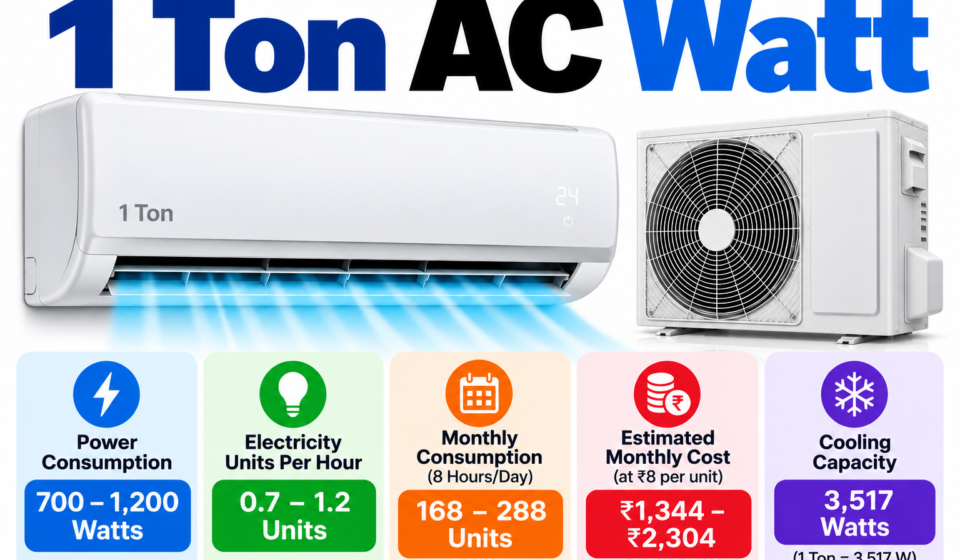

1 Ton AC Watt: Smart Guide to Power Consumption, Units & Electricity Bill
How Many Watts Does a 1 Ton AC Consume?
Are you planning to purchase a 1 Ton air conditioner and wondering how much electricity it will consume? Understanding 1 Ton AC Watt consumption is important before choosing an air conditioner for your bedroom, small office, shop or other compact space.
A 1 Ton AC does not continuously consume the same amount of electricity. Its power consumption depends on the compressor technology, star rating, cooling load, room size, outdoor temperature, insulation and thermostat setting.
As a general planning estimate, many 1 Ton split AC models may consume approximately 700 to 1,200 watts while operating, although the actual figure can be lower or higher depending on the model and operating conditions.
For example, a 1 Ton inverter AC with a rated power input of 1,060 watts consumes approximately 1.06 units of electricity in one hour if it operates continuously at that input.
In this guide, Vipul HVAC Solution Pvt Ltd explains 1 Ton AC wattage, electricity consumption, daily and monthly running costs, and practical ways to reduce your electricity bill.
What Is the Wattage of a 1 Ton AC?
A 1 Ton air conditioner is a cooling-capacity classification. It does not mean that the AC consumes 1,000 watts of electricity.
One ton of refrigeration (1 TR) is approximately equal to 3,517 watts of cooling capacity.
However, the electrical power required to produce that cooling is different.
For example:
| Parameter | Approximate value |
|---|---|
| AC capacity | 1 Ton |
| Cooling capacity | 3,517 W |
| Example rated electrical input | 1,060 W |
| Electrical input in kW | 1.06 kW |
| Electricity used in one hour at rated input | 1.06 units |
The rated electrical input varies from one AC model to another. Always check the manufacturer’s technical specifications and BEE label before purchasing.
Important: Cooling capacity and electrical power consumption are two different measurements. Do not assume that a 1 Ton AC consumes 3,517 watts of electricity.
How Many Watts Does a 1 Ton AC Consume?
The wattage of a 1 Ton AC depends on its technology, energy efficiency and operating conditions.
Here is an indicative planning comparison:
| AC type | Approximate electrical input |
|---|---|
| 1 Ton inverter AC | 700–1,200 W |
| 1 Ton fixed-speed AC | 900–1,300 W |
These are illustrative ranges, not guaranteed specifications for every model.
An inverter AC can adjust compressor speed according to the cooling requirement. Its electricity consumption can decrease after the room reaches the desired temperature.
A fixed-speed AC generally switches its compressor on and off to maintain the set temperature.
For an accurate comparison, check the rated power input and annual energy consumption printed on the BEE label of the exact model.
1 Ton AC Electricity Consumption Per Hour
Electricity consumption is measured in kilowatt-hours (kWh), commonly called units in electricity bills.
Use this formula:
Electricity Units = (Power Consumption in Watts × Operating Hours) ÷ 1,000
For example, assume your 1 Ton AC has a rated electrical input of 1,060 watts.
For one hour of continuous operation:
1,060 × 1 ÷ 1,000 = 1.06 units
Therefore, at this rated input, the AC consumes approximately 1.06 electricity units per hour.
Actual consumption may vary because an inverter compressor changes its power input depending on the cooling load.
1 Ton AC Electricity Consumption Per Day
Daily electricity consumption depends on the number of hours the AC operates.
Assuming a rated power input of 1,060 watts:
| Daily usage | Estimated consumption |
|---|---|
| 4 hours | 4.24 units |
| 6 hours | 6.36 units |
| 8 hours | 8.48 units |
| 10 hours | 10.60 units |
| 12 hours | 12.72 units |
Calculation for 8 hours:
1.06 kW × 8 hours = 8.48 units per day
These calculations assume continuous operation at the example rated input. Actual inverter AC consumption may be different.
1 Ton AC Monthly Electricity Consumption
Let’s calculate the monthly electricity consumption of a 1 Ton AC operating for different durations.
Assumptions:
- Rated electrical input: 1,060 watts (1.06 kW)
- Number of days: 30
- Electricity rate: ₹8 per unit
| Daily usage | Monthly units | Estimated energy cost |
|---|---|---|
| 4 hours | 127.2 | ₹1,017.60 |
| 6 hours | 190.8 | ₹1,526.40 |
| 8 hours | 254.4 | ₹2,035.20 |
| 10 hours | 318.0 | ₹2,544 |
| 12 hours | 381.6 | ₹3,052.80 |
For example, if you run a 1 Ton AC for 8 hours every day, the estimated monthly consumption at the assumed rated input is 254.4 units.
At ₹8 per unit, the estimated energy charge is ₹2,035.20.
This is an illustrative calculation, not a guaranteed electricity bill. Your actual bill can differ due to variable compressor operation, other appliances, electricity tariff slabs, fixed charges, taxes and duties.
How to Calculate the 1 Ton AC Electricity Bill?
You can calculate your AC electricity cost using this simple formula:
Monthly Electricity Units = AC Power Input (kW) × Daily Operating Hours × Number of Days
Monthly Electricity Cost = Monthly Units × Electricity Rate Per Unit
Example:
- AC rated input = 1.06 kW
- Daily usage = 8 hours
- Monthly period = 30 days
- Electricity rate = ₹8 per unit
Calculation:
1.06 × 8 × 30 = 254.4 units
254.4 × ₹8 = ₹2,035.20
Your estimated monthly energy charge is ₹2,035.20.
For more accurate results, use the AC’s actual measured electricity consumption rather than assuming it operates continuously at rated input.
Inverter AC vs Non-Inverter AC: Which Consumes Less Electricity?
One of the most important decisions when buying a 1 Ton AC is choosing between inverter and non-inverter technology.
1 Ton Inverter AC
An inverter AC adjusts compressor speed according to the room’s cooling requirement.
Advantages:
- Variable compressor operation.
- Can reduce electricity consumption under suitable operating conditions.
- More consistent room temperature.
- Reduced compressor start-stop cycling.
- Often suitable for longer operating periods.
1 Ton Non-Inverter AC
A non-inverter AC generally operates its compressor at a fixed speed. The compressor switches on and off according to the thermostat.
Advantages:
- Often lower initial purchase cost.
- Simpler compressor control system.
- May suit users with limited operating hours.
| Feature | Inverter AC | Non-Inverter AC |
|---|---|---|
| Compressor operation | Variable speed | Fixed speed |
| Cooling control | Modulates output | On/off cycling |
| Electricity consumption | Varies with load | Varies with on/off cycles |
| Temperature control | Generally more consistent | Wider temperature variation |
| Initial price | Often higher | Often lower |
Which is better?
If you use your AC for several hours every day, compare the BEE label, annual energy consumption and purchase price of inverter models. Do not assume every inverter model will automatically be more efficient than every fixed-speed model.
Does the BEE Star Rating Affect 1 Ton AC Watt Consumption?
Yes. Energy efficiency is an important factor when comparing air conditioners.
In India, the Bureau of Energy Efficiency (BEE) provides star ratings to help consumers compare the energy performance of eligible room air conditioners.
Generally:
- A higher star rating indicates better energy efficiency within the applicable rating category and label period.
- A more efficient AC can deliver cooling with lower electricity consumption under comparable test conditions.
- The exact power input and annual energy consumption depend on the model.
- Star-rating thresholds can change between label periods.
For 2026–2028, the BEE split-AC ISEER rating bands are:
- 1 Star: 3.5–3.79
- 2 Star: 3.8–4.29
- 3 Star: 4.3–4.99
- 4 Star: 5.0–5.59
- 5 Star: 5.6 and above
Always verify that the label period applies to the specific AC you are considering.
Buying tip: Compare the annual electricity consumption shown on the BEE label, not just the star rating.
Factors That Affect 1 Ton AC Power Consumption
The actual electricity consumption of a 1 Ton AC depends on several factors.
1. Room Size
A 1 Ton AC may be suitable for a small room, depending on heat load and other conditions. If the room is too large, the AC may run for longer periods and struggle to maintain the required temperature.
2. Outdoor Temperature
During hot summer conditions, the AC may need to work harder to remove heat from the room.
3. Temperature Setting
Setting the thermostat extremely low does not necessarily cool the room faster. It can increase the cooling demand and operating duration.
4. Insulation and Sunlight
Rooms exposed to direct sunlight, poorly insulated roofs and walls, and large windows can have higher cooling loads.
5. Number of Occupants
People generate heat. More occupants can increase the room’s cooling requirement.
6. Electrical Appliances
Computers, televisions, lighting and other electrical equipment generate heat, which increases the cooling load.
7. Air Filter Condition
Dirty filters restrict airflow and can reduce system performance. Regular cleaning helps maintain proper airflow.
8. Installation Quality
Incorrect installation, refrigerant-related issues, poor drainage and unsuitable piping can affect AC performance.
10. How to Reduce 1 Ton AC Electricity Consumption
Follow these practical tips to improve energy efficiency:
- Set the temperature around 24–26°C according to comfort.
- Clean or replace air filters as recommended by the manufacturer.
- Keep doors and windows closed while operating the AC.
- Use curtains or blinds to reduce direct sunlight.
- Avoid unnecessary heat-producing appliances in the room.
- Schedule periodic professional servicing.
- Ensure proper refrigerant charging and airflow.
- Check that the AC capacity is suitable for the room’s cooling load.
- Use sleep or energy-saving modes when appropriate.
- Select an efficient AC based on its BEE label and annual energy consumption.
Good installation and maintenance are just as important as choosing an energy-efficient model.
Is a 1 Ton AC Suitable for Your Room?
A 1 Ton AC is commonly considered for smaller rooms, but room area alone cannot determine the correct AC capacity.
The selection depends on:
- Room dimensions and ceiling height.
- Number of occupants.
- Window size and direction.
- Roof and wall exposure.
- Sunlight and ventilation.
- Electrical and appliance heat loads.
- Local outdoor design temperature.
For example, a compact bedroom with limited sunlight may need less cooling capacity than a similarly sized room on the top floor with direct afternoon sunlight.
For commercial spaces, offices and specialised applications, a proper HVAC cooling-load assessment is recommended.
How to Check the Actual Wattage of Your 1 Ton AC
You can identify your AC’s electrical power consumption in several ways.
Method 1: Check the BEE Label
Look for the power input, annual energy consumption, ISEER and star rating.
Method 2: Check the Manufacturer’s Technical Specification
Search for your exact model number on the manufacturer’s official website.
Method 3: Check the AC Rating Plate
The outdoor or indoor unit may contain electrical specifications such as rated voltage, current and power input.
Method 4: Use an Appropriate Energy Meter
A suitable energy meter can help measure actual electricity consumption over a period of operation. For fixed electrical installations, use a qualified electrician and an appropriately rated meter.
Remember that rated input and real-time power consumption are not always the same, particularly with inverter ACs.
Frequently Asked Questions About 1 Ton AC Watt
Q1. How many watts does a 1 Ton AC consume?
Many 1 Ton split AC models may consume approximately 700–1,200 watts while operating, but the exact value depends on the model, efficiency and operating conditions.
Q2. Does a 1 Ton AC consume 3,517 watts?
No. Approximately 3,517 watts refers to the cooling capacity of a 1 Ton AC, not its electrical input.
Q3. How many units does a 1 Ton AC consume in one hour?
If the AC has a rated input of 1,000 watts and operates continuously at that input for one hour, it consumes approximately 1 unit. Actual consumption varies by model and load.
Q4. How many units does a 1 Ton AC consume in 8 hours?
At an assumed constant rated input of 1,060 watts, an 8-hour operating period consumes approximately 8.48 units. An inverter AC may consume less or more depending on conditions.
Q5. What is the monthly electricity bill of a 1 Ton AC?
At 1.06 kW, 8 hours per day, 30 days and ₹8 per unit, the estimated energy cost is ₹2,035.20. Actual bills depend on real consumption and the applicable tariff.
Q6. Is a 1 Ton inverter AC energy efficient?
An inverter AC can operate more efficiently under suitable conditions because it adjusts compressor speed according to cooling demand. Compare its BEE label and annual energy consumption with other models before purchasing.
Q7. Which is better: 1 Ton 3 Star or 1 Ton 5 Star AC?
A 5 Star AC generally has a higher efficiency rating within the same applicable BEE category and label period. Compare annual energy consumption and purchase price to determine which model offers better value.
Q8. Can I run a 1 Ton AC for 12 hours daily?
Yes, provided the AC is correctly installed, maintained and operated within the manufacturer’s specifications. The electricity consumption will depend on the model and cooling load.
Q9. Does setting the AC at 18°C consume more electricity than setting it at 24°C?
A lower temperature setting can increase the cooling demand and operating time. A moderate setting, such as 24–26°C, can help balance comfort and energy use.
Q10. How can I calculate my exact 1 Ton AC electricity consumption?
Check the actual energy consumption using a suitable energy meter over a known operating period. Multiply the measured units by your electricity tariff to estimate the energy cost.
Conclusion: Choose the Right 1 Ton AC for Better Energy Efficiency
Understanding 1 Ton AC Watt consumption helps you make a better purchasing decision and manage your monthly electricity expenses.
A 1 Ton AC may have a cooling capacity of approximately 3,517 watts, while its electrical input is much lower and varies by model. Inverter technology, BEE star rating, room cooling load, installation quality and regular maintenance all influence actual energy consumption.
Before buying an AC, compare its rated power input, annual electricity consumption, ISEER rating and suitability for your room.
For professional HVAC guidance, AC installation, servicing and cooling solutions, contact Vipul HVAC Solution Pvt Ltd.
Vipul HVAC Solution Pvt Ltd
HVAC Solutions | VRF / VRV Systems | Chillers | AHU | Ductable AC | Cassette AC | HVAC Consultancy
Call: +91 8000392000
Website: https://vipulhvacsolution.in/
Important Links:
-
- AC Electricity Bill Calculator
- 1.5 Ton AC Watt
- 2 Ton AC Watts
- AC Power Consumption Per Hour
- AC Electricity Consumption
- HVAC Load Calculator
- 1 ton AC power consumption
- 1 ton AC electricity consumption per hour
- 1 ton AC wattage
- 1 ton inverter AC power consumption
- 1 ton AC electricity bill
- 1 ton AC units per day
- 1 ton AC running cost
- 1 ton AC electricity consumption per month
Suggested References:
- Bureau of Energy Efficiency (BEE): https://beeindia.gov.in/
- BEE Star Label Portal: https://beestarlabel.com/