
HVAC Equipment List: 25 Essential Items Explained
Heating, Ventilation and Air Conditioning (HVAC) systems help maintain comfortable temperatures, indoor air quality and ventilation in residential, commercial and industrial buildings. Depending on the project, an HVAC installation may include air conditioners, air handling units, chillers, cooling towers, pumps, ductwork, ventilation equipment, filters, dampers, control panels and many other components.
Understanding the HVAC equipment list is important when planning a new building, upgrading an existing air conditioning system or preparing an HVAC project specification. The correct equipment depends on the building’s cooling and heating loads, ventilation requirements, occupancy, operating schedule, indoor air quality targets and budget.
In this guide, VIPUL HVAC SOLUTION PVT. LTD. explains 25 essential HVAC equipment items, their functions, common applications and the factors to consider when selecting equipment for a project.
What Is an HVAC Equipment List?
An HVAC equipment list is a schedule of the major equipment and components required to install and operate a heating, ventilation and air conditioning system.
It may be prepared by an HVAC consultant, design engineer, contractor or project team during the design, tendering, procurement and installation stages.
A typical HVAC equipment list may include:
- Air conditioning and refrigeration equipment
- Air handling and ventilation equipment
- Air distribution components
- Chilled-water and condenser-water equipment
- Heating equipment, where required
- Electrical and control equipment
- Filtration and air-quality components
- Piping, valves and accessories
- Safety and monitoring devices
Not every project needs all these items. A small office with split air conditioners has a different equipment list from a hospital using central chillers, AHUs, fresh-air systems and dedicated exhaust ventilation.
Complete HVAC Equipment List: 25 Essential Items
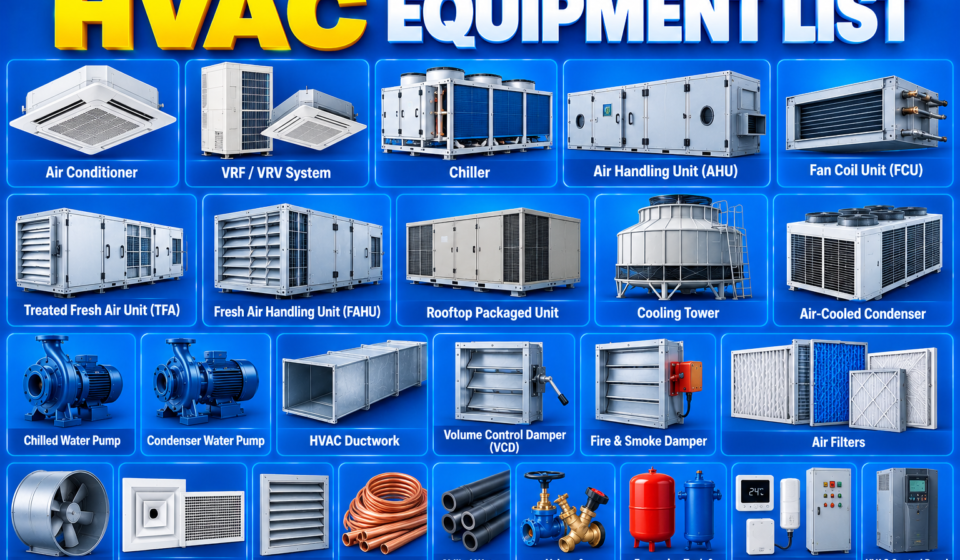
The following table provides an overview of common HVAC equipment and its primary function.
| No. | HVAC equipment | Main function |
|---|---|---|
| 1 | Air conditioner | Cools or heats a space, depending on the system |
| 2 | VRF/VRV system | Provides multi-zone refrigerant-based air conditioning |
| 3 | Chiller | Produces chilled water or another cooling fluid |
| 4 | Air Handling Unit (AHU) | Conditions and distributes air |
| 5 | Fan Coil Unit (FCU) | Provides local heating or cooling using a coil and fan |
| 6 | Treated Fresh Air Unit (TFA) | Treats outdoor air before supply |
| 7 | Fresh Air Handling Unit (FAHU) | Handles and conditions outdoor ventilation air |
| 8 | Rooftop packaged unit | Provides packaged air conditioning and ventilation |
| 9 | Cooling tower | Rejects heat from a conventional water-cooled system |
| 10 | Air-cooled condenser | Rejects heat directly to outdoor air |
| 11 | Chilled-water pump | Circulates chilled water |
| 12 | Condenser-water pump | Circulates condenser water in applicable systems |
| 13 | HVAC ductwork | Distributes supply, return and ventilation air |
| 14 | Volume Control Damper (VCD) | Adjusts airflow through ductwork |
| 15 | Fire and smoke dampers | Provide specified fire or smoke-control functions |
| 16 | Air filters | Remove airborne particles according to filter performance |
| 17 | Supply and exhaust fans | Move air through ventilation and duct systems |
| 18 | Diffusers and grilles | Distribute or return air at room level |
| 19 | Ventilation louvers | Allow air passage while helping protect openings |
| 20 | Refrigerant piping | Connects compatible refrigeration-system components |
| 21 | Chilled-water piping | Carries chilled water between plant and cooling coils |
| 22 | Valves and balancing devices | Isolate, regulate or balance fluid flow |
| 23 | Expansion tank and air separator | Support hydronic-system pressure management and air removal |
| 24 | Thermostats and sensors | Measure conditions and support control |
| 25 | HVAC control panel, VFD and BMS interface | Control, monitor and coordinate system operation |
This is a general reference list, not a universal bill of materials. Equipment quantities and specifications must be established from the project design.
1. Air Conditioner
Air conditioners are among the most familiar HVAC equipment items. They remove heat from an indoor space and reject it outdoors during cooling operation. Heat-pump models can also provide heating.
Common types include:
- Split air conditioners
- Window air conditioners
- Cassette air conditioners
- Ducted air conditioners
- Packaged air conditioners
- Portable air conditioners
- Commercial and industrial air conditioning systems
The correct model depends on the cooling load, room layout, occupancy, outdoor design conditions, electrical supply and installation requirements.
2. VRF or VRV Air Conditioning System
Variable Refrigerant Flow (VRF) systems and systems marketed as Variable Refrigerant Volume (VRV) use refrigerant-based technology to serve multiple indoor units from an outdoor system.
They are commonly considered for offices, hotels, commercial buildings and other projects with multiple independently controlled zones.
A typical installation may include outdoor units, indoor units, refrigerant piping, branch components, controls and communication wiring.
Selection should account for connected capacity, diversity, piping limitations, outdoor conditions, zoning and manufacturer requirements.
3. Chiller
A chiller removes heat from water or another circulating fluid. The chilled fluid is then distributed to cooling coils or process equipment.
Chillers are commonly used in large offices, hospitals, hotels, shopping malls, manufacturing facilities and central cooling plants.
Common types include:
- Air-cooled chillers
- Water-cooled chillers
- Scroll chillers
- Screw chillers
- Centrifugal chillers
- Absorption chillers
The appropriate type depends on the cooling load, operating schedule, efficiency requirements, water availability, plant space, climate and maintenance considerations.
A complete chilled-water plant may also require pumps, piping, valves, strainers, expansion provisions, controls and heat-rejection equipment.
4. Air Handling Unit (AHU)
An Air Handling Unit conditions and distributes air through an HVAC system.
Depending on its design, an AHU may include filters, a supply fan, cooling or heating coils, dampers, a mixing section, a drain pan and control components.
AHUs can be connected to chilled-water systems, direct-expansion cooling systems or other heating and cooling arrangements.
They are widely used in commercial buildings, hospitals, hotels, industrial plants and other applications where central air distribution is required.
5. Fan Coil Unit (FCU)
A Fan Coil Unit uses a fan to move air across a heating or cooling coil. The coil commonly receives chilled water or hot water, although equipment configurations vary.
FCUs are often installed in hotel rooms, offices, apartments and other areas where local temperature control is needed.
Common arrangements include ceiling-concealed, ceiling-cassette and floor-mounted units.
The final selection depends on cooling or heating load, airflow, noise, available installation space, piping and control requirements.
6. Treated Fresh Air Unit (TFA)
TFA commonly stands for Treated Fresh Air.
A TFA unit takes outdoor air and treats it before supplying it to a building or connected HVAC system. Depending on the specification, treatment may include filtration, cooling, heating and dehumidification.
TFA units can be useful in buildings where outdoor ventilation air needs to be managed separately from the main room-cooling system.
The required airflow, filtration, humidity performance and supply-air conditions should be established during design.
7. Fresh Air Handling Unit (FAHU)
FAHU stands for Fresh Air Handling Unit. It is commonly used for equipment designed to handle and condition outdoor ventilation air.
Depending on the project, a FAHU may include intake dampers, filtration, cooling or heating coils, fans and control systems.
The term FAHU is sometimes used interchangeably with TFA in project documents, but the equipment specification should confirm the actual outdoor-air percentage and treatment functions.
8. Rooftop Packaged Unit
A rooftop packaged unit combines major air-conditioning components into one packaged assembly, typically installed on a roof or suitable outdoor platform.
Depending on the model, it may include refrigeration components, fans, filters, coils and control equipment.
These units are used in commercial spaces, retail facilities, warehouses and other buildings where a packaged solution is suitable.
Selection requires attention to capacity, airflow, external static pressure, outdoor conditions, roof loading, duct connections and maintenance access.
9. Cooling Tower
A cooling tower rejects heat from water through heat and mass transfer with air. It is commonly used in conventional water-cooled chiller plants and selected industrial processes.
Typical cooling-tower components include the fill, fan or airflow arrangement, water distribution system, basin and drift-control provisions.
Cooling towers require appropriate water treatment, cleaning, inspection and maintenance. Their design should account for heat-rejection duty, entering and leaving water temperatures, outdoor wet-bulb conditions, water use, noise and installation space.
An air-cooled chiller normally does not require a separate cooling tower for its refrigeration heat-rejection circuit.
10. Air-Cooled Condenser
An air-cooled condenser rejects heat from refrigerant to outdoor air through a heat-transfer coil and fan arrangement.
It is used in many split systems, packaged air conditioners and air-cooled chillers.
The condenser must have adequate airflow and clearance. Restricted airflow, dirty coils or unsuitable installation conditions can reduce performance.
11. Chilled-Water Pump
A chilled-water pump circulates chilled water between the chiller and the building’s cooling coils.
The pump must be selected according to the required flow rate, system pressure drop, piping layout and control strategy.
Larger plants may use variable-speed pumping and more than one pump to support operating flexibility or redundancy.
12. Condenser-Water Pump
In a conventional water-cooled chiller plant, condenser-water pumps circulate water between the chiller condenser and the cooling tower.
Pump selection depends on the design flow rate, pressure drop, pipework, cooling-tower arrangement and chiller requirements.
Air-cooled chiller systems do not normally need condenser-water pumps for their air-cooled heat-rejection circuit.
13. HVAC Ductwork
Ductwork carries supply air, return air, outdoor ventilation air and exhaust air through the building.
Common duct materials and construction methods include galvanized steel, aluminum and other project-specific materials. Flexible duct may be used for suitable short connections.
Ductwork design should consider airflow, velocity, pressure drop, noise, leakage, insulation, fire and smoke requirements, cleanliness and access for maintenance.
14. Volume Control Damper (VCD)
A Volume Control Damper regulates airflow through a duct section.
VCDs may be manual or motorized. They are commonly used during testing and balancing to adjust airflow distribution between branches.
A VCD does not automatically measure airflow, and a conventional volume control damper is not a substitute for a dedicated fire or smoke damper.
15. Fire and Smoke Dampers
Fire and smoke dampers serve specialised life-safety functions in applicable duct penetrations and smoke-control arrangements.
A fire damper is designed to restrict fire spread through a protected barrier penetration. A smoke damper is designed to control smoke movement as part of an approved smoke-control strategy.
The correct damper type, rating, installation and inspection procedure must follow the approved design, manufacturer instructions and applicable regulations.
16. Air Filters
Air filters remove airborne particles from the air passing through an HVAC system.
Filter selection depends on the required filtration efficiency, airflow, pressure drop, indoor air-quality objectives and operating environment.
A system may use a pre-filter followed by a finer filter. HEPA filters are used in applications where the specified high-efficiency particle filtration is required.
Filters need periodic inspection and replacement according to condition, pressure drop and manufacturer recommendations.
17. Supply and Exhaust Fans
Fans move air through ductwork and ventilation systems.
Supply fans deliver air to the intended areas, while exhaust fans remove air from kitchens, washrooms, industrial spaces or other designated locations.
Fan selection depends on airflow, static pressure, efficiency, noise, motor arrangement and operating conditions.
Supply and exhaust systems must be coordinated to achieve the intended ventilation and pressure balance.
18. Diffusers and Grilles
Diffusers distribute supply air into a room, while grilles are commonly used for supply, return or exhaust openings, depending on their design.
Air-terminal selection affects air distribution, room comfort, throw, noise and the interaction between the supply air and occupied zone.
The selected terminal should match the design airflow and ceiling or wall arrangement.
19. Ventilation Louvers
Louvers are installed at outdoor air intakes and exhaust openings. Their design can help manage airflow while reducing the entry of rain and unwanted debris.
Selection should consider free area, pressure drop, weather protection, bird or insect screens where required, corrosion resistance and the location of nearby contamination sources.
A louver’s performance should be checked against the required airflow and installation conditions.
20. Refrigerant Piping
Refrigerant piping connects the relevant components of compatible refrigeration and air-conditioning systems.
Piping design depends on the refrigerant, system capacity, pipe lengths, vertical separation, oil return, manufacturer limitations and installation practices.
Correct pipe sizing, joint quality, insulation, leak testing and commissioning are essential for reliable operation.
21. Chilled-Water Piping
Chilled-water piping carries cooled water between the chiller and the cooling coils in AHUs, FCUs and other equipment.
The system may include supply and return pipes, insulation, valves, strainers, balancing devices, air vents and drains.
Pipe sizing should be based on the design flow rate, allowable pressure drop, water velocity, insulation requirements and operating conditions.
22. Valves and Balancing Devices
HVAC systems use different valves and balancing components to isolate equipment, regulate flow and support system commissioning.
Common examples include:
- Isolation valves
- Control valves
- Balancing valves
- Check valves
- Pressure-independent control valves, where specified
- Strainers
The correct valve depends on the fluid, temperature, pressure, flow requirement, actuator arrangement and system control strategy.
23. Expansion Tank and Air Separator
Hydronic HVAC systems may use an expansion tank to accommodate changes in water volume as temperature changes.
An air separator helps remove entrained air from circulating water. Depending on the system design, additional air vents and dirt separation equipment may also be installed.
These components support system stability and help reduce issues associated with unwanted air in the water circuit.
Their selection and installation should follow the hydronic-system design.
24. Thermostats and Sensors
Thermostats and sensors provide information used to control HVAC equipment.
Common examples include:
- Room temperature sensors
- Supply-air temperature sensors
- Return-air temperature sensors
- Humidity sensors
- Pressure sensors
- Differential-pressure sensors
- Flow sensors
- Outdoor-air temperature sensors
The correct sensor type, range, location and accuracy depend on the control objective and equipment requirements.
25. HVAC Control Panel, VFD and BMS Interface
HVAC control panels coordinate the operation of equipment, while variable frequency drives (VFDs) can adjust the speed of compatible motors.
A Building Management System (BMS) can monitor and coordinate equipment across a building when the necessary controllers and communication interfaces are provided.
Depending on the project, the control system may monitor temperatures, pressures, alarms, fan status, pump operation, energy consumption and operating schedules.
Control integration should be considered during design rather than added without checking compatibility at the end of installation.
HVAC Equipment List for Different Applications
The equipment required depends on the building type and its operating needs.
| Application | Common HVAC equipment |
|---|---|
| Small office | Split AC or cassette AC, ventilation provisions, controls and suitable electrical protection |
| Commercial office building | AHUs, chillers or VRF systems, FCUs or indoor units, ductwork, dampers and controls |
| Hospital | AHUs, filtration, fresh-air systems, exhaust ventilation, controls and application-specific pressure management |
| Hotel | Chillers or VRF systems, FCUs or indoor units, ventilation, pumps where required and controls |
| Shopping mall | Central cooling or VRF systems, AHUs, ventilation, exhaust systems, ductwork and BMS |
| Pharmaceutical facility | Application-specific AHUs, filtration, humidity control, pressure monitoring and validated or qualified systems where required |
| Industrial plant | Chillers or process cooling equipment, AHUs, ventilation fans, pumps, ductwork and process-specific controls |
| Warehouse | Packaged units or other suitable cooling equipment, ventilation fans, air distribution and controls |
These examples are indicative. Final equipment selection must follow the building’s load calculations, applicable codes, project requirements and approved design.
How to Prepare an HVAC Equipment Schedule
An HVAC equipment schedule is more useful when it contains technical details rather than just equipment names.
For each item, consider including:
- Equipment tag or identification number
- Equipment type and service
- Manufacturer and model, when selected
- Design capacity or duty
- Airflow or water flow rate, where applicable
- External static pressure or required head
- Electrical supply and motor details
- Dimensions and installation location
- Control requirements and BMS interface
- Acoustic or vibration requirements, where applicable
- Maintenance and access requirements
- Quantity and redundancy arrangement
- Relevant standards and project specifications
For example, an AHU schedule may include design airflow, cooling capacity, coil details, filtration stages, fan duty, motor power, external static pressure, casing requirements and electrical characteristics.
A chiller schedule may include cooling capacity, entering and leaving water temperatures, design flow, power input, heat-rejection arrangement, operating limits and control requirements.
A proper schedule helps engineers, contractors, suppliers and commissioning teams work from a consistent set of project requirements.
Factors to Consider When Selecting HVAC Equipment
Cooling and heating load
Calculate the building’s heating and cooling loads using the relevant design conditions, occupancy, envelope, lighting, equipment and ventilation requirements.
Outdoor-air ventilation
Determine the required outdoor-air quantity and filtration level according to occupancy, building use and applicable requirements.
Energy efficiency
Compare equipment performance at relevant operating conditions rather than relying only on a single headline efficiency value.
Climate and operating conditions
Outdoor temperature, humidity, dust, corrosion exposure and seasonal conditions affect equipment selection.
Noise and vibration
Consider sound levels, vibration isolation, equipment location and nearby occupied spaces.
Installation space
Check plant-room dimensions, roof loading, access routes, lifting arrangements and maintenance clearances.
Controls and integration
Confirm that sensors, actuators, controllers, electrical panels and BMS communication are compatible with the system design.
Maintenance and lifecycle cost
Consider filter replacement, coil cleaning, water treatment, service access, spare parts and long-term operating cost.
Codes and safety requirements
Equipment must comply with the relevant project specifications, building regulations, fire-safety provisions and manufacturer installation instructions.
Common Mistakes When Preparing an HVAC Equipment List
Selecting equipment only by building area: A square-foot estimate cannot replace a proper load calculation and ventilation assessment.
Ignoring ventilation requirements: Cooling equipment alone may not provide the required outdoor air.
Forgetting supporting equipment: Central cooling systems may require pumps, piping, valves, controls, expansion provisions and heat-rejection equipment.
Ignoring pressure drop: Fans and pumps must be selected for the system resistance and required flow.
Overlooking maintenance access: Filters, coils, fans, valves and controls need sufficient space for inspection and servicing.
Treating every project the same: A hospital, office, hotel and industrial plant can have very different filtration, humidity, ventilation and safety requirements.
Leaving controls until the end: Sensors, actuators, control sequences and BMS integration should be coordinated during design.
HVAC Equipment and Project Support from VIPUL HVAC SOLUTION PVT. LTD.
VIPUL HVAC SOLUTION PVT. LTD. supports HVAC requirements for commercial, industrial and institutional projects, including air-conditioning systems, VRF/VRV solutions, chillers, AHUs, fresh-air systems, ductwork, ventilation, HVAC design and consultancy, installation, testing, commissioning and maintenance.
Our team can discuss your project’s equipment requirements and help identify the information needed for appropriate HVAC planning and selection.
Contact VIPUL HVAC SOLUTION PVT. LTD.
- Phone: +91 8000392000
- Email: info@vipulhvacsolution.in
- Website: https://vipulhvacsolution.in/
- Our branches: https://vipulhvacsolution.in/our-branches/
- Contact page: https://vipulac.in/contact-us/
Our Gujarat Locations
We support HVAC enquiries through our listed locations in Gujarat:
- Surat: Head Office
- Ankleshwar: HVAC sales and project support
- Bharuch: HVAC sales and project support
- Vadodara (Baroda): HVAC sales and project support
- Ahmedabad: HVAC sales and project support
- Talala: HVAC sales and project support
- Junagadh: Contact the central sales team for assistance
- Vapi: Contact the central sales team for assistance
Visit the official branch directory for location details or contact the central sales team for assistance.
Frequently Asked Questions About HVAC Equipment
1. What equipment is included in an HVAC system?
An HVAC system may include air conditioners, AHUs, FCUs, chillers, pumps, cooling towers, ductwork, filters, fans, dampers, valves, piping, sensors and control equipment. The exact list depends on the system design.
2. What are the main HVAC equipment categories?
Major categories include cooling and heating equipment, air-handling equipment, ventilation equipment, air distribution components, hydronic equipment, controls and safety devices.
3. What is the difference between an AHU and an FCU?
An AHU is generally used to condition and distribute air through a central or larger air-distribution system. An FCU is commonly used for local heating or cooling with a fan and coil. Their functions and configurations depend on the application.
4. Is a chiller required in every HVAC system?
No. Small buildings may use split ACs, cassette ACs, packaged systems or VRF systems. Chillers are commonly used where a central chilled-water system is appropriate for the cooling load and operating requirements.
5. What equipment is required for a chilled-water HVAC system?
A typical chilled-water system includes a chiller, chilled-water pumps, piping, cooling coils in AHUs or FCUs, valves, controls and associated accessories. A conventional water-cooled chiller plant also normally includes condenser-water pumps and cooling towers.
6. What equipment is required for HVAC ducting?
Ducted systems may require sheet-metal or other specified ducts, fittings, supports, insulation, dampers, diffusers, grilles, access panels and suitable sealing. Fans and air-handling equipment provide the airflow.
7. What is the difference between HVAC equipment and HVAC accessories?
HVAC equipment usually refers to major functional units such as chillers, AHUs, FCUs and fans. Accessories and components include items such as valves, dampers, filters, sensors, insulation, supports and other installation materials. The distinction can vary by project schedule.
8. How do I prepare an HVAC equipment list for a commercial building?
Start with cooling and heating load calculations, ventilation requirements and the selected system type. Then identify the required equipment, capacities, airflow or water flow, electrical details, controls, quantities, installation constraints and maintenance provisions.
9. Which HVAC equipment is used in hospitals?
Hospital HVAC may include AHUs, specified filtration, fresh-air systems, exhaust ventilation, chillers or other cooling equipment, pumps, ductwork, controls and application-specific pressure management. The design must follow the requirements of the particular clinical and support areas.
10. Where can I get HVAC equipment and project support in Gujarat?
VIPUL HVAC SOLUTION PVT. LTD. supports HVAC project enquiries through its listed Gujarat locations, including Surat, Ankleshwar, Bharuch, Vadodara, Ahmedabad, Talala, Junagadh and Vapi. Call +91 8000392000 or visit https://vipulhvacsolution.in/ for assistance.
Conclusion
An HVAC equipment list is an important planning document for selecting, specifying, installing and maintaining a building’s heating, ventilation and air conditioning system.
The list may include air conditioners, VRF systems, chillers, AHUs, FCUs, TFA units, cooling towers, pumps, ductwork, dampers, filters, fans, piping, valves, sensors and control panels. The exact equipment and quantities depend on the building’s load, ventilation requirements, system design and operating conditions.
For the best result, prepare the equipment schedule using proper engineering calculations and coordinate it with the mechanical, electrical, architectural and fire-safety requirements.
For HVAC equipment enquiries and project assistance, contact VIPUL HVAC SOLUTION PVT. LTD. at +91 8000392000 or visit https://vipulhvacsolution.in/.