
Precision Air Conditioning in Vapi: 7 Key Benefits
If you are searching for Precision Air Conditioning in Vapi, the right PAC system should be selected according to the actual equipment heat load, temperature requirements, humidity, airflow, operating hours and reliability requirements—not simply by room area.
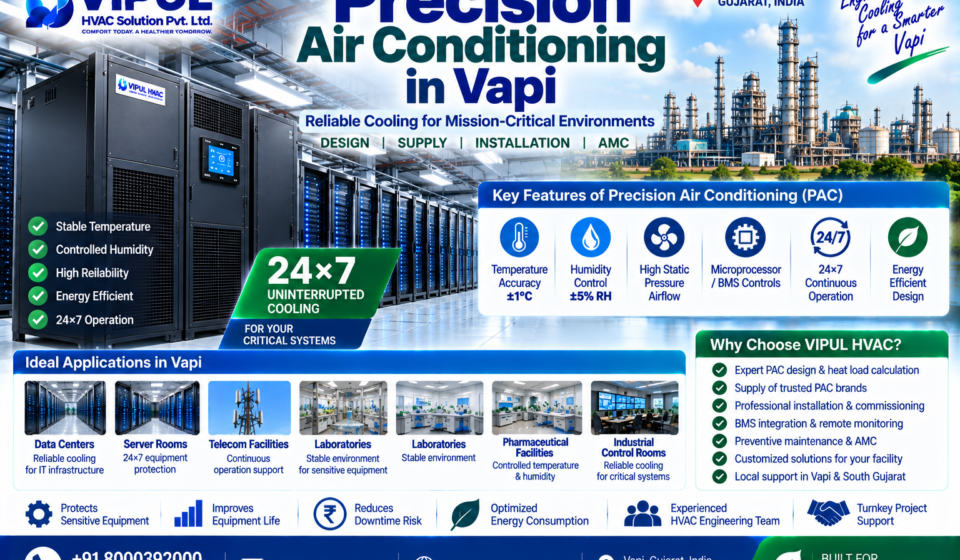
Precision Air Conditioning (PAC) is a specialized HVAC solution for critical environments such as data centers, server rooms, telecom facilities, laboratories, pharmaceutical facilities and industrial control rooms. VIPUL HVAC SOLUTION PVT. LTD. provides PAC solutions designed for controlled temperature and humidity, continuous cooling and sensitive-equipment protection. Its published PAC specifications include ±1°C temperature accuracy, ±5% RH humidity control, DX cooling, high-static-pressure airflow, 24×7 operation and microprocessor/BMS controls.
Vapi is an important industrial location in Gujarat, and current local information identifies Vapi GIDC as a major industrial estate with significant chemical-industry activity. This makes engineered HVAC, ventilation and environmental control particularly relevant for many industrial and technical facilities in the area.
What Is Precision Air Conditioning?
Precision Air Conditioning (PAC) is an HVAC system engineered to maintain controlled temperature, humidity and airflow in spaces where environmental stability is important for equipment or processes.
Unlike a conventional comfort AC, PAC focuses on the requirements of the equipment and critical environment, rather than primarily on human comfort.
A PAC design may consider:
- Equipment heat load
- Temperature accuracy
- Relative humidity
- Airflow
- Static pressure
- 24×7 operation
- Redundancy
- Alarm monitoring
- BMS integration
- Future expansion
- Maintenance requirements
VIPUL states that its PAC systems are intended for environments where temperature, humidity and airflow accuracy are mission-critical.
Why Precision Air Conditioning Is Important in Vapi
Vapi’s industrial environment includes manufacturing and chemical-related facilities, alongside commercial and technical infrastructure. In such environments, HVAC requirements can range from ordinary comfort cooling to highly controlled cooling for equipment and processes.
PAC can be considered when a facility requires:
- 24×7 cooling
- Stable temperature
- Humidity control
- High sensible cooling
- High airflow
- Continuous equipment protection
- Alarm monitoring
- BMS integration
- Cooling redundancy
- Future expansion
VIPUL’s broader HVAC portfolio includes PAC, VRF/VRV systems, chillers, AHUs, ducted and package AC, ventilation and customized HVAC design.
Precision AC vs Normal AC
| Feature | Normal Comfort AC | Precision Air Conditioning |
|---|---|---|
| Main purpose | Human comfort | Critical equipment/process environment |
| Heat-load focus | Occupancy | Equipment/process heat |
| Operation | Usually scheduled | Designed for continuous operation |
| Temperature control | General comfort | Precise control |
| Humidity | Usually limited | Dedicated control possible |
| Airflow | Comfort-oriented | Application-specific |
| Monitoring | Basic | Advanced |
| Alarms | Model dependent | Common in critical applications |
| Redundancy | Usually limited | Can be engineered |
| BMS | Model dependent | Available |
| Typical applications | Homes/offices | Server rooms/data centers/technical areas |
The correct choice depends on the project’s actual technical requirements.
7 Key Benefits of Precision Air Conditioning
1. Accurate Temperature Control
Sensitive electronic equipment can require stable environmental conditions.
VIPUL’s published PAC specifications include temperature accuracy of ±1°C.
This can make PAC appropriate for:
- Server rooms
- Data centers
- Telecom rooms
- Laboratories
- Industrial control rooms
- Technical rooms
2. Humidity Control
Temperature is only one part of environmental management.
Depending on the application, excessive or insufficient humidity can create operational concerns for sensitive equipment and processes.
VIPUL’s published PAC specifications include ±5% RH humidity control.
A project may incorporate:
- Humidity sensors
- Humidification
- Dehumidification
- Automatic controls
- Environmental monitoring
- BMS integration
The actual humidity range should be established according to the equipment and project requirements.
3. 24×7 Continuous Cooling
Servers, networking equipment, telecom systems and industrial electronics may generate heat continuously.
VIPUL lists 24×7 continuous operation among its PAC specifications.
A continuous-duty HVAC system should also be planned around:
- Redundancy
- Preventive maintenance
- Alarm monitoring
- Remote monitoring
- Service accessibility
- Spare parts
4. High-Static-Pressure Airflow
Critical environments may require conditioned air to travel through:
- Raised floors
- Ductwork
- Filters
- Containment systems
- Long airflow paths
VIPUL’s published PAC specification includes high-static-pressure airflow.
Correct airflow design is important because adequate cooling capacity alone does not guarantee that all equipment receives the required airflow.
5. Microprocessor and BMS Controls
Modern PAC systems can monitor and control operating conditions through dedicated electronic controllers.
VIPUL lists microprocessor/BMS controls for its PAC systems.
Depending on the installation, monitoring can include:
- Room temperature
- Relative humidity
- Supply-air temperature
- Return-air temperature
- Fan status
- Compressor status
- Fault conditions
- Alarm status
- Filter condition
BMS integration can provide centralized monitoring where required by the project’s control architecture.
6. Sensitive Equipment Protection
PAC is not simply designed to make a room colder.
The objective is to maintain the environmental conditions required by the equipment or process.
Applications can include:
- Servers
- Network equipment
- Telecom equipment
- PLC systems
- SCADA systems
- Laboratory instruments
- Industrial control systems
- Electronic equipment
7. Cooling Redundancy
Critical environments may require backup cooling capacity.
One commonly used engineering approach is N+1 redundancy.
For example:
Required operating capacity: 3 units
Installed capacity: 4 units
Configuration: N+1
The additional unit can provide backup capacity if one unit is unavailable, subject to the actual system design.
VIPUL’s PAC service information includes heat-load and redundancy planning.
Where Is PAC Used in Vapi?
1. Industrial Control Rooms
Vapi’s industrial environment makes control-room HVAC an important application to consider.
Control rooms can contain:
- PLCs
- SCADA systems
- Automation equipment
- Electrical panels
- Control electronics
- Monitoring systems
Precision cooling can help maintain an appropriate environment for these systems.
2. Pharmaceutical Facilities
Pharmaceutical facilities may require carefully controlled:
- Temperature
- Humidity
- Air changes
- Pressure
- Filtration
- Airflow
PAC can form part of a broader HVAC strategy depending on the specific application.
VIPUL also provides pharmaceutical HVAC solutions as part of its HVAC portfolio.
3. Data Centers
Data centers can have substantial continuous heat loads.
A data-center cooling strategy may involve:
- PAC/CRAC systems
- CRAH systems
- Chilled-water systems
- Raised-floor airflow
- Hot-aisle/cold-aisle planning
- Containment
- Temperature monitoring
- Humidity monitoring
- Redundant cooling
- BMS integration
The appropriate configuration depends on IT load, rack density, facility architecture and redundancy requirements.
4. Server Rooms
A server room can have a relatively small floor area but a high equipment heat load.
Therefore:
Small room does not necessarily mean small cooling requirement.
PAC sizing should consider:
- Server power
- Rack density
- Networking equipment
- UPS losses
- Lighting
- Occupancy
- Room construction
- Future expansion
5. Telecom Facilities
Telecom equipment may operate continuously and produce substantial heat.
Precision cooling can provide:
- Continuous cooling
- Temperature control
- Humidity management
- High airflow
- Equipment protection
- Monitoring
- Alarm functionality
VIPUL’s precision-cooling information identifies telecom facilities among its applications.
6. Laboratories
PAC can be considered for laboratories containing sensitive instruments and equipment.
Potential applications include:
- Research laboratories
- Testing laboratories
- Medical laboratories
- Electronics laboratories
- Technical research areas
7. Banking and IT Infrastructure
Banking and IT facilities may have dedicated server and communication rooms.
PAC can potentially be integrated with:
- Environmental sensors
- Alarm systems
- BMS
- Remote monitoring
- Redundant cooling
How Does a Precision Air Conditioner Work?
A simplified PAC airflow process is:
Return Air → Filtration → Cooling Coil → Conditioned Supply Air → Equipment → Return Air
For a DX PAC system:
- Warm air returns from the critical room.
- Air passes through the filtration section.
- The cooling coil removes heat.
- Refrigerant absorbs heat from the air.
- Conditioned air is supplied back into the room.
- Sensors monitor temperature and humidity.
- The controller adjusts operation according to demand.
- Heat is rejected through the refrigeration system.
VIPUL’s published PAC specifications identify DX cooling as one of its configurations.
PAC Cooling Capacity Calculation
One of the most important steps in PAC selection is determining the actual cooling load.
A simplified concept is:
Total Cooling Load = Equipment Heat + UPS Heat + Lighting + People + Building Heat Gain + Other Loads
For industrial control rooms and server rooms, equipment heat can be a major component.
For example, if equipment produces approximately 100 kW of heat, the HVAC design must remove that heat while also considering:
- Redundancy
- Future expansion
- UPS losses
- Electrical losses
- Lighting
- Occupancy
- Outdoor conditions
- Building envelope
- Temperature requirements
- Humidity requirements
- Airflow distribution
Therefore, PAC capacity should not be selected only by square footage.
Hot-Aisle and Cold-Aisle Airflow
For server rooms and data centers, airflow management is an important part of precision cooling.
A simplified airflow arrangement is:
Cold Aisle → Server Intake → Server → Hot Aisle → Return Air → PAC
Depending on facility design, engineers may consider:
- Cold-aisle containment
- Hot-aisle containment
- Raised-floor supply
- Overhead supply
- In-row cooling
- Rack-level cooling
The appropriate arrangement depends on rack density, equipment layout and facility architecture.
Important PAC Design Factors in Vapi
Before selecting a Precision Air Conditioning system, consider:
1. Equipment Heat Load
Calculate the actual heat generated by servers, machines and electronic equipment.
2. Room Dimensions
Length, width and height affect airflow and air distribution.
3. Equipment Density
High-density equipment can create localized hotspots.
4. Operating Hours
Determine whether the system must operate continuously.
5. Temperature Requirements
Define the required operating temperature range.
6. Humidity
Determine whether active humidity control is necessary.
7. Airflow
Plan supply and return airflow carefully.
8. Redundancy
Determine whether N+1 or another configuration is required.
9. Controls
Evaluate microprocessor controls, alarms, BMS and monitoring.
10. Future Expansion
Allow for additional equipment and potential future heat-load growth.
Precision Air Conditioning Installation in Vapi
A professional PAC installation should generally follow a structured engineering process.
Step 1: Site Survey
Assess:
- Room dimensions
- Existing HVAC
- Equipment arrangement
- Heat sources
- Electrical infrastructure
- Ceiling/floor configuration
- Installation access
Step 2: Heat-Load Calculation
Calculate the actual cooling requirement.
Step 3: PAC Selection
Select the appropriate:
- Cooling capacity
- Airflow
- Static pressure
- Cooling configuration
- Controls
- Redundancy
Step 4: Airflow Design
Develop the supply and return-air strategy.
Step 5: Installation
Depending on the project, installation may include:
- PAC units
- Refrigerant piping
- Drainage
- Electrical connections
- Sensors
- Controls
- Ductwork
Step 6: Testing & Commissioning
Verify:
- Temperature
- Humidity
- Airflow
- Refrigeration operation
- Electrical parameters
- Alarms
- Controls
- BMS communication
Step 7: Maintenance & AMC
Establish a preventive-maintenance schedule appropriate for continuous-duty equipment.
VIPUL’s HVAC project approach includes design, load calculation, equipment selection, installation, testing, commissioning and maintenance support.
PAC Maintenance in Vapi
A PAC system operating continuously should have planned preventive maintenance.
Typical activities include:
- Filter inspection
- Filter cleaning/replacement
- Coil cleaning
- Fan inspection
- Refrigeration-system inspection
- Condensate-drain inspection
- Electrical inspection
- Sensor verification
- Temperature/humidity checks
- Alarm testing
- Controller inspection
- BMS communication testing
- Compressor inspection
VIPUL’s PAC offering includes preventive maintenance support for critical cooling applications.
How Much Does Precision Air Conditioning Cost in Vapi?
There is no single fixed PAC price because project requirements vary.
The total cost can depend on:
- PAC cooling capacity
- Number of units
- DX or chilled-water configuration
- Airflow requirement
- Static pressure
- Redundancy
- Controls
- BMS integration
- Sensors
- Refrigerant piping
- Electrical work
- Ductwork
- Installation
- Testing and commissioning
- AMC
- Future expansion
For an industrial or critical facility, a site survey and heat-load calculation should preferably be completed before preparing a final quotation.
PAC vs VRF for Critical Applications
| Factor | PAC | VRF |
|---|---|---|
| Primary application | Critical/precision cooling | Comfort cooling |
| Server room | Suitable | Application dependent |
| Data center | Precision-cooling solution | Generally not primary solution |
| Continuous operation | Designed for continuous-duty applications | Depends on system |
| Humidity control | Dedicated control possible | More limited |
| High equipment heat | Suitable | Application dependent |
| Redundancy | Can be engineered | System dependent |
| BMS integration | Available | Available depending on system |
| Airflow management | Critical design feature | Primarily comfort-oriented |
The appropriate system should be selected according to the actual project requirements.
Common PAC Selection Mistakes
- Selecting PAC Based Only on Room Area
Equipment heat load can be much more important than floor area in technical environments.
- Ignoring Future Expansion
Additional servers, machines or control equipment can increase cooling demand.
- No Redundancy Planning
Critical facilities may require backup cooling capacity.
- Poor Airflow Design
Incorrect airflow distribution can create localized hotspots.
- Ignoring Humidity
Temperature and humidity should be evaluated according to the application’s requirements.
- Oversizing Without Engineering Analysis
Excessive capacity can increase capital costs and affect operating efficiency and control.
- No Preventive Maintenance
Continuous-duty HVAC systems need planned maintenance.
Why Choose VIPUL HVAC Solution for PAC in Vapi?
VIPUL HVAC SOLUTION PVT. LTD. has a broad HVAC portfolio covering commercial, industrial and institutional applications. Its official website states that the company has 26+ years of HVAC experience and provides solutions including air conditioning, ventilation and climate-control systems.
VIPUL’s published PAC capabilities include:
- PAC system design
- Heat-load planning
- Redundancy planning
- Equipment supply
- Installation
- High-static-pressure airflow
- 24×7 cooling
- Monitoring
- BMS integration
- Preventive maintenance
- AMC support
VIPUL also officially lists Vapi among its branch locations, alongside Surat, Ankleshwar, Bharuch, Vadodara, Ahmedabad, Talala and Junagadh.
For a Vapi PAC project, the engineering workflow can be structured as:
Site Survey → Heat-Load Calculation → PAC Selection → Airflow Design → Installation → Testing & Commissioning → AMC
Frequently Asked Questions
What is Precision Air Conditioning?
Precision Air Conditioning is a specialized HVAC system designed to provide controlled temperature, humidity and airflow for critical environments such as data centers, server rooms, telecom facilities, laboratories and industrial control rooms.
What is PAC used for?
PAC can be used for:
- Data centers
- Server rooms
- Telecom facilities
- Laboratories
- Pharmaceutical facilities
- Industrial control rooms
- Banking and IT infrastructure
VIPUL’s precision-cooling information identifies these types of critical applications.
What is the difference between PAC and normal AC?
Normal AC primarily provides comfort cooling, while PAC is engineered around equipment heat load, environmental control, airflow, continuous operation and monitoring.
Can PAC operate 24×7?
Yes. PAC systems can be designed for continuous operation. VIPUL’s published PAC specifications specifically list 24×7 continuous operation.
Can PAC integrate with BMS?
Yes. VIPUL’s published PAC specification includes microprocessor/BMS controls.
Is PAC suitable for an industrial control room in Vapi?
PAC can be considered when an industrial control room contains heat-generating electronic equipment and requires stable temperature, humidity and continuous cooling. Final selection should be based on the equipment heat load and environmental requirements.
Does PAC require a raised floor?
No. Different supply and return-air configurations can be engineered depending on the facility.
How is PAC capacity calculated?
PAC capacity should primarily be based on actual equipment and building heat loads, airflow and operating requirements—not simply floor area.
Does VIPUL provide PAC services in Vapi?
VIPUL’s official website lists Vapi among its branch locations and provides PAC design, supply, installation and maintenance capabilities.
Conclusion
Precision Air Conditioning in Vapi is an important HVAC solution for facilities where conventional comfort AC may not provide the required level of environmental control.
For industrial control rooms, server rooms, data centers, telecom facilities, laboratories and pharmaceutical environments, PAC design should consider:
Heat Load + Airflow + Temperature + Humidity + Redundancy + Controls + Future Expansion
VIPUL HVAC SOLUTION PVT. LTD. provides PAC solutions covering design, equipment supply, installation, monitoring/BMS integration and preventive maintenance/AMC support.
Contact VIPUL HVAC SOLUTION PVT. LTD.
Vapi: Local branch/project support available
Central Sales: +91 8000392000
Email: info@vipulhvacsolution.in
Website: vipulhvacsolution.in
Service Area: Vapi, South Gujarat and project locations across India
VIPUL’s current branch information confirms Vapi as one of its listed locations.
Important Links: