


2 Ton AC Watts: How Many Watts Does a 2 Ton Air Conditioner Consume?
Understanding 2 Ton AC Watts and Power Consumption
Are you planning to buy a 2-ton air conditioner and wondering how many watts it consumes? Understanding 2 ton AC watts is important for estimating electricity bills, selecting the correct electrical connection, and choosing an energy-efficient air conditioner.
A 2-ton air conditioner is commonly considered for larger bedrooms, living rooms, offices, conference rooms, and commercial spaces where the cooling load requires this capacity.
However, a 2-ton AC does not necessarily consume 2,000 watts of electricity every hour. Its actual power consumption depends on the model, inverter technology, BEE star rating, compressor operation, room temperature, outdoor conditions, and installation quality.
There is also an important difference between cooling capacity and electrical power consumption. A 2-ton AC has a nominal cooling capacity of approximately 7,034 watts, but its electrical input is lower.
In this guide, VIPUL HVAC SOLUTION PVT. LTD. explains 2-ton AC wattage, electricity consumption per hour, daily and monthly units, estimated electricity bills, and practical energy-saving tips.
How Many Watts Does a 2 Ton AC Consume?
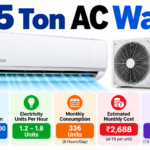
A 2-ton split AC may have a rated electrical power input in the approximate range of 1,600–2,500 watts, depending on its model, efficiency, and compressor technology.
This is an indicative range, not a specification that applies to every 2-ton AC.
For example, a published Blue Star 2-ton, 3-star inverter AC specification lists a rated cooling power input of 2,020 watts. Its actual input varies with operating conditions and compressor load.
| 2 Ton AC Type | Indicative Power Input |
|---|---|
| 2 Ton 5 Star Inverter AC | 1,600–1,900 W |
| 2 Ton 3 Star Inverter AC | 1,850–2,150 W |
| 2 Ton Non-Inverter AC | 2,000–2,500 W |
These are illustrative ranges, not guaranteed values for all products. Always check the exact model’s technical specifications and BEE label.
Example: 2 Ton AC Rated Power Input
Assume a 2-ton AC has a rated electrical input of 2,020 watts.
- AC capacity: 2 Ton
- Rated power input: 2,020 W
- Power in kilowatts: 2.02 kW
This means that when the AC draws its rated input continuously for one hour, it consumes approximately 2.02 electricity units.
Actual inverter AC consumption varies as the compressor adjusts its speed to meet the cooling demand.
Difference Between 2 Ton AC Cooling Capacity and Electrical Wattage
Cooling capacity and electrical power consumption are two different measurements.
Cooling capacity: The amount of heat an air conditioner can remove from a room.
Electrical power input: The electrical power consumed by the air conditioner during operation.
One ton of refrigeration is approximately equal to 3,517 watts of cooling capacity.
Therefore:
Formula:
2 Ton AC Cooling Capacity = 2 × 3,517
2 Ton AC Cooling Capacity = 7,034 Watts
A 2-ton AC has a nominal cooling capacity of approximately 7,034 watts.
However, this does not mean that the AC consumes 7,034 watts of electricity. Its actual electrical input is considerably lower because cooling capacity and electrical consumption measure different things.
Important: Never use the cooling-capacity figure as the electrical wattage when calculating your electricity bill.
2 Ton AC Power Consumption Per Hour
Electricity consumption is measured in kilowatt-hours (kWh), commonly called units on electricity bills.
Use this formula:
Electricity Units = (Power in Watts × Operating Hours) ÷ 1,000
Let’s assume the 2-ton AC has a rated power input of 2,020 watts.
| Operating Time | Estimated Electricity Consumption |
|---|---|
| 1 Hour | 2.02 Units |
| 2 Hours | 4.04 Units |
| 4 Hours | 8.08 Units |
| 6 Hours | 12.12 Units |
| 8 Hours | 16.16 Units |
| 10 Hours | 20.20 Units |
| 12 Hours | 24.24 Units |
These figures assume a constant 2,020-watt electrical input.
In an inverter AC, the compressor can reduce its speed when the cooling demand decreases. Therefore, actual consumption may be lower than the constant-input estimate.
2 Ton AC Electricity Consumption Per Day
Daily electricity consumption depends on the AC’s average power input and operating hours.
Assume:
- Rated power input: 2,020 watts
- Power in kilowatts: 2.02 kW
- Daily usage: Different operating periods
| Daily Usage | Estimated Electricity Consumption |
|---|---|
| 4 Hours | 8.08 Units |
| 6 Hours | 12.12 Units |
| 8 Hours | 16.16 Units |
| 10 Hours | 20.20 Units |
| 12 Hours | 24.24 Units |
For example, if a 2-ton AC continuously draws 2.02 kW for 8 hours:
Electricity Consumption = 2.02 × 8
Daily Electricity Consumption = 16.16 Units
Actual consumption depends on room conditions, outdoor temperature, thermostat settings, and compressor operation.
2 Ton AC Monthly Electricity Consumption
Let’s calculate the estimated monthly electricity consumption for a 2-ton AC operating 8 hours per day.
Assumptions:
- AC rated power input: 2,020 watts
- Power in kilowatts: 2.02 kW
- Daily usage: 8 hours
- Monthly operating period: 30 days
Formula:
Monthly Electricity Consumption = Power (kW) × Daily Usage Hours × Number of Days
Calculation:
2.02 × 8 × 30 = 484.8 kWh
Estimated Monthly Electricity Consumption = 484.8 Units
| Daily Usage | Estimated Monthly Units |
|---|---|
| 4 Hours | 242.4 Units |
| 6 Hours | 363.6 Units |
| 8 Hours | 484.8 Units |
| 10 Hours | 606 Units |
| 12 Hours | 727.2 Units |
These calculations assume constant rated power input. Actual inverter AC consumption can differ significantly depending on cooling demand.
2 Ton AC Electricity Bill Calculation
To calculate the estimated electricity cost of operating a 2-ton AC, multiply the monthly electricity consumption by your electricity tariff.
Formula:
Electricity Cost = Monthly Units × Rate per Unit
For example, assume:
- Monthly consumption: 484.8 units
- Electricity rate: ₹8 per unit
Calculation:
484.8 × ₹8 = ₹3,878.40
Estimated Monthly Electricity Cost = ₹3,878.40
| Daily Usage | Monthly Units | Cost at ₹8 per Unit |
|---|---|---|
| 4 Hours | 242.4 | ₹1,939.20 |
| 6 Hours | 363.6 | ₹2,908.80 |
| 8 Hours | 484.8 | ₹3,878.40 |
| 10 Hours | 606 | ₹4,848 |
| 12 Hours | 727.2 | ₹5,817.60 |
These are illustrative energy charges only. Actual electricity bills may include fixed charges, fuel adjustments, taxes, and other applicable charges.
Difference Between 2 Ton Inverter and Non-Inverter AC Power Consumption
The compressor technology plays an important role in determining how an AC operates and consumes electricity.
2 Ton Inverter AC
An inverter AC adjusts compressor speed according to the cooling requirement.
When the desired room temperature is reached, the compressor can slow down instead of repeatedly switching completely off and on.
Potential advantages include:
- Variable compressor speed
- More consistent room temperature
- Better efficiency in suitable operating conditions
- Reduced start-stop cycling
- Potentially lower electricity consumption during long operating periods
Actual savings depend on the AC model, installation, room conditions, and operating pattern.
2 Ton Non-Inverter AC
A conventional non-inverter AC generally operates its compressor at a fixed speed.
The compressor switches off when the thermostat reaches the selected temperature and starts again when additional cooling is required.
Its electricity consumption depends on how frequently and how long the compressor operates.
Inverter vs Non-Inverter Comparison
| Parameter | Inverter AC | Non-Inverter AC |
|---|---|---|
| Compressor operation | Variable speed | Generally fixed speed |
| Temperature control | More gradual | Compressor cycles on and off |
| Power input | Changes with cooling demand | Depends on compressor operating cycle |
| Energy efficiency | Often higher in efficient models | Depends on model and rating |
| Long operating hours | Can be advantageous | Depends on operating conditions |
| Initial price | May be higher | May be lower |
Before buying, compare the BEE star rating, ISEER value, annual electricity consumption, and rated power input.
2 Ton AC 3 Star vs 5 Star Power Consumption
BEE star ratings help consumers compare the energy efficiency of air conditioners within the applicable product category and label period.
Generally, a higher star rating indicates better energy efficiency under standardized testing conditions.
However, a 5-star AC does not have one fixed wattage, and a 3-star AC does not always consume the same amount of electricity.
Compare these specifications:
- Rated power input in watts
- Cooling capacity
- ISEER value
- Annual electricity consumption
- BEE label period
- Compressor technology
Which Is Better: 3 Star or 5 Star?
A 5-star AC may be a better long-term choice when the equipment operates for many hours every day.
A 3-star model may be worth considering when daily operating hours are limited or the purchase budget is a priority.
Compare the additional purchase cost against the expected annual electricity savings before deciding.
Factors That Affect 2 Ton AC Watt Consumption
Two identical AC models may consume different amounts of electricity in different rooms.
Important factors include:
1. Room Size
If the room has a higher cooling load than the AC can handle, the equipment may run for longer periods without achieving the desired temperature.
2. Outdoor Temperature
During hot weather, the AC may need to work harder to remove heat from the room.
3. Temperature Setting
Setting the thermostat unnecessarily low can increase cooling demand and electricity consumption.
4. Room Insulation
Poor insulation allows outdoor heat to enter the room and increases the cooling load.
5. Direct Sunlight
Rooms exposed to strong sunlight through windows or roofs may require more cooling.
6. Number of Occupants
People generate heat. A higher number of occupants can increase the cooling requirement.
7. AC Maintenance
Dirty filters, blocked airflow, and dirty heat exchangers can reduce equipment performance.
8. Door and Window Leakage
Hot outdoor air entering the room increases the cooling load.
How to Reduce 2 Ton AC Electricity Consumption
Follow these practical recommendations to improve energy efficiency:
- Maintain a comfortable temperature, commonly around 24–26°C depending on personal comfort and conditions.
- Clean indoor air filters regularly.
- Keep doors and windows closed while cooling.
- Use curtains or blinds to reduce direct solar heat gain.
- Select the correct AC capacity for the room’s cooling load.
- Schedule professional AC maintenance.
- Keep the outdoor unit’s airflow unobstructed.
- Use sleep or energy-saving modes when suitable.
- Avoid unnecessarily low temperature settings.
- Compare BEE star ratings and annual electricity consumption before purchasing.
These practices can help reduce unnecessary electricity use, although actual savings depend on the installation and operating conditions.
What Electrical Connection Is Required for a 2 Ton AC?
A 2-ton split AC can have a substantial electrical load. Its electrical installation must be designed according to the manufacturer’s specifications.
Important considerations include:
- Rated current and maximum operating current
- Rated supply voltage
- Cable size and material
- Cable length and voltage drop
- MCB or circuit-breaker rating
- Dedicated electrical circuit
- Proper earthing
- Outdoor isolator and protection requirements
- Installation method and ambient temperature
Do not select the cable size or MCB rating using tonnage alone.
A qualified electrician should verify the installation using the equipment nameplate, manufacturer instructions, and applicable electrical standards.
Is a 2 Ton AC Suitable for Your Room?
A 2-ton AC may be suitable for a large bedroom, living room, office, conference room, or commercial space, but room area alone does not determine the correct capacity.
A proper cooling-load assessment should consider:
- Room length, width, and height
- Window size and direction
- Roof and wall exposure
- Number of occupants
- Lighting and electrical equipment
- Outdoor design temperature
- Insulation and ventilation
- Heat generated by appliances
- Air leakage and occupancy patterns
For example, a top-floor room exposed to direct sunlight may require more cooling than a shaded room with the same floor area.
An HVAC cooling-load calculation helps determine whether a 2-ton AC is suitable or whether a different capacity is required.
How to Check Actual 2 Ton AC Electricity Consumption
If you want to measure the actual electricity consumption of your 2-ton AC, consider these methods.
Method 1: Check the Manufacturer’s Specification
Find the rated cooling power input in watts on the product specification sheet.
Method 2: Check the BEE Label
Review the annual electricity consumption, star rating, and ISEER value.
Method 3: Use a Suitable Energy Meter
A properly rated energy meter installed by a qualified electrician can measure the electricity consumed over time.
Method 4: Check Your Electricity Meter
Compare electricity-meter readings before and after operating the AC, while accounting for other appliances using electricity.
For inverter ACs, measuring over several hours or days gives a more useful picture than checking instantaneous wattage alone.
Frequently Asked Questions About 2 Ton AC Watts
Q1. How many watts does a 2 ton AC consume?
A 2-ton split AC may have a rated electrical input of approximately 1,600–2,500 watts, depending on the model and technology. Check the manufacturer’s specification for the exact value.
Q2. Does a 2 ton AC consume 2,000 watts?
Not always. Some models have a rated input below 2,000 watts, while others may have a higher input. Actual inverter AC consumption also changes with compressor load.
Q3. How many units does a 2 ton AC consume in one hour?
If a 2-ton AC continuously draws 2,020 watts for one hour, it consumes 2.02 units of electricity.
Q4. How many units does a 2 ton AC consume in 8 hours?
At a constant 2,020 W input, it consumes 16.16 units in 8 hours. Actual consumption depends on the model and cooling demand.
Q5. What is the cooling capacity of a 2 ton AC in watts?
One ton of refrigeration is approximately 3,517 watts. Therefore, a 2-ton AC has a nominal cooling capacity of approximately 7,034 watts.
Q6. How much electricity does a 2 ton 5 star AC consume?
There is no single consumption value for all 2-ton 5-star ACs. Check the specific model’s BEE label, rated power input, ISEER, and annual electricity consumption.
Q7. Is a 2 ton inverter AC more energy efficient?
Many inverter models can offer better efficiency because they adjust compressor speed according to cooling demand. Compare the actual ISEER and annual energy consumption figures before buying.
Q8. How much does it cost to run a 2 ton AC for 8 hours?
If the AC draws an average of 2.02 kW for 8 hours, it consumes 16.16 units. At ₹8 per unit, the estimated energy charge is ₹129.28 per day.
Q9. Can a 2 ton AC run on a single-phase connection?
Some residential 2-ton split AC models are designed for single-phase supply. However, the exact supply requirements must be checked on the product nameplate and manufacturer’s instructions.
Q10. How can I reduce my 2 ton AC electricity bill?
Use an appropriate temperature setting, clean filters, maintain the outdoor unit, reduce heat entering the room, and select an energy-efficient model suitable for the cooling load.
Q11. Is 2 ton AC suitable for a commercial office?
It may be suitable for some office spaces, but the final capacity should be based on a cooling-load calculation that includes occupants, equipment, lighting, windows, and ventilation requirements.
Q12. What is the difference between 2 ton AC wattage and 2 ton AC cooling capacity?
Wattage for electrical input measures electricity consumed by the AC. Cooling capacity measures heat removed from the room. A 2-ton AC has approximately 7,034 W of cooling capacity, but its electrical input is lower.
Conclusion: Understand 2 Ton AC Watts Before Buying
Understanding 2 ton AC watts helps you estimate electricity consumption, compare air conditioner models, and plan the electrical requirements of your home or office.
Remember these important points:
- 2-ton AC cooling capacity is approximately 7,034 watts.
- Actual electrical input depends on the model and operating conditions.
- A 2,020 W AC consumes 2.02 units per hour only when drawing that input continuously.
- At 8 hours per day and 30 days per month, the constant-input estimate is 484.8 units.
- Inverter AC consumption varies according to cooling demand.
Before purchasing a 2-ton AC, compare the rated power input, BEE star rating, ISEER, annual electricity consumption, and installation requirements.
VIPUL HVAC SOLUTION PVT. LTD. provides HVAC-related solutions for residential, commercial, and industrial requirements.
Need assistance with AC selection, cooling-load calculations, or HVAC solutions? Contact VIPUL HVAC SOLUTION PVT. LTD.
Phone: +91 8000392000
Website: https://vipulhvacsolution.in/
Company: VIPUL HVAC SOLUTION PVT. LTD.
Important Links:
- AC Electricity Bill Calculator
- 1 Ton AC Electricity Bill
- 1.5 Ton AC Watt
- AC Power Consumption Per Hour
- AC Electricity Consumption
- AC Load Calculator
- HVAC Load Calculator
Technical references
-
Blue Star – 2 Ton 3-Star Inverter AC specifications — rated power input 2,020 W.
-
Blue Star – 2 Ton 3-Star Inverter AC specifications — another model’s technical specifications.
-
Bureau of Energy Efficiency – AC energy-efficiency standards — explains the BEE and ISEER framework.


[…] 2 Ton AC Watts […]