
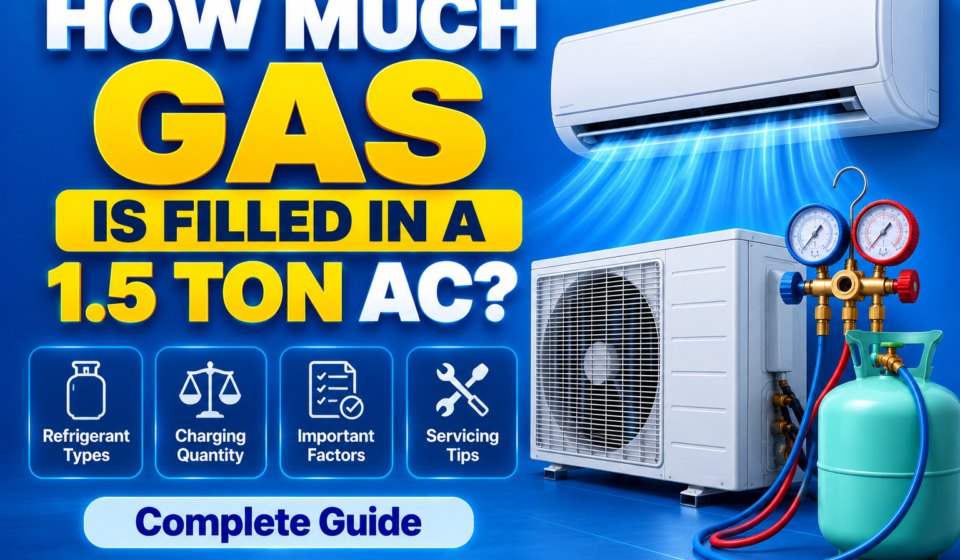

How Much Gas Is Filled in a 1.5 Ton AC? Complete Refrigerant Guide
Are you wondering how much gas is filled in a 1.5 ton AC? The answer depends on the air conditioner’s brand, model, refrigerant type, factory charge and refrigerant piping length.
A 1.5-ton air conditioner does not have one universal refrigerant quantity. Different models can require different amounts of refrigerant, even when their cooling capacities are similar. The correct quantity is specified by the manufacturer and should be checked on the outdoor unit’s nameplate or in its installation manual.
Refrigerant is commonly called AC gas in India. It circulates through the air-conditioning system, absorbing heat indoors and releasing it outdoors. If the refrigerant charge is incorrect or the system develops a leak, cooling performance and operating efficiency may be affected.
VIPUL HVAC SOLUTION PVT. LTD. provides air-conditioning and HVAC solutions for residential, commercial and industrial applications. This guide explains refrigerant quantity, common refrigerant types, signs of low refrigerant, charging methods and important servicing precautions.
How Much Gas Is Required for a 1.5 Ton AC?
There is no single fixed gas quantity for every 1.5-ton AC. The exact refrigerant charge must be confirmed from the specific model’s technical documentation.
The required quantity depends on:
- AC brand and model number.
- Refrigerant type, such as R32 or R410A.
- Factory refrigerant charge.
- Refrigerant pipe length and diameter.
- Manufacturer’s specified additional-charge requirements.
- Whether the system is being installed for the first time or completely recharged after a repair.
For example, manufacturers may specify a factory charge intended for a particular standard piping length. If the installed pipework exceeds that length, some models require additional refrigerant calculated using the manufacturer’s instructions.
The outdoor unit’s nameplate and installation manual are therefore more reliable than a general online estimate.
Important: Do not ask a technician to fill refrigerant based only on the AC’s tonnage. The correct amount must be determined for the exact model and installation.
Which Gas Is Used in a 1.5 Ton AC?
The refrigerant used in a 1.5-ton AC varies by manufacturer, model and product generation.
R32 refrigerant
R32 is used in many modern air-conditioning systems. It has different operating and charging requirements from other refrigerants. R32 is classified as mildly flammable, so technicians must follow the manufacturer’s safety instructions.
R410A refrigerant
R410A is used in many air-conditioning systems, including older models and some equipment still available in the market. It has different pressure characteristics and charging procedures from R32.
R22 refrigerant
R22 was used in many older air conditioners. Refrigerant requirements, servicing rules and equipment compatibility differ from those of modern systems. It must never be substituted with another refrigerant without explicit manufacturer approval.
How do you identify the correct AC gas?
Check the following:
- The refrigerant label on the outdoor unit.
- The model number and technical specifications.
- The manufacturer’s installation manual.
- The servicing documentation, where available.
Never mix refrigerants or select a replacement gas simply because the AC has the same tonnage.
Does AC Tonnage Determine Refrigerant Quantity?
No. AC tonnage represents cooling capacity, not the weight of refrigerant inside the system.
A 1.5-ton AC has a nominal cooling capacity of approximately 18,000 BTU per hour, but that does not tell you how many kilograms of refrigerant it contains.
Two 1.5-ton air conditioners can have different refrigerant charges because of differences in:
- Heat-exchanger design.
- Refrigerant circuit dimensions.
- Compressor and system design.
- Refrigerant type.
- Standard piping length.
- Manufacturer-specific operating requirements.
For this reason, a technician should use the model-specific refrigerant charge rather than a universal kilograms-per-ton rule.
Does Refrigerant Pipe Length Affect Gas Quantity?
Yes. Refrigerant pipe length can affect the total charge required by certain split AC systems.
Many outdoor units are supplied with a factory refrigerant charge intended for a specified standard piping length. When the installation exceeds the manufacturer’s stated limit, additional refrigerant may be required.
However, the calculation is not the same for every AC.
For example, a manufacturer may specify an additional charge in grams per metre for pipework beyond a defined length. Another model may use a different formula or have different piping restrictions.
Before adding refrigerant, the technician should:
- Identify the exact model.
- Measure the relevant pipe length.
- Check the specified standard piping length.
- Apply the manufacturer’s additional-charge formula, if applicable.
- Verify that the installation remains within the permitted piping limits.
For an example of model-specific charging instructions, see the Daikin India product manuals.
What Are the Signs of Low Refrigerant in a 1.5 Ton AC?
Low refrigerant can result from leakage or an incorrect initial charge. The following symptoms may indicate a problem, but they do not prove that the system is low on refrigerant.
Poor cooling
The AC may take longer to cool the room or fail to maintain the desired temperature.
Longer operating time
The compressor may run for extended periods because the system cannot meet the cooling demand.
Ice formation
Ice may form on the evaporator coil or refrigerant pipes. Restricted airflow, dirty filters and other faults can also cause icing.
Unusual system behaviour
Changes in compressor operation, abnormal pressures or certain error codes may indicate a refrigerant-circuit problem or another system fault.
Higher electricity consumption
A fault that reduces system performance may increase energy use, depending on the operating conditions.
Do not diagnose refrigerant quantity from one symptom alone. Dirty filters, blocked coils, fan problems, incorrect settings and other faults can produce similar symptoms.
How Do Technicians Check Refrigerant Quantity?
A qualified technician should diagnose the system before adding refrigerant.
Step 1: Inspect the air conditioner
Check filters, coils, airflow, fans, operating conditions and visible refrigerant-pipe connections.
Step 2: Identify the refrigerant
Read the outdoor unit’s label and verify the manufacturer’s requirements.
Step 3: Check for leaks
If a leak is suspected, inspect the refrigerant circuit using appropriate methods. A leak should be repaired rather than repeatedly topping up the gas.
Step 4: Review operating measurements
Depending on the equipment and manufacturer procedure, the technician may check operating pressures, temperatures, superheat, subcooling, error codes and other relevant parameters.
Pressure alone is not a reliable universal measurement of refrigerant quantity because readings vary with operating conditions and system design.
Step 5: Recover or charge refrigerant as required
If a complete recharge is necessary, the technician should follow the manufacturer’s specified procedure and charge the correct refrigerant by weight. If only an additional charge is required, the model-specific formula must be followed.
Step 6: Test the system
After servicing, check for leaks, confirm appropriate operation and verify that the system is performing according to the manufacturer’s requirements.
Is It Necessary to Refill AC Gas Every Year?
No. A properly installed, leak-free air conditioner should not normally require routine annual refrigerant refilling.
Refrigerant circulates within a sealed system. If the refrigerant level is low, a leak or another charging issue should be investigated.
Repeatedly topping up refrigerant without finding the cause can waste money and allow the original fault to continue.
Routine AC maintenance should focus on cleaning filters and coils, checking airflow, inspecting drainage and verifying overall system operation. Refrigerant servicing is needed when testing indicates a problem.
What Happens If Too Much or Too Little Gas Is Filled?
Correct refrigerant charging is important for reliable operation.
If refrigerant is insufficient
An undercharged system may have reduced cooling capacity, abnormal operating conditions and extended running times. The exact effects depend on the system design and operating conditions.
If refrigerant is excessive
Overcharging can also cause abnormal operating pressures, reduced performance or equipment damage. The effects depend on the refrigerant, system design and operating conditions.
Why accurate charging matters
The correct charge helps the system operate within its intended performance range. Technicians should follow the manufacturer’s charging procedure rather than relying on a general pressure reading or an assumed quantity.
Can You Fill AC Gas Yourself?
Refrigerant charging should be performed by a suitably trained technician using the correct tools and safety procedures.
Important precautions include:
- Use only the refrigerant specified by the manufacturer.
- Never mix refrigerants.
- Do not release refrigerant intentionally into the atmosphere.
- Repair leaks before recharging a leaking system.
- Follow the specified leak-testing and evacuation procedures.
- Use suitable protective equipment.
- Observe the additional precautions required for refrigerants such as R32.
Improper charging can damage equipment and create safety risks. Follow the manufacturer’s instructions and applicable requirements.
What Affects the Cost of AC Gas Refilling?
There is no single service price for every 1.5-ton AC. The cost depends on the work required, the refrigerant used and the service provider.
Common cost factors include:
- Refrigerant type.
- Quantity required.
- Whether the job involves a partial or complete recharge.
- Leak detection and repair.
- Refrigerant-pipe or connection repairs.
- Evacuation and testing requirements.
- Site accessibility and service charges.
Before approving the work, ask the technician to explain the diagnosis, refrigerant type, quantity charged, leak-repair requirements and applicable warranty on the service.
Frequently Asked Questions About Gas in a 1.5 Ton AC
How much gas is filled in a 1.5 ton AC?
The exact quantity varies by brand, model, refrigerant type and piping configuration. Check the outdoor unit’s nameplate and installation manual for the specified charge.
Which gas is best for a 1.5-ton AC?
There is no single best refrigerant that can be selected independently of the equipment. Use only the refrigerant specified for your particular AC model.
Can R32 be filled in an R410A AC?
Do not substitute R32 for R410A unless the equipment manufacturer explicitly specifies that the system is designed and approved for that refrigerant. Their properties and charging requirements differ.
Does a longer copper pipe require more refrigerant?
Some models require additional refrigerant when piping exceeds a specified length. Follow the manufacturer’s formula and limits for the exact model.
Why is my 1.5-ton AC not cooling properly?
Possible causes include dirty filters, blocked coils, poor airflow, refrigerant leakage, electrical faults, incorrect sizing or other equipment problems. A qualified technician should diagnose the cause.
How often should AC gas be refilled?
There is no fixed annual refill schedule for a properly functioning, leak-free system. Recharge only when diagnosis indicates that it is necessary.
Can low AC gas increase electricity consumption?
It can contribute to poor cooling and longer operating times. However, other faults can cause similar symptoms, so proper diagnosis is important.
Where can I find the correct gas quantity for my AC?
Check the refrigerant label on the outdoor unit, the model-specific installation manual or the manufacturer’s technical support documentation.
HVAC Solutions From VIPUL HVAC SOLUTION PVT. LTD.
VIPUL HVAC SOLUTION PVT. LTD. provides HVAC solutions for residential, commercial and industrial requirements.
Its published portfolio includes:
- Split and cassette air-conditioning systems.
- Ducted air-conditioning systems.
- VRF/VRV systems.
- Chiller systems.
- Air Handling Units (AHUs).
- HVAC ducting and ventilation.
- Fresh-air and exhaust-system solutions.
- HVAC design and consultancy.
- Installation and commissioning-related services.
- Maintenance and AMC-related services.
Customers can contact the company to discuss equipment selection and project requirements. Confirm the availability of any specific refrigerant repair, AC servicing or installation service directly with the relevant team.
VIPUL HVAC SOLUTION PVT. LTD. Branches Across Gujarat
The company lists eight branch locations across Gujarat. Contact the relevant branch or central sales team to confirm current contact details and service availability.
1. Surat – Head Office
Surat is the company’s head-office location and a central contact point for HVAC enquiries.
Central sales: +91 8000392000
2. Ankleshwar Branch
Address: G-14, G-23-24, Golden Square, Ankleshwar–Valia Road, opposite CNG Pump, near Maruti Showroom, GIDC Chokdi, Ankleshwar, Gujarat 393002.
Sales: +91 8000192000
3. Bharuch Branch
Address: G-8, Bhagvati Enclave, near ABC Circle, Chokdi, Bholav, Bharuch, Gujarat 392001.
Sales: +91 9081309300
4. Vadodara (Baroda) Branch
Address: Rajnagar Society, Tarangan Society, Haripura, Vadodara, Gujarat 390007.
Sales: +91 90990 74214
5. Ahmedabad Branch
Address: 11, Saanvi Nirman Stella, opposite Flora Ixora Road, South Bopal, Ahmedabad, Gujarat 380058.
Sales: +91 7096500050
6. Talala Branch
Address: Shop No. 3, Ajit Chambers, Veraval–Talala Road, near New S.T. Bus Stand, Kailash Nagar, Talala, Gujarat 362150.
Sales: +91 7700046246
7. Junagadh Branch
Junagadh is listed in the company’s official branch directory. Contact central sales to confirm current local contact details and service arrangements.
Central sales: +91 8000392000
8. Vapi Branch
Vapi is listed in the company’s official branch directory. Contact central sales to confirm current local contact details and service arrangements.
Central sales: +91 8000392000
For updated branch information, visit the official directory:
https://vipulhvacsolution.in/our-branches/
Contact VIPUL HVAC SOLUTION PVT. LTD.
Need help selecting an air-conditioning system or discussing an HVAC project? Contact VIPUL HVAC SOLUTION PVT. LTD. to discuss your requirements.
Central sales: +91 8000392000
Email: info@vipulhvacsolution.in
Website: https://vipulhvacsolution.in/
Visit our official branch directory or contact page for further information.
VIPUL HVAC SOLUTION PVT. LTD. – Air Conditioning and HVAC Solutions Across Gujarat.