
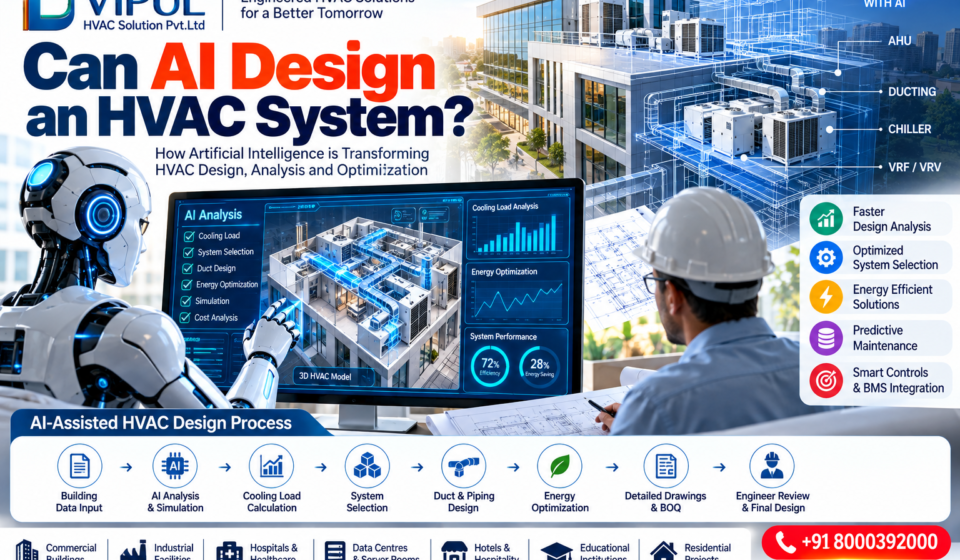

Can AI Design an HVAC System? A Complete Guide for Modern HVAC Projects
Artificial Intelligence (AI) is rapidly changing how engineers analyze buildings, calculate loads, optimize energy consumption and operate HVAC systems. This raises an important question:
Can AI design an HVAC system?
Yes, AI can assist significantly with HVAC design, analysis, simulation, optimization and system operation—but AI should not be treated as a complete replacement for a qualified HVAC engineer.
Modern AI can help analyze large amounts of building and operational data, identify patterns, compare design alternatives, forecast energy use and support intelligent HVAC controls. ASHRAE is actively examining AI applications across HVAC design, commissioning, operation and maintenance, including AI-assisted design and data-enhanced building performance.
For a real HVAC project, however, the final engineering decisions still need to account for building conditions, applicable codes and standards, equipment limitations, constructability, safety, commissioning and site-specific requirements.
VIPUL HVAC SOLUTION PVT. LTD. provides customized HVAC design services using an engineering-focused process that includes site analysis, load calculation, system planning, technology selection, detailed drawings and implementation support.
What Does AI Mean in HVAC Design?
AI in HVAC can refer to several technologies, including:
- Machine learning
- Generative AI
- Predictive analytics
- Building performance simulation
- Optimization algorithms
- Computer vision
- Digital twins
- Automated fault detection
- Predictive maintenance
- AI-based building controls
These technologies can be used at different stages of an HVAC project’s lifecycle.
Traditional HVAC Design
Building Data → Engineer → Load Calculation → System Selection → Design → Installation
AI-Assisted HVAC Design
Building Data → AI/Software Analysis → Design Alternatives → Engineer Review → Detailed Design → Installation → Monitoring → Optimization
The second approach can help engineers evaluate more alternatives and process large quantities of information more efficiently.
ASHRAE’s HVAC design resources continue to emphasize load calculations, ventilation, air distribution, duct design and pipe design as core parts of HVAC engineering.
Can AI Calculate HVAC Cooling Loads?
AI can assist with cooling-load analysis, but the quality of the result depends heavily on the quality and completeness of the input data.
A cooling-load assessment may need information such as:
- Building location
- Building orientation
- Building geometry
- Wall construction
- Roof construction
- Window area
- Glazing properties
- Solar exposure
- Occupancy
- Lighting
- Equipment loads
- Ventilation
- Infiltration
- Operating schedules
- Indoor design conditions
- Outdoor design conditions
ASHRAE’s current guidance describes cooling-load calculations as involving heat gain through building surfaces and fenestration, ventilation and infiltration, occupancy, lighting and equipment, among other factors.
Therefore, AI can speed up analysis and explore scenarios, but it cannot produce a reliable result from incomplete or incorrect building information.
How AI Can Help With HVAC Design
1. Cooling-Load Analysis
AI-assisted tools can process building information and help engineers analyze:
- Sensible heat
- Latent heat
- Solar heat gain
- Occupancy loads
- Lighting loads
- Equipment loads
- Ventilation loads
- Infiltration
This can make scenario analysis faster.
2. HVAC System Selection
AI can compare different HVAC configurations based on predefined engineering criteria.
For example:
Option A
VRF / VRV
Option B
Chiller + AHU + FCU
Option C
Ducted AC
Option D
Package AC
Option E
Heat Pump
The final selection should consider the project’s technical requirements, capital cost, operating cost, space, maintenance and applicable requirements—not simply an AI-generated recommendation.
3. HVAC Energy Optimization
AI can analyze historical HVAC operating data and identify opportunities for optimization.
Possible inputs include:
- Temperature
- Humidity
- Occupancy
- Chiller load
- Fan speed
- Pump speed
- Compressor operation
- Energy consumption
- Outdoor weather
- Operating schedules
ASHRAE identifies AI applications including energy optimization, predictive maintenance, fault detection and diagnosis, HVAC operation and load flexibility.
4. Predictive HVAC Maintenance
AI can analyze equipment operating patterns to identify potential abnormalities.
For example, an AI system could analyze trends in:
- Compressor performance
- Fan vibration
- Motor current
- Chilled-water temperature
- Refrigerant parameters
- Supply-air temperature
- Return-air temperature
- Filter pressure drop
This can support predictive maintenance, although alerts still need to be verified by qualified technicians.
5. AI-Based HVAC Controls
AI can also be applied after installation.
A building-management system can collect data from:
- Temperature sensors
- Humidity sensors
- CO₂ sensors
- Occupancy sensors
- Energy meters
- Chillers
- AHUs
- FCUs
- VRF systems
- Pumps
- Fans
AI algorithms can then analyze this information and help optimize operation.
ASHRAE’s 2026 conference materials specifically identify AI opportunities in building automation and control systems, including energy efficiency, occupant comfort, maintenance and HVAC operation.
6. AI for HVAC Zoning
Different areas of a building have different cooling requirements.
For example:
| Area | Typical HVAC Consideration |
|---|---|
| Open Office | Occupancy + comfort |
| Conference Room | Variable occupancy |
| Server Room | High equipment heat |
| Reception | Variable occupancy |
| Meeting Room | High short-term occupancy |
| Electrical Room | Equipment heat |
| Laboratory | Process/environment requirements |
| Production Area | Process + ventilation |
AI can help identify patterns in occupancy and operating conditions and support zoning analysis.
However, the engineer still needs to verify whether the proposed zoning is physically and technically practical.
7. AI for Duct Design
AI and optimization software can assist with evaluating:
- Airflow
- Duct dimensions
- Pressure loss
- Fan requirements
- Air distribution
- Noise considerations
- Energy consumption
ASHRAE’s computer-application guidance explains that HVAC software can perform duct-system sizing and analysis, while engineers continue to make important decisions such as duct dimensions, air quantities and routing.
This illustrates an important principle:
Software can perform calculations; engineering judgment determines the design.
8. AI for Chiller Plant Optimization
AI can be particularly useful when a building has a large central cooling plant.
Possible optimization parameters include:
- Chiller loading
- Chilled-water temperature
- Condenser-water temperature
- Pump speed
- Cooling-tower operation
- Building cooling demand
- Outdoor conditions
- Time-of-day operation
The objective can be to identify efficient operating combinations while maintaining required conditions.
AI research and industry programs increasingly examine data-driven chiller optimization and building energy management.
9. AI for VRF System Analysis
For VRF projects, AI-assisted workflows can potentially help analyze:
- Building zones
- Indoor-unit requirements
- Cooling loads
- Operating schedules
- Energy consumption
- Setpoints
- System performance
However, VRF refrigerant piping, manufacturer-specific limitations, branch configurations, safety requirements and commissioning must be checked using appropriate engineering procedures and manufacturer documentation.
10. AI and Digital Twins
A digital twin is a digital representation of a physical building or system that can be connected to operational data.
For HVAC, a digital twin can potentially represent:
- Chillers
- AHUs
- FCUs
- Pumps
- Fans
- Duct systems
- Sensors
- Building zones
- Energy meters
ASHRAE’s current AI vision specifically includes digital twins, AI-aided design, commissioning and ongoing optimization as part of the future intelligent-building lifecycle.
Can ChatGPT Design an HVAC System?
AI assistants such as ChatGPT can help with conceptual HVAC engineering work, for example:
- HVAC design checklists
- Load-calculation methodology
- HVAC equipment comparison
- Design documentation
- BOQ templates
- HVAC specifications
- Project questionnaires
- Duct-design concepts
- HVAC calculations
- Technical explanations
- Design review checklists
- Energy-efficiency ideas
- Maintenance procedures
However, asking an AI chatbot:
“My building is 10,000 sq ft. Tell me which AC I should install.”
is not enough information for a professional HVAC design.
A real design needs significantly more information.
Why AI Alone Cannot Fully Design Every HVAC System
1. Incomplete Building Information
AI cannot accurately determine information that has not been provided.
For example:
- Actual construction materials
- Insulation
- Window specifications
- Solar exposure
- Equipment heat
- Occupancy patterns
- Existing HVAC infrastructure
must be established.
2. Site Conditions
Actual site conditions can differ from drawings.
An engineer may discover:
- Unexpected duct restrictions
- Limited ceiling space
- Existing piping
- Electrical limitations
- Structural constraints
- Equipment-access problems
during a site survey.
3. Codes and Standards
HVAC designs need to comply with applicable:
- Building codes
- Fire-safety requirements
- Electrical requirements
- Energy requirements
- HVAC standards
- Local regulations
- Project specifications
AI-generated output should not be assumed to constitute compliance.
4. Equipment Manufacturer Limitations
Every HVAC manufacturer has specific technical limitations.
For example:
- VRF piping limits
- Chiller operating conditions
- Fan static pressure
- AHU coil requirements
- Compressor operating range
- Electrical requirements
These need to be checked against actual manufacturer documentation.
5. Safety-Critical Applications
Applications such as:
- Hospitals
- Pharmaceutical cleanrooms
- Chemical plants
- Hazardous areas
- Data centres
- Laboratories
- Industrial process environments
can require specialized engineering and verification.
AI should be used as an engineering support tool, not as the sole design authority.
AI + HVAC Engineer: A Better Approach
The most practical approach is not:
AI OR Engineer
but:
AI + HVAC Engineer
AI Can Help With
- Data analysis
- Repetitive calculations
- Scenario comparison
- Energy analysis
- Documentation
- Pattern recognition
- Optimization
- Predictive analytics
HVAC Engineer Provides
- Engineering judgment
- Site verification
- System architecture
- Code/standard interpretation
- Equipment validation
- Safety assessment
- Constructability
- Installation coordination
- Commissioning
- Final responsibility
This human-plus-AI workflow is consistent with the direction of current HVAC industry research and professional discussion around AI-assisted design. ASHRAE’s current materials explicitly discuss AI’s role in HVAC design and why load calculations are one area where AI applications are being explored.
AI-Assisted HVAC Design Workflow
A practical future-ready workflow can look like this:
Step 1 — Collect Building Data
↓
Step 2 — Site Survey
↓
Step 3 — Enter Architectural Information
↓
Step 4 — Calculate Cooling & Heating Loads
↓
Step 5 — AI-Assisted Scenario Analysis
↓
Step 6 — HVAC Engineer Reviews Alternatives
↓
Step 7 — Select HVAC Technology
↓
Step 8 — Design Ductwork/Piping
↓
Step 9 — Select Equipment
↓
Step 10 — Prepare Drawings & BOQ
↓
Step 11 — Installation
↓
Step 12 — Testing & Commissioning
↓
Step 13 — Collect Operating Data
↓
Step 14 — AI-Assisted Optimization
This approach uses AI where it is strongest while retaining engineering oversight where physical, regulatory and project-specific decisions matter.
AI in HVAC for Commercial Buildings
AI can support HVAC optimization in:
- Offices
- Hotels
- Shopping malls
- Retail buildings
- Banks
- Corporate campuses
- Educational buildings
Possible applications include:
- Occupancy-based optimization
- Energy forecasting
- Temperature optimization
- HVAC scheduling
- Fault detection
- Predictive maintenance
AI in HVAC for Industrial Buildings
Industrial facilities can have more complex HVAC requirements because of:
- Machinery heat
- Process heat
- Large spaces
- Variable operating schedules
- Ventilation
- Exhaust
- Dust
- Specialized environmental requirements
AI can help analyze operating data, but industrial HVAC design still requires proper engineering assessment of the process and environment.
AI in HVAC for Data Centres
AI is particularly relevant to data-centre cooling because IT loads can vary significantly.
Potential applications include:
- Cooling-load forecasting
- Rack-level monitoring
- Temperature prediction
- Hot-spot detection
- Cooling optimization
- Chiller optimization
- Predictive maintenance
- Energy monitoring
For a data centre, however, reliability and redundancy must remain fundamental design considerations.
AI and Indoor Air Quality
AI can also analyze indoor-air-quality data.
Inputs can include:
- CO₂
- Temperature
- Relative humidity
- PM2.5
- VOCs
- Occupancy
- Outdoor-air conditions
AI can identify patterns and support ventilation strategies.
This can complement conventional HVAC controls and IAQ monitoring.
Benefits of AI-Assisted HVAC Design
Faster Analysis
AI and software can process large datasets rapidly.
More Design Alternatives
Engineers can compare multiple design scenarios.
Energy Optimization
AI can identify operating strategies that may reduce unnecessary energy use.
Predictive Maintenance
Equipment data can be analyzed for abnormal patterns.
Better Monitoring
Large quantities of sensor data can be processed continuously.
Improved Documentation
AI can assist in preparing specifications, schedules, checklists and reports.
Continuous Optimization
AI can continue analyzing the HVAC system after commissioning.
Limitations of AI in HVAC Design
AI is not a magic solution.
Important limitations include:
- Poor-quality input data
- Incorrect assumptions
- Lack of site information
- Model uncertainty
- Manufacturer-specific limitations
- Code-compliance requirements
- Cybersecurity concerns
- Sensor errors
- Integration challenges
- Need for engineering verification
ASHRAE’s discussion of AI in buildings also emphasizes practical challenges around implementation, data and the complexity of integrating AI into building systems.
Why Choose VIPUL HVAC SOLUTION PVT. LTD. for AI-Assisted HVAC Design?
VIPUL HVAC SOLUTION PVT. LTD. provides customized HVAC design services based on project-specific engineering requirements.
Its published design process includes:
- Site analysis
- Cooling-load calculation
- System planning
- Ductwork optimization
- Equipment placement
- Technology selection
- Energy-efficiency optimization
- Detailed drawings
- Installation guidance
- Testing and commissioning support
Depending on project requirements, VIPUL’s published HVAC design portfolio includes:
- VRF / VRV
- Chillers
- AHUs
- FCUs
- Ducted AC
- Package AC
- Precision Air Conditioning
- Ventilation
- HVAC ductwork
- BMS and automation
- Indoor Air Quality solutions
For clients interested in AI-assisted workflows, the practical approach is to combine AI/data analysis with professional HVAC engineering, site verification, equipment documentation and commissioning.
The Future of AI in HVAC Design
The role of AI in HVAC is likely to expand beyond simple calculations.
Future applications can include:
AI → Digital Twin → Predictive Load → Automated Optimization → Smart Controls → Predictive Maintenance
ASHRAE’s current Vision 2035 explicitly describes an intelligent-building lifecycle in which AI and data can support design, commissioning, operation and adaptation.
This means the future HVAC engineer may increasingly work with both engineering principles and data-driven technologies.
Frequently Asked Questions
Can AI design an HVAC system?
AI can assist with HVAC design, calculations, simulations, optimization and documentation. A complete project should still be reviewed and finalized by qualified HVAC professionals.
Can AI calculate cooling load?
AI and HVAC software can assist with cooling-load calculations when sufficient and accurate building, climate, occupancy and equipment data are available.
Can ChatGPT calculate HVAC load?
ChatGPT can help explain and perform calculation methodologies when the required project data is provided, but its output should be independently checked before being used for an actual construction project.
Can AI select an HVAC system?
AI can compare potential HVAC configurations using defined criteria. The final equipment selection should be validated against engineering requirements, manufacturer data, applicable standards and site conditions.
Can AI design ductwork?
AI and HVAC software can assist with duct sizing, airflow analysis and optimization. Engineering review is still required for routing, pressure, installation and project coordination.
Can AI reduce HVAC energy consumption?
AI can support HVAC energy optimization by analyzing operating data, forecasting loads and adjusting controls. Actual savings depend on the building, equipment, controls and implementation.
Can AI be used with BMS?
Yes. AI can analyze BMS data and support advanced control, energy optimization, fault detection and predictive maintenance. ASHRAE identifies these as important AI applications for building systems.
Will AI replace HVAC engineers?
AI can automate or assist with many analytical and repetitive tasks, but HVAC projects still require engineering judgment, site verification, safety assessment, code compliance, equipment validation, installation and commissioning.
Conclusion
So, can AI design an HVAC system?
AI can assist with a substantial part of the HVAC design and optimization workflow, but a reliable real-world HVAC project should not depend on AI alone.
The most practical model is:
AI + HVAC Software + Engineering Knowledge + Site Data + Human Verification
AI can help with load analysis, simulation, system comparison, energy optimization, predictive maintenance and smart controls, while HVAC engineers remain essential for translating those results into a safe, compliant, constructible and maintainable system.
For businesses planning a new HVAC installation, retrofit or energy-optimization project, VIPUL HVAC SOLUTION PVT. LTD. provides customized HVAC design and engineering support for commercial, industrial and specialized applications.
Need Customized HVAC Design?
VIPUL HVAC SOLUTION PVT. LTD.
📞 +91 8000392000
📧 info@vipulhvacsolution.in
Get professional HVAC design, load calculation, system selection, installation and commissioning support for your project.
Important Links:
- Customized HVAC Design Services in India
- HVAC Load Calculator
- VRF Design Consultancy India
- Chiller Plant Design
- Precision Air Conditioning
- Ducted & Package Air Conditioning
- AHU Supplier in India
- Indoor Air Quality Solutions
- HVAC Turnkey Services
- HVAC Maintenance & AMC