
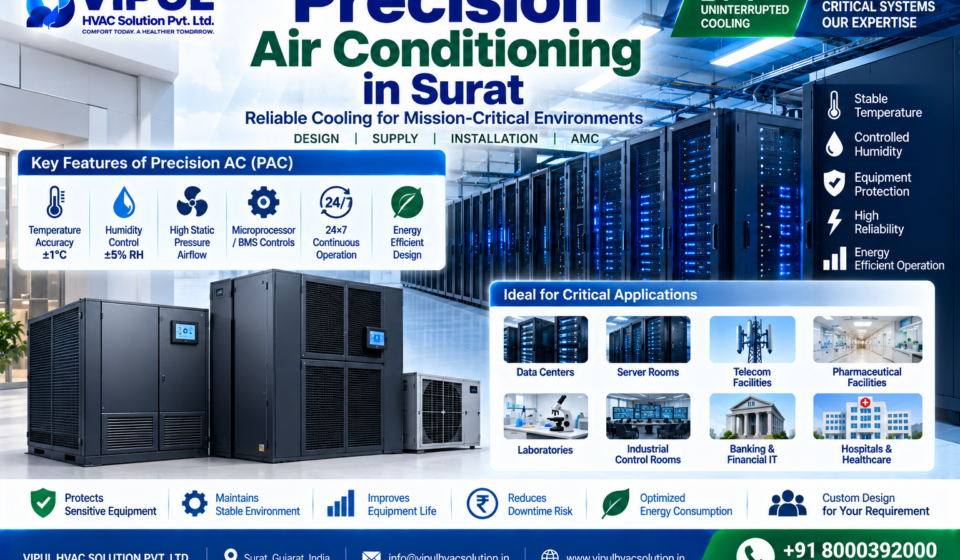

Precision Air Conditioning in Surat: Complete PAC Guide for Critical Environments
If you are searching for Precision Air Conditioning in Surat, the key requirement is not simply cooling the room—it is maintaining stable temperature, humidity, airflow and continuous operation for equipment-sensitive environments.
Precision Air Conditioning (PAC), also called precision cooling, is designed for applications such as data centers, server rooms, telecom facilities, laboratories, pharmaceutical areas, control rooms and other critical spaces where conventional comfort AC may not provide the required level of environmental control.
VIPUL HVAC SOLUTION PVT.LTD. provides PAC solutions in Surat, including system design, equipment supply, installation and maintenance support. VIPUL’s published PAC specifications include temperature accuracy of ±1°C, humidity control of ±5% RH, DX cooling, high-static-pressure airflow, 24×7 operation and microprocessor/BMS controls.
What Is Precision Air Conditioning?
Precision Air Conditioning (PAC) is a specialized HVAC system designed to maintain closely controlled environmental conditions in spaces where temperature, humidity and airflow can directly affect sensitive equipment or processes.
Unlike conventional comfort air conditioning, which is primarily designed for people, PAC systems are designed around the heat load, airflow requirements, operating schedule and environmental limits of equipment and critical processes.
For example, a server room may operate continuously even when the building is unoccupied. Servers, networking equipment, UPS systems and other electrical equipment generate substantial heat. A PAC system is therefore designed to provide reliable cooling continuously rather than operating only according to normal office occupancy.
ASHRAE identifies CRAC and CRAH systems as common cooling solutions for datacom equipment rooms and emphasizes appropriate temperature/humidity control and airflow management.
Why Precision Air Conditioning Is Important in Surat
Surat has a combination of high ambient temperatures, commercial development, industrial facilities, IT infrastructure, healthcare facilities and process industries. Critical rooms in these facilities may need cooling throughout the year.
A conventional split or commercial AC may not be appropriate when the application requires:
- 24×7 cooling
- Tight temperature control
- Humidity management
- High sensible cooling
- High airflow
- Continuous operation
- Equipment protection
- Alarm monitoring
- Redundant cooling
- BMS integration
- Future capacity expansion
VIPUL’s Surat HVAC portfolio includes precision air conditioning alongside VRF/VRV, chillers, AHUs, ducted systems and ventilation solutions.
Precision AC vs Normal AC
| Feature | Normal Comfort AC | Precision Air Conditioning |
|---|---|---|
| Primary purpose | Human comfort | Equipment/process protection |
| Operation | Usually scheduled | Designed for continuous operation |
| Temperature control | General comfort range | Tighter control |
| Humidity control | Limited | Dedicated humidity management |
| Heat-load profile | Occupancy-focused | Equipment-focused |
| Sensible heat | Moderate | High sensible cooling |
| Airflow | Comfort-oriented | High and application-specific |
| Monitoring | Basic | Advanced controls and alarms |
| Redundancy | Usually limited | Can be designed with redundancy |
| BMS integration | Model-dependent | Common in critical installations |
| Typical applications | Homes/offices | Data centers/server rooms/critical facilities |
The exact design should always be based on the application and equipment requirements rather than assuming that every critical room needs the same PAC configuration.
PAC Specifications Offered by VIPUL HVAC
VIPUL’s published Precision Air Conditioning specifications include:
Temperature Accuracy
±1°C
Precise temperature control helps maintain stable conditions for sensitive electronic equipment and critical processes.
Humidity Control
±5% RH
Humidity management can be important in technical environments where excessive moisture or excessively dry conditions may create operational risks.
Cooling Type
DX — Direct Expansion
DX PAC systems use a refrigeration circuit to directly cool the air passing through the system.
High Static Pressure Airflow
High-static-pressure configurations can support applications requiring substantial airflow resistance, such as ducted distribution or raised-floor cooling arrangements.
24×7 Continuous Operation
Critical technical environments may operate continuously. PAC equipment is designed around this type of duty cycle.
Microprocessor / BMS Controls
Advanced controllers can monitor operating parameters, alarms and system status and may integrate with a building management system.
Where Is Precision Air Conditioning Used?
1. Data Centers
Data centers are among the most important PAC applications.
Servers and networking equipment continuously convert electrical energy into heat. The HVAC system must remove this heat while maintaining appropriate environmental conditions.
ASHRAE’s data-center guidance identifies CRAC and CRAH systems as common approaches for datacom cooling.
A PAC design may include:
- CRAC/PAC units
- CRAH units
- Raised-floor airflow
- Hot-aisle/cold-aisle configuration
- Cold-aisle containment
- Temperature sensors
- Humidity sensors
- BMS/DCIM integration
- Redundant cooling
- Alarm systems
2. Server Rooms
Small and medium server rooms also generate continuous heat.
A PAC system can be considered when:
- Servers operate 24×7
- IT load is significant
- Room temperature must remain stable
- Equipment cannot tolerate frequent temperature fluctuations
- Conventional split AC is not sufficient
- Continuous monitoring is required
The correct PAC capacity should be calculated from the actual IT and electrical heat load.
3. Telecom Facilities
Telecommunication rooms contain equipment that may operate continuously.
PAC solutions can provide:
- Continuous cooling
- Stable temperature
- Humidity management
- High airflow
- Equipment protection
- Alarm monitoring
- Redundant cooling options
4. Pharmaceutical Facilities
Pharmaceutical applications can require carefully controlled temperature, humidity, filtration and airflow.
Depending on the application, HVAC design may also involve:
- HEPA filtration
- Pressure control
- Air changes
- Temperature monitoring
- Humidity control
- Airflow balancing
- Cleanroom HVAC
- BMS monitoring
VIPUL also provides specialized pharmaceutical HVAC solutions alongside PAC and other HVAC systems.
5. Laboratories
Laboratories may contain sensitive instruments and processes that require stable environmental conditions.
PAC or precision HVAC can be evaluated for:
- Research laboratories
- Testing laboratories
- Medical laboratories
- Electronic laboratories
- Specialized technical rooms
6. Industrial Control Rooms
Industrial control rooms may house PLCs, automation equipment, electrical panels and monitoring systems.
Maintaining appropriate temperature and humidity can help protect sensitive electronic equipment.
7. Banking and Financial Infrastructure
Critical banking infrastructure and technology rooms may require uninterrupted cooling for servers, networking equipment and other IT systems.
PAC can be integrated with monitoring and alarm systems to provide continuous environmental supervision.
How Does a Precision Air Conditioner Work?
A simplified PAC cooling cycle works as follows:
Return Air → Filter → Cooling Coil → Supply Air → Critical Equipment → Hot Return Air → PAC
Inside a DX PAC system:
- Warm return air enters the PAC.
- Air passes through filtration.
- The cooling coil removes heat.
- Refrigerant absorbs the heat from the air.
- The conditioned air is supplied back into the room.
- Sensors monitor temperature and humidity.
- The controller adjusts system operation according to demand.
- Heat is rejected through the refrigeration system.
The exact configuration depends on whether the project uses DX, chilled water, upflow, downflow, ducted or other precision-cooling arrangements.
PAC and Hot Aisle / Cold Aisle Design
For data centers, airflow management is as important as cooling capacity.
In a typical hot-aisle/cold-aisle arrangement:
Cold Aisle → Server Intake → Server → Hot Aisle → Return Air → Cooling Unit
ENERGY STAR recommends separating cold supply air from hot server exhaust air to improve cooling efficiency. It also identifies hot-aisle/cold-aisle layouts, containment and in-row/in-rack cooling as important airflow-management strategies.
This means simply installing a high-capacity PAC does not automatically guarantee good data-center cooling. Air distribution and rack layout must also be engineered correctly.
PAC Capacity Calculation
One of the most important steps in PAC design is calculating the actual heat load.
A simplified cooling-load concept is:
Total Cooling Load = IT Load + Electrical Load + Lighting + People + Building Heat Gain + Other Loads
For a data center, IT equipment can dominate the cooling requirement.
For example, if the IT equipment produces approximately:
100 kW of heat
the cooling system must be capable of removing approximately that heat load, while the final design also considers:
- Redundancy
- Future expansion
- Airflow
- Supply/return temperature
- Humidity
- Equipment operating conditions
- Electrical losses
- UPS losses
- Lighting
- Building envelope
- Distribution losses
Therefore, PAC capacity should not be selected simply from room area.
Redundancy in Precision Air Conditioning
Critical environments often require cooling redundancy.
For example, a project could use:
N+1 configuration
This means the installed cooling capacity includes one additional unit beyond the number required to meet the design load.
A simplified example:
Required operating capacity = 3 PAC units
Installed configuration = 4 PAC units
If one unit is unavailable for maintenance or experiences a fault, the remaining system can potentially continue serving the required load, subject to the actual design.
The appropriate redundancy strategy depends on the criticality and uptime requirements of the facility.
Important PAC Design Factors
Before selecting a Precision Air Conditioning system in Surat, evaluate:
1. IT or Process Heat Load
Determine the actual heat generated by equipment.
2. Room Dimensions
Room size affects airflow distribution and air volume.
3. Ceiling Height
Higher rooms may require different air-distribution strategies.
4. Rack Density
High-density server racks can create localized hotspots.
5. Operating Hours
24×7 applications require equipment designed for continuous duty.
6. Temperature Requirements
Define the acceptable operating temperature range.
7. Humidity Requirements
Determine whether active humidification/dehumidification is necessary.
8. Airflow Arrangement
Evaluate raised floor, overhead supply, ducting, return-air path and containment.
9. Redundancy
Determine whether N+1 or another redundancy configuration is required.
10. Future Expansion
Consider additional racks, equipment or process loads.
11. Controls
Evaluate microprocessor control, alarms, remote monitoring and BMS integration.
12. Maintenance
Ensure access for filters, coils, fans, compressors and other service components.
Energy Efficiency in PAC Systems
Precision cooling does not mean the system should simply overcool the room.
Efficient PAC design should focus on matching cooling capacity and airflow to the actual heat load.
ENERGY STAR notes that intelligent sensors and controls can help match cooling capacity to actual data-center conditions and avoid both overcooling and undercooling.
Airflow optimization is also important. ENERGY STAR reports that hot/cold aisle layouts and containment can reduce unnecessary mixing of supply and exhaust air, improving cooling efficiency.
Possible efficiency measures include:
- Variable-speed fans
- EC fans
- BMS controls
- Temperature sensors
- Rack-level monitoring
- Hot/cold aisle design
- Containment
- Proper return-air management
- Correct equipment sizing
- Preventive maintenance
- Free-cooling/economizer strategies where technically suitable
Precision Air Conditioning Installation in Surat
A professional PAC installation should generally follow an engineering process.
1: Site Survey
Assess:
- Room dimensions
- Existing HVAC
- Electrical infrastructure
- Rack arrangement
- Heat sources
- Ceiling/floor configuration
- Access for equipment
2: Heat-Load Calculation
Calculate the actual sensible and total cooling requirement.
3: PAC Selection
Select suitable:
- Cooling capacity
- Airflow
- Static pressure
- Cooling configuration
- Controls
- Redundancy
4: Airflow Design
Plan supply and return airflow according to the room configuration.
5: Installation
Installation may include:
- PAC equipment
- Refrigerant piping
- Drainage
- Electrical connections
- Controls
- Ductwork where applicable
- Sensors
6: Testing & Commissioning
Check:
- Temperature
- Humidity
- Airflow
- Refrigeration parameters
- Electrical parameters
- Alarms
- Controls
- BMS communication
7: Maintenance & AMC
Regular preventive maintenance helps identify issues before they become major failures.
PAC Maintenance in Surat
Because PAC systems may operate continuously, maintenance is particularly important.
A maintenance program may include:
- Filter inspection and cleaning
- Coil cleaning
- Fan inspection
- Refrigerant checks
- Condensate-drain inspection
- Electrical inspection
- Sensor calibration
- Temperature/humidity verification
- Alarm testing
- Controller inspection
- BMS communication testing
- Compressor inspection
- Airflow verification
VIPUL offers HVAC maintenance and AMC services as part of its broader HVAC project support.
Why Choose VIPUL HVAC Solution for PAC in Surat?
VIPUL HVAC SOLUTION PVT. LTD. provides Precision Air Conditioning solutions for critical environments and positions PAC as part of its broader commercial and industrial HVAC portfolio.
The company’s published PAC capabilities include:
- PAC system design
- Heat-load and redundancy planning
- Equipment supply
- Installation
- High-static-pressure airflow solutions
- 24×7 cooling
- Hot-aisle/cold-aisle planning
- Monitoring and alarm integration
- BMS integration
- Preventive maintenance
- AMC support
VIPUL’s broader HVAC capabilities include VRF/VRV, chillers, AHUs, ductwork, ventilation, customized HVAC design, indoor air quality and commercial HVAC solutions.
For a PAC project, the objective should be to design the complete cooling environment, rather than selecting an AC unit based only on its nominal tonnage.
Common Mistakes When Selecting PAC
- Selecting PAC Based Only on Room Area
PAC sizing should primarily consider heat load and airflow requirements.
- Ignoring Future IT Expansion
A server room may have substantially higher heat load after additional racks are installed.
- Installing Cooling Without Airflow Planning
Poor airflow can create hotspots even when sufficient cooling capacity is installed.
- No Redundancy Planning
Critical facilities may require backup capacity.
- Ignoring Humidity
Temperature alone does not describe the complete environmental condition.
- Oversizing Without Analysis
Excess capacity can increase capital and operating costs and may create control/efficiency issues.
- No Preventive Maintenance
A PAC operating continuously requires a planned maintenance strategy.
PAC vs VRF: Which Is Suitable?
| Parameter | PAC | VRF |
|---|---|---|
| Primary application | Critical equipment | Comfort cooling |
| Data center | Suitable | Usually not the primary precision solution |
| Server room | Suitable | Application dependent |
| Office | Usually unnecessary | Common option |
| 24×7 critical cooling | Designed for it | Model/application dependent |
| Tight environmental control | High | Generally comfort-oriented |
| Redundancy | Can be engineered | System dependent |
| Hot/cold aisle integration | Possible | Not typically the primary approach |
| BMS integration | Available | Available depending on system |
| Equipment heat load | Major design input | Important but comfort-oriented |
The correct selection depends on the building and application. PAC should not automatically replace VRF, chillers or AHUs in every project.
Frequently Asked Questions
What is Precision Air Conditioning?
Precision Air Conditioning is a specialized HVAC system designed for accurate temperature, humidity and airflow control in critical environments such as data centers, server rooms, telecom facilities and laboratories.
What is PAC used for?
PAC is commonly used for data centers, server rooms, telecom rooms, laboratories, pharmaceutical applications and industrial control rooms.
What is the difference between PAC and normal AC?
Normal AC is primarily designed for human comfort. PAC is engineered for precise environmental control, continuous operation, equipment heat loads, airflow management and higher reliability.
Does PAC work 24 hours?
PAC systems can be designed for 24×7 continuous operation, which is one of their important applications. VIPUL’s published PAC specification specifically lists 24×7 continuous duty.
Can PAC be connected to BMS?
Yes. VIPUL’s published PAC specifications include microprocessor/BMS controls.
Is PAC suitable for a server room in Surat?
It can be suitable when the server room requires continuous, controlled cooling. The final system should be selected after evaluating IT load, room configuration, airflow, humidity and redundancy requirements.
Does PAC require a raised floor?
No. PAC/CRAC/CRAH systems can be designed for different air-distribution configurations. ASHRAE discusses both raised-floor and overhead air-delivery approaches for datacom facilities.
How much does a PAC system cost in Surat?
There is no single PAC price because cost depends on cooling capacity, DX or chilled-water configuration, airflow, redundancy, controls, installation, piping, electrical work, monitoring and project requirements. A site survey and heat-load calculation are preferable before preparing a quotation.
Which PAC is suitable for a data center?
The appropriate PAC depends on IT heat load, rack density, airflow configuration, redundancy, temperature/humidity requirements, floor arrangement and future expansion. CRAC and CRAH systems are established approaches for datacom cooling.
Precision Air Conditioning in Surat – Final Takeaway
Precision Air Conditioning in Surat is designed for environments where ordinary comfort AC may not provide the required temperature, humidity, airflow and reliability control.
For data centers, server rooms, telecom facilities, laboratories, pharmaceutical environments and industrial control rooms, PAC design should consider actual heat load, airflow distribution, humidity, redundancy, controls, future expansion and maintenance.
VIPUL HVAC SOLUTION PVT. LTD. provides PAC solutions in Surat as part of its commercial and industrial HVAC portfolio, including design, installation, monitoring integration and maintenance support.
For a PAC requirement, contact VIPUL HVAC SOLUTION PVT. LTD.:
Phone: +91 8000392000
Email: info@vipulhvacsolution.in
Website: vipulhvacsolution.in
Location: Surat, Gujarat
Important Links: