


HVAC Solutions for Laboratories: Complete Guide to Safe, Efficient & Reliable Laboratory HVAC Systems
Laboratories require more than ordinary air conditioning. Whether it is a pharmaceutical laboratory, research and development centre, chemical testing facility, medical diagnostic laboratory, microbiology laboratory, or industrial testing unit, the indoor environment must be carefully controlled to support safety, accuracy, and reliable operations.
A properly designed HVAC Solutions for Laboratories helps maintain temperature, humidity, ventilation, air quality, and pressure relationships. It also supports the removal of chemical fumes, odours, heat, and airborne contaminants generated during laboratory activities.
Unlike conventional commercial buildings, laboratory HVAC systems must be designed around the specific activities taking place inside each room. A chemical laboratory may require dedicated fume hood exhaust, while a microbiology laboratory may need carefully controlled airflow and containment. A pharmaceutical testing laboratory may require additional environmental controls to protect samples and testing processes.
VIPUL HVAC SOLUTION PVT. LTD. provides HVAC solutions and technical support for projects involving air conditioning, AHU systems, chillers, VRF/VRV systems, ductable AC, and ventilation requirements. This guide explains the major components, design considerations, applications, and benefits of laboratory HVAC systems.
What Is an HVAC Solutions for Laboratories?
An HVAC system for laboratories is an integrated heating, ventilation, and air-conditioning arrangement designed to maintain suitable indoor environmental conditions for laboratory personnel, equipment, samples, and research activities.
The system may include:
- Air Handling Units (AHUs)
- Chiller systems
- VRF/VRV air-conditioning systems
- Ductable air-conditioning systems
- Fresh air ventilation systems
- Exhaust air systems
- Laboratory fume hood exhaust
- Air filtration systems
- Temperature and humidity control
- Room pressure control
- Building Management System (BMS) integration
The final system configuration depends on the laboratory’s purpose, risk assessment, equipment loads, operating procedures, and applicable standards.
Why Are Specialised HVAC Systems Important in Laboratories?
Laboratory activities can generate heat, vapours, chemical fumes, aerosols, dust, odours, and other airborne contaminants. At the same time, sensitive instruments and experiments may require stable environmental conditions.
A properly engineered laboratory HVAC system helps achieve the following objectives.
1. Maintaining Controlled Temperature
Laboratory equipment such as analytical instruments, incubators, refrigerators, testing machines, and computers can generate considerable heat.
Uncontrolled temperature variations may affect equipment performance, sample stability, and testing accuracy. HVAC systems help maintain the temperature range specified for each laboratory activity and equipment manufacturer.
2. Controlling Relative Humidity
Humidity control is important in laboratories where moisture can affect chemical materials, electronic instruments, samples, and testing procedures.
An appropriately selected AHU, cooling coil, humidification or dehumidification arrangement can help maintain the required relative humidity.
3. Removing Chemical Fumes and Harmful Vapours
Chemical laboratories may generate fumes and vapours during testing, mixing, heating, and sample preparation.
Dedicated exhaust ventilation and suitable fume hood systems help capture and remove contaminants at their source. General room ventilation alone should not be treated as a replacement for properly selected and tested local exhaust equipment.
4. Maintaining Air Quality
Air filtration and controlled ventilation help manage airborne particles and maintain suitable indoor air quality.
The filtration arrangement should be selected according to the laboratory’s activities and cleanliness requirements. HEPA filtration is appropriate for specific applications where high-efficiency particle filtration is required, but it is not automatically necessary in every laboratory.
5. Maintaining Room Pressure Relationships
Different laboratory rooms may require different pressure relationships.
For example:
- Some hazardous-material laboratories require negative pressure relative to adjoining spaces.
- Certain clean or sterile environments may require positive pressure.
- Transition areas may require carefully planned pressure cascades.
Pressure relationships must be based on the laboratory’s risk assessment and operational requirements.
6. Protecting Laboratory Equipment and Samples
Sensitive laboratory equipment may require stable temperature, humidity, and airflow conditions. A correctly designed HVAC system helps reduce environmental fluctuations and supports dependable laboratory operations.
Major Components of a Laboratory HVAC System
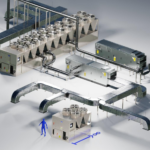
A laboratory HVAC system consists of multiple components working together. The design engineer selects the equipment according to the room’s cooling load, ventilation requirements, safety needs, and operating schedule.
1. Air Handling Unit (AHU)
An Air Handling Unit is one of the most important components in many laboratory HVAC installations.
An AHU may contain:
- Fresh air and return air sections, where permitted by the design
- Pre-filters and fine filters
- Cooling coils
- Heating coils, where required
- Humidification or dehumidification provisions
- Supply and return fans
- Dampers
- Access sections for inspection and maintenance
The AHU conditions and distributes air to the designated laboratory areas.
For laboratories with special containment or contamination-control requirements, air recirculation must be evaluated carefully. Some spaces may require dedicated systems or once-through ventilation rather than shared return air.
2. Chiller System
A chiller system produces chilled water that can be supplied to AHU cooling coils or other compatible cooling equipment.
Chiller-based HVAC systems are often considered for:
- Large pharmaceutical laboratories
- Research and development facilities
- Industrial testing laboratories
- Large diagnostic or laboratory buildings
- Facilities with significant and continuous cooling demand
The selection between air-cooled and water-cooled chillers depends on project size, energy considerations, available space, water availability, maintenance requirements, and operating conditions.
3. VRF/VRV Air Conditioning System
VRF/VRV systems provide flexible zone-wise cooling and temperature control.
They may be suitable for selected laboratory support spaces, administrative areas, meeting rooms, and other spaces where the application permits.
However, VRF/VRV systems should not automatically be considered a replacement for dedicated laboratory ventilation, fume hood exhaust, or containment systems.
4. Ductable Air Conditioning System
Ductable AC systems distribute conditioned air through a network of ducts and supply air outlets.
They may be used in suitable laboratory spaces where the required cooling and air distribution can be achieved. The design must consider air distribution, filtration, fresh air requirements, and room pressure relationships.
5. Fresh Air Ventilation System
Fresh air ventilation is essential for providing outdoor air and supporting the removal or dilution of indoor contaminants as part of an engineered ventilation strategy.
A laboratory fresh air system may include:
- Fresh air intake louvers
- Pre-filtration
- Fresh air handling units
- Supply air fans
- Ductwork
- Volume control dampers
- Air distribution grilles
- Monitoring and control devices
The amount of fresh air should be determined by the laboratory’s ventilation and exhaust requirements, not by applying a generic air-change figure to every room.
6. Exhaust Air System
Laboratory exhaust systems remove air from designated spaces and equipment.
Depending on the application, the system may include:
- General room exhaust
- Fume hood exhaust
- Equipment exhaust
- Chemical storage exhaust
- Dedicated process exhaust
- Exhaust fans and ductwork
- Suitable discharge arrangements
The exhaust system must be designed around the characteristics of the contaminants, duct materials, fan selection, discharge location, and applicable safety requirements.
7. Filtration System
Filtration helps remove particles from air supplied to or exhausted from selected laboratory areas.
Common filtration options include:
- Pre-filters
- Fine filters
- HEPA filters
- Specialised gas-phase filtration, where required
Filter selection should be based on particle size, filtration efficiency, pressure drop, airflow, contamination risk, and the intended location of the filter.
HVAC Requirements for Different Types of Laboratories
Every laboratory has different operational requirements. A single HVAC design cannot be applied to all laboratory categories.
1. Pharmaceutical Laboratories
Pharmaceutical laboratories may perform raw material testing, quality control, stability testing, analytical testing, and research activities.
Important HVAC considerations include:
- Controlled temperature and humidity
- Suitable air filtration
- Room pressure management
- Appropriate fresh air ventilation
- Equipment heat-load management
- Environmental monitoring
- Separation of incompatible activities
The actual environmental specifications depend on the laboratory function and applicable quality and regulatory requirements.
2. Chemical Laboratories
Chemical laboratories may handle solvents, acids, alkalis, reagents, and other substances that can release hazardous fumes or vapours.
Important HVAC requirements include:
- Properly selected fume hoods
- Dedicated local exhaust ventilation
- Chemical-compatible duct materials
- Suitable exhaust fans
- Appropriate make-up air
- Negative room pressure where required
- Safe exhaust discharge arrangements
The exhaust design must consider chemical compatibility, fire and explosion risks, and the possibility of incompatible exhaust streams reacting with each other.
3. Microbiology Laboratories
Microbiology laboratories may handle microorganisms, biological samples, and potentially infectious materials.
HVAC design depends on the assigned biosafety level and the laboratory’s documented risk assessment.
Key considerations may include:
- Controlled airflow direction
- Appropriate pressure relationships
- Suitable ventilation and exhaust
- Biological safety cabinets
- Air filtration where required
- Monitoring and alarm systems
- System reliability and emergency procedures
Biosafety cabinets and room ventilation perform different functions. The HVAC system must be coordinated with the selected primary containment equipment.
4. Medical Diagnostic Laboratories
Diagnostic laboratories may perform blood testing, pathology, clinical chemistry, microbiology, and other diagnostic procedures.
Important HVAC considerations include:
- Temperature control
- Suitable ventilation
- Odour and heat removal
- Equipment cooling
- Air quality
- Room-wise environmental requirements
Different diagnostic sections may require different operating conditions.
5. Research and Development Laboratories
R&D laboratories often use specialised instruments and conduct experiments that require stable environmental conditions.
HVAC planning should consider:
- Equipment heat loads
- Temperature stability
- Humidity control
- Fresh air requirements
- Exhaust requirements
- Future equipment expansion
- Flexible zoning
The HVAC system should be coordinated with the research team’s equipment schedule and operating procedures.
6. Food Testing Laboratories
Food testing laboratories may conduct microbiological, chemical, nutritional, and quality testing.
HVAC requirements may include:
- Temperature and humidity control
- Suitable ventilation
- Odour management
- Appropriate filtration
- Separation of clean and potentially contaminated activities
- Environmental stability for testing equipment
7. Industrial Testing Laboratories
Industrial laboratories may test metals, polymers, chemicals, construction materials, textiles, and other products.
The HVAC system must consider heat-generating equipment, dust, fumes, process exhaust, and the required environmental conditions for testing.
Laboratory HVAC Design Considerations
Good laboratory HVAC design starts with understanding the activities performed in each room.
1. Laboratory Zoning
The facility should be divided into functional zones according to the nature of the work.
Examples include:
- General testing areas
- Chemical testing rooms
- Sample preparation rooms
- Instrument rooms
- Microbiology rooms
- Sample storage rooms
- Washing and cleaning areas
- Support and administrative areas
Zoning helps the design team determine which rooms can share HVAC systems and which require dedicated ventilation or exhaust.
2. Air Changes Per Hour (ACH)
Air Changes Per Hour, or ACH, describes how many room air volumes are supplied or removed in one hour.
The basic formula is:
ACH = Airflow Rate (m³/hour) ÷ Room Volume (m³)
For example:
- Room length: 6 metres
- Room width: 5 metres
- Room height: 3 metres
- Room volume: 90 m³
- Supply airflow: 900 m³/hour
ACH = 900 ÷ 90 = 10 air changes per hour.
This is only a mathematical example, not a recommended design value. The required ventilation rate must be established for the actual laboratory application, applicable standards, exhaust equipment, contaminant risk, and pressure-control strategy.
3. Room Pressure Differential
Pressure relationships help control the direction of airflow between connected rooms.
A negative-pressure room generally draws air inward from adjoining areas. A positive-pressure room generally pushes air outward towards adjoining spaces.
The correct pressure arrangement depends on whether the priority is containment, product protection, cleanliness, or another operational requirement.
4. Cooling Load Calculation
Laboratory cooling loads can be higher than those in ordinary offices because of specialised equipment and ventilation requirements.
The cooling-load calculation should consider:
- Room dimensions
- Outdoor design conditions
- Number of occupants
- Lighting load
- Laboratory equipment load
- Fresh air load
- Exhaust and make-up air
- Building envelope heat gain
- Operating hours
- Required temperature and humidity
Accurate load calculations help avoid undersized or oversized HVAC equipment.
5. Humidity Control
Humidity requirements vary by laboratory type and activity.
The design may require cooling-coil dehumidification, reheat, humidification, or a dedicated environmental control arrangement. The selection should account for the required operating range and the impact of outdoor air.
6. Air Distribution
Air supply and return locations should be coordinated with workstations, fume hoods, biological safety cabinets, equipment, and room airflow patterns.
Poorly positioned supply diffusers can disturb fume hood containment or create unwanted airflow across sensitive work areas.
7. Exhaust Discharge Location
Laboratory exhaust must be discharged in a way that minimises the risk of contaminants re-entering the building through outdoor air intakes, windows, or occupied areas.
Exhaust stack height and discharge velocity should be determined through proper engineering evaluation rather than simple rules of thumb.
8. Controls and Monitoring
Laboratory HVAC controls may monitor:
- Room temperature
- Relative humidity
- Room pressure differential
- Supply and exhaust airflow
- Filter differential pressure
- Fume hood airflow status
- Equipment operating status
- Alarm conditions
Critical parameters should have suitable alarms and response procedures. Monitoring alone does not guarantee containment; the system must also be properly designed, tested, and maintained.
Role of Fume Hoods in Laboratory HVAC Systems
A laboratory fume hood is a local exhaust containment device designed to capture and remove hazardous vapours, fumes, and gases generated during laboratory procedures.
The fume hood works as part of a coordinated ventilation system.
Important design considerations include:
- Required exhaust airflow
- Hood type and dimensions
- Sash position
- Face velocity and containment performance
- Make-up air arrangement
- Exhaust duct material
- Fan selection
- Airflow indication and alarms
- Testing and commissioning
Fume hood performance should be evaluated using the applicable testing method, such as ANSI/ASHRAE Standard 110. A fume hood should not be assumed to provide adequate protection simply because it is connected to an exhaust fan.
Energy-Efficient HVAC Solutions for Laboratories
Laboratories often require significant ventilation and conditioning energy. Energy efficiency should be considered without compromising safety, containment, or environmental requirements.
Useful strategies include:
1. Variable Air Volume (VAV) Systems
VAV systems can adjust airflow according to demand, where permitted by the laboratory’s ventilation and safety design.
For compatible fume hood systems, sash position and airflow controls can help reduce exhaust and make-up air demand when the hood is not fully open.
2. Energy-Efficient Chillers
Selecting appropriately sized chillers with efficient part-load performance can help reduce cooling energy consumption.
3. Variable Frequency Drives (VFDs)
VFDs can control compatible fan and pump motors according to system demand. Their use must be coordinated with minimum ventilation, pressure control, and equipment safety requirements.
4. Demand-Based Controls
Suitable sensors and control sequences can help optimise airflow and conditioning while maintaining required minimum ventilation and containment performance.
5. Proper Duct Design
Well-designed ductwork reduces unnecessary pressure losses and can improve fan-system efficiency.
6. Regular Filter Maintenance
Clogged filters can increase pressure drop and energy consumption. Filters should be inspected and replaced according to the manufacturer’s recommendations and the facility’s maintenance programme.
7. Building Management System Integration
A BMS can help operators monitor HVAC equipment, operating conditions, alarms, and energy consumption from a central interface.
Energy-saving measures must never reduce required exhaust, minimum ventilation, or pressure relationships below approved design conditions.
Laboratory HVAC Installation, Testing and Commissioning
Correct installation and commissioning are essential for dependable laboratory HVAC performance.
A typical project process includes:
- Reviewing laboratory activities and room data.
- Identifying ventilation, cooling, and exhaust requirements.
- Preparing HVAC layouts and equipment schedules.
- Calculating cooling loads and airflow requirements.
- Selecting AHUs, chillers, fans, filters, and controls.
- Installing ductwork, piping, insulation, and equipment.
- Checking electrical and control connections.
- Testing airflow and room pressure relationships.
- Balancing supply and exhaust systems.
- Verifying alarms, controls, and operating sequences.
- Completing handover documentation and maintenance guidance.
Specialist containment equipment, fume hoods, and biosafety cabinets require their own appropriate performance testing and certification. General HVAC commissioning does not replace those specialist tests.
Maintenance of Laboratory HVAC Systems
Preventive maintenance helps maintain stable environmental conditions and reduces the risk of unexpected equipment failure.
A laboratory HVAC maintenance programme may include:
- Inspecting AHU filters
- Checking cooling coils
- Inspecting fans and motors
- Checking belts, bearings, and vibration
- Inspecting chilled-water systems
- Checking condensate drains
- Inspecting ductwork and dampers
- Verifying temperature and humidity sensors
- Checking room pressure indicators
- Testing alarms and control sequences
- Reviewing exhaust fan performance
- Inspecting outdoor air intakes and exhaust outlets
The maintenance frequency should be based on equipment requirements, operating conditions, risk assessments, and the facility’s approved procedures.
Common Laboratory HVAC Problems and Their Solutions
| Common problem | Possible cause | Recommended action |
|---|---|---|
| Unstable room temperature | Incorrect load calculation or control issue | Review cooling load, sensors, and control sequence |
| High humidity | Insufficient dehumidification | Check cooling coil, airflow, and humidity controls |
| Poor ventilation | Incorrect airflow or blocked filters | Measure airflow and inspect filters and dampers |
| Unstable room pressure | Supply and exhaust imbalance | Rebalance airflow and verify pressure controls |
| Fume hood alarm | Low or unstable exhaust airflow | Inspect exhaust system and hood controls |
| High energy consumption | Excess airflow or inefficient equipment | Review system operation and energy performance |
| Uneven cooling | Poor air distribution | Review diffuser placement and duct balancing |
Troubleshooting should be performed by qualified personnel. Safety-critical exhaust or containment systems should not be adjusted in a way that compromises laboratory protection.
Standards and Guidelines for Laboratory HVAC Design
Laboratory HVAC design must consider the type of work, local regulations, safety requirements, and applicable technical standards.
Important references may include:
- ASHRAE Handbook – HVAC Applications, Chapter 17: Laboratories: Covers laboratory ventilation, exhaust, containment, airflow, and design considerations.
- ANSI/ASHRAE Standard 110: Provides methods for testing laboratory fume hood performance.
- ANSI/ASSP Z9.5: Laboratory ventilation guidance.
- CDC/NIH Biosafety in Microbiological and Biomedical Laboratories (BMBL): Provides biosafety guidance for biomedical and microbiological laboratories.
- NFPA 45: Fire protection considerations for laboratories using chemicals, where applicable.
- National Building Code of India (NBC): Relevant building and fire/life-safety provisions, as applicable to the project.
The applicable editions, statutory requirements, and local authority approvals should be verified for each project. A reference standard should not be treated as a substitute for a project-specific risk assessment or specialist design review.
Why Choose VIPUL HVAC SOLUTION PVT. LTD.?
Selecting an HVAC partner for a laboratory project requires careful consideration of technical requirements, equipment selection, airflow planning, and long-term operating needs.
VIPUL HVAC SOLUTION PVT. LTD. works with HVAC solutions involving:
- Air Handling Unit (AHU) systems
- Chiller systems
- VRF/VRV air-conditioning systems
- Ductable air-conditioning systems
- Fresh air ventilation
- HVAC planning and consultancy
- Cooling-load and equipment selection support
For laboratory projects, the HVAC scope should be clearly defined according to the facility’s activities and safety requirements. Specialist fume hood, biosafety, hazardous exhaust, and containment design or certification should be handled by appropriately qualified specialists where required.
The objective is to develop an HVAC arrangement that supports suitable indoor conditions, reliable operation, and efficient system performance.
Conclusion
A properly designed laboratory HVAC system is essential for maintaining controlled temperature, humidity, ventilation, air quality, and room pressure relationships. It also supports the safe operation of laboratory equipment and helps protect personnel, samples, and research activities.
From pharmaceutical and chemical laboratories to microbiology, diagnostic, food testing, and industrial research facilities, every laboratory requires an HVAC design based on its specific operational and safety needs.
If you are planning a new laboratory, upgrading an existing HVAC installation, or evaluating AHU, chiller, air-conditioning, or ventilation requirements, VIPUL HVAC SOLUTION PVT. LTD. can assist with relevant HVAC solutions and project discussions.
Contact VIPUL HVAC SOLUTION PVT. LTD.
Website: https://vipulhvacsolution.in/
Phone: +91 8000392000
Discuss your laboratory HVAC requirements with the team.
Frequently Asked Questions (FAQs)
1. What is the purpose of an HVAC system in a laboratory?
A laboratory HVAC system maintains suitable temperature, humidity, ventilation, air quality, and room pressure conditions. It also supports the removal of heat, fumes, odours, and airborne contaminants according to the laboratory’s activities.
2. Which HVAC system is best for laboratories?
The best system depends on laboratory type, room size, equipment heat load, ventilation requirements, and safety classification. AHUs, chillers, fresh air systems, dedicated exhaust, and suitable air-conditioning systems may be combined to meet project requirements.
3. Why is negative pressure required in some laboratories?
Negative pressure helps maintain inward airflow from adjoining spaces, reducing the risk of contaminants escaping from certain laboratory areas. It is used where required by the laboratory’s risk assessment and containment strategy.
4. What is the role of an AHU in laboratory HVAC?
An AHU conditions and distributes air. Depending on its design, it may provide filtration, cooling, heating, humidity control, and controlled air distribution to laboratory spaces.
5. Is a fume hood part of the laboratory HVAC system?
A fume hood is a local exhaust containment device connected to a suitable ventilation system. Its exhaust airflow, make-up air, controls, and containment performance must be properly coordinated and tested.
6. How is ACH calculated for a laboratory?
ACH is calculated by dividing the airflow rate in cubic metres per hour by the room volume in cubic metres. The required ACH must be determined from the laboratory’s ventilation needs and applicable design requirements rather than using one universal value.
7. How can laboratory HVAC energy consumption be reduced?
Energy consumption may be reduced through efficient chillers, suitable VAV controls, VFDs, optimised duct design, appropriate filtration, and BMS integration. Energy-saving measures must always preserve required ventilation, exhaust, and containment performance.
Technical references for editorial credibility
These are useful authoritative references to support the technical sections of the article:
-
ASHRAE Handbook – Laboratories — laboratory ventilation, airflow and exhaust design.
-
ASHRAE Standard 110 — laboratory fume hood performance testing.
-
CDC/NIH Biosafety in Microbiological and Biomedical Laboratories — biosafety guidance for biomedical and microbiological laboratories.
-
ASHRAE Laboratory Design Guide — laboratory planning, design, operation and energy efficiency.
-
EPA Facilities Manual — laboratory ventilation and exhaust-system design considerations.


[…] HVAC Solutions for Laboratories […]