
AC Gas Refilling Services: Expert Refrigerant Charging for Better Cooling
Is your air conditioner running continuously but failing to cool your room? Does the air coming from your AC feel less cold than usual, or are you noticing longer cooling cycles and uneven temperatures? These problems can be frustrating, particularly during India’s hot summer months.
VIPUL HVAC SOLUTION PVT. LTD. provides HVAC solutions for residential, commercial, and industrial applications. If you are searching for reliable AC gas refilling services, the first step is to identify the reason behind the cooling problem and determine whether refrigerant charging is necessary.
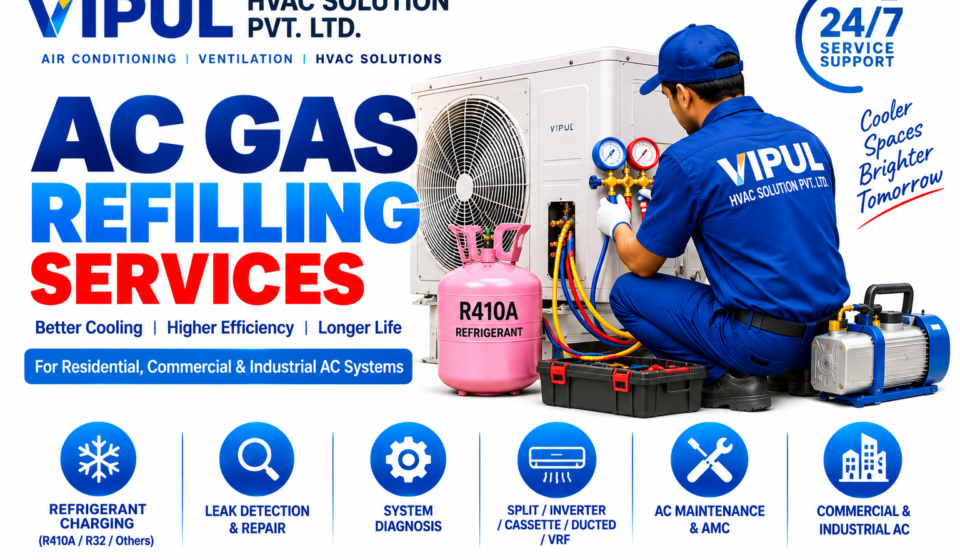
AC gas refilling, more accurately called refrigerant charging, involves adding the refrigerant specified by the equipment manufacturer in the required quantity. The process differs depending on whether the system is a split AC, window AC, inverter AC, cassette AC, ducted AC, or a commercial VRF/VRV system.
Simply adding refrigerant does not always solve poor cooling. A professional inspection may reveal a refrigerant leak, airflow restriction, dirty coil, electrical fault, sensor problem, or another issue.
Contact VIPUL HVAC SOLUTION PVT. LTD.
- Phone: +91 8000392000
- Email: info@vipulhvacsolution.in
- Website: https://vipulhvacsolution.in/
- Contact page: https://vipulac.in/contact-us/
Contact the team to discuss your AC requirements and confirm service availability for your location.
What Are AC Gas Refilling Services?
AC gas refilling services involve inspecting an air-conditioning system and, when testing shows it is necessary, restoring the refrigerant charge to the quantity specified by the manufacturer.
Refrigerant circulates between the indoor and outdoor components to absorb heat indoors and release it outside. It is not consumed like fuel during normal operation.
If an air conditioner has insufficient refrigerant, possible causes include a refrigerant leak, refrigerant loss during previous repair work, or an incorrect initial charge.
A proper refrigerant service may involve:
- Inspecting the AC unit and identifying the reported problem.
- Checking the equipment nameplate and refrigerant specification.
- Evaluating airflow, filters, coils, and relevant operating conditions.
- Testing for refrigerant leakage when indicated.
- Repairing a confirmed leak where necessary.
- Performing prescribed pressure testing and evacuation where required.
- Calculating and adding the correct refrigerant charge.
- Checking system operation after the work.
The exact procedure depends on the equipment type, refrigerant, and manufacturer’s technical instructions.
Signs Your AC May Need Refrigerant Inspection
Not every cooling problem means the AC needs gas refilling. However, certain symptoms may justify a professional inspection.
1. AC Is Running but Cooling Is Weak
If your air conditioner is running but the room is not reaching the set temperature, the refrigerant circuit may need to be checked.
Other possible causes include dirty filters, blocked airflow, dirty condenser or evaporator coils, incorrect settings, or mechanical and electrical faults.
A technician should diagnose the problem before recommending refrigerant charging.
2. Ice Formation on the Indoor Unit or Refrigerant Pipe
Ice formation around the evaporator coil or refrigerant piping can occur for several reasons, including restricted airflow, a dirty filter, or a refrigerant-related fault.
Switch the system off if ice is developing and arrange an inspection. Allow the ice to thaw safely, and do not attempt to remove it using sharp objects.
Adding refrigerant without diagnosing the cause may not resolve the problem.
3. AC Takes Longer to Cool the Room
If an AC takes significantly longer than usual to reach the desired temperature, the cause may involve airflow, room heat load, equipment condition, refrigerant charge, or other operating factors.
A system inspection can help identify which component or condition needs attention.
4. Refrigerant-Related Error Codes
Some inverter and modern air-conditioning systems display fault codes when particular operating conditions or sensor readings fall outside expected ranges.
An error code does not always confirm low refrigerant. The code should be interpreted using the manufacturer’s service documentation.
5. Repeated Cooling Problems After Previous Gas Filling
If an air conditioner loses cooling performance again soon after refrigerant has been added, it may have an unresolved leak or another underlying fault.
Repeated refilling without investigating the reason can increase costs and allow the original problem to continue.
6. Visible Damage Around Refrigerant Piping
Damaged copper pipes, disturbed joints, or other signs of physical damage may justify a leak inspection.
Do not loosen refrigerant fittings or try to check the system by releasing refrigerant. Arrange an appropriate technical assessment instead.
Does AC Gas Need to Be Refilled Every Year?
No. An air conditioner does not normally need annual refrigerant refilling when its refrigerant circuit is intact and the system is operating correctly.
Refrigerant circulates within the sealed circuit. It is not routinely consumed during normal cooling.
A system may need refrigerant charging if:
- A leak has been detected and repaired.
- Refrigerant has been lost during service or repair.
- The original installation charge was incorrect.
- An installation or piping modification requires a calculated additional charge.
Routine maintenance should focus on cleaning filters, checking airflow, inspecting coils, and assessing the equipment’s operation. Refrigerant should be adjusted when diagnosis shows that it is necessary.
For additional manufacturer guidance, consult LG India’s support information about AC gas refilling.
Types of AC Gas Refilling Services
Different air-conditioning systems have different refrigerant circuits and service procedures. The correct process should be selected according to the equipment model and installation.
1. Split AC Gas Refilling
Split air conditioners typically consist of an indoor unit and an outdoor unit connected by refrigerant piping.
A split AC may need refrigerant charging if a confirmed leak has been repaired or another condition has caused refrigerant loss.
Before charging, the technician should consider the cooling symptoms, condition of the filters and coils, refrigerant specification, and relevant operating parameters.
2. Inverter AC Gas Refilling
Inverter AC systems adjust compressor operation according to cooling demand. Their diagnostic and charging procedures can differ from those of conventional systems.
The refrigerant type and quantity must be confirmed from the equipment nameplate and manufacturer instructions. Charging should not be based on a generic pressure value that ignores the actual system conditions.
3. Window AC Gas Refilling
Window AC units combine the indoor and outdoor components within one enclosure. If performance declines, the system may require inspection for dirty filters, airflow restrictions, electrical problems, or refrigerant-related faults.
The refrigerant circuit should be opened only when the service procedure requires it.
4. Cassette AC Gas Refilling
Cassette air conditioners are often used in offices, showrooms, restaurants, and other commercial spaces.
Their cooling performance depends on the refrigerant circuit, airflow, filters, coils, installation conditions, and operating controls. Refrigerant charging must follow the specific equipment manufacturer’s procedure.
5. Ducted AC Gas Refilling
Ducted AC systems provide conditioned air through ductwork and may serve multiple rooms or zones.
Low airflow can be associated with blocked filters, duct restrictions, fan problems, or other faults. A technician should assess the air distribution system alongside the refrigerant circuit when investigating poor cooling.
6. VRF and VRV Refrigerant Charging
VRF/VRV systems can connect multiple indoor units to one or more outdoor units through an extensive piping network.
The additional refrigerant charge depends on the equipment specifications and actual installed piping configuration. Manufacturer-specific calculations and commissioning procedures are essential.
VRF refrigerant charging should not be treated as identical to filling a conventional single-split AC.
Our AC Gas Refilling Service Process
A structured service process helps identify the cause of a cooling problem and determine the appropriate corrective work.
Step 1: Initial Inspection
The technician reviews the reported symptoms, equipment type, model number, refrigerant specification, and available service history.
The inspection may also include checking filters, coils, airflow, electrical components, and visible refrigerant piping.
Step 2: Cooling Fault Diagnosis
Before recommending refrigerant charging, the system should be evaluated for other possible causes of poor cooling.
Depending on the equipment, this may involve checking temperature readings, fault codes, fan operation, sensors, and relevant operating parameters.
Step 3: Refrigerant Leak Testing
If refrigerant loss is suspected, suitable leak-detection methods should be selected according to the equipment and refrigerant.
When a leak is confirmed, the source should be repaired before recharging the system. The required testing and evacuation procedure depends on the manufacturer’s instructions.
Step 4: Refrigerant Verification
The technician checks the equipment nameplate and technical documentation to confirm which refrigerant the system uses.
Different refrigerants have different operating characteristics and must not be mixed or substituted without explicit manufacturer approval.
Step 5: Correct Refrigerant Charging
The refrigerant charge should be established using the manufacturer’s procedure. Where specified, the refrigerant should be weighed using suitable equipment.
Pressure readings alone should not be treated as a substitute for the correct charging method.
Step 6: Final Performance Checks
After charging or repair, the system should be tested according to the applicable service procedure.
Checks may include operating parameters, cooling performance, fault codes, and confirmation that the prescribed work has been completed.
Where appropriate, the service record should include the identified fault, repair performed, and refrigerant quantity added.
Which Refrigerants Are Used in Air Conditioners?
The refrigerant depends on the manufacturer, equipment model, and design.
Common examples include:
- R32: Used in many newer residential and commercial air-conditioning systems.
- R410A: Used in many split, inverter, and VRF/VRV systems.
- R22: Found in some older air-conditioning equipment.
This is not a complete list, and refrigerant type should never be assumed from the unit’s age or appearance alone.
The nameplate and manufacturer documentation should be used to verify the correct refrigerant. Refrigerants must not be mixed, and an alternative must not be used unless the manufacturer explicitly permits it.
Some refrigerants have additional handling and safety requirements. Refrigerant recovery, leak testing, evacuation, and charging should be performed by a suitably trained technician using the appropriate equipment.
How Much Does AC Gas Refilling Cost?
The cost of AC gas refilling services depends on the equipment, fault, refrigerant, and work required. There is no single price that applies to every AC.
Important pricing factors include:
- Type of air conditioner and equipment capacity.
- Refrigerant type and quantity required.
- Whether a leak is present.
- Leak detection and repair work.
- Accessibility of the equipment and piping.
- Pressure testing and evacuation, where required.
- Replacement parts or component repairs.
- Site location and service requirements.
- Additional testing or commissioning work for complex systems.
For example, a split AC requiring a straightforward inspection may have a different service scope from a VRF installation requiring leak repair and a calculated additional refrigerant charge.
For a more accurate quotation, provide the equipment brand, model, capacity if known, symptoms, site location, and any displayed error codes.
Contact VIPUL HVAC SOLUTION PVT. LTD.
- Phone: +91 8000392000
- Email: info@vipulhvacsolution.in
- Website: https://vipulhvacsolution.in/
Contact the team to discuss the equipment and confirm the applicable inspection charges, service coverage, and quotation before booking.
Why Choose VIPUL HVAC SOLUTION PVT. LTD.?
VIPUL HVAC SOLUTION PVT. LTD. provides HVAC solutions focused on air conditioning, ventilation, and commercial and industrial climate control.
Its published service portfolio includes VRF/VRV systems, chillers, air handling units, ducted air conditioning, HVAC design and consultancy, installation, and maintenance-related solutions.
Customers can contact the company to discuss:
- Residential and commercial air-conditioning requirements.
- VRF and VRV systems.
- Cassette and ducted AC applications.
- HVAC equipment selection and installation.
- Commercial and industrial HVAC projects.
- Preventive maintenance and AMC enquiries.
- Refrigerant-related fault diagnosis and service requirements.
Service availability depends on the equipment type, location, and work required. Contact the company to confirm whether the requested AC gas refilling service is available for your specific installation.
Contact Details
Company: VIPUL HVAC SOLUTION PVT. LTD.
Phone: +91 8000392000
Email: info@vipulhvacsolution.in
Website: https://vipulhvacsolution.in/
Contact page: https://vipulac.in/contact-us/
Corporate office: VIPUL HVAC House, Hari Ichchha Industrial Society, Udhna Udhyog Nagar, Udhna, Surat, Gujarat 394210.
Tips to Maintain Your AC After Gas Refilling
Correct refrigerant charging is only one part of air-conditioner maintenance. The following practices can help support reliable performance.
1. Clean the Air Filters
Follow the manufacturer’s recommendations for cleaning or replacing filters. Dirty filters can restrict airflow and reduce cooling performance.
2. Keep the Outdoor Unit Unobstructed
Ensure that the outdoor unit has adequate airflow. Avoid blocking the air intake and discharge areas.
3. Maintain the Indoor and Outdoor Coils
Dust and other deposits can affect heat transfer. Coil cleaning should be performed when necessary, using methods suitable for the equipment.
4. Monitor Cooling Performance
If the system repeatedly loses cooling after servicing, arrange another inspection rather than assuming it only needs more refrigerant.
5. Address Fault Codes Promptly
Record any displayed error code and share the equipment brand and model with the technician. This can help with diagnosis.
6. Schedule Preventive Maintenance
Maintenance frequency should follow manufacturer recommendations and reflect the system’s usage, environmental conditions, and operating requirements.
7. Keep Service Records
Maintain records of inspections, repairs, leak testing, and refrigerant quantities. These details can help identify recurring faults.
Regular maintenance cannot guarantee that every fault will be prevented, but it can help identify problems and support informed repair decisions.
Frequently Asked Questions About AC Gas Refilling Services
1. How do I know if my AC needs gas refilling?
Weak cooling, recurring cooling faults, ice formation, or refrigerant-related error codes may justify an inspection. These symptoms have several possible causes, so a technician should establish whether refrigerant charging is actually required.
2. Does AC gas need to be refilled every year?
No. Refrigerant is not normally consumed during correct, leak-free operation. Annual refilling is not a routine requirement for a properly functioning system.
3. Can I refill AC gas without repairing a refrigerant leak?
If a leak is confirmed, the source should generally be repaired before recharging. Otherwise, the refrigerant may escape again and the cooling problem may return.
4. Which refrigerant is best for my AC?
The correct refrigerant is the one specified by the equipment manufacturer. R32, R410A, R22, and other refrigerants are not interchangeable unless the manufacturer explicitly approves the alternative.
5. How long does AC gas refilling take?
The duration depends on the equipment type, quantity of refrigerant required, accessibility, diagnosis, and whether leak repairs or additional testing are necessary. The time should be estimated after reviewing the specific system.
6. Is AC gas refilling different for inverter ACs?
Yes. Inverter systems have model-specific operating and service requirements. The manufacturer-approved refrigerant and charging method must be followed.
7. Can refrigerant be added to a VRF or VRV system?
Yes, when diagnosis and the manufacturer’s procedure establish that charging is necessary. The quantity must account for the equipment and installed piping configuration, and the work should be performed by a suitably trained technician.
8. Does low refrigerant always mean there is a leak?
A low charge can result from leakage, refrigerant loss during previous work, or an incorrect initial charge. Testing and a review of the service history help determine the likely cause.
9. How can I request an AC gas refilling quotation?
Provide the equipment brand, model, capacity if known, location, cooling symptoms, and available error codes. Contact VIPUL HVAC SOLUTION PVT. LTD. at +91 8000392000 or info@vipulhvacsolution.in to discuss the requirement and confirm service availability.
10. Does VIPUL HVAC SOLUTION PVT. LTD. provide residential and commercial HVAC solutions?
The company publishes HVAC solutions for residential, commercial, and industrial applications. Contact the team to confirm service availability for your AC type, location, and specific refrigerant-related requirement.
Conclusion: Contact Us for AC Gas Refilling Services
Reliable AC gas refilling services begin with an accurate diagnosis, suitable leak testing when required, and refrigerant charging according to the equipment manufacturer’s specifications.
Adding refrigerant without addressing an underlying leak or other fault can lead to recurring cooling problems and unnecessary costs. A proper inspection helps determine whether the system needs refrigerant charging, leak repair, cleaning, electrical troubleshooting, or another corrective action.
For air-conditioning and HVAC enquiries, contact VIPUL HVAC SOLUTION PVT. LTD.
Phone: +91 8000392000
Email: info@vipulhvacsolution.in
Website: https://vipulhvacsolution.in/
Discuss your equipment details with the team, confirm the service scope and availability, and request an appropriate quotation before arranging the work.
VIPUL HVAC SOLUTION PVT. LTD. — HVAC solutions for residential, commercial, and industrial applications.