
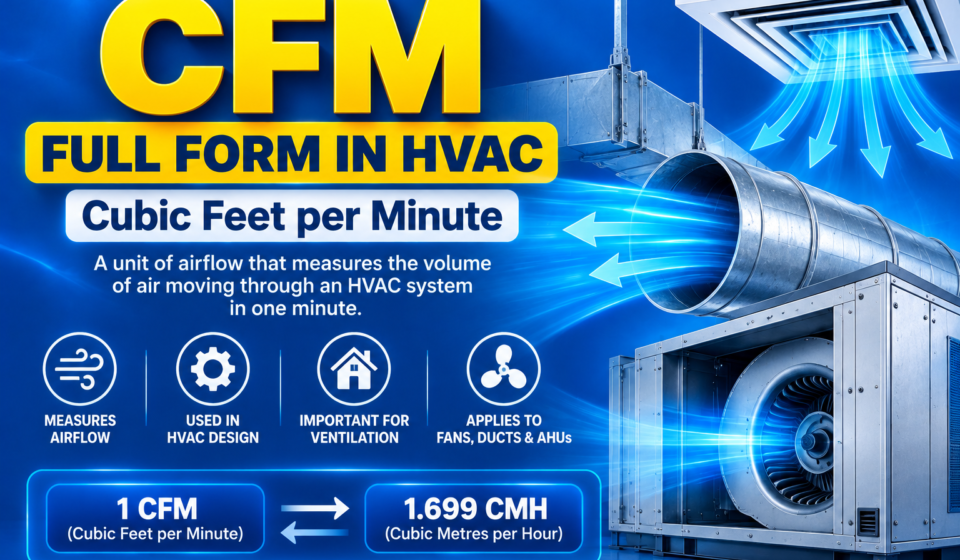

CFM Full Form in HVAC: Meaning, Calculation, Applications and Benefits
CFM full form in HVAC is Cubic Feet per Minute. It is a unit used to measure the volume of air moving through an air-conditioning, ventilation or exhaust system in one minute.
CFM is an important HVAC design parameter because it helps engineers assess airflow through air handling units (AHUs), air conditioners, ventilation fans, ductwork, diffusers, grilles and exhaust systems.
Whether you are planning an office air-conditioning project, an industrial ventilation system, a commercial building or a fresh-air installation, understanding CFM can help you make better decisions about airflow distribution and equipment selection.
VIPUL HVAC SOLUTION PVT. LTD. provides HVAC-related solutions for commercial and industrial applications, including air-conditioning systems, VRF/VRV, chillers, AHUs, ventilation, ducting and HVAC design and consultancy.
In this guide, we explain the meaning of CFM, its importance in HVAC, airflow calculations, CFM per ton, ductwork applications and common questions asked by HVAC professionals and building owners.
1. What Is the CFM Full Form in HVAC?
CFM stands for Cubic Feet per Minute.
It measures the volume of air that passes a specific point in one minute. In HVAC systems, this point might be a duct, air outlet, fan, AHU or ventilation opening.
For example, a fan rated at 1,000 CFM is specified to move 1,000 cubic feet of air per minute under its stated test and operating conditions. Actual airflow in an installed system can differ because of duct resistance, filters, dampers, static pressure and other factors.
CFM is a volumetric airflow measurement. It does not directly measure air temperature, cooling capacity, air quality or the amount of fresh outdoor air.
CFM full form at a glance
- C: Cubic
- F: Feet
- M: Minute
- Measurement: Volumetric airflow
- Common applications: Air conditioning, ventilation, exhaust, duct design and air distribution
CFM is widely used in HVAC equipment specifications and airflow calculations. SI-based specifications may instead express airflow in litres per second (L/s) or cubic metres per second (m³/s).
2. Why Is CFM Important in HVAC Systems?
Correct airflow is essential for HVAC systems to perform as intended. Selecting equipment based only on cooling capacity or motor power does not guarantee that the required air volume will reach the occupied space.
Maintaining indoor comfort
Suitable airflow helps distribute conditioned air throughout a room and reduce uneven temperature conditions.
Supporting cooling performance
Airflow through an evaporator coil affects heat transfer and system operation. Insufficient or excessive airflow relative to the equipment’s design can affect performance and may contribute to operational problems.
Designing ventilation systems
Ventilation engineers use airflow measurements to plan outdoor-air supply and exhaust requirements for buildings.
Selecting fans and air handling units
CFM is one of the parameters used to evaluate fans and AHUs. The required airflow must be considered alongside the system’s static pressure and other performance requirements.
Planning ductwork
Airflow calculations help engineers estimate the volume of air that each duct section must carry. Duct dimensions are then selected using appropriate design methods, pressure-drop limits, noise considerations and air-velocity targets.
Improving air distribution
Correctly selected airflow and properly positioned diffusers, grilles and dampers help deliver air to the intended areas.
3. What Is the Difference Between CFM and CMH?
CFM and CMH are both units of volumetric airflow.
- CFM: Cubic Feet per Minute
- CMH: Cubic Metres per Hour
CMH is commonly used in HVAC specifications in India and other countries using metric units.
CFM to CMH conversion
The conversion formula is:
CMH = CFM × 1.699
For example:
1,000 CFM × 1.699 = approximately 1,699 CMH.
CMH to CFM conversion
CFM = CMH ÷ 1.699
For example:
1,700 CMH ÷ 1.699 = approximately 1,001 CFM.
Quick CFM conversion table
| CFM | Approximate CMH |
|---|---|
| 100 | 170 |
| 250 | 425 |
| 500 | 850 |
| 750 | 1,274 |
| 1,000 | 1,69 |
| 1,500 | 2,549 |
| 2,000 | 3,398 |
| 3,000 | 5,097 |
These values are rounded for practical reference.
4. How to Calculate CFM in HVAC
The correct CFM calculation depends on what the airflow is intended to achieve. Common approaches include room air-change calculations, ventilation design, equipment selection and cooling-system airflow requirements.
Method 1: Calculate airflow using room volume and air changes
For an air-change-based calculation, use:
CFM = Room volume × Required air changes per hour ÷ 60
Room volume must be expressed in cubic feet.
Room volume is calculated as:
Room volume = Length × Width × Height
For example, consider a room with these dimensions:
- Length: 20 feet
- Width: 15 feet
- Height: 10 feet
Room volume = 20 × 15 × 10 = 3,000 cubic feet.
If a design calls for 6 air changes per hour:
CFM = 3,000 × 6 ÷ 60
Required airflow = 300 CFM
This is an illustrative air-change calculation. The appropriate air-change rate depends on the room’s use, applicable standards, contaminant sources and design requirements.
Also, when calculating air changes based on outdoor air, use the relevant outdoor-airflow rate—not automatically the total recirculated supply airflow.
Method 2: Calculate airflow from CMH
If the required airflow is given in cubic metres per hour, convert it to CFM.
CFM = CMH ÷ 1.699
Example:
Required airflow = 3,000 CMH.
CFM = 3,000 ÷ 1.699
Required airflow ≈ 1,766 CFM
This conversion is useful when comparing Indian HVAC equipment specifications with products or technical documents that use CFM.
Method 3: Use manufacturer airflow data
For an AHU, fan, air conditioner or other HVAC unit, check the manufacturer’s performance data.
The rated CFM should be evaluated at the applicable static pressure and operating conditions. A fan’s free-air rating may be higher than the airflow it delivers after connection to real ductwork.
For final equipment selection, use the manufacturer’s fan curves, selection software or certified performance information where available.
5. What Is CFM per Ton in HVAC?
CFM per ton describes the airflow associated with one ton of air-conditioning cooling capacity.
A commonly used preliminary rule of thumb for certain comfort-cooling applications is approximately 400 CFM per ton. This is not a universal design requirement.
For example, using that rule of thumb:
| Cooling capacity | Illustrative airflow |
|---|---|
| 1 ton | 400 CFM |
| 2 tons | 800 CFM |
| 3 tons | 1,200 CFM |
| 5 tons | 2,000 CFM |
| 10 tons | 4,000 CFM |
These figures are examples for understanding the relationship between airflow and cooling capacity. Actual requirements vary by equipment design, indoor and outdoor conditions, humidity-control needs, coil characteristics and manufacturer specifications.
Why does CFM per ton matter?
The relationship between airflow and cooling capacity helps engineers assess whether the air-conditioning equipment is operating within its intended design range.
However, a designer should not select a fan, duct or AHU solely by multiplying tonnage by 400. The final selection should account for the specific equipment and system requirements.
6. What Is the Difference Between Supply Air CFM and Fresh Air CFM?
These terms describe different aspects of HVAC airflow.
Supply air CFM
Supply air CFM is the volume of air delivered into a space by the HVAC system. Depending on the design, the supplied air may include recirculated room air, outdoor air or a mixture of both.
Fresh air CFM
Fresh air CFM generally refers to the volume of outdoor air introduced into a building or space. The required quantity depends on applicable ventilation standards, occupancy, building use and other design factors.
Exhaust air CFM
Exhaust air CFM is the volume of air removed from a space. Exhaust systems are common in kitchens, toilets, industrial processes and other areas where contaminants, heat, moisture or odours need to be removed.
Why the distinction matters
A room can receive a large volume of recirculated supply air without receiving the same volume of outdoor fresh air.
For this reason, total supply airflow and outdoor-air ventilation requirements must be calculated and documented separately when the design requires it.
7. CFM Requirements for Different HVAC Applications
The airflow needed for a project depends on its intended use and the equipment serving it.
Offices and commercial buildings
Office HVAC design considers occupancy, cooling loads, outdoor-air requirements, room layout and air distribution.
Hospitals and healthcare facilities
Healthcare HVAC requires careful attention to room function, ventilation, filtration, pressure relationships and applicable healthcare requirements. General CFM rules should not replace specialist design.
Restaurants and commercial kitchens
Kitchen exhaust airflow depends on the cooking equipment, hood design, capture requirements and applicable codes. Make-up air must also be considered.
Factories and industrial facilities
Industrial ventilation airflow may be determined by heat removal, process exhaust, contaminant control or other specific process requirements.
Data centers
Airflow design must account for IT equipment heat loads, rack arrangement, supply and return paths, and equipment operating requirements.
Hotels and hospitality buildings
HVAC design may include guest rooms, lobbies, kitchens, restaurants, meeting rooms and other areas with different ventilation and cooling requirements.
The correct CFM cannot be determined reliably from building type alone. Each application requires suitable engineering inputs.
8. How Does CFM Affect HVAC Duct Size?
CFM is an important input in duct sizing because the duct must carry the required airflow while meeting the design’s pressure, velocity, noise and space constraints.
A simplified relationship is:
Airflow = Duct area × Air velocity
When using consistent units, this relationship can be expressed in cubic feet per minute, square feet and feet per minute.
CFM = Duct area (ft²) × Air velocity (ft/min)
Therefore:
Duct area (ft²) = CFM ÷ Air velocity (ft/min)
Example duct area calculation
Suppose a duct must carry 1,000 CFM at a design velocity of 1,000 feet per minute.
Required area = 1,000 ÷ 1,000
Required duct area = 1 square foot
This calculation provides only a theoretical cross-sectional area. It does not establish the final duct dimensions.
Actual duct sizing should consider friction loss, fitting losses, static pressure, noise, available ceiling space, insulation and the chosen duct-design method. Rectangular and circular ducts with the same area may not have identical pressure-drop characteristics.
9. Common CFM Calculation Mistakes
Avoid these common errors when planning HVAC airflow.
- Using one CFM-per-ton value for every system: Actual airflow requirements depend on equipment design and operating conditions.
- Confusing supply air with fresh air: Recirculated supply air is not equivalent to outdoor ventilation air.
- Ignoring static pressure: A fan may deliver less airflow when connected to restrictive ductwork or filters.
- Selecting duct dimensions from area alone: Pressure loss, velocity, fittings and noise also matter.
- Using an arbitrary air-change rate: The required rate depends on the room’s function and applicable design criteria.
- Ignoring manufacturer specifications: Equipment selection should be checked against the manufacturer’s performance data.
- Mixing metric and imperial units: Convert airflow, area and velocity consistently before performing calculations.
10. How VIPUL HVAC SOLUTION PVT. LTD. Supports HVAC Projects
VIPUL HVAC SOLUTION PVT. LTD. provides HVAC-related solutions for residential, commercial and industrial applications.
Its published portfolio includes:
- Cassette and split air-conditioning systems.
- Ducted air-conditioning systems.
- VRF/VRV systems.
- Chiller systems.
- Air Handling Units (AHUs).
- HVAC ducting and ventilation solutions.
- Fresh-air and exhaust-system requirements.
- HVAC design and consultancy.
- Installation, testing and commissioning.
- Maintenance and AMC-related services.
For projects involving airflow calculations, fan selection, duct sizing or AHU selection, requirements should be established from the building layout, cooling load, ventilation criteria and equipment specifications. The precise engineering scope and availability of services should be confirmed with the company.
11. Frequently Asked Questions About CFM in HVAC
What is the full form of CFM in HVAC?
CFM stands for Cubic Feet per Minute. It is a unit of volumetric airflow used in air-conditioning, ventilation, exhaust and duct systems.
What does 1,000 CFM mean?
It means a volumetric airflow rate of 1,000 cubic feet per minute under the stated operating conditions.
How many CMH are in 1,000 CFM?
1,000 CFM is approximately 1,699 cubic metres per hour (CMH).
How much CFM is required per ton of AC?
Approximately 400 CFM per ton is a common preliminary rule of thumb for some comfort-cooling applications. The correct airflow must be determined from the equipment specifications and design conditions.
How do I calculate CFM for a room?
For an air-change-based calculation, multiply room volume in cubic feet by the required air changes per hour, then divide by 60. The appropriate air-change rate depends on the application and design criteria.
Is CFM the same as fresh-air airflow?
No. CFM is a unit of volumetric airflow. Supply, fresh-air and exhaust CFM describe different airflow streams within an HVAC system.
Does higher CFM always mean better cooling?
No. Airflow must match the equipment and application. Excessive or insufficient airflow can affect comfort, noise, humidity control and equipment performance.
Why is CFM important for an AHU?
CFM helps define the required air volume that an AHU must move. Selection also requires consideration of external static pressure, filtration, coil performance, fan efficiency and other design parameters.
What is the difference between CFM and FPM?
CFM measures volumetric airflow, while FPM means feet per minute and measures air velocity. Both are used in HVAC calculations.
Can CFM be converted to litres per second?
Yes. One CFM is approximately 0.472 litres per second. Therefore, 1,000 CFM is approximately 472 litres per second.
12. VIPUL HVAC SOLUTION PVT. LTD. Branches Across Gujarat
VIPUL HVAC SOLUTION PVT. LTD. lists eight branch locations across Gujarat. Customers can contact the relevant branch or central sales team for air-conditioning and HVAC enquiries.
1. Surat – Head Office
Surat is the company’s head-office location and a central point for HVAC project enquiries.
Central sales: +91 8000392000
2. Ankleshwar Branch
Address: G-14, G-23-24, Golden Square, Ankleshwar–Valia Road, opposite CNG Pump, near Maruti Showroom, GIDC Chokdi, Ankleshwar, Gujarat 393002.
Sales: +91 8000192000
3. Bharuch Branch
Address: G-8, Bhagvati Enclave, near ABC Circle, Chokdi, Bholav, Bharuch, Gujarat 392001.
Sales: +91 9081309300
4. Vadodara (Baroda) Branch
Address: Rajnagar Society, Tarangan Society, Haripura, Vadodara, Gujarat 390007.
Sales: +91 90990 74214
5. Ahmedabad Branch
Address: 11, Saanvi Nirman Stella, opposite Flora Ixora Road, South Bopal, Ahmedabad, Gujarat 380058.
Sales: +91 7096500050
6. Talala Branch
Address: Shop No. 3, Ajit Chambers, Veraval–Talala Road, near New S.T. Bus Stand, Kailash Nagar, Talala, Gujarat 362150.
Sales: +91 7700046246
7. Junagadh Branch
Junagadh is listed in the company’s official branch directory. Contact central sales to confirm current local contact details and project support arrangements.
Central sales: +91 8000392000
8. Vapi Branch
Vapi is listed in the company’s official branch directory. Contact central sales to confirm current local contact details and project support arrangements.
Central sales: +91 8000392000
For the latest branch information, visit the official directory:
https://vipulhvacsolution.in/our-branches/
Contact VIPUL HVAC SOLUTION PVT. LTD.
Planning an HVAC project for an office, factory, hospital, hotel, commercial building or industrial facility? Understanding CFM is an important step in planning airflow, ventilation and air distribution.
Contact VIPUL HVAC SOLUTION PVT. LTD. to discuss your HVAC equipment and project requirements.
Central sales: +91 8000392000
Email: info@vipulhvacsolution.in
Website: https://vipulhvacsolution.in/
Explore our official branch directory or contact page for more information.
VIPUL HVAC SOLUTION PVT. LTD. – Air Conditioning and HVAC Solutions Across Gujarat.
Technical references for the article
- ASHRAE — Handbook abbreviations and symbols, which lists CFM as cubic feet per minute.
- ASHRAE Terminology — reference definitions for airflow, ventilation and air distribution.
- Trane — CFM meaning, explaining airflow measurement and its relevance to HVAC equipment.
Important links:
- HVAC Load Calculator
- Fresh Air CFM Calculator
- AHU Supplier in Gujarat
- Fresh Air AHU: Design, Filtration & Applications
- HVAC Turnkey Services
- Chiller System Supplier in Gujarat
- Precision Air Conditioning
- VRF/VRV HVAC Solutions